



The asset and the claim
Assessed, then approved.
Section
Structuring
The instrument classes DAMREV structures, and the four situations that bring most clients here.
Not sure which page answers your question? A structuring review starts with that conversation.
Start a Structuring ReviewSection
Services
The ladder, from a paid first look to a programme DAMREV operates for you.
Not sure which page answers your question? A structuring review starts with that conversation.
Start a Structuring ReviewSection
Platform
Eight capabilities and twenty named engines. DAMREV runs its own instruments on it.
Not sure which page answers your question? A structuring review starts with that conversation.
Start a Structuring ReviewSection
Tokenized IPO
A tokenized listing is a listing first. This section is about whether yours is ready.
Not sure which page answers your question? A structuring review starts with that conversation.
Start a Structuring ReviewSection
Compliance
Written to be read by a regulator, a counterparty or an auditor without a call first.
The Americas & the Caribbean
Europe
Not sure which page answers your question? A structuring review starts with that conversation.
Start a Structuring ReviewSection
Insights
The published record. Papers, positions and the vocabulary, all dated.
Not sure which page answers your question? A structuring review starts with that conversation.
Start a Structuring ReviewNot sure which page answers your question? A structuring review starts with that conversation.
Start a Structuring ReviewGuide
At DAMREV, no one both does a piece of work and approves it. Four eyes and six eyes determine who may assess, approve or review each class of decision, and the same rule binds DAMREV's people, its clients' people and the agentic artificial intelligence (AI) working inside the platform. Every approval is recorded against its inputs.
The principle
It is the rule that a consequential decision needs two people: one who prepares or assesses it and a second, independent person who approves it. Neither can complete the decision alone, so a single mistake, a single lapse of judgement or a single bad actor cannot carry it through.
In a programme
At every stage of the fixed sequence, wherever work from one stage is relied on by the next. The asset and the claim are assessed before a structure is drawn; the structure is approved before rules are encoded; issuance and every later servicing event follow the approval path set for their class.
Assessed, then approved.
Vehicle, ranking and control framework approved.
Rights and rules checked before encoding.
Minted under the licensed entity's authority. Issuance is performed by the licensed entity for the programme, which is not DAMREV. The approval path records the decision and the authority under which the instrument was minted, so the register can always be traced back to it.
Each lifecycle event on its approval path.
What this page does not publish
The table that assigns each class of decision to four eyes or six eyes, and the definition of the floor below which a reviewer is added, are not published on this page. Ask for the version that governs a programme through the contact page.
Six eyes
A third person, who reviews. Under six eyes an assessor drafts, a separate approver signs off, and a reviewer independent of both examines the decision before it takes effect. On DAMREV the reviewer is added on adverse or below-floor decisions, where the consequence of a mistake is greatest.
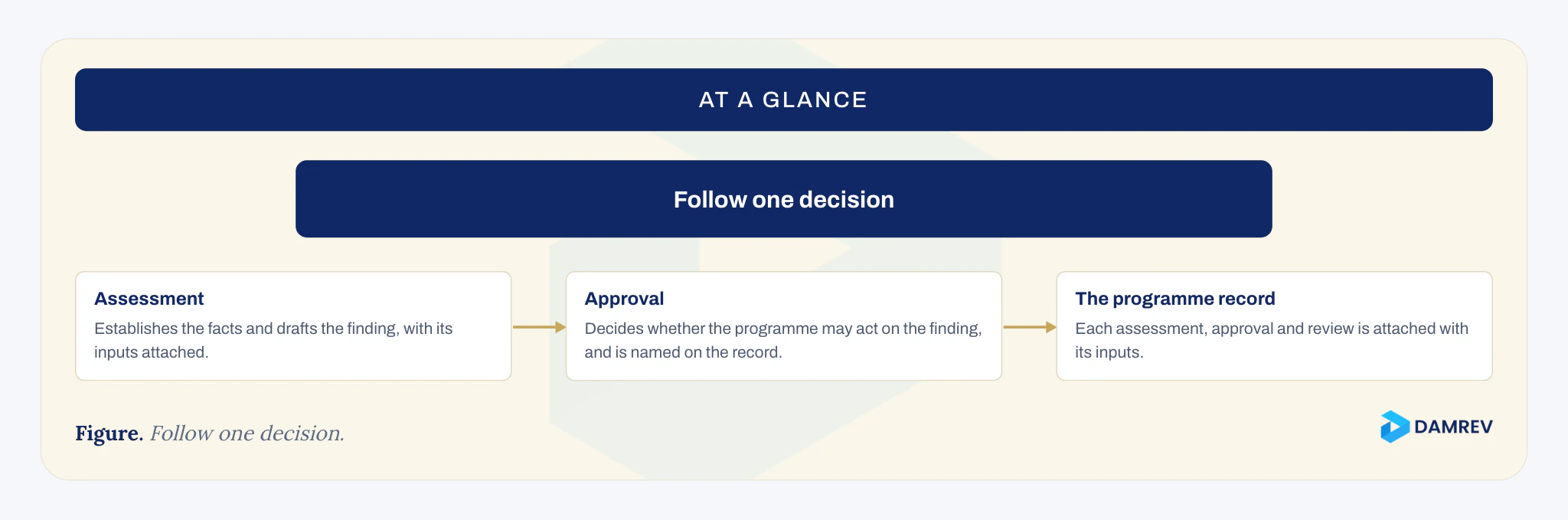
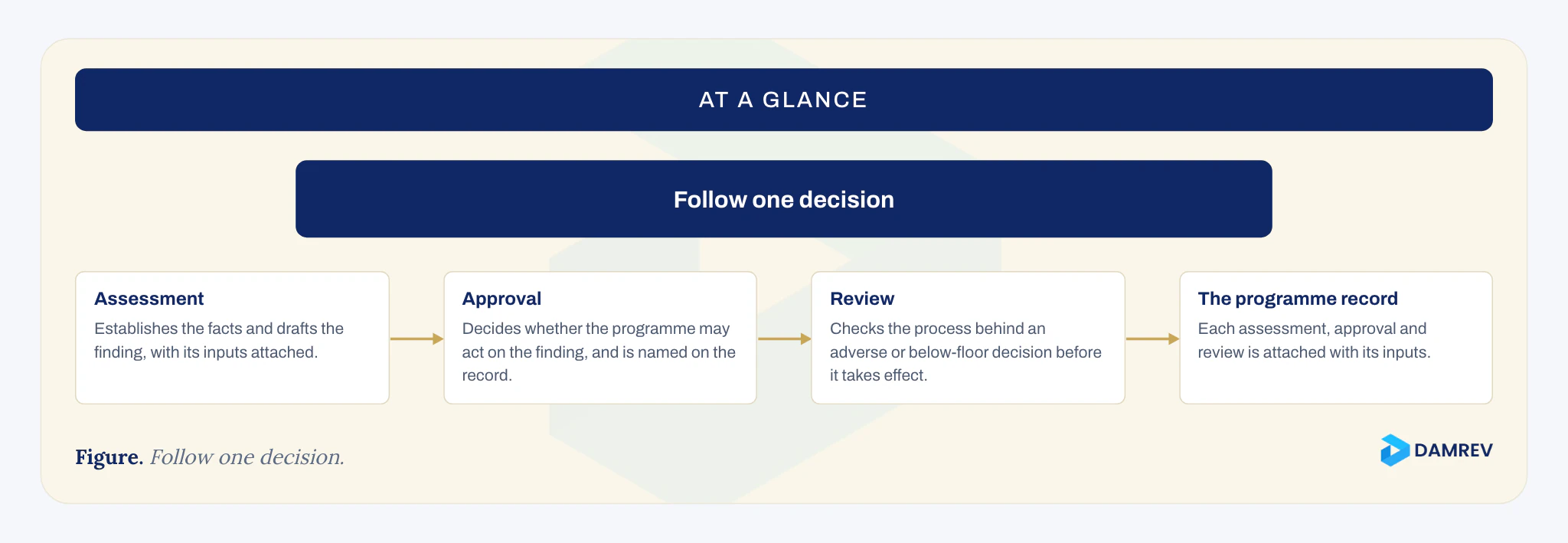
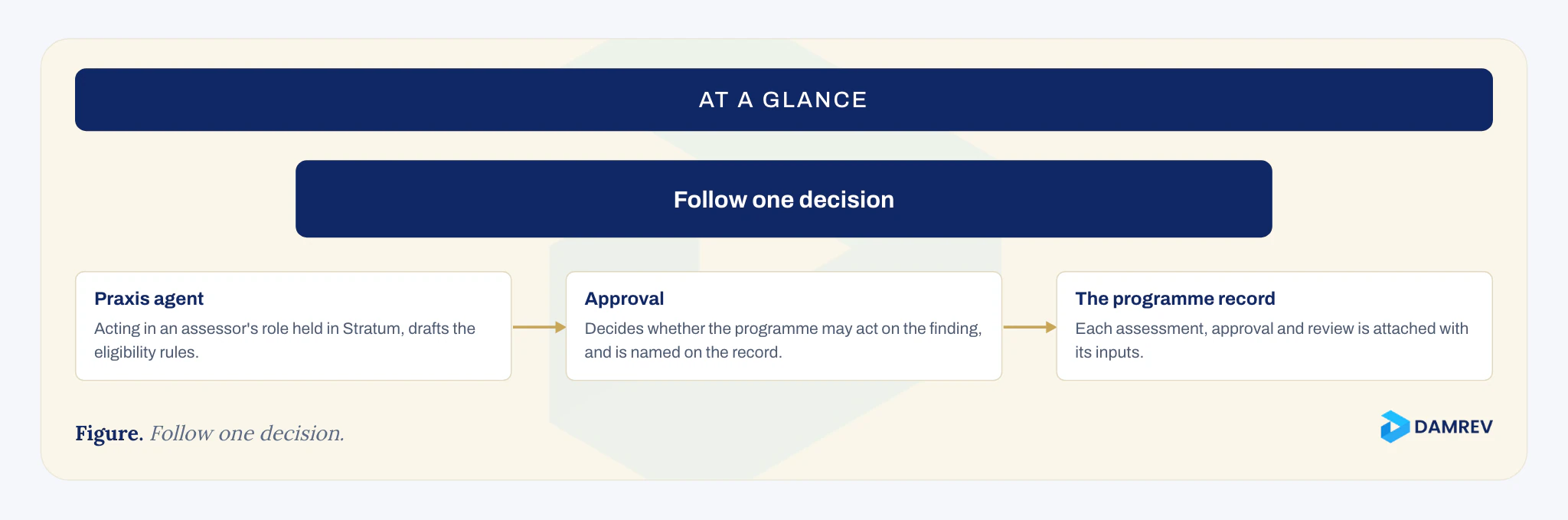
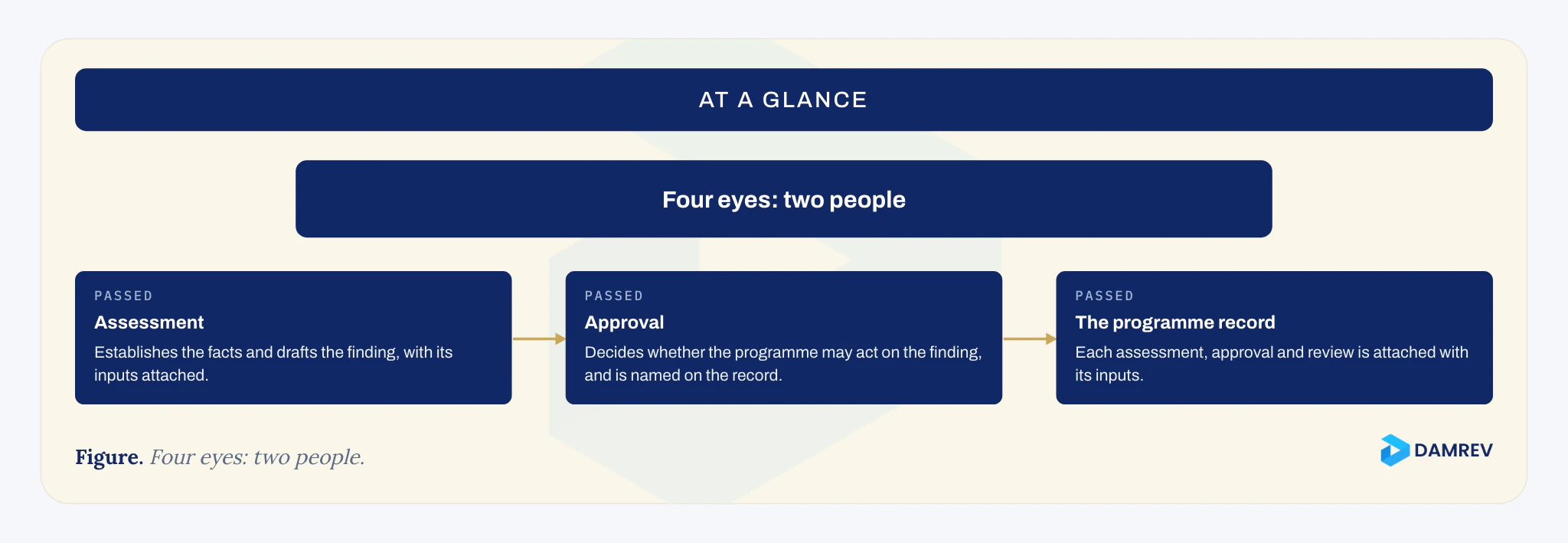
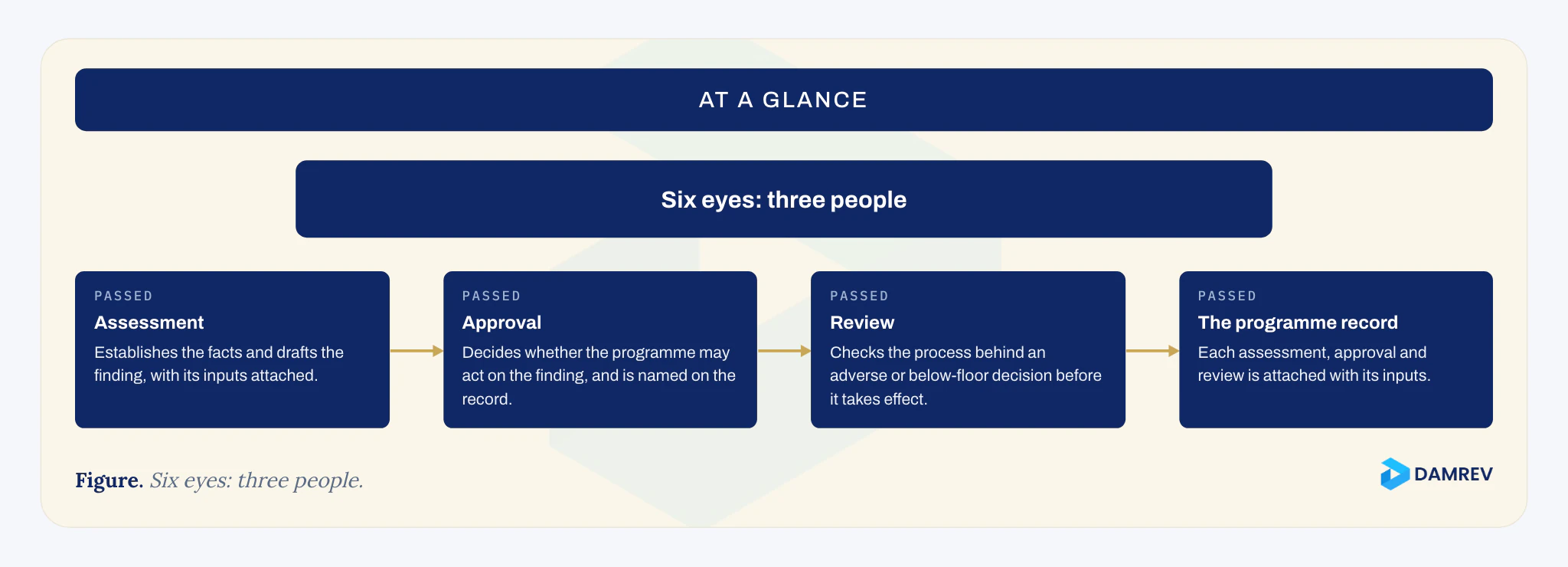
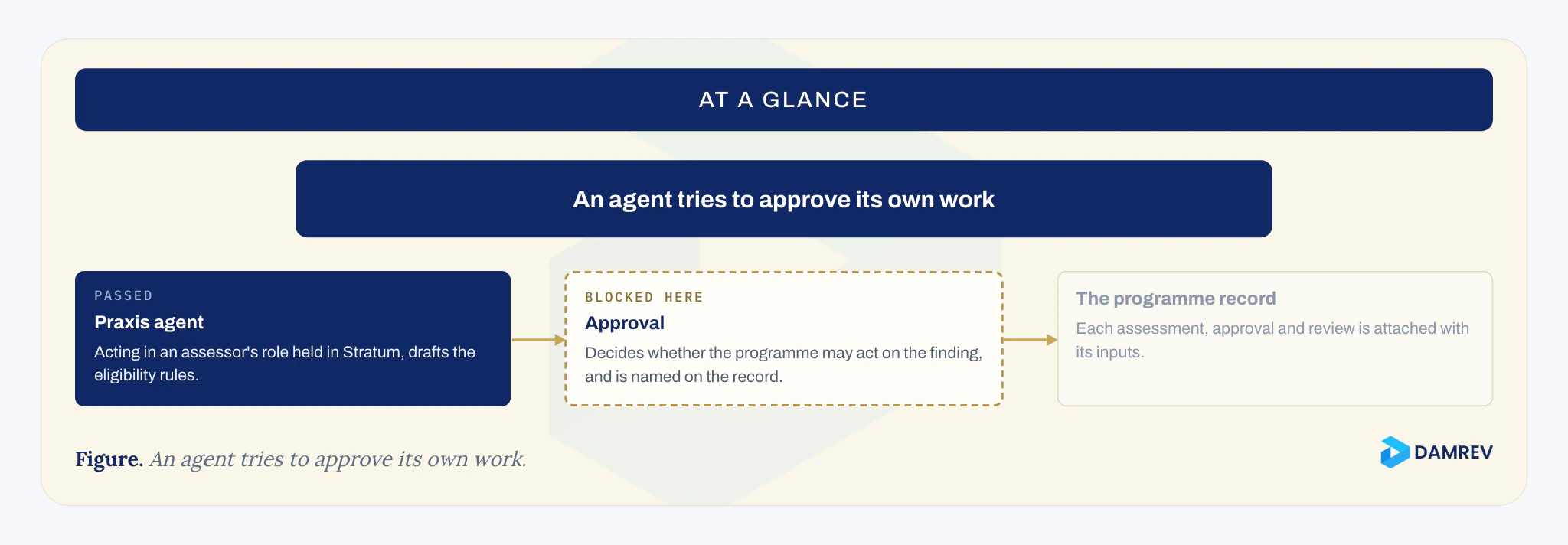
Choose an approval path and follow one decision through it.
The record
Each one is attached to the programme record with its inputs. An auditor can see not only that a decision was approved, but by whom, on what information, and under which version of the Standard, so the operating instrument can always be traced back to the terms that authorised it.
01
02
03
04
05
06
On request
Ask through the contact page and name the programme and your role. Each box below opens the contact page for that request.
Common questions
Short answers on four eyes and six eyes: how they differ, whether a senior person can assess and approve alone, whether the controls apply to DAMREV's own staff, whether an AI agent can approve, which decisions need six eyes, how an auditor confirms two people acted, and whether Praxis is certified under an AI standard.
Four eyes needs two people: an assessor and a separate approver. Six eyes adds a third person who reviews, and on DAMREV that reviewer is added on adverse or below-floor decisions.
No. The person who builds a thing never signs it off, whatever their seniority. The approval path is set by the class of decision, not by the person making it.
Yes. The same approval paths bind DAMREV's people, its clients' people and agentic AI. DAMREV runs its own operations on the platform, with Stratum as tenant zero.
An agent acts only in the role it is given in Stratum, and it cannot approve work prepared in its own role. Its actions are routed through Sentinel and Veritas and signed via Sentry on the user's device.
Adverse or below-floor decisions add a reviewer. The table that assigns every class of decision to four or six eyes can be requested through the contact page for the version that governs a programme.
From the programme record. Each assessment, approval and review is attached with its inputs and the names of the people who acted, under the version of the Standard in force at the time.
Praxis is aligned with the model of recognised AI governance frameworks, including ISO/IEC 42001, the NIST AI Risk Management Framework and the European Union's AI Act. It is not certified against them.
Where next
The pages below pick up where this one ends. Start with the one closest to where your asset or programme stands today.
Last updated:
Insights

Since 17 September 2026 a tokenized securities venue may run automated liquidity pools in tokenized listed stock without registering as an exchange, on conditions.

The GENIUS Act binds payment stablecoin issuers from 18 January 2027, not the firms that hold or settle in stablecoins. Service providers follow in 2028.

The CLARITY Act stalled on a 49 to 50 vote, so tokenized securities stay with the Securities and Exchange Commission, as before.

Guernsey's guidance of 24 July 2026 lets a fund or issuer record and transfer its investments as tokens, under the regimes already applying to it.
Tell us what you want to tokenize.
We will show you how DAMREV can run it.