Article · Law, Regulation & Policy
When the GENIUS Act Takes Effect: 18 January 2027 & 18 July 2028
The Guiding and Establishing National Innovation for US Stablecoins Act (GENIUS Act) takes effect on 18 January 2027, because no final implementing rule was issued early enough to bring the date forward1, 3. On that date it binds payment stablecoin issuers, not the firms that hold or settle in stablecoins; the restriction on service providers follows on 18 July 20281.


In this article
01 · The effective date
When does the GENIUS Act take effect?
The GENIUS Act takes effect on 18 January 2027. Section 20 sets the earlier of 18 months after enactment or 120 days after final regulations, and no final regulation came early enough to make the second date the earlier one1, 3.
The Guiding and Establishing National Innovation for US Stablecoins Act (GENIUS Act) was signed on 18 July 2025. Section 20 provides that the Act and its amendments "shall take effect on the earlier of" two dates: "the date that is 18 months after the date of enactment of this Act", which is 18 January 2027.
Or "the date that is 120 days after the date on which the primary Federal payment stablecoin regulators issue any final regulations implementing this Act"1.
The second limb could only bring the date forward if a final regulation had been issued by 19 September 2026, because 120 days from 20 September lands on 18 January 2027 itself. None was.
As of 5 October 2026 no primary federal regulator had issued a final implementing rule3, so any final regulation issued now produces a date later than the first limb.
The arithmetic settles the question. Unless Congress amends Section 20, the Act takes effect on 18 January 2027.
The GENIUS Act timeline, as of 7 October 2026
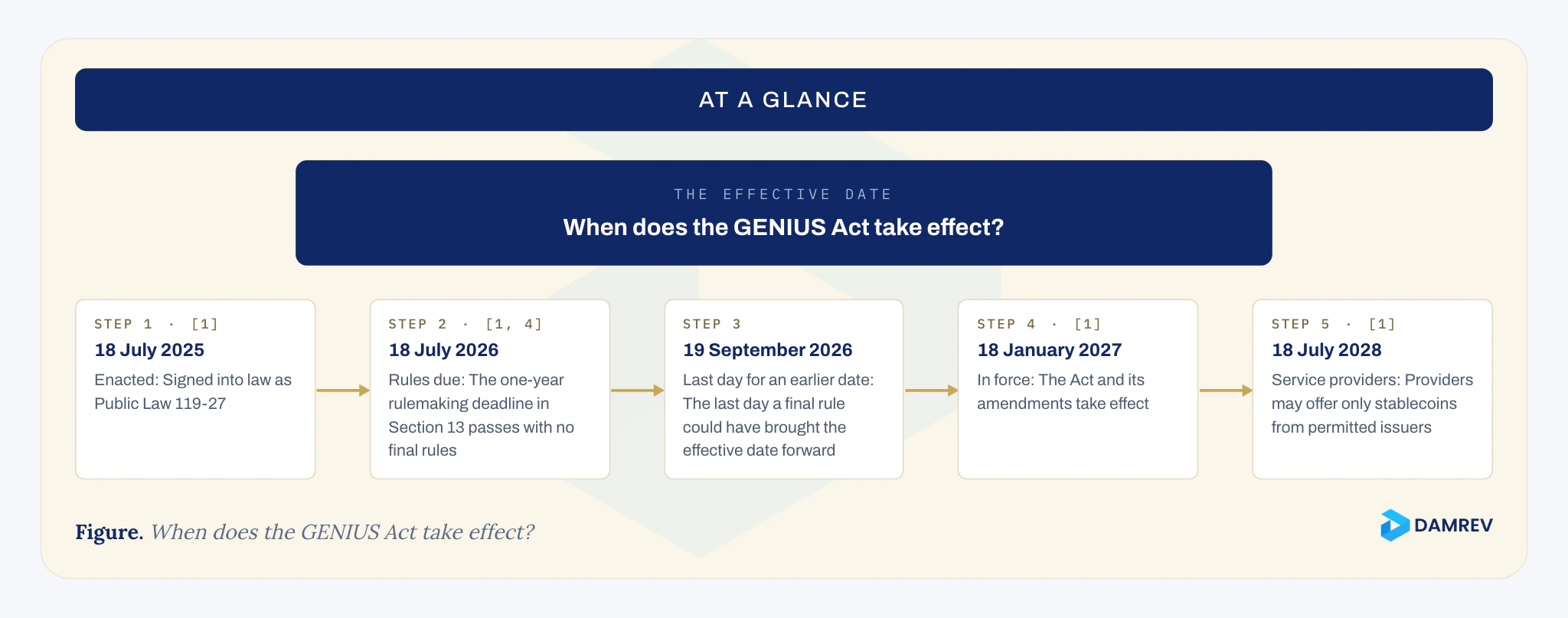
- When does the GENIUS Act take effect?
- 18 July 2025: Enacted: Signed into law as Public Law 119-27 (Step 1, [1])
- 18 July 2026: Rules due: The one-year rulemaking deadline in Section 13 passes with no final rules (Step 2, [1, 4])
- 19 September 2026: Last day for an earlier date: The last day a final rule could have brought the effective date forward (Step 3)
- 18 January 2027: In force: The Act and its amendments take effect (Step 4, [1])
- 18 July 2028: Service providers: Providers may offer only stablecoins from permitted issuers (Step 5, [1])
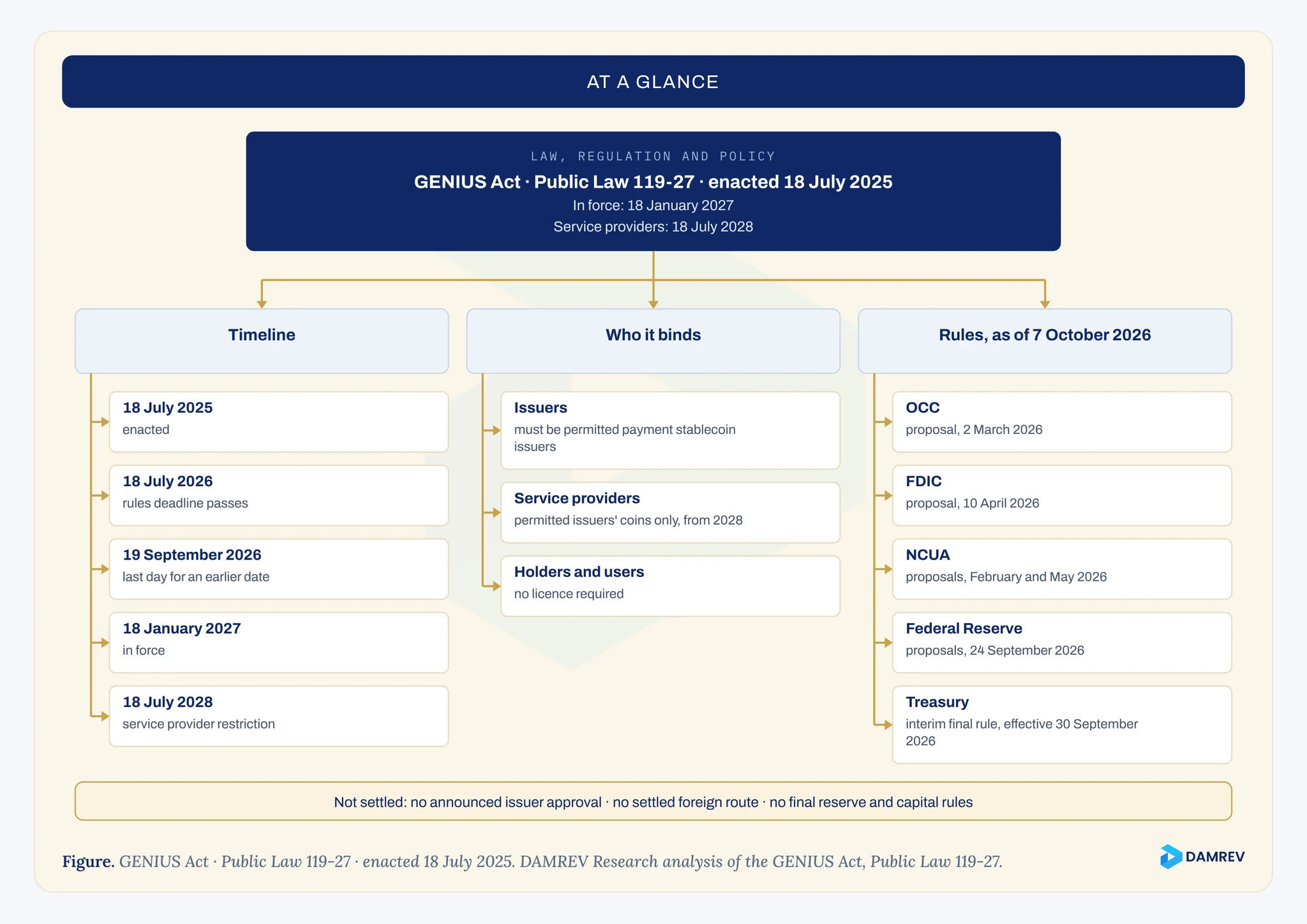
02 · Who it binds
Who does the Act bind on 18 January 2027?
On 18 January 2027 the GENIUS Act binds issuers: from that date it is unlawful for anyone other than a permitted payment stablecoin issuer to issue a payment stablecoin in the United States. Holders and businesses that only use stablecoins are not licensed by it1.
Section 3(a) is short: "It shall be unlawful for any person other than a permitted payment stablecoin issuer to issue a payment stablecoin in the United States"1. The obligations that follow, on reserves, redemption, capital, and the ban on paying interest or yield, all attach to the issuer1.
The distinction matters for anyone planning around a stablecoin they did not issue. A fund that settles subscriptions in a payment stablecoin, or a company that pays a supplier in one, is a user. The Act does not require it to hold a licence for that use1.
What changes for a user on 18 January 2027 is the quality of what it holds, since stablecoins issued in the United States after that date must come from a permitted issuer.
| Who | From 18 January 2027 | From 18 July 2028 | Source |
|---|---|---|---|
| Issuer of a payment stablecoin in the United States | Must be a permitted payment stablecoin issuer; reserve, redemption, and no-yield rules apply | No further change | Act1 |
| Digital asset service provider | May not offer a foreign issuer's stablecoin in the United States unless the issuer can and will comply with lawful orders (Section 3(b)(2)) | May offer or sell to a person in the United States only stablecoins from permitted issuers, subject to the exceptions in Sections 3(c) and 18 | Act1 |
| Business that holds, pays, or settles in a stablecoin it does not issue | No licence required by the Act for that use | No licence required by the Act for that use | Act1 |
A user can still be more than a user. A business that exchanges, transfers, or holds stablecoins for other people may fall within the Act's definition of a digital asset service provider, and that brings the 2028 date into play1.
03 · 18 July 2028
What happens on 18 July 2028?
The GENIUS Act's distribution restriction starts on 18 July 2028. Three years after enactment, a digital asset service provider may not offer or sell to a person in the United States a payment stablecoin that a permitted issuer did not issue1.
beginning on the date that is 3 years after the date of enactment of this Act, it shall be unlawful for a digital asset service provider to offer or sell a payment stablecoin to a person in the United States, unless the payment stablecoin is issued by a permitted payment stablecoin issuer1
This provision reaches the market rather than the issuer. Section 3(b)(1) applies from 18 July 2028 to exchanges, custodians, and other providers serving persons in the United States1.
The restriction has two exceptions. Section 18 provides a route for stablecoins from foreign issuers under comparable regimes, and Section 3(c) lets the Secretary of the Treasury set safe harbours, for example for small volumes or unusual circumstances1.
A separate rule in Section 3(b)(2), with no three-year delay, already bars a provider from making a foreign issuer's stablecoin available in the United States unless the issuer can and will comply with lawful orders; it applies from the Act's effective date1.
As of 7 October 2026, neither exception had been applied to a named issuer or regime.
The two dates are 18 months apart. The second determines which stablecoins a US-facing provider may still offer.
04 · The rules
Where does the rulemaking stand?
The GENIUS Act rulemaking is behind the statute: Section 13 required rules within one year, and every rule was still a proposal when that deadline passed on 18 July 20261, 4. No primary federal regulator had a final rule by 5 October 20263.
The primary federal regulators have each proposed rules for the issuers they supervise under the Act. The Office of the Comptroller of the Currency proposed its framework on 2 March 2026, and the Federal Deposit Insurance Corporation, the National Credit Union Administration, and Treasury published proposals in the months that followed4, 7, 8, 9, 10.
The Federal Reserve was last, announcing two proposals on 24 September 2026: one on reserves, capital, and risk management for the issuers it supervises, and one on applications2.
| Body | Stage | Date | Source |
|---|---|---|---|
| Office of the Comptroller of the Currency | Proposal | 2 March 2026 | 7 |
| Federal Deposit Insurance Corporation | Proposal | 10 April 2026 | 8 |
| National Credit Union Administration | Proposals | February and May 2026 | 9, 10 |
| Federal Reserve Board | Proposals; comment for 60 days after Federal Register publication | 24 September 2026 | 2 |
| Treasury, for the Stablecoin Certification Review Committee | Interim final rule on procedures for state certifications | Effective 30 September 2026 | 3, 6 |
The Treasury rule is the one implementing measure already in effect, and it is an interim final rule, so it would be wrong to say that nothing under the Act is final. It is not a trigger for the effective date.
Section 20 counts final regulations issued by the primary Federal payment stablecoin regulators, and on our reading a procedural rule for the review committee's state certifications is not one of those1, 3. Since the effective date is now fixed in any case, the point affects nothing.

05 · What it does not establish
What does the Act not establish?
As of 7 October 2026, the GENIUS Act as read here does not license users, approve any named stablecoin, or decide which foreign regimes count as comparable. Without final rules, the Act also does not say in detail what a permitted issuer's reserves and capital must be1, 3.
No list of permitted issuers
As of 7 October 2026 no final rule sets out how an issuer is approved, and we found no announced approval of a permitted payment stablecoin issuer under the Act3.
No settled foreign route
The foreign issuer route in Section 18 and the safe harbours in Section 3(c) depend on decisions that have not been made1.
No rule on what users must do
The Act places no licensing duty on a business for holding, paying, or settling in a stablecoin it does not issue1.
No answer on tax or accounting
The Act does not settle how a holder reports a stablecoin. That question belongs with the reader's own tax adviser or auditor.
The dates are fixed in the statute; the rules that give them content are, as of 7 October 2026, proposals.
What a reader should take from the statute is narrower than most summaries suggest. The first date governs issuers. The second governs distribution. Neither, on its own, governs a business that only pays or settles in a stablecoin.
Common questions
What else do people ask?
Short answers to the questions people ask most about this topic.
Can the effective date still move earlier than 18 January 2027?
Not under Section 20 as written. The earlier date would be 120 days after final regulations, and any final regulation issued on or after 20 September 2026 gives no earlier date than 18 January 20271. Only a change to the Act could move it.
Does a business that pays or settles in a stablecoin need a licence under the Act?
Not as a user. The Act's licensing requirement falls on issuers1. A business that exchanges, transfers, or holds stablecoins for others may be a digital asset service provider, and the restriction on those providers applies from 18 July 20281.
Is a payment stablecoin a security under the Act?
The Act amends the federal securities and commodities laws so that a payment stablecoin issued by a permitted issuer is excluded from them1, 5. Those amendments take effect with the rest of the Act.
Can a permitted issuer pay interest to holders?
No. Section 4(a)(11) bars a permitted or foreign issuer from paying holders any form of interest or yield solely for holding, using, or retaining the stablecoin1.
Where should you go next?
The pages below pick up where this one ends. Start with the one closest to where your asset or programme stands today.
- SEC & CFTC Authority After the CLARITY Act Failed to AdvanceThe CLARITY Act stalled on a 49 to 50 vote, so tokenized securities stay with the Securities and Exchange Commission, as before.
- The SEC's Innovation Exemption of 17 September 2026: What Tokenized Securities Venues & Tokenized NMS Stock May Now DoSince 17 September 2026 a tokenized securities venue may run automated liquidity pools in tokenized listed stock without registering as an exchange, on conditions.
- JurisdictionsThe rules for tokenized finance in the twelve jurisdictions where the group works, mapped to where each group entity sits, claiming no permission.
- ImplementationBringing a designed programme live: encoding rights, eligibility, and transfer controls, gating issuance, and opening the register of holders on Stellar.
References
- 1.Guiding and Establishing National Innovation for US Stablecoins Act, Public Law 119-27, 18 July 2025, Sections 2, 3, 4, 13, 17, and 20. https://www.govinfo.gov/content/pkg/PLAW-119publ27/html/PLAW-119publ27.htm
- 2.Board of Governors of the Federal Reserve System, press release on two proposals implementing the GENIUS Act, 24 September 2026. https://www.federalreserve.gov/newsevents/pressreleases/bcreg20260924a.htm
- 3.Willkie Farr & Gallagher, "Final pieces to the stablecoin puzzle: Federal Reserve and Treasury propose GENIUS Act framework", 5 October 2026. https://www.willkie.com/-/media/files/publications/2026/10/final-pieces-to-the-stablecoin-puzzle-federal-reserve-and-treasury-propose-genius-act-framework.pdf
- 4.The Block, "US regulators miss GENIUS Act's one-year deadline for final stablecoin rules", 18 July 2026. https://www.theblock.co/post/408843/us-regulators-miss-genius-act-deadline
- 5.Gibson Dunn, "The GENIUS Act: a new era of stablecoin regulation", July 2025. https://www.gibsondunn.com/the-genius-act-a-new-era-of-stablecoin-regulation/
- 6.Department of the Treasury, "Forms and Procedures for Review of State Certifications by the Stablecoin Certification Review Committee", interim final rule, 91 FR 61688, 30 September 2026. https://www.federalregister.gov/documents/2026/09/30/2026-19966/forms-and-procedures-for-review-of-state-certifications-by-the-stablecoin-certification-review-committee
- 7.Office of the Comptroller of the Currency, "Implementing the Guiding and Establishing National Innovation for U.S. Stablecoins Act for the Issuance of Stablecoins by Entities Subject to the Jurisdiction of the Office of the Comptroller of the Currency", proposed rule, 91 FR 10202, 2 March 2026. https://www.govinfo.gov/content/pkg/FR-2026-03-02/pdf/2026-04089.pdf
- 8.Federal Deposit Insurance Corporation, "GENIUS Act Requirements and Standards for FDIC-Supervised Permitted Payment Stablecoin Issuers and Insured Depository Institutions", proposed rule, 91 FR 18534, 10 April 2026. https://www.govinfo.gov/content/pkg/FR-2026-04-10/pdf/2026-06974.pdf
- 9.National Credit Union Administration, "Investments in and Licensing of Permitted Payment Stablecoin Issuers", proposed rule, 91 FR 6531, 12 February 2026. https://www.govinfo.gov/content/pkg/FR-2026-02-12/pdf/2026-02868.pdf
- 10.National Credit Union Administration, "Implementing the Guiding and Establishing National Innovation for U.S. Stablecoins Act for the Issuance of Stablecoins by Entities Subject to the Jurisdiction of the National Credit Union Administration", supplemental proposed rule, 91 FR 28956, 18 May 2026. https://www.federalregister.gov/documents/2026/05/18/2026-09915/implementing-the-guiding-and-establishing-national-innovation-for-us-stablecoins-act-for-the
This article is analysis of public sources, not legal advice. Last updated: