


Jurisdictions · Africa
Mauritius
In Mauritius, the treatment of tokenized assets depends on the instrument's legal classification, the issuer, the offering arrangements, and the regulated functions performed. The licences, approvals, and exemptions that apply are assessed for each structure.
Fiat held at a licensed Mauritius bank is the settlement asset the security token guidance provides for, and expert funds are open only to expert investors.
No DAMREV entity claims a regulatory permission in Mauritius on this page.
Position as of 14 November 2026

The framework
What does Mauritius's framework cover?
In Mauritius, the Financial Services Commission (FSC) supervises security tokens under the Securities Act 2005, and virtual asset services and initial token offerings fall under the Virtual Asset and Initial Token Offering Services Act 2021 (VAITOS Act), which it administers. Stablecoins are virtual assets, and the Bank of Mauritius licenses stablecoins used as payment instruments1, 2, 3.
The VAITOS Act, Act 21 of 2021, has been in force since 7 February 20222. Section 55(8) of that Act removes virtual tokens from the Securities Act definition of securities, which is the line between the two regimes2.
The FSC licenses virtual asset service providers (VASPs) and registers issuers of initial token offerings (ITOs), and no person may carry on VASP business in or from Mauritius without a licence2.
On the securities side, shares, debentures, derivatives, and collective investment scheme (CIS) units in digital form are security tokens, supervised by the FSC under the Securities Act 20051. Act No. 13 of 2026 amended the VAITOS Act, including section 34A on unlicensed solicitation, and was gazetted on 13 August 20264.
The rules
Which rules apply in Mauritius, and how settled are they?
The position in Mauritius rests on settled law and published guidance. The VAITOS Act 2021, the Securities Act 2005, the sandbox provisions of the Financial Services Act 2007, and the 2026 fee rules are in force, and the FSC and BoM guidance notes are published, while the decentralised finance consultation has no recorded outcome2, 1, 5, 6, 7.
| Instrument | Date | Status |
|---|---|---|
| Virtual Asset and Initial Token Offering Services Act 2021, Act 21 of 20212 | In force 7 February 2022 | Law in force |
| Securities Act 20051 | 2005 | Law in force |
| Financial Services Act 2007, sections 14B and 14C5 | In force 5 August 2021 | Law in force |
| Financial Services (Consolidated Licensing and Fees) (Amendment) Rules 2026, GN No. 119 of 20266 | In force 1 July 2026 | Law in force |
| Economic and Financial Measures (Miscellaneous Provisions) Act 2026, Act No. 13 of 2026, section 34A of the VAITOS Act4 | Gazetted 13 August 2026 | Law in force |
| FSC Security Token Offerings and Security Token Trading Systems Guidance Notes1 | 15 June 2020, updated 23 August 2022 | Guidance |
| FSC Guidance Notes on Stablecoins3 | 13 August 2026; no effective date stated | Guidance |
| BoM Guideline for Virtual Asset related Activities8 | 13 November 2024; full compliance by 31 May 2025 | Guidance |
| FSC paper on financial collateral arrangements in decentralised finance7 | File name dated 14 February 2024 | Consultation; no outcome found |
Section 56(c) of Act No. 13 of 2026 inserted section 34A into the VAITOS Act, which prohibits anyone not licensed or registered under that Act from soliciting, targeting, or engaging Mauritius investors for virtual asset transactions or a token offering4.
A communication the public can reach is presumed to target Mauritius, and websites are expressly covered4. Section 34A is in force, because section 61 of the amending Act defers only paragraph 56(d)4.
Classification
How are different token types classified in Mauritius?
Classification in Mauritius follows the instrument. Shares, debentures, derivatives, and CIS units in digital form are security tokens. A stablecoin is a virtual asset and not legal tender, treated as a security or CIS share where linked to one. Commodity-linked stablecoins are assessed case by case, and no rule covers other asset-backed tokens1, 3.
The VAITOS Act extends the fund regime into virtual-asset form: CIS "shares" include interests held as virtual assets2. If a token in an ITO application turns out to be a security, the ITO application is withdrawn and the token may be registered under the Securities Act instead2.
For physical-asset-backed tokens, the FSC's stablecoin guidance states that commodity-linked stablecoins are assessed case by case and may be derivatives3. No rule covers non-stablecoin tokens backed by a physical asset3.
How it works
How does a tokenized instrument become regulated in Mauritius?
The steps set out here for a tokenized structure in Mauritius run in five stages. Classify the token as a security token or a virtual asset, follow the matching offer route, license the trading venue, place custody with a licensed or accepted custodian, and hold fiat at a licensed Mauritian bank1, 2.
Hold the settlement asset
Fiat for a security token trading system is held with a licensed Mauritian commercial bank1.
Licences
Which licence does each role need in Mauritius?
Each role has its own FSC licence or registration. Security token issuers follow the securities offer rules and ITO issuers register under the VAITOS Act. Trading venues need a Securities Trading System licence or VASP Class S, custodians need Class R or a custodian licence, and advisers on virtual asset offers need Class I1, 2, 6.
VASP licences run in classes: Class S (Virtual Asset Market Place) permits operating a virtual asset exchange, and Class M (Virtual Asset Broker Dealer) permits exchange with fiat2.
VASP licence classes also include Class R (Virtual Asset Custodian), which covers safekeeping, Class O (Virtual Asset Wallet Services), which covers transfers, and Class I (Virtual Asset Advisory Services), which covers financial services related to an issuer's offer or sale of virtual assets2.
Security tokens must sit with an FSC-licensed custodian or an accepted custodian regulated in an International Organization of Securities Commissions Multilateral Memorandum of Understanding (IOSCO MMoU) jurisdiction1. The licence codes include FS-1.7 Custodian Services (non-CIS) and SEC-4.1 CIS Custodian6.
Who regulates what
Who regulates what in Mauritius?
The FSC regulates security tokens, virtual asset services, initial token offerings, and stablecoins held as virtual assets, and it grants sandbox authorisations. The BoM licenses stablecoins used as payment instruments and must give a no-objection for fiat-pegged stablecoins issued from Mauritius. The Economic Development Board (EDB) runs a separate non-fintech sandbox1, 2, 3, 9.
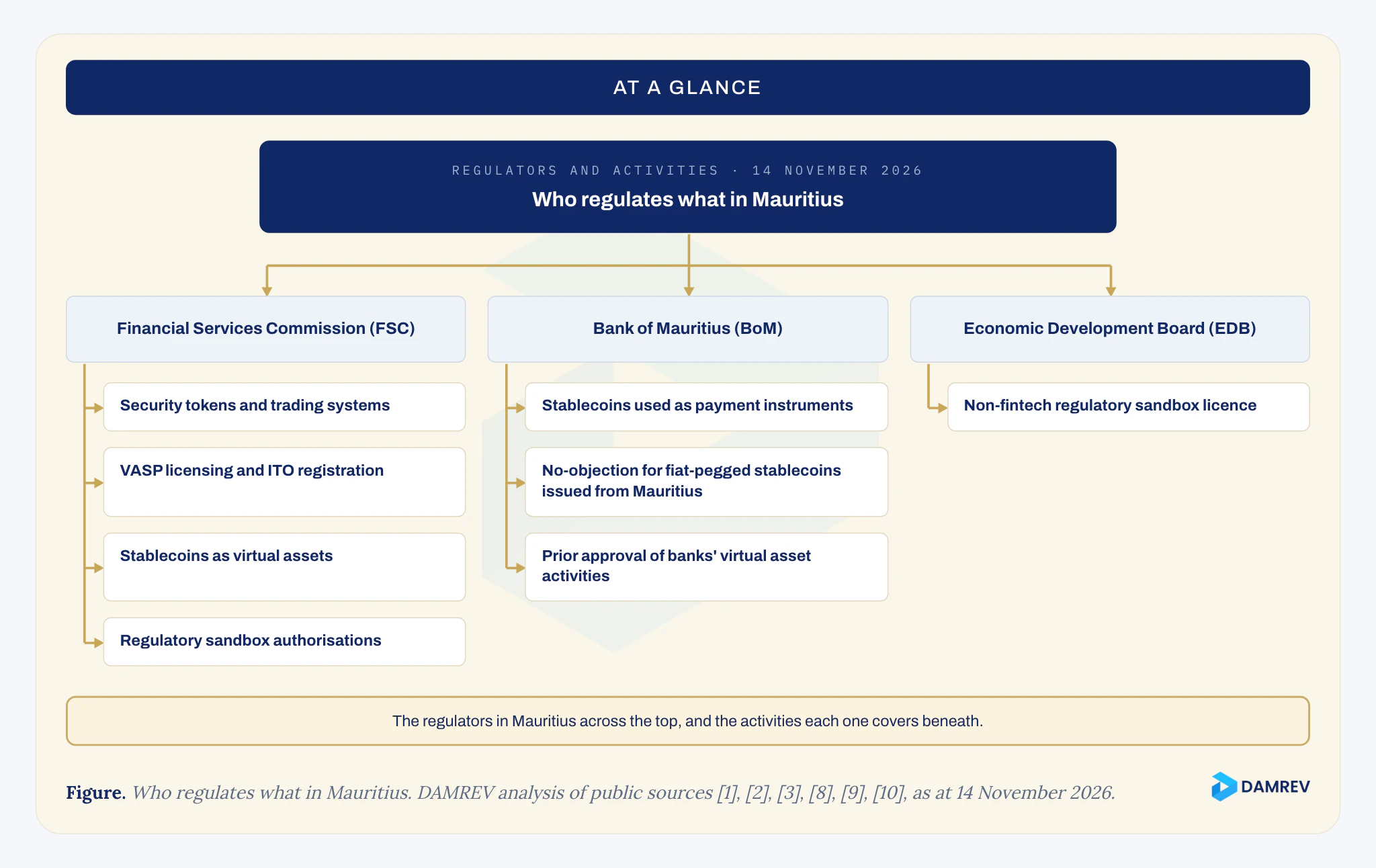
- Who regulates what in Mauritius
- Mauritius
- Financial Services Commission (FSC)
- Security tokens and trading systems
- VASP licensing and ITO registration
- Stablecoins as virtual assets
- Regulatory sandbox authorisations
- Bank of Mauritius (BoM)
- Stablecoins used as payment instruments
- No-objection for fiat-pegged stablecoins issued from Mauritius
- Prior approval of banks' virtual asset activities
- Economic Development Board (EDB)
- Non-fintech regulatory sandbox licence
- Financial Services Commission (FSC)
- The regulators in Mauritius across the top, and the activities each one covers beneath.
- Source: DAMREV analysis of public sources [1], [2], [3], [8], [9], [10], as at 14 November 2026.
Banks need prior BoM approval for virtual asset related activities, under a guideline of 13 November 2024 that set full compliance by 31 May 20258. Mauritius left Financial Action Task Force (FATF) increased monitoring on 21 October 2021 and remains in Eastern and Southern Africa Anti-Money Laundering Group (ESAAMLG) enhanced follow-up10.
Investor access
How do investors access tokenized products in Mauritius?
Public offers of security tokens need a registered prospectus, and private placements and sophisticated-investor offers use the Preferential Offer Rules 2017. Expert funds are open only to expert investors, meaning an initial own-account investment of at least 100,000 US dollars (USD) or a sophisticated investor. No statutory compensation scheme covers security token investors1.
- Public offersA public offer of security tokens needs a registered prospectus under the Securities (Public Offers) Rules 20071.
- Private and expert offersPrivate placements and sophisticated-investor offers use the Preferential Offer Rules 2017, and expert funds take only investors putting in at least USD 100,000 on their own account or sophisticated investors1.
- SolicitationA communication the public can reach is presumed to target Mauritius under section 34A, which reaches anyone not licensed or registered under the VAITOS Act4.
Section 34A of the VAITOS Act prohibits anyone not licensed or registered under that Act from soliciting, targeting, or engaging Mauritius investors for virtual asset transactions or a token offering, and websites are expressly covered4. An ITO is registered through a virtual exchange with a white paper and a legal opinion2.
Settlement
How does settlement work in Mauritius?
Mauritius settlement runs in fiat at a licensed Mauritius bank, the asset the security token guidance provides for, in any currency. Non-rupee stablecoins used for investment sit with the FSC, and its guidance names no coin. For payments, only stablecoin categories the BoM specifies may be used, and none had been specified as at 14 November 20261, 3, 11.
Fiat for a security token trading system is held with a licensed Mauritian commercial bank1. Stablecoin services run through VAITOS VASP licences, including Class R custody, banks need prior BoM approval, and payment use needs a National Payment Systems Act licence3, 2, 8.
The stablecoin guidance does not say whether settling a securities purchase counts as "investment" or "payment"3. Fiat-pegged stablecoins issued from Mauritius need a BoM no-objection, and issuers need stated capital of the higher of 5 million Mauritian rupees (MUR) or 50 percent of annual operating expenses3.
Sandbox and pilots
Is there a sandbox or pilot route in Mauritius?
Yes. The FSC grants sandbox authorisations under section 14B of the Financial Services Act 2007 and may exempt participants from regulatory requirements. It charges no fee, testing runs for up to 12 months, and a decision is targeted within 30 business days. The EDB runs a separate sandbox for non-fintech activity5, 12, 9.
Risks and controls
What should an issuer weigh in Mauritius?
The Securities Act 2005 and the VAITOS Act are both in force in Mauritius. An issuer weighs the solicitation ban in section 34A, the fee and capital rules, the penalties under the VAITOS Act, the absence of investor compensation, the open question between investment and payment stablecoins, and the country's anti-money laundering follow-up status4, 6, 2, 1, 3, 10.
Seven risks
Choose a risk
The risk
Anyone not licensed or registered under the VAITOS Act may not solicit, target, or engage Mauritius investors, and that includes doing so through a website4.
What the rules require
Section 34A prohibits anyone not licensed or registered under the VAITOS Act from soliciting, targeting, or engaging Mauritius investors, and websites are expressly covered4.
The risk
A VASP's processing and annual fees rise with its class, from USD 1,000 and USD 1,900 for Class O to USD 3,000 and USD 5,000 for Classes I and S6.
What the rules require
VASP fees from 1 July 2026 range from USD 1,000 processing and USD 1,900 annual for Class O to USD 3,000 and USD 5,000 for Classes I and S6.
The risk
The FSC register records licences that have ended: it lists a holder of VASP Classes M, O, R, I, and S, dated 3 January 2024, under a "Surrendered Licences" heading13.
What the rules require
The FSC register lists a holder of VASP Classes M, O, R, I, and S dated 3 January 2024 under a "Surrendered Licences" heading13.
Our position
Where does DAMREV stand?
No DAMREV entity claims a regulatory permission in Mauritius, and no group entity is licensed or registered under the Virtual Asset and Initial Token Offering Services Act 2021.
This page sets out the public rules in Mauritius as at 14 November 2026. It is analysis of public sources, not legal advice, and nothing on it is an offer of, or an invitation to engage in, a virtual asset transaction or initial token offering in Mauritius.
Common questions
What else do people ask?
Short answers to the questions people ask most about this topic.
Are security tokens securities in Mauritius?
Yes. Shares, debentures, derivatives, and collective investment scheme units in digital form are security tokens, supervised by the Financial Services Commission under the Securities Act 2005. Virtual tokens are removed from the Securities Act definition of securities by section 55(8) of the VAITOS Act.
Who regulates stablecoins in Mauritius?
The FSC states that stablecoins are virtual assets under the VAITOS Act and that it is their regulator. The Bank of Mauritius licenses stablecoins used as payment instruments under the National Payment Systems Act, and fiat-pegged stablecoins issued from Mauritius need its no-objection.
What does section 34A of the VAITOS Act do?
Act No. 13 of 2026 amended the VAITOS Act, including section 34A on unlicensed solicitation, and was gazetted on 13 August 2026. Section 34A prohibits anyone not licensed or registered under the VAITOS Act from soliciting, targeting, or engaging Mauritius investors for virtual asset transactions or a token offering.
How is an initial token offering registered in Mauritius?
Only a company may apply, through a virtual exchange at least 45 days before the offer, with a white paper and a legal opinion. If the token is a security, the application is withdrawn and the token may be registered under the Securities Act instead.
Who can invest in an expert fund in Mauritius?
Only expert investors: anyone making an initial own-account investment of at least USD 100,000, or a sophisticated investor. Security token investors have no statutory compensation scheme.
Is there a regulatory sandbox in Mauritius?
Yes. The FSC grants sandbox authorisations under section 14B of the Financial Services Act 2007, with no fee, testing of up to 12 months, and a decision targeted within 30 business days. The Economic Development Board runs a separate non-fintech sandbox.
Does DAMREV hold a licence in Mauritius?
No. DAMREV Labs, LLC does not hold a financial services or virtual asset licence, and no DAMREV entity claims a regulatory permission in Mauritius.
Where next
Where should you go next?
Mauritius sits within the African group of DAMREV's jurisdictions. These pages compare it with its neighbours and set out how settlement and compliance are designed.
- JurisdictionsAll twelve jurisdiction pages in one place, grouped by region, each stating its rules as at 14 November 2026.
- South AfricaSouth Africa's Financial Sector Conduct Authority licenses crypto asset services, and exchange control law still applies to any cross-border structure.
- Stablecoins & Payment InfrastructureHow a payment token is structured around its reserve: a licensed issuer, minting against confirmed reserve, eligibility checks at each transfer, and proof of reserve.
- Compliance by Design Position PaperThe compliance by design position paper: what code can enforce in a tokenized instrument, and what only law and licence decide, across twelve jurisdictions.
References
- 1.FSC, Updated Guidance Notes on Security Token Offerings and Security Token Trading Systems, 15 June 2020, updated 23 August 2022. https://www.fscmauritius.org/media/84937/updated-guidance-notes-on-security-token-offerings-and-security-token-trading-systems.pdf
- 2.Virtual Asset and Initial Token Offering Services Act 2021, Act 21 of 2021 (Financial Crimes Commission copy). https://fcc.mu/wp-content/uploads/2024/06/THE-VIRTUAL-ASSET-AND-INITIAL-TOKEN.pdf
- 3.FSC, Guidance Notes on Stablecoins and Annexure, 13 August 2026. https://www.fscmauritius.org/media/dyedhu0b/fsc-guidance-notes-on-stablecoins-and-annexure.pdf
- 4.Republic of Mauritius, The Economic and Financial Measures (Miscellaneous Provisions) Act 2026, Act No. 13 of 2026, sections 56 and 61. https://president.govmu.org/president/wp-content/uploads/2026/08/13_The-Economic-and-Financial-Measures-Miscellaneous-Provisions-Act-2026.pdf
- 5.Financial Services Act 2007 (unofficial consolidated text, hosted by the Stock Exchange of Mauritius). https://stockexchangeofmauritius.com/media/12664/2026-financial-services-act.pdf
- 6.FSC, Financial Services (Consolidated Licensing and Fees) (Amendment) Rules 2026, GN No. 119 of 2026. https://www.fscmauritius.org/media/it1dm5yd/financial-services-consolidated-licensing-and-fees-amendment-rules-2026.pdf
- 7.FSC, Consultation Paper on financial collateral arrangements in decentralised finance. https://www.fscmauritius.org/media/170457/attachment-2_defi-consultation-paper-140224.pdf
- 8.Bank of Mauritius, Guideline for Virtual Asset related Activities, 13 November 2024. https://bom.mu/sites/default/files/guideline_for_virtual_asset_related_activities_0.pdf
- 9.Economic Development Board, Regulatory Sandbox Licence Guidelines (Non Fintech). https://edbmauritius.org/wp-content/uploads/2026/04/Guidelines-RSL-Non-Fintech.pdf
- 10.FSC, Financial Action Task Force and Eastern and Southern Africa Anti-Money Laundering Group page. https://www.fscmauritius.org/amlcftcpf/financial-action-task-force-fatf-eastern-and-southern-africa-anti-money-laundering-group-esaamlg
- 11.Bank of Mauritius, National Payment Systems Act 2018, as amended by the Finance Act 2025. https://www.bom.mu/sites/default/files/the_national_payment_systems_act_2018_amended_finance_act_2025.pdf
- 12.FSC, Regulatory Sandbox Guidelines. https://www.fscmauritius.org/media/167529/regulatory-sandbox-guidelines.pdf
- 13.FSC, Register of Licensees (page 43). https://www.fscmauritius.org/en/supervision/register-of-licensees?page=43
Position as of 14 November 2026: the law and sources on this page are stated as at that date. Last updated:



