


Skip to content
DAMREV
Start a Structuring Review

How it works across the platform

Roles & Responsibilities

Every function on a DAMREV programme has a named owner. DAMREV Labs, LLC builds and operates the software, the issuer sets the rules, licensed providers perform identity checks and the fiat leg, an assessor assesses smart contracts, and Sentinel enforces. No party holds the power both to assess and to enforce, and each appointed entity keeps its regulated role.

The flow

Where does each party act in a programme?

At a defined point in the flow, and only there. Identity is verified before rules apply, rules are assessed before they are enforced, and issuance follows both.

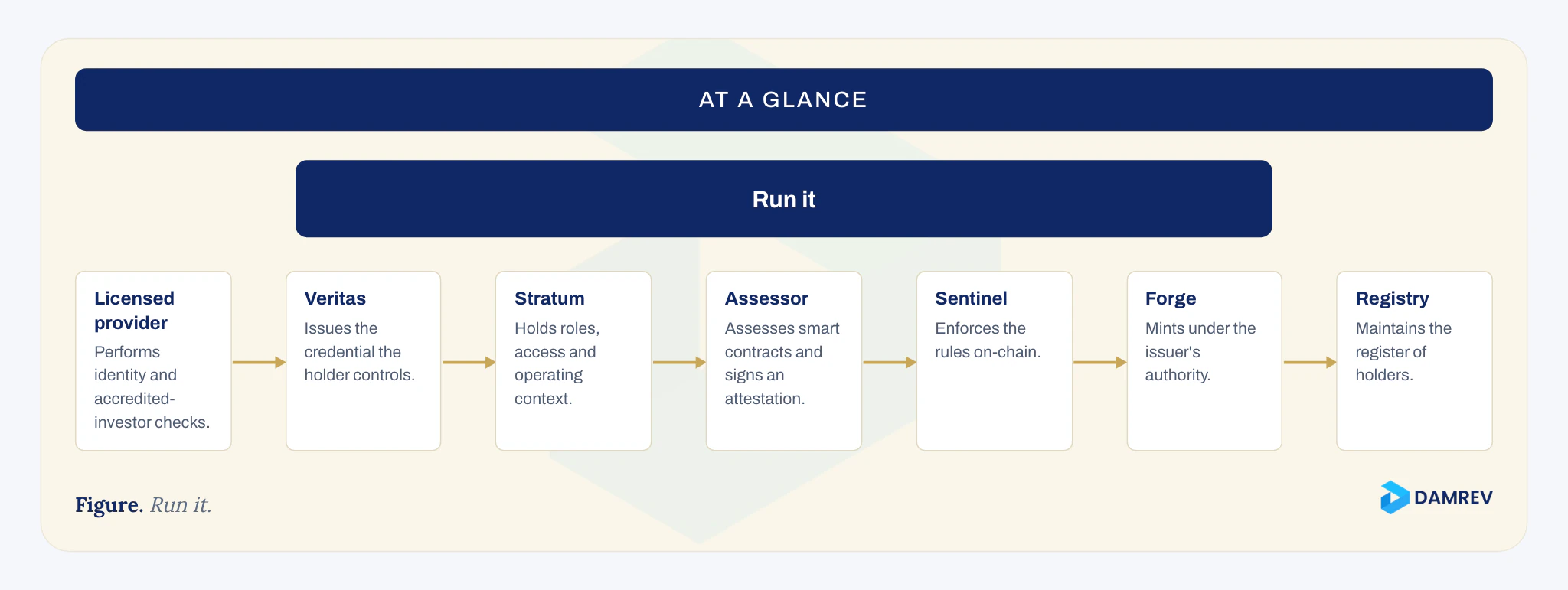
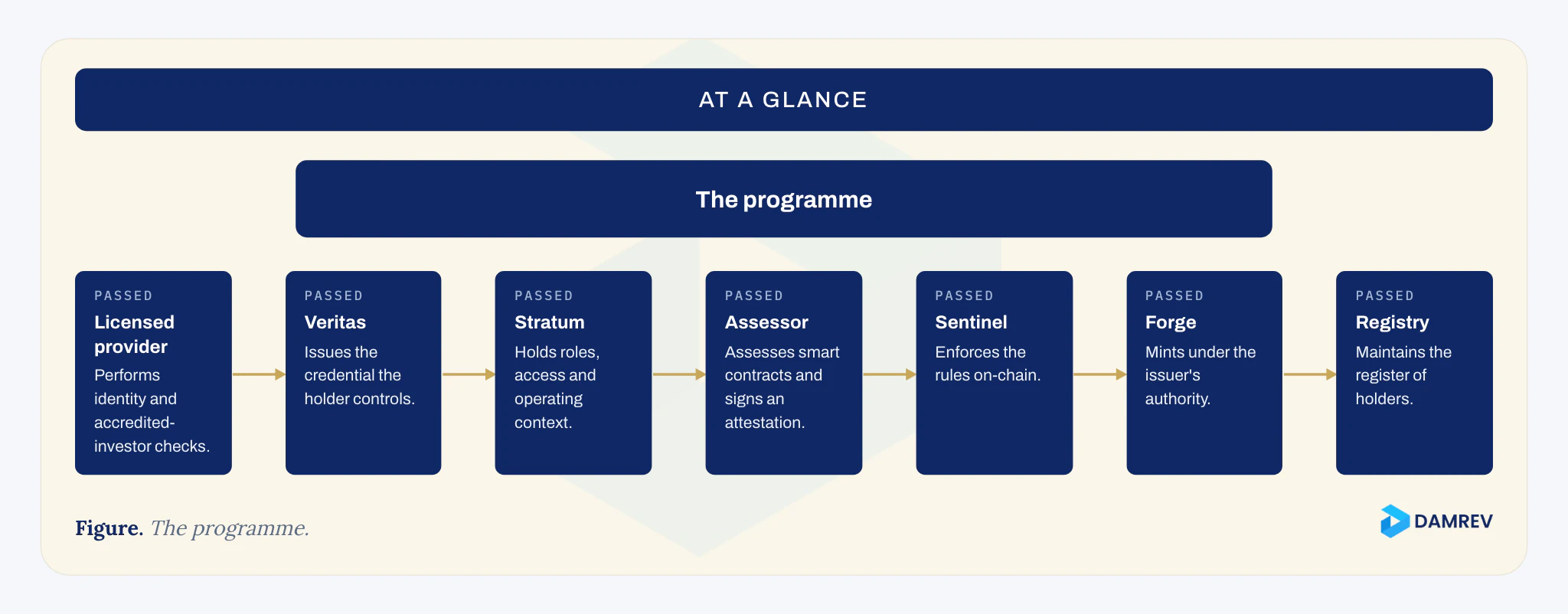
Run it. Licensed provider, then Veritas, then Stratum, then Assessor, then Sentinel, then Forge, then Registry. Run it to see who acts, in order.
  • Run it
  • Licensed provider: Performs identity and accredited-investor checks.
  • Veritas: Issues the credential the holder controls.
  • Stratum: Holds roles, access and operating context.
  • Assessor: Assesses smart contracts and signs an attestation.
  • Sentinel: Enforces the rules on-chain.
  • Forge: Mints under the issuer's authority.
  • Registry: Maintains the register of holders.
Run it. Licensed provider, then Veritas, then Stratum, then Assessor, then Sentinel, then Forge, then Registry. Run it to see who acts, in order.

Run it to see who acts, in order.

Step by step

Who does what, and why there?

Each function sits with the party qualified to perform it.

  1. Step one

    Who verifies identity?

    A licensed verification provider, not DAMREV. Veritas integrates that provider and issues a reusable credential that the holder controls. Other engines read identity from Veritas when they need it, so the check is performed once, by the party qualified to perform it.


    Read about Veritas

  2. Step two

    Who decides what each user may do?

    The client, through roles held in Stratum. Stratum holds roles, access and operating context for the platform and its tenants, and the engines that consume it read those roles. A platform user personalises within role and tenant limits, and the agents Praxis runs compose through the same roles.

    Read about Stratum

  3. Step three

    Who sets the rules of the instrument?

    The issuer. The issuer sets and changes the rules, and the rules configure per jurisdiction. Counsel and the appointed regulated parties work alongside, so the economic terms, the legal documents and the encoded rules describe the same transaction. DAMREV encodes the agreed rules; it does not choose them.

    Read about Sentinel

  4. Step four

    Why does no party both assess and enforce?

    Because a party that renders a verdict and acts on it can mark its own work. A smart contract assessor assesses smart contracts and renders a signed attestation. Sentinel, the enforcer, acts on that verdict on-chain. The assessor does not enforce, mint, sign or settle, and Sentinel does not assess.

    The assessor is set up as a separate entity, with DAMREV as its first client. The relationship is disclosed as related-party because of common ownership.

    Read about independent validationRead about conflicts of interest

  5. Step five

    Who issues, and who keeps the register?

    The issuer issues, and the platform records. Forge mints under the issuer's authority once Veritas and Sentinel clear eligibility, and Registry maintains the register of holders, performing the transfer-agent function as software. Where a programme appoints a transfer agent, custodian or administrator, that party keeps its role.

    A register kept on a public ledger is not an untested idea. Franklin Templeton's money market fund has used Stellar as its official system of record since April 20211; the fund's appointed parties kept their roles.

    Read about ForgeRead about Registry

No party holds the power both to assess and to enforce, and each appointed entity keeps its regulated role.

The parties

Who is responsible for what, and never for what?

The software company, the issuer and the validator are different legal persons with different functions.

  • WyomingDAMREV Labs, LLCBuilding and operating the software, and encoding the agreed rules.What it is notIssuing securities, acting as general partner, managing funds, giving investment advice, or holding client assets.
  • MauritiusDAMREV Capital PartnersActing as issuer and general partner, as a separate legal entity.What it is notOperating the platform software.
  • RulesThe issuerSetting and changing the rules of the instrument.What it is notOperating the platform.
  • IdentityLicensed verification providerIdentity and accredited-investor checks.What it is notEnforcing transfers.
  • Fiat legLicensed fiat providerThe fiat leg of the on-ramp.What it is notThe rest of the platform.
  • ValidationAssessorAssessing smart contracts and rendering a signed attestation.What it is notEnforcing, minting, signing or settling.

The principle

What rule governs the division of roles?

The separation of assessor and enforcer, and the separation of entities. Who sponsors a tokenized instrument, and in what role, is also a legal question that regulators now address directly.

The assessor assesses

Assesses each smart contract and renders a signed attestation. It never enforces, mints, signs or settles.

No party holds both powers

Sentinel enforces

Acts on that verdict on-chain, in the contract logic of every transfer. It never assesses.

Configuration

What does the client configure, and what is fixed?

The client shapes who does what inside its own programme. The separations that make the programme trustworthy are fixed, because a control a client could switch off would not be a control.

The client configures

  • Roles and access for its own users, held in Stratum
  • The rule set for each asset, per jurisdiction, set by the issuer
  • Which regulated parties it appoints, such as an administrator, custodian or transfer agent
  • Whether it uses the whole stack or selected engines

Fixed by the platform

  • The separation of assessor and enforcer
  • Identity checks performed by a licensed provider, never by DAMREV
  • Keys held by the user, never by DAMREV
  • Every decision, input, encoded rule and approval kept on the programme record

Common questions

What else do people ask?

Short answers to the questions people ask most about this topic.

Who performs know your customer checks?

A licensed verification provider performs them. Veritas integrates that provider and issues the resulting credential, and DAMREV Labs, LLC provides the software.

Can the smart contract assessor enforce its own findings?

The assessor assesses and attests, and Sentinel enforces. Keeping those powers in different hands is the point of the arrangement.

Which group entity can act as issuer?

DAMREV Capital Partners, incorporated in Mauritius, is the separate entity that can act as issuer and general partner. DAMREV Labs, LLC does not issue securities. Permissions are held entity by entity.

What happens to an appointed transfer agent or custodian?

It keeps its role. The issuer, general partner, administrator, custodian, bank or transfer agent keeps the role assigned to that entity, and the platform works alongside it.

References

  1. 1.Stellar Development Foundation, Franklin Templeton case study. https://stellar.org/case-studies/franklin-templeton
  2. 2.US Securities and Exchange Commission, Statement on Tokenized Securities, 28 January 2026. https://www.sec.gov/newsroom/speeches-statements/corp-fin-statement-tokenized-securities-012826-statement-tokenized-securities

Last updated:

Ready to build on programmable infrastructure?

Tell us what you want to tokenize. We will show you how DAMREV can run it.


