


The investor applies
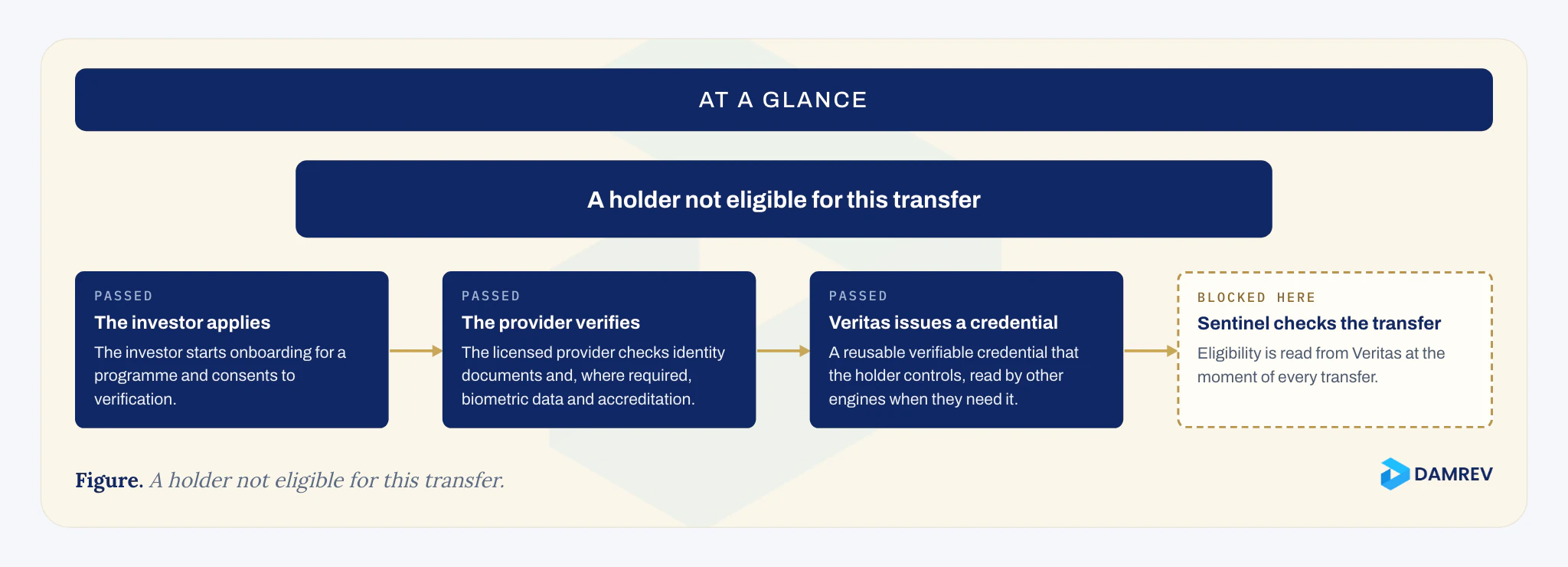
The investor starts onboarding for a programme and consents to verification.
Section
Structuring
The instrument classes DAMREV structures, and the four situations that bring most clients here.
Not sure which page answers your question? A structuring review starts with that conversation.
Start a Structuring ReviewSection
Services
The ladder, from a paid first look to a programme DAMREV operates for you.
Not sure which page answers your question? A structuring review starts with that conversation.
Start a Structuring ReviewSection
Platform
Eight capabilities and twenty named engines. DAMREV runs its own instruments on it.
Not sure which page answers your question? A structuring review starts with that conversation.
Start a Structuring ReviewSection
Tokenized IPO
A tokenized listing is a listing first. This section is about whether yours is ready.
Not sure which page answers your question? A structuring review starts with that conversation.
Start a Structuring ReviewSection
Compliance
Written to be read by a regulator, a counterparty or an auditor without a call first.
The Americas & the Caribbean
Europe
Not sure which page answers your question? A structuring review starts with that conversation.
Start a Structuring ReviewSection
Insights
The published record. Papers, positions and the vocabulary, all dated.
Not sure which page answers your question? A structuring review starts with that conversation.
Start a Structuring ReviewNot sure which page answers your question? A structuring review starts with that conversation.
Start a Structuring ReviewTrust centre
Every investor on a DAMREV programme is verified before holding anything and checked again at every transfer. A licensed verification provider performs identity and accredited-investor checks, Veritas carries the result as a reusable credential, and Sentinel reads it each time an instrument moves. Anti-money laundering, sanctions and travel-rule obligations are met as legal obligations.
The problem
Because it is where a programme decides who it will deal with, and every later transfer inherits that decision. A check done once and never repeated lets an investor's status drift from the facts. DAMREV checks at onboarding and again at each transfer.
How it works
In five steps. The provider verifies, DAMREV receives the result, Veritas issues a credential the holder controls, and Sentinel reads that credential at every transfer against the rules that govern the asset.
The investor starts onboarding for a programme and consents to verification.
The licensed provider checks identity documents and, where required, biometric data and accreditation.
DAMREV receives the result and the data its obligations need, not the biometric templates.
A reusable verifiable credential that the holder controls, read by other engines when they need it.
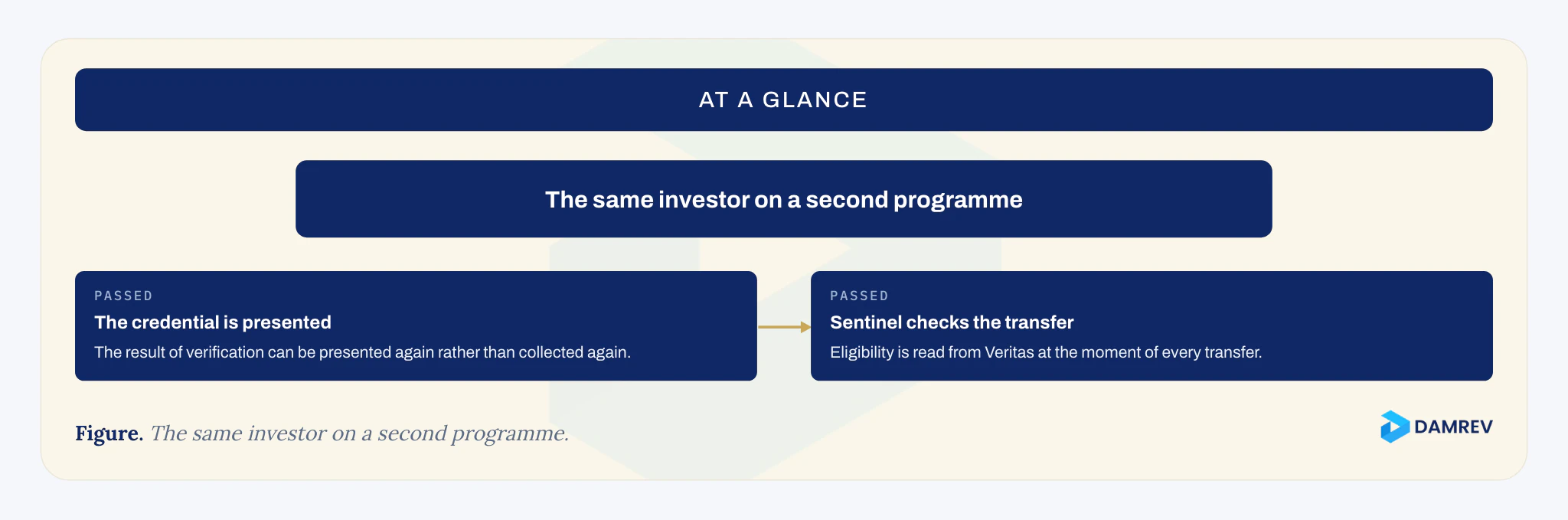
Eligibility is read from Veritas at the moment of every transfer, and a failing transfer does not proceed.
The credential standard
The World Wide Web Consortium (W3C) published Verifiable Credentials 2.0 as a Recommendation on 15 May 2025: a standard way to express digital credentials that is cryptographically secure, privacy respecting and machine-verifiable3. Veritas is aligned with the W3C Verifiable Credentials data model, not certified against it.
Each transfer
It is checked at every transfer. Sentinel reads eligibility from Veritas when an instrument moves, so a holder who is not eligible for a particular transfer cannot complete it.
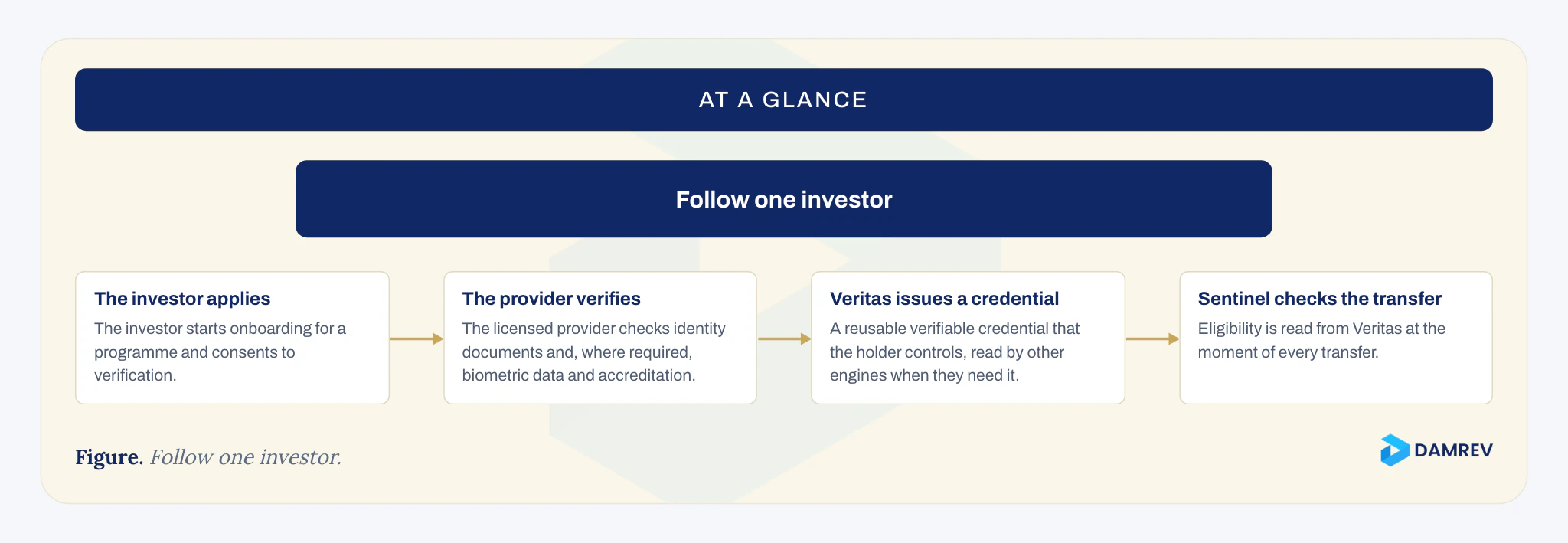
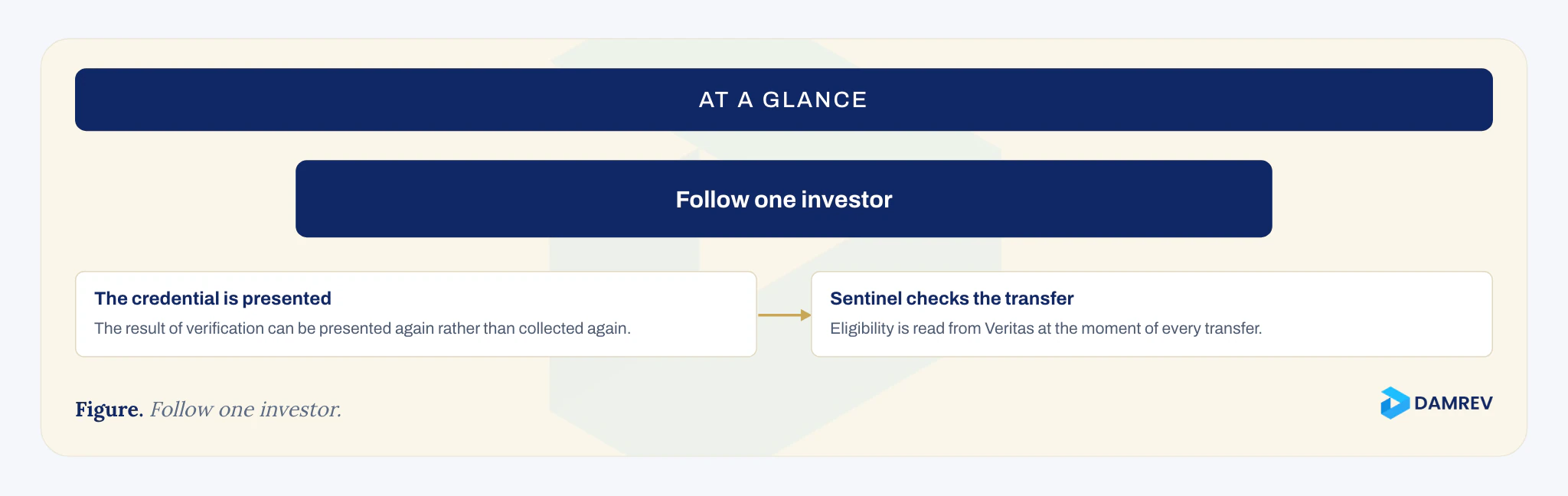
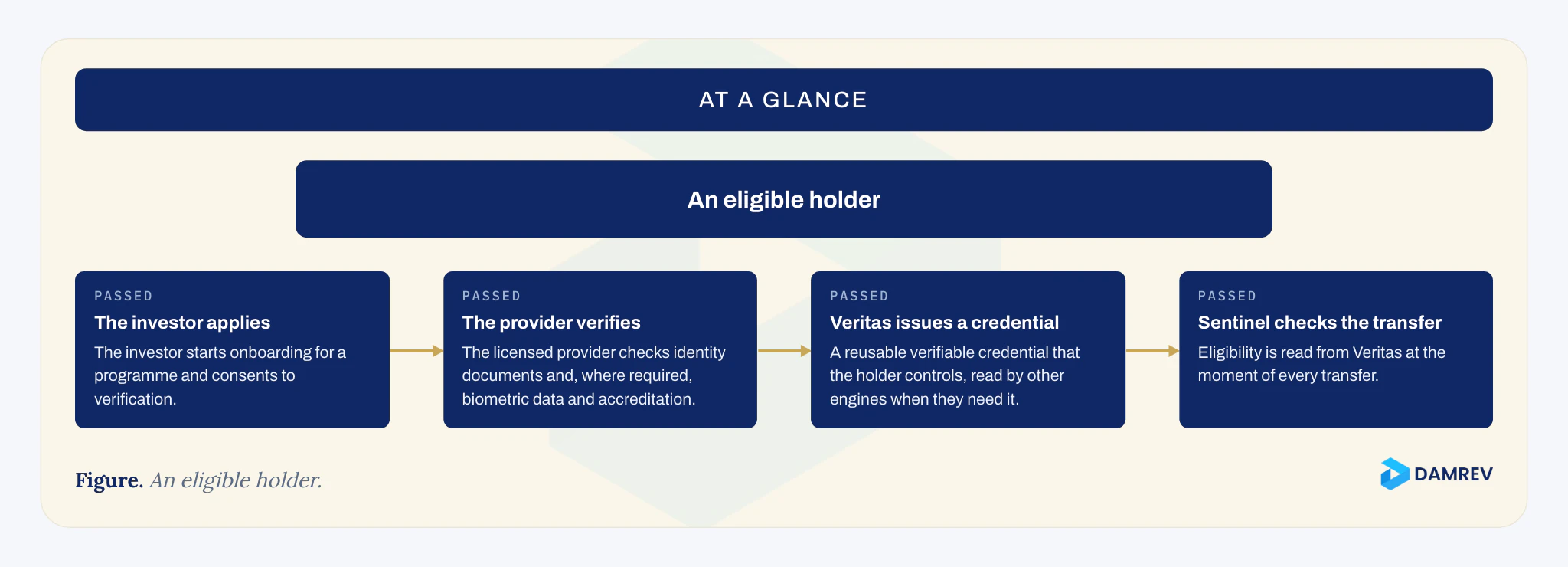
Choose a case and follow one investor from application to transfer.
Evidence
What an auditor needs to show that each holder was eligible for each transfer, and nothing the obligations do not require.
01
02
03
04
05
On request
Ask through the contact page, naming the programme and your role.
Common questions
Short answers to the questions people ask most about this topic.
A licensed verification provider, named in the privacy policy. It collects identity documents and, where required, biometric data. DAMREV receives the result, not the biometric templates.
It is checked at every transfer. Sentinel reads eligibility from Veritas when an instrument moves, so a holder who is not eligible for a particular transfer cannot complete it.
Veritas issues a reusable verifiable credential that the holder controls, so the result of verification can be presented again rather than collected again, subject to the rules of each programme.
Only the scope the rule requires, as the privacy policy states. In South Africa, FIC Directive 9 of 2024 has applied the travel rule to crypto asset transfers since 30 April 20252.
The issuer sets the eligibility and transfer rules for its programme, per jurisdiction, and Sentinel enforces them. The platform applies the rules; it does not decide which rules a jurisdiction requires.
Where next
The pages below pick up where this one ends. Start with the one closest to where your asset or programme stands today.
Last updated:
Insights

Since 17 September 2026 a tokenized securities venue may run automated liquidity pools in tokenized listed stock without registering as an exchange, on conditions.

The GENIUS Act binds payment stablecoin issuers from 18 January 2027, not the firms that hold or settle in stablecoins. Service providers follow in 2028.

The CLARITY Act stalled on a 49 to 50 vote, so tokenized securities stay with the Securities and Exchange Commission, as before.

Guernsey's guidance of 24 July 2026 lets a fund or issuer record and transfer its investments as tokens, under the regimes already applying to it.
Tell us what you want to tokenize.
We will show you how DAMREV can run it.