


How it works across the platform
Technical Architecture
The DAMREV platform is built in five architecture layers on Stellar, with Soroban running the contract logic in Rust and a settlement asset chosen per jurisdiction. Twenty engines sit across the layers, each with one defined function, stated dependencies and named integrations. This page is the engineer's view: what runs where, what depends on what, and which standards it follows.
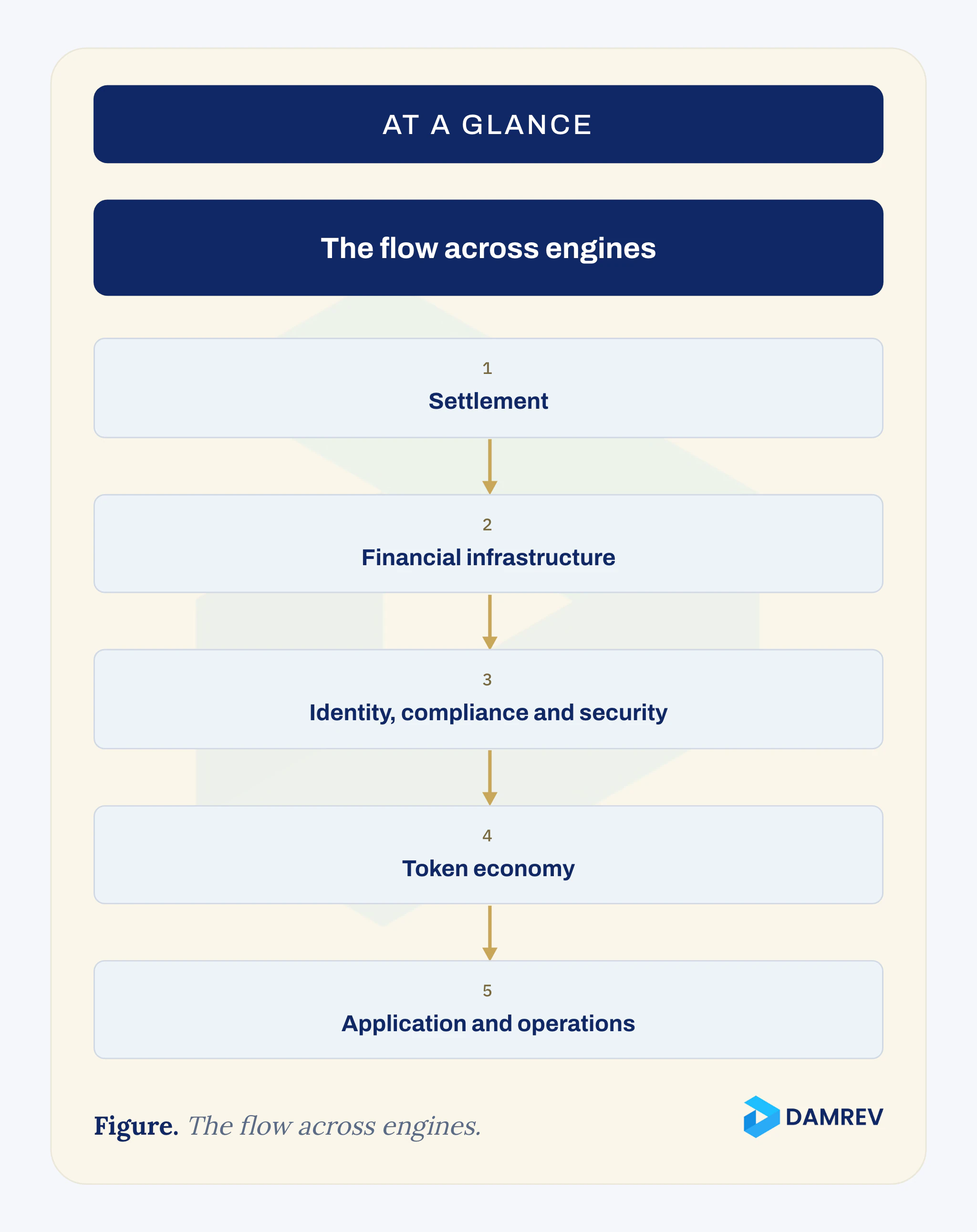
- The flow across engines
- Settlement (1)
- Financial infrastructure (2)
- Identity, compliance and security (3)
- Token economy (4)
- Application and operations (5)

The architecture
How is the platform put together?
As a stack of five layers. Settlement moves value; financial infrastructure issues, releases, services and prices; identity, compliance and security decides who may act; the token economy models value and carries governance; application and operations presents the platform. Each engine sits in exactly one layer, and each links to its own page.
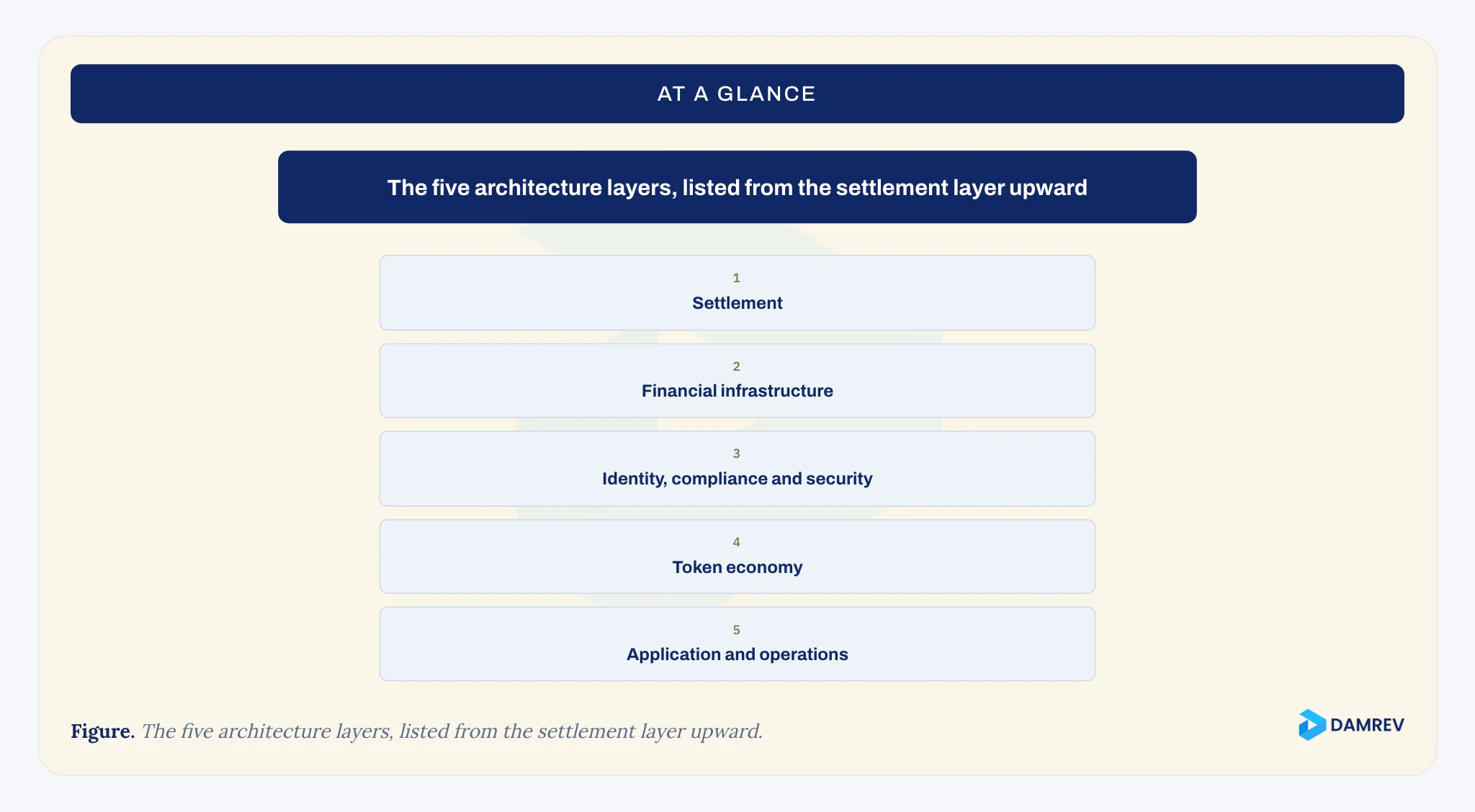
- The five architecture layers, listed from the settlement layer upward
- Settlement (1)
- Financial infrastructure (2)
- Identity, compliance and security (3)
- Token economy (4)
- Application and operations (5)
- 1Settlement: Conduit, on Stellar, in the asset each jurisdiction permits.
- 2Financial infrastructure: Forge, Cadence, Registry, Beacon, Agora, Flux, Anchor and Reserve.
- 3Identity, compliance and security: Veritas, Sentinel and Sentry.
- 4Token economy: Equilibrium and Quorum.
- 5Application and operations: Stratum, Portal, Vault, Praxis, Atelier and Lyceum.
Step one
What does the platform run on?
Stellar settles, and Soroban runs the contract logic in Rust on the same ledger. Transfer rules are enforced in that contract logic on the settlement layer. DAMREV provides the identity, compliance, treasury, servicing and governance layers above, available as composable components.
| Component | Role | Properties |
|---|---|---|
| Stellar | The settlement network. | Public since 31 July 2014. Runs the Stellar Consensus Protocol and closes a ledger roughly every five seconds, with finality at close. Any account can issue an asset natively, with authorisation flags and clawback available to the issuer1. |
| Soroban | The contract layer, written in Rust, in which transfer rules are enforced. | Live on Stellar mainnet since February 2024 with Protocol 20, running natively on the same ledger2. |
| Settlement asset | Chosen per jurisdiction. | From what local rules permit. The group issues none of them. |
| An oracle network | Designed to bring external price and reserve data on-chain. | Through Beacon, by design. |
The reference case for a regulated instrument on this network is Franklin Templeton's Franklin OnChain U.S. Government Money Fund, which launched on Stellar in April 2021 as the first money market fund registered in the United States to use a public blockchain as the official system of record for transactions and share ownership3.
Step two
Which engines sit in each layer?
Each engine belongs to one layer, taken from its own record. Financial infrastructure is the largest layer, with eight engines; settlement is the smallest, with one. The layer tells an engineer where an engine's data comes from and which controls stand above and below it.
| Layer | Engines | What the layer does |
|---|---|---|
| Settlement | Conduit | Brings fiat in through a licensed provider and hands the settlement asset to the platform. |
| Financial infrastructure | Forge, Cadence, Registry, Beacon, Agora, Flux, Anchor, Reserve | Issues, releases and services the instrument, brings external data on-chain, and runs the marketplace, swap routing, collateral and DAMREV's own treasury. |
| Identity, compliance and security | Veritas, Sentinel, Sentry | Establishes who a party is, whether a transfer may proceed, and which device authorised it. |
| Token economy | Equilibrium, Quorum | Models token economies and a fair-market-value view, and carries governance, a right designed to be earned by staking $DREV. |
| Application and operations | Stratum, Portal, Vault, Praxis, Atelier, Lyceum | Holds roles and operating context, and presents the platform through the portal, the wallet, agents, theming and the Academy. |
Step three
How do the engines depend on one another?
Each engine states the engines it depends on and the engines that consume it, and the table reproduces every statement exactly. Veritas, Beacon and Conduit depend on no other engine: they are the roots of identity, external data and value. Where two engines' statements do not mirror each other, both are shown as stated.
| Engine | Layer | Depends on | Consumed by |
|---|---|---|---|
| Conduit | Settlement | None | Flux, Vault |
| Forge | Financial infrastructure | Veritas, Sentinel | Cadence, Registry, Agora |
| Cadence | Financial infrastructure | Forge | Registry, Reserve, Equilibrium |
| Registry | Financial infrastructure | Forge, Veritas, Sentinel | Agora, Portal, Reserve, Anchor |
| Beacon | Financial infrastructure | None | Anchor, Reserve, Registry, Equilibrium, Forge |
| Agora | Financial infrastructure | Veritas, Sentinel, Registry | None stated |
| Flux | Financial infrastructure | Conduit, Vault | Quorum |
| Anchor | Financial infrastructure | Beacon, Reserve | None stated |
| Reserve | Financial infrastructure | Flux, Cadence, Beacon | Quorum, Equilibrium |
| Veritas | Identity, compliance and security | None | Stratum, Sentinel, Sentry, Portal, Registry, Agora, Conduit, Lyceum, Vault |
| Sentinel | Identity, compliance and security | Veritas | Forge, Agora, Registry, Flux, Quorum |
| Sentry | Identity, compliance and security | Veritas, Vault | Forge, Flux, Agora, Conduit, Quorum |
| Equilibrium | Token economy | Beacon, Veritas | Forge, Cadence, Reserve, Flux, Agora, Registry, Portal |
| Quorum | Token economy | Vault, Sentry, Veritas | None stated |
| Stratum | Application and operations | Veritas | Praxis, Portal, Registry |
| Portal | Application and operations | Veritas, Registry, Stratum | None stated |
| Vault | Application and operations | Veritas, Sentry | Flux, Conduit, Quorum |
| Praxis | Application and operations | Stratum, Sentinel, Veritas, Sentry | None stated |
| Atelier | Application and operations | Stratum | None stated |
| Lyceum | Application and operations | Veritas | None stated |
Three chains carry most programmes. The identity chain runs from Veritas to Sentinel and on to the engines that act on a transfer. The issuance chain runs from Forge to Cadence, Registry and Agora. The value chain runs from Conduit to Flux and Vault.
Stratum, which depends on Veritas, holds roles, access and operating context, and Praxis, Portal and Registry state that they consume it.
Some relationships are stated from one side only. Beacon lists Forge as a consumer, and Forge records Beacon as an integration for its mint circuit-breaker rather than as a dependency. Sentry lists Forge, Flux, Agora and Conduit as consumers that do not list Sentry in turn. The table keeps each engine's own statement rather than inferring the other side.
Step four
Which third parties does the platform integrate?
Integrations are stated as integrations, with the function each performs. Where a function is regulated, such as identity checks or the fiat leg of an on-ramp, a licensed provider performs it and DAMREV does not. The table lists every external integration that the engine records name.
| Integration | Engines | Function |
|---|---|---|
| The identity verification provider | Veritas, Conduit | Performs know your customer (KYC) checks. |
| Xago | Conduit | The group's rand on-ramp and off-ramp partner in South Africa, which operates the fiat on-ramp. |
| An oracle network | Beacon | Designed to bring external price and reserve data on-chain. |
| Stellar and Soroban | Veritas, Sentinel, Forge, Cadence, Registry, Agora, Anchor, Reserve, Quorum | Settlement and contract logic. Veritas uses Stellar to anchor issuers for credential issuance. |
| Stellar decentralised exchange | Flux | The exchange through which Flux routes swaps, with the user keeping custody. |
| Circle USDC | Flux | The stable unit a swap into $DREV would start from. The group does not issue it. |
| Device secure enclave or StrongBox | Sentry | Hardware-backed key storage on the user's device. |
| Angular | Stratum | The current generation of the platform on which Stratum is built. |
| Next.js and MDX | Atelier | The Git-based website platform that Atelier themes. |
- VeritasIntegrates the identity verification provider, which performs the checks. Veritas then issues a reusable credential that the holder controls.
- ConduitIntegrates Xago, the group's rand on-ramp and off-ramp partner in South Africa, which operates the fiat leg. Conduit then hands the resulting settlement asset to Flux and Vault.
- BeaconIs designed to integrate an oracle network to bring external price and reserve data on-chain. Beacon depends on no other engine, and five engines, Forge among them, read from it.
Step five
Which standards is the architecture aligned with?
Veritas is aligned with the World Wide Web Consortium (W3C) Verifiable Credentials model, and Praxis with the model of recognised artificial intelligence (AI) governance frameworks. Alignment means following the published model. It never means certification, and no engine claims to be certified or compliant.
| Standard or framework | Engine | Position |
|---|---|---|
| W3C Verifiable Credentials | Veritas | Aligned with the data model. |
| OpenID for Verifiable Credentials | Veritas | Aligned. |
| ISO/IEC 18013-5 | Veritas | Aligned. |
| eIDAS 2.0, the European Union framework for electronic identification | Veritas | Aligned. |
| ISO/IEC 42001 | Praxis | Aligned with the model. |
| The AI risk management framework of the US National Institute of Standards and Technology | Praxis | Aligned with the model. |
| The European Union AI Act | Praxis | Aligned with the model. High-risk exposure for a worldwide deployment is a reserved item. |
Configuration
What can a client configure, and what is fixed?
A client configures which engines it uses and how they behave inside its programme. The base network, the settlement unit, the custody line and each engine's place in the architecture are fixed, so every programme can be described by the same map.
The client configures
- Which engines a programme uses, from the whole stack to a selected few
- The rule set for each asset, per jurisdiction
- Roles, access and operating context in Stratum
- Brand and theme on white-label surfaces, through Atelier
- Integration by API, through configuration and capability endpoints
Fixed by the platform
- Settlement on Stellar, with contract logic in Soroban
- A settlement asset chosen per jurisdiction
- Identity checks by a licensed provider
- Keys held by the user, and signing on the user's device
- The separation of assessor and enforcer
- Each engine's layer, function and stated dependencies
Common questions
What else do people ask?
Short answers on the architecture: which language the contracts are written in, which engines have no dependencies, whether the platform is certified against any standard, whether one engine can be integrated without the rest, and whether this page says which engines are deployed.
Which language are the contracts written in?
Rust, running as Soroban smart contracts on the Stellar ledger. Soroban went live on Stellar mainnet in February 2024 with Protocol 202.
Which engines have no dependencies?
Veritas, Beacon and Conduit. Veritas integrates the licensed identity provider, Beacon is designed to integrate an oracle network, and Conduit integrates the licensed fiat provider.
Is the platform certified against any standard?
The platform is aligned with the standards it names, which means it follows their published models. It claims no certification against any of them.
Can one engine be integrated without the rest?
Yes, together with the engines it depends on. The platform integrates in both directions: Forge, for example, travels with Veritas and Sentinel.
Does this page say which engines are deployed?
Deployment is recorded engine by engine in capability status records, kept apart from the roadmap. Those records are being prepared, so this page marks no capability as live.
Where next
Where should you go next?
The pages below pick up where this one ends. Start with the one closest to where your asset or programme stands today.
- Roles & ResponsibilitiesWho owns each function on a programme, from the software company and the issuer to licensed providers, and why no party holds both powers.
- How It WorksThe five stages every programme follows, the five architecture layers, and how twenty engines hand off so each control has a named owner.
- Identity & EligibilityHow a holder is verified once by a licensed provider, receives a reusable credential from Veritas, and is checked at every transfer.
- Settlement & LiquidityHow value settles in the asset each jurisdiction permits: fiat through a licensed provider, swaps without custody, and sales behind an eligibility gate.
References
- 1.Chainstack, "What is Stellar". https://chainstack.com/what-is-stellar/ Also: Stellar developer documentation, "Control access to an asset", https://developers.stellar.org/docs/tokens/control-asset-access
- 2.Stellar Development Foundation, "Protocol 20 and smart contracts are live on Mainnet". https://stellar.org/blog/developers/protocol-20-and-smart-contracts-are-live-on-mainnet
- 3.Stellar Development Foundation, Franklin Templeton case study. https://stellar.org/case-studies/franklin-templeton
- 4.World Wide Web Consortium, "Verifiable Credentials 2.0 is a W3C standard". https://www.w3.org/press-releases/2025/verifiable-credentials-2-0/
Last updated:




