



Structure agreed
The asset, claim, vehicle, ranking and control framework are settled with counsel.
Section
Structuring
The instrument classes DAMREV structures, and the four situations that bring most clients here.
Not sure which page answers your question? A structuring review starts with that conversation.
Start a Structuring ReviewSection
Services
The ladder, from a paid first look to a programme DAMREV operates for you.
Not sure which page answers your question? A structuring review starts with that conversation.
Start a Structuring ReviewSection
Platform
Eight capabilities and twenty named engines. DAMREV runs its own instruments on it.
Not sure which page answers your question? A structuring review starts with that conversation.
Start a Structuring ReviewSection
Tokenized IPO
A tokenized listing is a listing first. This section is about whether yours is ready.
Not sure which page answers your question? A structuring review starts with that conversation.
Start a Structuring ReviewSection
Compliance
Written to be read by a regulator, a counterparty or an auditor without a call first.
The Americas & the Caribbean
Europe
Not sure which page answers your question? A structuring review starts with that conversation.
Start a Structuring ReviewSection
Insights
The published record. Papers, positions and the vocabulary, all dated.
Not sure which page answers your question? A structuring review starts with that conversation.
Start a Structuring ReviewNot sure which page answers your question? A structuring review starts with that conversation.
Start a Structuring ReviewWhy DAMREV
Alignment means the operating instrument keeps doing what the terms that authorised it say, because DAMREV encodes those terms and enforces them at every event. Retention means the proof is kept: every decision, input, rule and approval stays on the programme record, under a versioned standard. DAMREV's charging basis follows the same instrument for its life.
Definitions
Alignment means the operating instrument stays true to the terms that authorised it, because those terms are encoded and enforced rather than copied. Retention means the record of how it stayed true is kept: every decision, input, rule and approval, attached to the programme for the life of the instrument.
The two only work as a pair. Alignment without retention gives an instrument that behaves correctly but cannot show it did, which leaves an issuer exposed the first time an auditor or a holder asks. Retention without alignment gives a careful record of an instrument drifting away from its documents.
Together they answer the question every party to a long-lived instrument eventually asks: did this instrument do what the documents said, on every date, and can you prove it? On DAMREV the answer is designed to come from the record itself, not from a reconstruction assembled after the question is put.
The problem
Because terms are agreed once but operated for years, by several parties each working from its own copy. Registers are updated, holders change, distributions are calculated and amendments are made, and every copy updated separately is a place where the record can part company with the terms.
Alignment
The terms are encoded once, after the structure is settled with counsel, and enforced at every event from issuance onwards.
The asset, claim, vehicle, ranking and control framework are settled with counsel.
Rights, eligibility, transfer controls and servicing logic are encoded once.
Forge issues only after Veritas and Sentinel clear eligibility.
Sentinel reads eligibility from Veritas and applies the rules at each transfer.
Cadence releases tokens on the agreed schedule, gated by the same checks.
Registry keeps the register and handles corporate actions against the same rules.
Eligibility travels as a credential rather than a spreadsheet row. A licensed provider performs identity and accredited-investor checks, and Veritas issues a reusable credential that the holder controls, aligned with the World Wide Web Consortium (W3C) Verifiable Credentials model, published as a Recommendation on 15 May 20252.
Some rules come from the law rather than the deal and are encoded the same way: in Mauritius, issuers of initial token offerings must give purchasers a 72-hour withdrawal right3.
The rules run in contract logic on Soroban, which has run natively on the Stellar ledger since February 20244. Because the check happens at the moment of the event, against the encoded rule, there is no second copy to fall out of date. A transfer that fails the rules does not settle.
Authority
The issuer can, and only through an assessed, approved and recorded decision. DAMREV encodes and operates the rules; it does not set them.
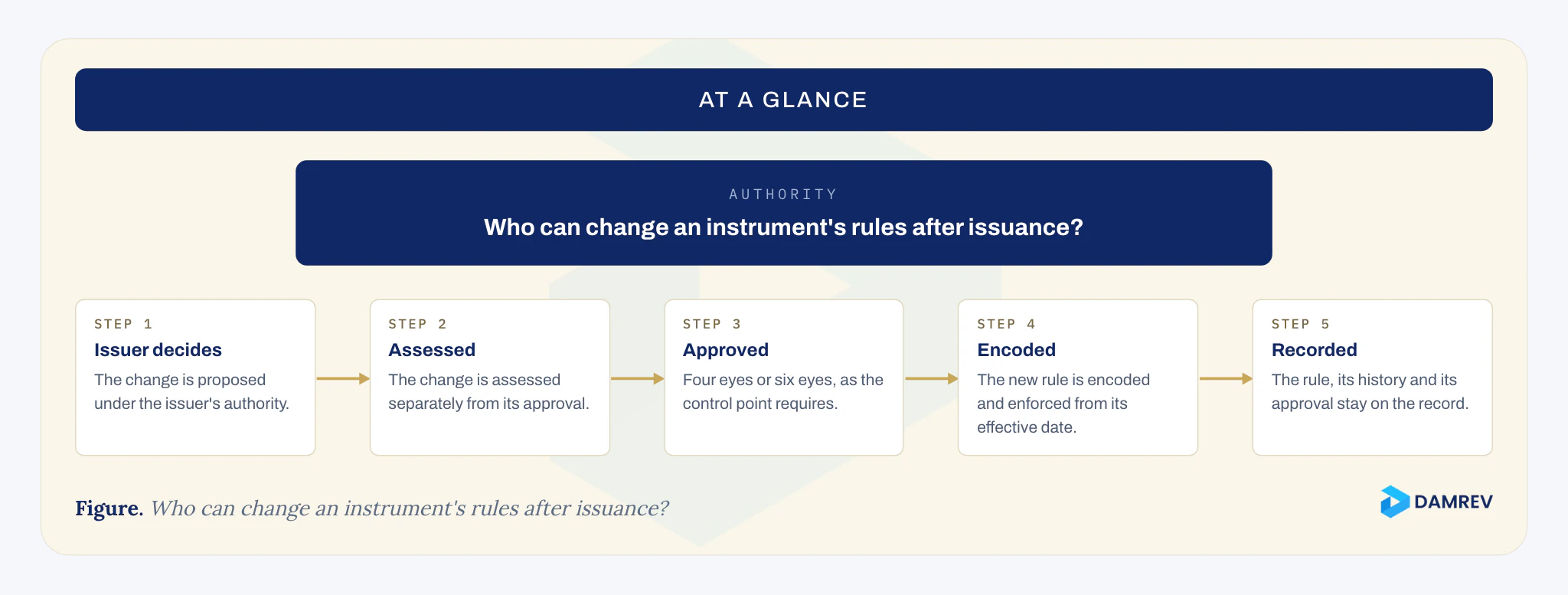
The base network supports this division of authority. On Stellar, any account can issue an asset natively, and authorisation flags and clawback are available to the issuer5.
Four eyes and six eyes determine who may assess, approve or review each class of decision, and agentic artificial intelligence (AI) works inside those roles and approval paths rather than around them.
A smart contract assessor, a related party, assesses the smart contracts and Sentinel enforces, so no party holds both the verdict and the power to act on it.
Retention
Every decision, input, encoded rule and approval is attached to the programme record, so the operating instrument can always be traced back to the terms that authorised it. Choose an item to see what is kept and the question it answers.
Who acted, and under which authority.
The information in front of the person or agent deciding.
The rule in force on each date, with its history.
Assessment, approval and review, kept distinct.
The version of the method that governed the programme.
A ledger can already carry legal weight as a record. Franklin Templeton's Franklin OnChain U.S. Government Money Fund, launched on Stellar in April 2021, was the first US-registered money market fund to use a public blockchain as the official system of record for transactions and share ownership6.
The programme record extends that idea: it keeps not only what moved and who holds it, but the decision, the rule and the approval that allowed it to move.
Some inputs are kept because the law requires them: South Africa's Financial Intelligence Centre applied the travel rule to crypto asset transfers from 30 April 20257.
The method
The DAMREV Standard is a versioned operating standard that governs how programmes are researched, structured, encoded and overseen after deployment, including how assessment is separated from approval. A programme can be read against the version that governed it.
Retaining the method matters as much as retaining the events. A decision that was right under one version of the standard may be handled differently under the next, and without the earlier version a reviewer can only judge an old decision by a new rule.
Because each version runs on DAMREV's own programmes first, a change reaches a client's programme only after DAMREV has operated under it.
Compared
Conventional operation keeps the terms in documents and the operating record in several systems, joined by re-keying. An encoded, retained record keeps the terms, the enforcement and the evidence together. Choose a question to compare the two.
Six questions
Choose one
Conventional operation
In the documents, copied into each party's systems.
Encoded and retained on DAMREV
Encoded once and enforced by the platform at each event.
Conventional operation
A person or system at one party, before its register is updated.
Encoded and retained on DAMREV
Sentinel, reading eligibility from Veritas at the moment of transfer.
Conventional operation
Recorded by each party separately, on its own timetable.
Encoded and retained on DAMREV
Made under the issuer's authority, approved, and recorded against that approval.
Conventional operation
The history, from several parties' files.
Encoded and retained on DAMREV
Little: decisions, inputs, rules and approvals are already on the record.
Conventional operation
Often unrecorded.
Encoded and retained on DAMREV
The dated version of the DAMREV Standard that governed the programme.
Conventional operation
The federal securities laws apply.
Encoded and retained on DAMREV
The same laws apply, whatever the format1.
Counsel, an administrator, a custodian or a transfer agent keeps its role where the programme appoints one. What changes is where the truth of the instrument is kept: on DAMREV it sits in one record that every party reads, each according to its role.
Commercial alignment
DAMREV is paid on three bases that follow the instrument. Each depends on the instrument working as its terms say, so DAMREV's interest runs with the client's rather than ending at issuance.
A provider paid once, at issuance, has no commercial reason to care what happens to the instrument in its third year. A provider paid to service it for life does, because every failure of alignment becomes its own operating problem.
The same logic explains why DAMREV structures before it encodes: a structure that never settles produces no success component, so DAMREV has a direct interest in saying early when a transaction is not ready.
Worked example
Take an illustrative receivables book, tokenized so that eligible holders fund it and receive distributions from collections. The example follows one refused transfer and one amendment through the programme.
01
02
03
04
05
The instrument refused a transfer its terms did not allow, accepted a change its issuer authorised, and kept the proof of both. That is alignment and retention working together on one programme.
Common questions
Short answers to the questions people ask most about this topic.
No. The issuer sets and changes the rules. DAMREV encodes and operates them, and each change is recorded against the approval behind it.
It does not settle. Sentinel reads eligibility from Veritas at the moment of the transfer and blocks it, and the refusal is recorded with the rule that caused it.
No. SEC staff stated on 28 January 2026 that the format in which a security is issued does not affect the application of the federal securities laws1. That is why the encoded rules must match the documents.
The record stays attached to the programme for the life of the instrument. Retention periods for personal data are set in the privacy policy.
A smart contract assessor, set up as a separate entity, assesses them and renders a signed attestation. Sentinel enforces. The relationship is disclosed as related-party because of common ownership.
The dated version of the DAMREV Standard in force for the programme. Superseded versions stay readable, with the evidence that changed them.
For orchestrating the programme, for servicing the instrument for its life, and on success tied to capital actually settled. The charging basis follows the instrument, so DAMREV's interest runs with the client's.
Where next
The pages below pick up where this one ends. Start with the one closest to where your asset or programme stands today.
Last updated:
Insights

Since 17 September 2026 a tokenized securities venue may run automated liquidity pools in tokenized listed stock without registering as an exchange, on conditions.

The GENIUS Act binds payment stablecoin issuers from 18 January 2027, not the firms that hold or settle in stablecoins. Service providers follow in 2028.

The CLARITY Act stalled on a 49 to 50 vote, so tokenized securities stay with the Securities and Exchange Commission, as before.

Guernsey's guidance of 24 July 2026 lets a fund or issuer record and transfer its investments as tokens, under the regimes already applying to it.
Tell us what you want to tokenize.
We will show you how DAMREV can run it.
