



Identity clears
Forge checks identity from Veritas before any mint.
Section
Structuring
The instrument classes DAMREV structures, and the four situations that bring most clients here.
Not sure which page answers your question? A structuring review starts with that conversation.
Start a Structuring ReviewSection
Services
The ladder, from a paid first look to a programme DAMREV operates for you.
Not sure which page answers your question? A structuring review starts with that conversation.
Start a Structuring ReviewSection
Platform
Eight capabilities and twenty named engines. DAMREV runs its own instruments on it.
Not sure which page answers your question? A structuring review starts with that conversation.
Start a Structuring ReviewSection
Tokenized IPO
A tokenized listing is a listing first. This section is about whether yours is ready.
Not sure which page answers your question? A structuring review starts with that conversation.
Start a Structuring ReviewSection
Compliance
Written to be read by a regulator, a counterparty or an auditor without a call first.
The Americas & the Caribbean
Europe
Not sure which page answers your question? A structuring review starts with that conversation.
Start a Structuring ReviewSection
Insights
The published record. Papers, positions and the vocabulary, all dated.
Not sure which page answers your question? A structuring review starts with that conversation.
Start a Structuring ReviewNot sure which page answers your question? A structuring review starts with that conversation.
Start a Structuring ReviewGuide
Structured probabilities is how the DAMREV platform treats inputs that are not settled facts. External data enters through one engine, values that are views carry human verification, a doubtful reading can stop an action, and decisions that need a person follow set approval paths. Every judgement stays on the programme record, before and after encoding.
The term
It means giving uncertainty a structure instead of hiding it. An instrument depends on some inputs that are readings, some that are views and some that are decisions. The platform names each kind and routes it through the engine or the person responsible for it.
The platform lets each kind hold or stop an action according to how far it can be relied on.
The problem
Because encoded rules act without hesitation. A person who doubts a number pauses; a contract executes. If an estimate is encoded as though it were certain, every automatic action that follows inherits the error, and on a network whose ledger is final at close the action cannot be quietly undone afterwards1.
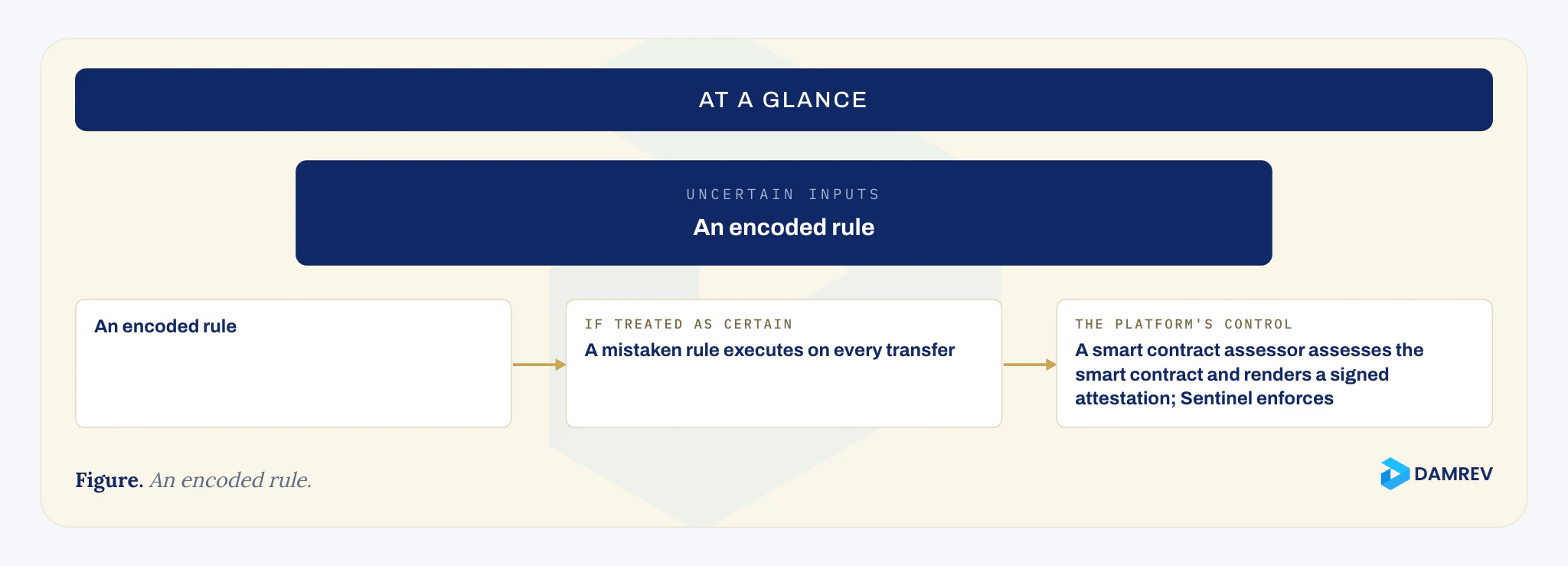
Structured finance has always depended on uncertain inputs. Tokenization removes many of the steps in which people question them, which is much of its value, but it also removes the pauses in which a doubtful number would have been caught.
Tokenized real-world assets on public chains, excluding stablecoins, were reported at about 26.4 billion US dollars in March 2026, up from about 6.6 billion US dollars a year earlier2.
The answer is not to avoid encoding. Soroban contracts run natively on the same Stellar ledger that settles the asset3. The answer is to decide, before encoding, which inputs a contract may act on alone, which need human verification, and which must be able to stop it.
External data
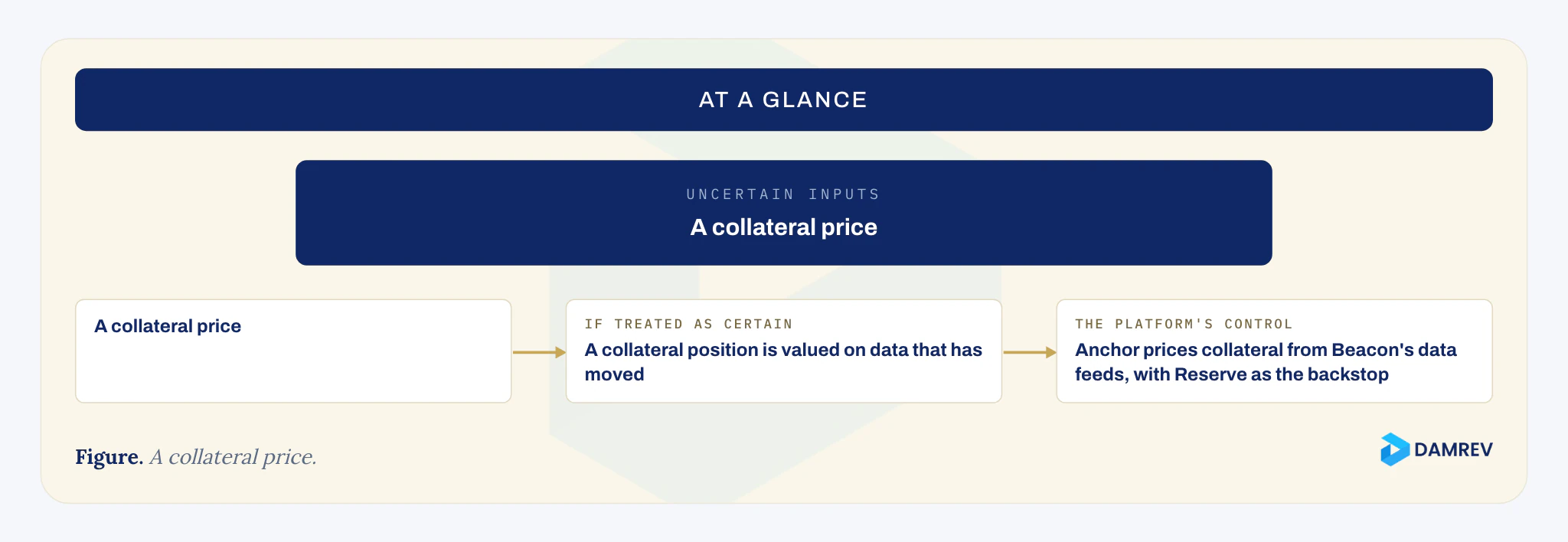
Through Beacon, the proof-of-reserve and oracle engine. Each external reading enters at one point, where it can be examined, and reaches only engines named in advance.
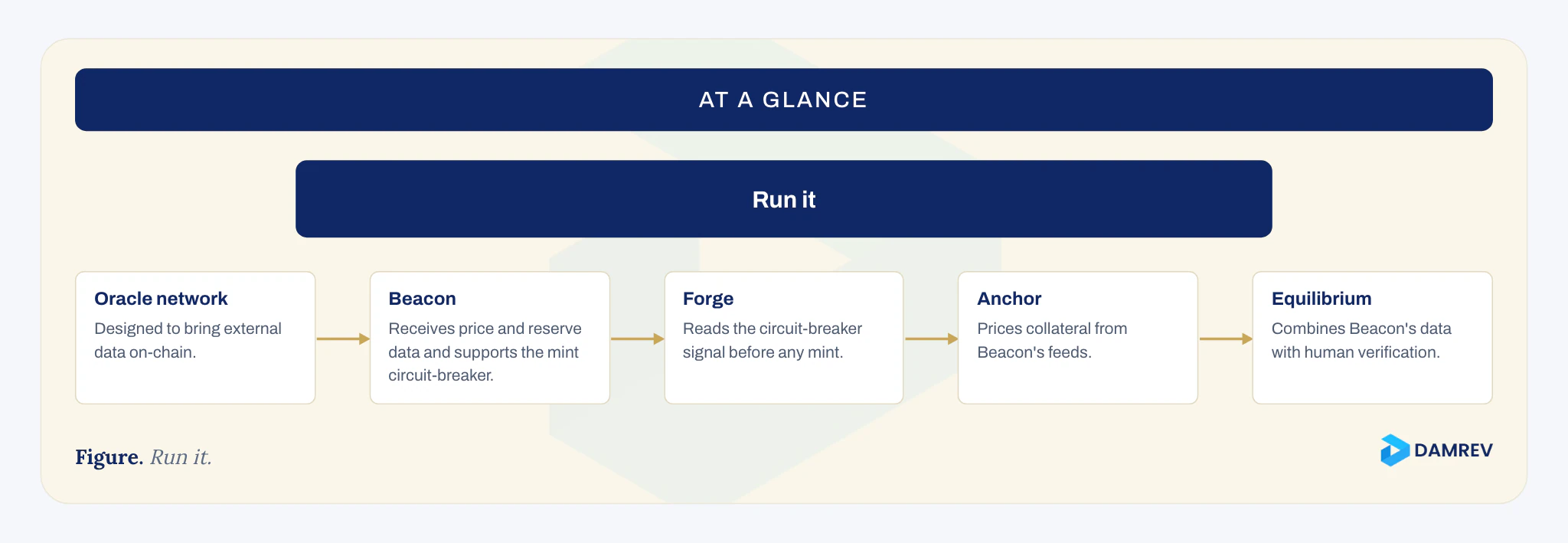
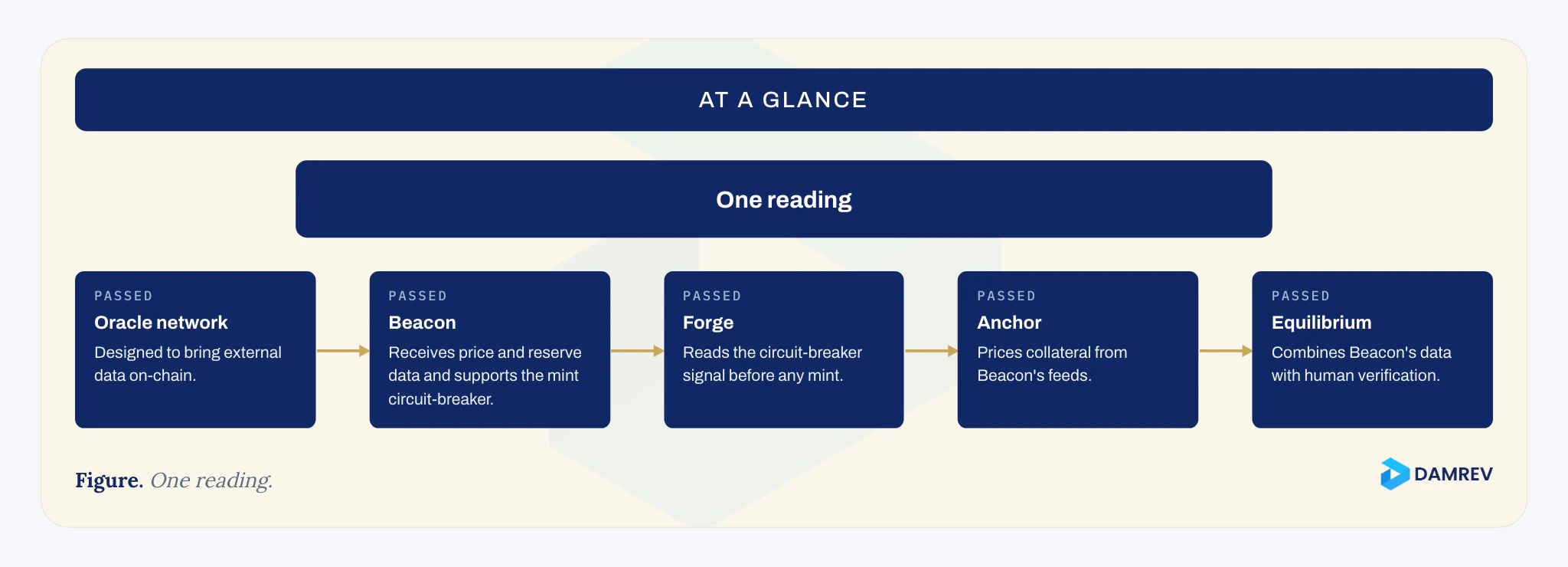
Run it to follow one external reading.
Beacon states five consumers: Anchor, Reserve, Registry, Equilibrium and Forge. It depends on no other engine, which keeps the entry point simple to audit, and it makes no price, valuation or return claim about any asset, because a feed is a reading and not an opinion.
Evidence of reserves is also becoming a legal expectation: in the United States, the GENIUS Act of July 2025 requires payment stablecoin issuers to hold reserves on at least a one-to-one basis4.
Human judgement
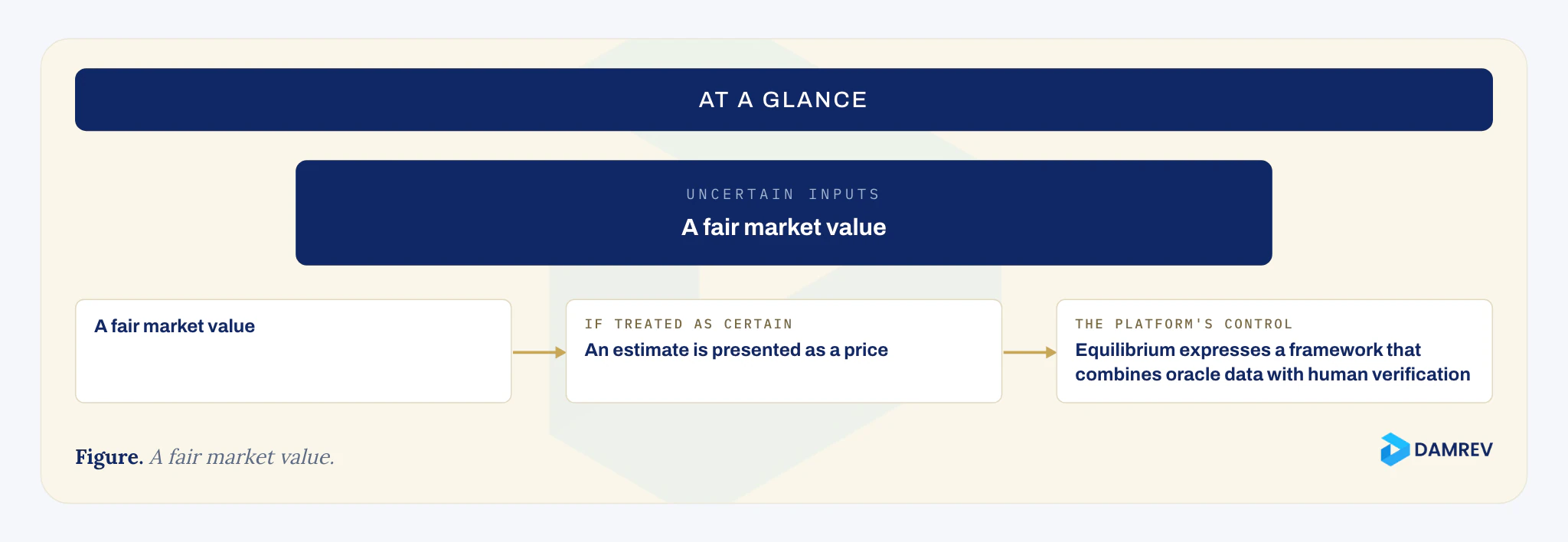
Wherever a value is a view rather than a reading. Equilibrium combines oracle data from Beacon with human verification to express a fair-market-value view and to model token economies, presented as a framework, never as a price, a guarantee or an investment signal.
Equilibrium depends on Beacon and Veritas, so the verification behind a view is tied to a verified person. Seven engines state that they consume Equilibrium's model: Forge, Cadence, Reserve, Flux, Agora, Registry and Portal.
Stops
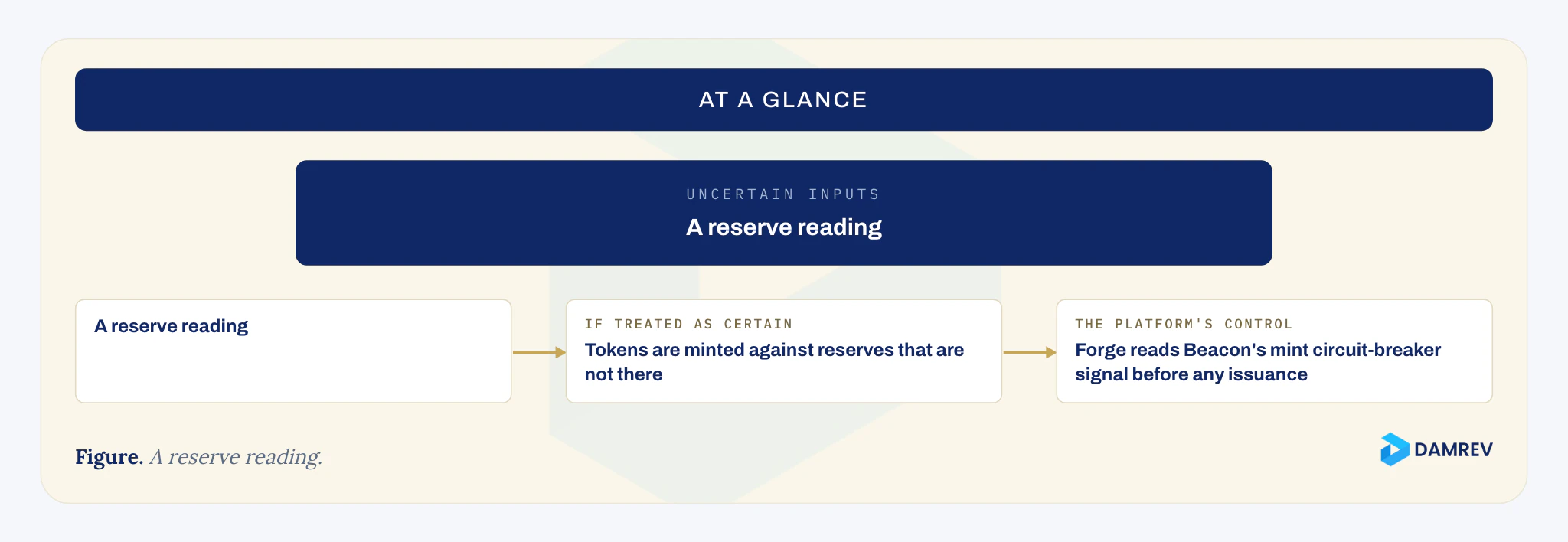
The action can stop. Beacon supports a mint circuit-breaker that can halt minting when a reserve or data condition is not met, and Forge reads that signal before any issuance.
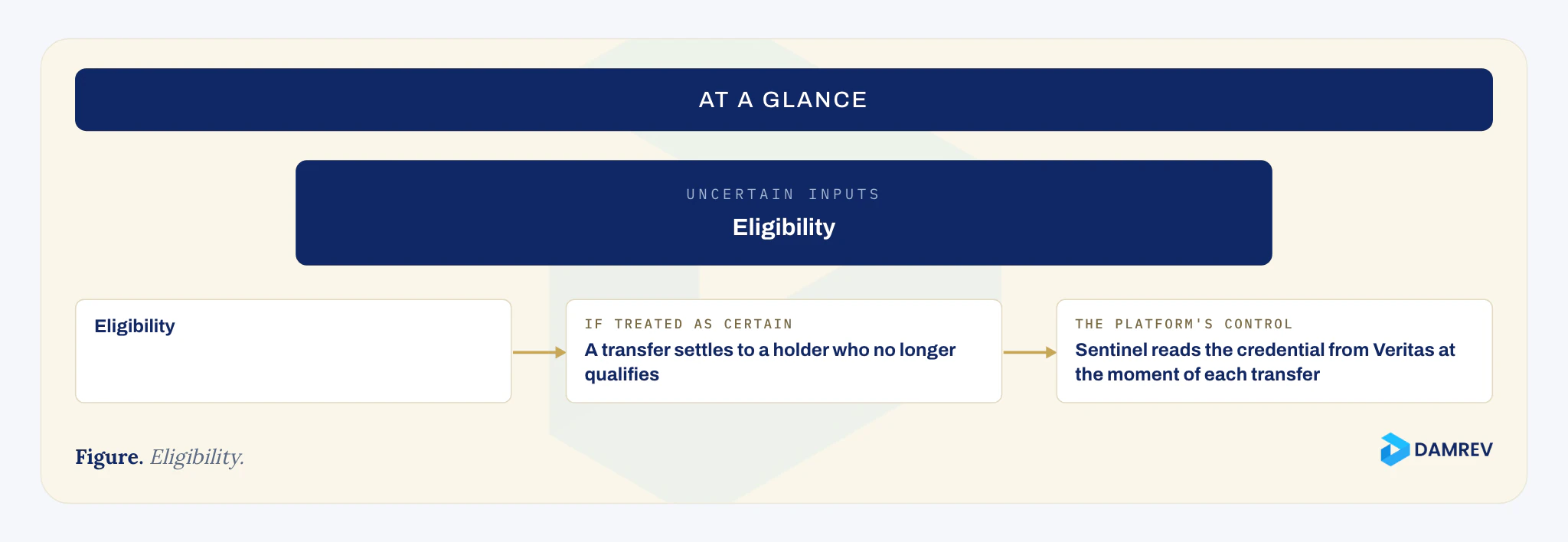
Forge checks identity from Veritas before any mint.
Sentinel supplies the rule set that governs the asset.
Forge reads Beacon's circuit-breaker signal. A failed condition halts the mint.
Forge issues under the issuer's authority only when all three have cleared.
Approval paths
The people the approval path names. Four eyes and six eyes determine who may assess, approve or review each class of decision, so no one person both does a thing and approves it.
The record
By attaching it to the programme record. Every decision, input, encoded rule and approval stays with the programme, so the operating instrument can always be traced back to the terms that authorised it.
The record answers the question a regulator asks after the event: was this a reasonable action on the information available? Under the January 2026 statement of the Securities and Exchange Commission (SEC), putting a security in token form does not change how the federal securities laws apply to it5.
Worked example
An illustrative programme, not a client: tokens represent claims on a commodity held in a warehouse, with reserves reported by an external source.
01
02
03
04
05
06
Common questions
Short answers on structured probabilities: whether it is a pricing or forecasting model, which engine brings in external data, whether a failed data condition can stop issuance, who verifies a fair-market-value view, whether agentic AI decides on its own, what the DAMREV Standard contributes, and whether any of it is marked as deployed.
It is a way of handling inputs, not a model of prices. The platform makes no price, return or yield statement. Equilibrium expresses fair market value as a framework, and Beacon supplies data without any valuation claim.
Beacon, through an oracle network. The engines that need external price or reserve data read it from Beacon: Anchor, Reserve, Registry, Equilibrium and Forge.
Yes. Beacon supports a mint circuit-breaker that can halt minting when a reserve or data condition is not met, and Forge reads the signal before any issuance.
People do, alongside oracle data. Equilibrium combines Beacon's data with human verification, and it depends on Veritas, so the verification is tied to a verified person.
Agents act inside defined roles. Praxis runs agents that use the engines as tools, routed through Sentinel and Veritas, signed via Sentry, and composed through the roles held in Stratum. Four eyes and six eyes apply to agents as they do to people.
It sets how an asset is researched, how human judgement is applied before encoding begins, and how assessment is separated from approval. Each version is dated, and superseded versions stay readable.
Capability status is recorded separately, engine by engine, and those records are being prepared. This page describes how the platform is designed to treat uncertain inputs and marks no capability as live.
Where next
The pages below pick up where this one ends. Start with the one closest to where your asset or programme stands today.
Last updated:
Insights

Since 17 September 2026 a tokenized securities venue may run automated liquidity pools in tokenized listed stock without registering as an exchange, on conditions.

The GENIUS Act binds payment stablecoin issuers from 18 January 2027, not the firms that hold or settle in stablecoins. Service providers follow in 2028.

The CLARITY Act stalled on a 49 to 50 vote, so tokenized securities stay with the Securities and Exchange Commission, as before.

Guernsey's guidance of 24 July 2026 lets a fund or issuer record and transfer its investments as tokens, under the regimes already applying to it.
Tell us what you want to tokenize.
We will show you how DAMREV can run it.