Article · Law, Regulation & Policy
The SEC's Innovation Exemption of 17 September 2026: What Tokenized Securities Venues & Tokenized NMS Stock May Now Do
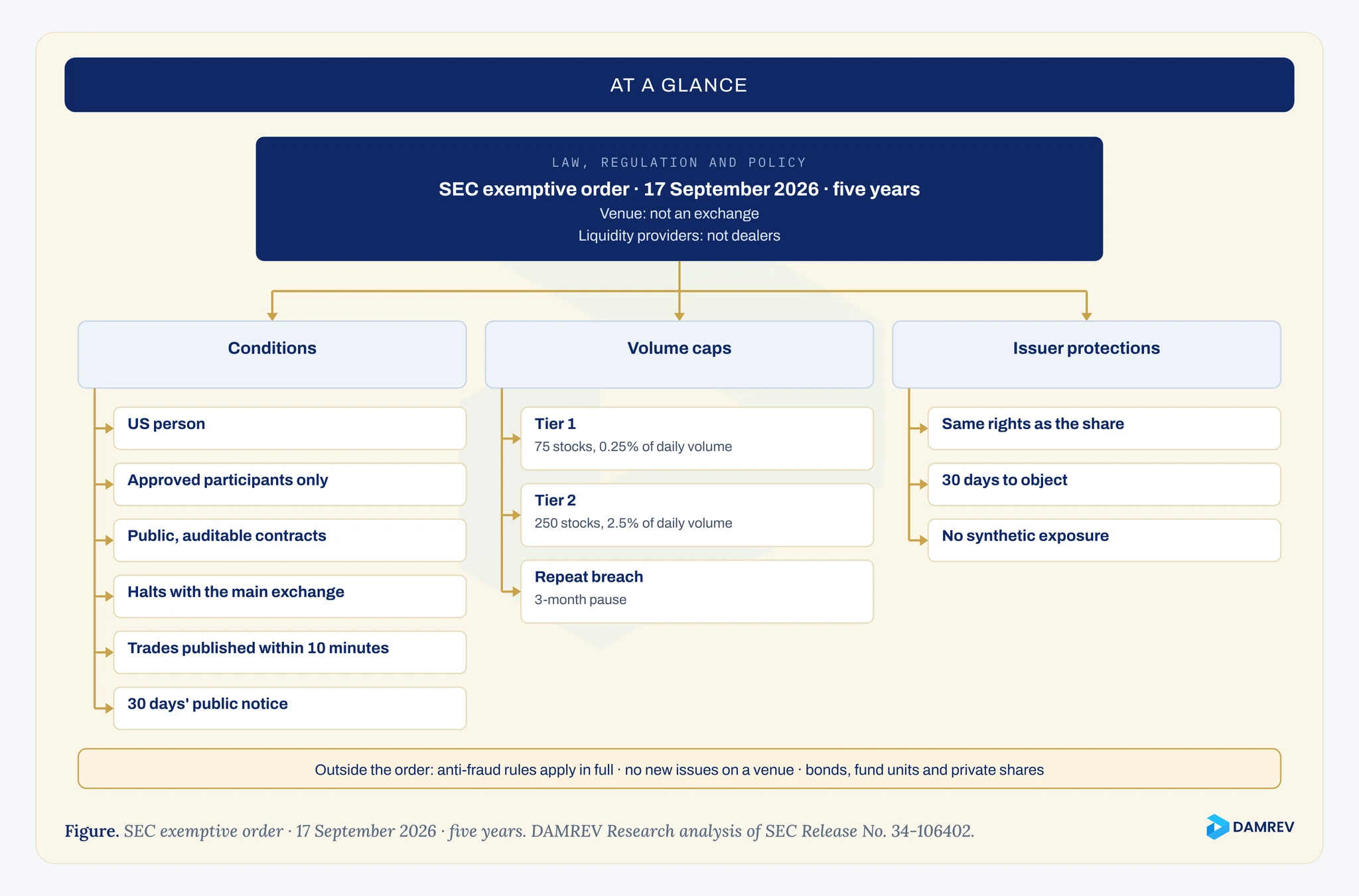
From 17 September 2026, for five years, a tokenized securities venue may run automated liquidity pools in tokenized National Market System (NMS) stock without registering as an exchange, and certain liquidity providers in those pools need not register as dealers1.
The relief is a temporary exemption with conditions: listed stock only, approved participants, volume caps, an issuer's right to object to third-party tokens, and the anti-fraud rules in full force1, 2.


In this article
01 · The order
What did the SEC grant on 17 September 2026?
On 17 September 2026 the Securities and Exchange Commission (SEC) granted two temporary exemptions, each for five years. A tokenized securities venue is exempted from the definition of an exchange, and certain liquidity providers in its pools from the definition of a dealer1.
The Commission acted by exemptive order under Section 36 of the Securities Exchange Act of 1934, not by rule1, 3. The first exemption runs to the venue itself, and the order grants it in a single sentence.
[The Commission] hereby issues, subject to the conditions set forth herein, a temporary exemption from the definition of 'exchange' to a TSV.1
The second exemption reaches "any liquidity provider in an AMM Liquidity Pool that supplies liquidity in the form of Tokenized NMS Stock", which need not register as a dealer1. Both expire five years after publication, on 17 September 20311.
The order defines the venue by what it does. A tokenized securities venue brings together buyers and sellers of tokenized NMS stock by providing automated market maker liquidity pools for permissioned participants, and by setting the standards for who may trade1.
The Chairman's statement of the same day calls the order an interim measure, and the label matters3. An exemptive order can be modified or withdrawn by a later Commission without the process a rule requires, and the five-year term is a ceiling rather than a promise1, 3.
The order also rests on the staff statement of 28 January 2026, which set the principle that the format in which a security is issued does not affect how the federal securities laws apply4. That statement granted no relief. This order is the first instrument that does.
02 · The conditions
What must a venue do to rely on the exemption?
A venue relying on the exemption must be a US person, admit only permissioned participants, run public and auditable contracts on a public ledger, pair each stock with an approved asset, halt with the primary market, publish its trades, and give 30 days' public notice first1.
The contracts must be open to inspection and the ledger must be public and permissionless, yet the people trading are known and approved by the venue1. A venue cannot build a private chain and claim the exemption.
| Condition | What the order requires | Source |
|---|---|---|
| Operator | "a TSV must be a U.S. person", and it must comply with US sanctions programmes | Order1 |
| Access | Trading only by permissioned participants, under standards the venue sets | Order1 |
| Contracts | Smart contracts "must be auditable, public, and deployed on a public, permissionless distributed ledger" | Order1 |
| Trading pairs | Each tokenized stock paired with another tokenized NMS stock, a non-security crypto asset such as a permitted payment stablecoin, or a tokenized money market fund | Order1 |
| Halts | Trading stops "concurrently with any stoppage of trading in the underlying NMS stock" on the primary listing exchange | Order1 |
| Reporting | Transaction data in US dollars, free and machine-readable, updated within ten minutes of each trade | Order1 |
| Notice | A public notice at least 30 calendar days before operating, with written notice to the Division of Trading and Markets | Order1 |
Two consequences follow from the definition rather than from any single condition. Because the venue is defined by automated market maker pools, a conventional order book does not fit within it, as the law firm commentary also reads it5, 6.
And because the order names its pairs, a tokenized stock cannot trade on the venue against an arbitrary token. The settlement asset must be a non-security crypto asset, another tokenized NMS stock, or a tokenized money market fund1.
03 · The caps
How much may trade under the exemption?
The exemption allows very little trading. The order sets two tiers, each capped by the number of stocks a venue may trade and by a share of the underlying stock's average daily volume in the prior month1.
The caps make the order a controlled test rather than a market. A venue may trade no more than 75 Tier 1 symbols, each held to 0.25 percent of the prior month's average daily share volume, and no more than 250 Tier 2 symbols at 2.5 percent1.
The order ties Tier 1 to the first tier of the market-wide limit up-limit down plan: "all NMS stocks included in the S&P 500 Index, the Russell 1000 Index, and certain exchange-traded products", the last limited to products trading over 2 million US dollars in notional consolidated average daily volume1.
The tighter cap applies to the stocks where a tokenized market could most affect the main one.
- Tier 1: the most a venue may trade, in symbols and in share of prior-month average daily volume1
- 75 · 0.25%
- Tier 2: the same limits for all other eligible NMS stock1
- 250 · 2.5%
- The pause in trading a stock after any breach of its volume cap that follows the first1
- 3 months
The volume breach rule is lenient once and strict after that; the symbol limits have no such allowance and are simply conditions of the exemption.
The first time a venue exceeds a volume threshold it need only ensure it does not do so again; each later breach means the venue "must immediately pause trading in such Tokenized NMS Stock for three months"1.
04 · Issuers and rights
What protects the company whose shares are tokenized?
Three conditions protect the company whose shares are tokenized. The token must carry the same rights as the share, synthetic exposure is excluded, and a third-party token cannot trade until the issuer has had 30 calendar days' notice and the chance to object1.
The same rights as the share
A venue "must verify" that the token gives holders "the same rights and privileges as does traditional NMS stock of an equivalent class", including the same interest in the company and the same dividends1.
30 days to object
Third-party tokens may not trade until at least 30 calendar days after the issuer receives notice. A written objection within that time means the venue cannot make the token available1.
No synthetics
A third party's own security that only tracks a share, such as a linked security or a security-based swap, is not tokenized NMS stock1.
These conditions follow the map the staff drew in January. That statement separated tokens issued by the company itself, tokens issued by a third party that represent the underlying share, and third-party tokens that only give synthetic exposure4. The order admits the first two and shuts out the third1.
The objection right is the issuer's most practical protection. A company that has not chosen to put its shares on a ledger can stop a third party's token from trading on a venue, provided it answers the notice in time1. The order does not say how notice must reach the issuer beyond requiring it in writing.

05 · What it does not establish
What does the order not establish?
The order leaves almost everything outside the venue untouched. Anti-fraud rules, Securities Act registration of offers, the Investment Company Act, and every security other than NMS stock stand as they were1.
| Question | What the order says | Source |
|---|---|---|
| Anti-fraud and anti-manipulation rules | Apply in full: the order "does not provide an exemption from any other applicable laws" | Order1 |
| Offers and sales of the tokens | Still subject to Securities Act registration requirements | Order1 |
| New issues on a venue | "No primary issuance or initial offerings of securities are permitted on a TSV" | Order1 |
| Funds | No exemption under the Investment Company Act of 1940 | Order1 |
| Bonds, private shares, fund units | Outside the order, which defines its scope by NMS stock. This is a reading of the definition, not a stated exclusion | Order1 |
| Rights and warrants | Not eligible: tokenized NMS stock on a venue "does not include rights and warrants" | Order1 |
| Comment period | Comment invited on changes and next steps under File No. 4-927; no deadline stated | Order1, 7 |
It does not say that tokenized trading of listed shares is safe or liquid. It does not reach the instruments most structured finance programmes issue, which are fund units, notes, receivables, and private shares. It does not create a primary market, since no issue or initial offering may take place on a venue1.
Nor does it list venues. Each venue must post its own public notice 30 days before operating, and the order creates no Commission register of those notices1. And it is an order, not a rule: the Chairman's own statement calls it an interim measure, and no rule replacing it has been proposed3.
For an issuer weighing a tokenized listing, the registration, offering, and listing work is the same as it was on 16 September 2026.
Common questions
What else do people ask?
Short answers on the exemption: whether a tokenized stock is still a security, when the exemption ends, whether a company can stop a third party tokenizing its shares for a venue, whether the order covers tokenized bonds or fund units, and whether there is a deadline for comments.
Is a tokenized stock still a security?
Yes. The SEC staff statement of 28 January 2026 holds that the format in which a security is issued, or the way its holders are recorded, does not affect how the federal securities laws apply4.
When does the exemption end?
On 17 September 2031, five years after it was issued, unless the Commission modifies or replaces it sooner1.
Can a company stop a third party tokenizing its shares for trading on a venue?
Yes, under this order. The venue must give the issuer written notice, trading cannot begin until 30 calendar days after the issuer receives it, and a written objection within that period stops the token from being made available for trading1.
Does the order cover tokenized bonds or fund units?
No. Its scope is NMS stock, and it gives no exemption under the Investment Company Act of 19401.
Where should you go next?
The pages below pick up where this one ends. Start with the one closest to where your asset or programme stands today.
- What the SEC's January 2026 Statement Means for Tokenized SecuritiesOn 28 January 2026 three divisions of the US Securities and Exchange Commission said a tokenized security is still a security, whatever its format.
- SEC & CFTC Authority After the CLARITY Act Failed to AdvanceThe CLARITY Act stalled on a 49 to 50 vote, so tokenized securities stay with the Securities and Exchange Commission, as before.
- Tokenized or ConventionalWhere tokenized and conventional listings actually differ, and the three questions that decide which route suits your company.
- JurisdictionsThe rules for tokenized finance in the twelve jurisdictions where the group works, mapped to where each group entity sits, claiming no permission.
References
- 1.US Securities and Exchange Commission, Order Granting Exemptions for Tokenized Securities Venues, Exchange Act Release No. 34-106402, 17 September 2026. https://www.sec.gov/files/rules/exorders/2026/34-106402.pdf
- 2.US Securities and Exchange Commission, press release 2026-90, "SEC issues innovation exemption to facilitate trading of tokenized NMS stock; requests comment", 17 September 2026. https://www.sec.gov/newsroom/press-releases/2026-90-sec-issues-innovation-exemption-facilitate-trading-tokenized-nms-stock-request-comment
- 3.Chairman Paul S. Atkins, "Statement on the Innovation Exemption: A Bridge Toward Durable Rulemaking", 17 September 2026. https://www.sec.gov/newsroom/speeches-statements/atkins-innovation-exemption-bridge-toward-durable-rulemaking-091726
- 4.SEC Divisions of Corporation Finance, Investment Management, and Trading and Markets, "Statement on Tokenized Securities", 28 January 2026. https://www.sec.gov/newsroom/speeches-statements/corp-fin-statement-tokenized-securities-012826
- 5.Sullivan & Cromwell, "SEC issues innovation exemption for tokenized securities", 18 September 2026. https://www.sullcrom.com/insights/memo/2026/September/SEC-Issues-Innovation-Exemption-for-Tokenized-Securities
- 6.Jones Day, "The SEC's new innovation exemption: five-year relief for trading on tokenized securities venues", September 2026. https://www.jonesday.com/de/insights/2026/09/the-secs-new-innovation-exemption-fiveyear-relief-for-trading-on-tokenized-securities-venues
- 7.Federal Register, Vol. 91, p. 60168, Release No. 34-106402, File No. 4-927, published 22 September 2026. https://www.federalregister.gov/documents/2026/09/22/2026-19388/order-granting-temporary-conditional-exemptive-relief-pursuant-to-section-36a1-of-the-securities
This article is analysis of public sources, not legal advice. Last updated: