


Article · Law, Regulation & Policy
What the SEC's January 2026 Statement Means for Tokenized Securities
The statement confirms that a tokenized security is still a security. On 28 January 2026 three divisions of the US Securities and Exchange Commission (SEC) said the issuing format does not change how the federal securities laws apply, and separated issuer-sponsored tokens from third-party ones1. For issuers, the structure now carries the weight.

01 · The statement
What did the SEC say on 28 January 2026?
It said that tokenization changes the format of a security, not its legal character. The Divisions of Corporation Finance, Investment Management, and Trading and Markets issued a joint Statement on Tokenized Securities, and it sets out that the federal securities laws apply to a security whatever format it is issued in1.
The statement's value is clarity. For several years the market argued over whether a share or a fund interest placed on a blockchain became a new kind of asset. The answer given is that it does not: an instrument is judged by what it is, and the ledger it is recorded on is a matter of operations.
The statement also sorts tokenized securities into families by who sponsors them, which is the more useful half for anyone designing a programme. It gives issuers, custodians and platforms a shared vocabulary for the question every investor asks first: what exactly do I own?
02 · Two families
What separates issuer-sponsored from third-party tokenized securities?
Who puts the security on-chain, and what the holder ends up owning. In the issuer-sponsored model the issuer itself issues the security in tokenized form. In the third-party models someone other than the issuer creates a token linked to a security, in either a custodial or a synthetic model1.
| Model | Who creates the token | What the holder has | The question it raises |
|---|---|---|---|
| Issuer-sponsored | The issuer of the security | The security itself, in tokenized form | The same disclosure, eligibility and record-keeping questions as any issue of that security |
| Third-party, custodial | A party other than the issuer, which holds the underlying security | An interest linked to a security held in custody by that party | The holder's rights against the custodian, and the custodian's against the issuer |
| Third-party, synthetic | A party other than the issuer, which does not hold the security for the holder | Exposure that references the security | What the token itself is, and whose credit the holder relies on |
The difference matters because a holder in the third-party models carries a layer the issuer-sponsored holder does not: the third party itself. If the custodian fails, or the synthetic arrangement is unwound, the holder's position depends on contracts with that party rather than on the issuer's own register.
For an institution weighing a tokenized instrument, the first question is therefore not which chain it runs on but which of these families it belongs to.
03 · Format neutrality
Does a token change an issuer's obligations?
No. Everything that applied before still applies: how the offering is made, who may buy, what must be disclosed, and how the record of holders is kept. The token changes how those obligations are carried out, and that is where the opportunity lies1.
Disclosure
What investors must be told does not shrink because the instrument is a token.
Eligibility
Who may hold the instrument is set by the offering, and the token has to respect it.
The record of holders
Someone keeps the official record, and the models turn on who that is.
Transfer restrictions
Restrictions that applied on paper apply on-chain, where code can enforce them.
This is the ground DAMREV builds on. Every programme runs the same fixed sequence: the asset and the claim, the structure, the instrument, issuance and the register, then servicing for life. The legal analysis of the structure comes first and is settled with counsel.
Only then are the rights, eligibility and transfer rules encoded, so that the instrument enforces what the documents say. A format-neutral regime rewards that order, because the documents and the code describe the same transaction.
04 · The payment leg
Where do stablecoins fit beside tokenized securities?
In their own regime. The GENIUS Act, signed on 18 July 2025, governs payment stablecoins: it requires issuers to hold reserves on at least a one-to-one basis and limits issuance to three types of permitted issuer2. A tokenized security settled in a stablecoin therefore touches two bodies of law.
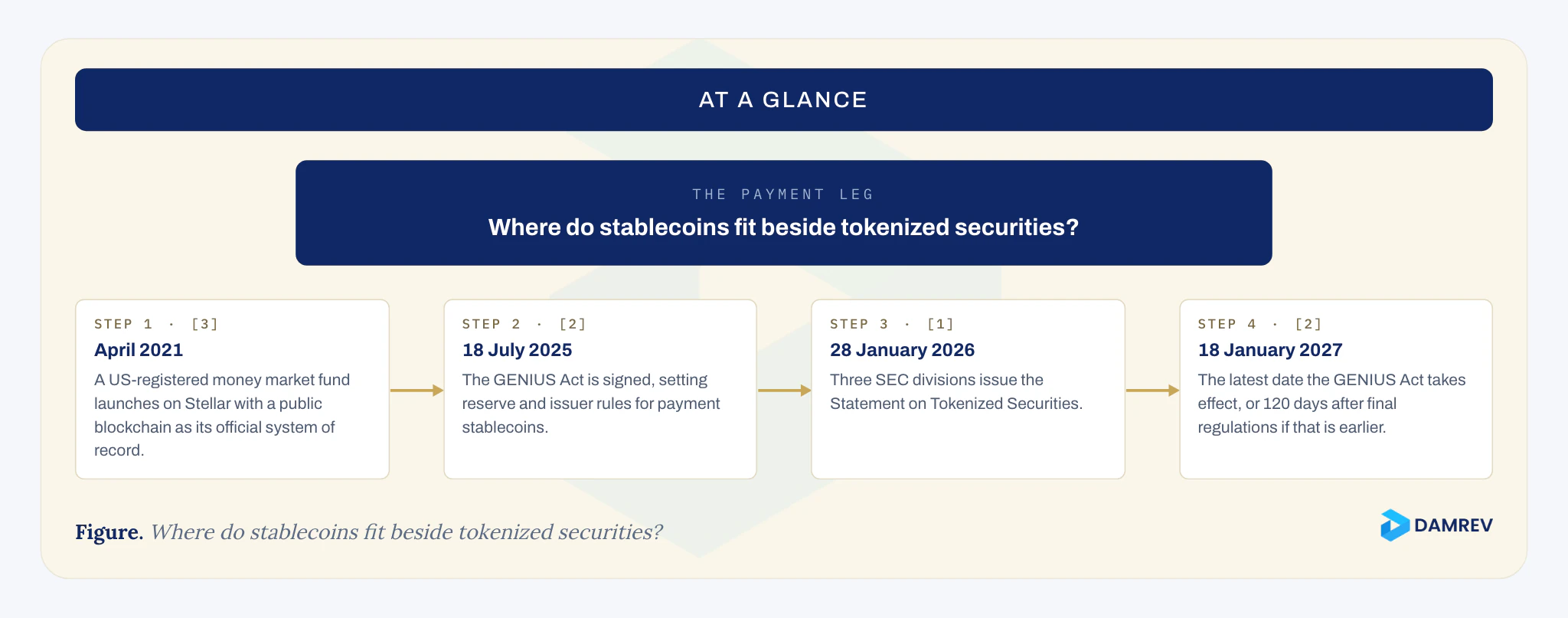
- Where do stablecoins fit beside tokenized securities?
- April 2021: A US-registered money market fund launches on Stellar with a public blockchain as its official system of record. (Step 1, [3])
- 18 July 2025: The GENIUS Act is signed, setting reserve and issuer rules for payment stablecoins. (Step 2, [2])
- 28 January 2026: Three SEC divisions issue the Statement on Tokenized Securities. (Step 3, [1])
- 18 January 2027: The latest date the GENIUS Act takes effect, or 120 days after final regulations if that is earlier. (Step 4, [2])
The two regimes answer different questions. The statement says how securities law treats the instrument; the GENIUS Act says who may issue the money used to pay for it and what must back that money. On DAMREV, settlement runs in the asset each jurisdiction permits, such as USDC, EURC, a licensed local stablecoin, tokenized deposits, or fiat through a bank.
The group issues none of them and has no stablecoin of its own, so the Act's reserve and issuer obligations fall on the stablecoin's issuer rather than on the programme. Programme design still has to name the settlement asset and record which party issues it.
05 · Programme design
What should an issuer settle before tokenizing a security?
Four points, each decided with counsel before any code: who the issuer is, what the holder owns, who keeps the official record, and which regulated parties hold which roles. A programme that answers them can say at once which of the statement's models it follows1.
Settle these first
- Name the issuer, and confirm that it issues the security in tokenized form itself.
- Define what the holder owns: the security, or an interest linked to it.
- Decide who keeps the official record of holders, and where that record lives.
- Assign each regulated function, such as custodian or transfer agent, to an appointed party.
- Name the settlement asset and the party that issues it.
Within DAMREV's architecture those answers map to specific engines. Forge issues only after Veritas and Sentinel clear eligibility, under the issuer authority of the relevant entity. Registry maintains the register of holders and performs the transfer-agent function as a function, without asserting a transfer-agent registration.
Sentinel applies the transfer rules at the moment of each transfer. Where the group supplies the issuer or general partner, that is DAMREV Capital Partners, incorporated in Mauritius and separate from DAMREV Labs, LLC. Permissions are held entity by entity.
Public chains already carry official records. A US-registered money market fund has used one as its system of record for transactions and share ownership since April 20213.
Common questions
What else do people ask?
Short answers to the questions people ask most about this topic.
Is a tokenized share still a share?
Yes. The SEC divisions stated that the format in which a security is issued does not affect the application of the federal securities laws1. A share issued as a token is analysed as a share.
Who issued the statement?
Three divisions of the SEC: Corporation Finance, Investment Management, and Trading and Markets, on 28 January 20261.
What is an issuer-sponsored tokenized security?
One that the issuer itself issues in tokenized form, so the holder owns the security directly. The statement sets it apart from the third-party-sponsored models1.
What are the third-party models?
Custodial and synthetic1. In general terms, a custodial model links a token to a security a third party holds, and a synthetic model gives exposure to a security without the holder owning it.
Does the GENIUS Act apply to tokenized securities?
The Act governs payment stablecoins, with reserves of at least one-to-one and three types of permitted issuer2. It matters to a securities programme where a stablecoin settles the trade.
Who decides which model a programme follows?
The issuer and its counsel. DAMREV structures the programme with them and encodes the result; it does not give legal advice.
Where should you go next?
The pages below pick up where this one ends. Start with the one closest to where your asset or programme stands today.
- The SEC's Innovation Exemption of 17 September 2026: What Tokenized Securities Venues & Tokenized NMS Stock May Now DoSince 17 September 2026 a tokenized securities venue may run automated liquidity pools in tokenized listed stock without registering as an exchange, on conditions.
- When the GENIUS Act Takes Effect: 18 January 2027 & 18 July 2028The GENIUS Act binds payment stablecoin issuers from 18 January 2027, not the firms that hold or settle in stablecoins. Service providers follow in 2028.
- Tokenized IPOWhat a tokenized initial public offering is, what stays the same as a conventional listing, and how DAMREV prepares and operates the instrument.
- Token Classes We IssueHow security, utility, payment, and asset-backed tokens differ, why the issuer and its counsel decide a token's class, and what DAMREV encodes.
References
- 1.US Securities and Exchange Commission, Statement on Tokenized Securities, 28 January 2026. https://www.sec.gov/newsroom/speeches-statements/corp-fin-statement-tokenized-securities-012826-statement-tokenized-securities
- 2.Greenberg Traurig, "GENIUS Act enacted, establishing a regulatory framework for payment stablecoins". https://www.gtlaw.com/en/insights/2025/7/genius-act-enacted-establishing-a-regulatory-framework-for-payment-stablecoins-issued-or-sold-in-the-united-states
- 3.Stellar Development Foundation, Franklin Templeton case study. https://stellar.org/case-studies/franklin-templeton
This article is analysis of public sources, not legal advice. Last updated:




