


Skip to content
DAMREV
Start a Structuring Review

How it works across the platform

The Securities Register

On DAMREV the register of holders is kept by Registry, the asset-servicing engine. Registry maintains the authoritative register for each issued asset, performs the transfer-agent function as software, and handles corporate actions for the life of the instrument. Portal reports to verified, eligible holders from that same register, so holders see what the register records.

The flow

Where does the register sit among the engines?

Between issuance and everything that follows it. The register is the fact every other part of an instrument depends on: who holds what.

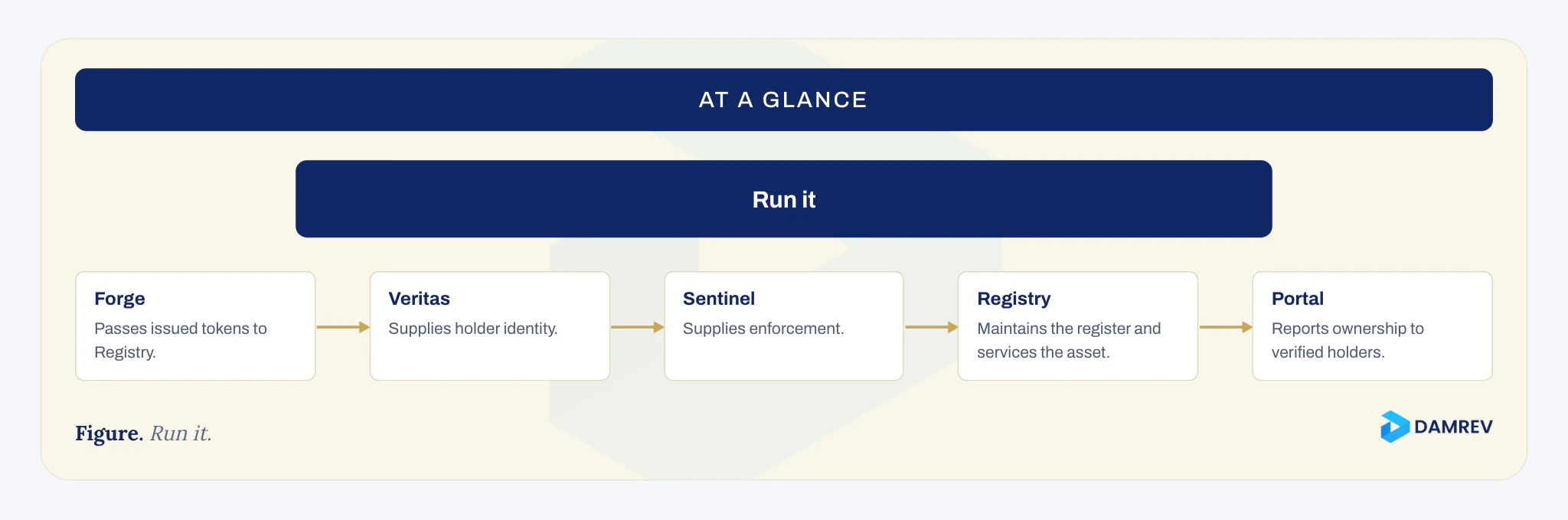
Run it. Forge, then Veritas, then Sentinel, then Registry, then Portal. Run it to follow an issue from the mint to the holder's report.
  • Run it
  • Forge: Passes issued tokens to Registry.
  • Veritas: Supplies holder identity.
  • Sentinel: Supplies enforcement.
  • Registry: Maintains the register and services the asset.
  • Portal: Reports ownership to verified holders.
Run it. Forge, then Veritas, then Sentinel, then Registry, then Portal. Run it to follow an issue from the mint to the holder's report.

Run it to follow an issue from the mint to the holder's report.

One record

Which engines read ownership from the register?

Registry sits downstream of issuance and identity and upstream of the marketplace, the portal, the treasury and collateral, so each of those reads ownership from one place.

Step by step

How does the register follow an instrument?

From the first issue to what each holder sees.

  1. Step one

    Where does the register begin?

    At issuance. Registry depends on Forge, Veritas and Sentinel: Forge passes issued tokens to Registry for servicing, Veritas supplies holder identity, and Sentinel supplies enforcement. The register opens with the first issue and follows the instrument from then on.


    Read about Forge

  2. Step two

    What does Registry keep?

    The authoritative register of holders for each issued asset, and the servicing record around it. Registry handles corporate actions and servicing over the life of the asset. The register and its servicing actions settle on Stellar, and releases made by Cadence are recorded through Registry.

    Read about Registry

  3. Step three

    Does Registry replace a transfer agent?

    It performs the transfer-agent function as software. Registry does not assert a transfer-agent registration and does not classify the assets it services. Where a programme appoints a transfer agent, that party keeps the role assigned to it, and the platform works alongside it.

    See the service

  4. Step four

    What do holders see?

    What the register says, through Portal. Portal confirms identity and eligibility from Veritas before showing material, stages disclosure, and reports ownership and servicing data drawn from Registry, with operating context from Stratum. It uses no return or performance language.

    Read about Portal

  5. Step five

    Which engines rely on the register?

    Four engines state it. Registry's consumers are Agora, Portal, Reserve and Anchor. Agora draws on Registry for servicing when it matches eligible sales, and Portal reads ownership from it, so a listing and a holder's report start from the same record.

    Read about Agora

A listing and a holder's report start from the same record, because every engine reads ownership from Registry.

The precedent

Can a public ledger serve as the official register?

It already has, for a regulated fund. A money market fund registered in the United States has used Stellar as its official system of record since 2021. Keeping the register on-chain changes how it is kept, not the law that applies to it.

Configuration

What does the client configure, and what is fixed?

The client decides who else holds a role in the register and what holders are shown. The register itself, and whom it reports to, are fixed.

The client configures

  • Whether the programme appoints its own transfer agent
  • The corporate actions and servicing events the instrument carries
  • What holders see in Portal, and in which stages disclosure is released

Fixed by the platform

  • One authoritative register per issued asset
  • Holder identity drawn from Veritas, and enforcement from Sentinel
  • Reporting only to verified, eligible holders
  • No return or performance language in holder reporting

Common questions

What else do people ask?

Short answers on the register: whether it is kept on-chain, whether Registry is a registered transfer agent, whether a holder can see their own position, and who handles corporate actions.

Is the register kept on-chain?

Yes. Registry's register and servicing actions settle on Stellar, where Soroban contracts run natively on the same ledger3.

Is Registry a registered transfer agent?

Registry performs the transfer-agent function as software and does not assert a transfer-agent registration. Where a transfer agent is appointed, it keeps its role.

Can a holder see their own position?

Yes, through Portal, once Veritas confirms their identity and eligibility. Portal reports ownership and servicing data drawn from Registry.

Who handles corporate actions?

Registry handles corporate actions and servicing over the life of the asset, following the terms encoded for the instrument.

Where next

The pages below pick up where this one ends. Start with the one closest to where your asset or programme stands today.

References

  1. 1.Stellar Development Foundation, Franklin Templeton case study. https://stellar.org/case-studies/franklin-templeton
  2. 2.US Securities and Exchange Commission, Statement on Tokenized Securities, 28 January 2026. https://www.sec.gov/newsroom/speeches-statements/corp-fin-statement-tokenized-securities-012826-statement-tokenized-securities
  3. 3.Stellar Development Foundation, "Protocol 20 and smart contracts are live on Mainnet". https://stellar.org/blog/developers/protocol-20-and-smart-contracts-are-live-on-mainnet

Last updated:

Ready to build on programmable infrastructure?

Tell us what you want to tokenize. We will show you how DAMREV can run it.


