


Skip to content
DAMREV
Start a Structuring Review

How it works across the platform

Identity & Eligibility

On DAMREV a holder is verified once and checked at every transfer. A licensed provider performs the identity check, Veritas issues a reusable credential the holder controls, and Sentinel reads that credential each time an instrument changes hands. Eligibility is therefore enforced continuously and on-chain, under the rules the issuer sets for each jurisdiction.

The flow

How does a verified identity become an eligibility check?

Know your customer (KYC) checks are usually repeated by every party a holder deals with, and still checked only once, at onboarding. The platform reverses both: one verification, reused by every engine that needs it, and a check at every transfer rather than only at the door.

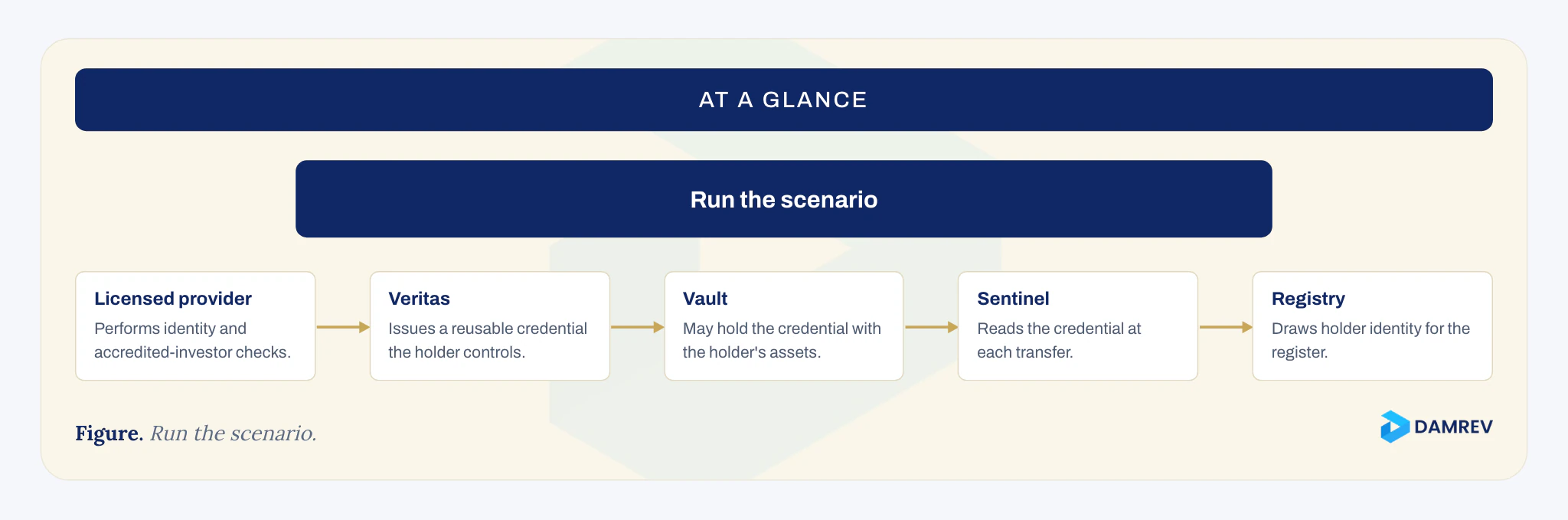
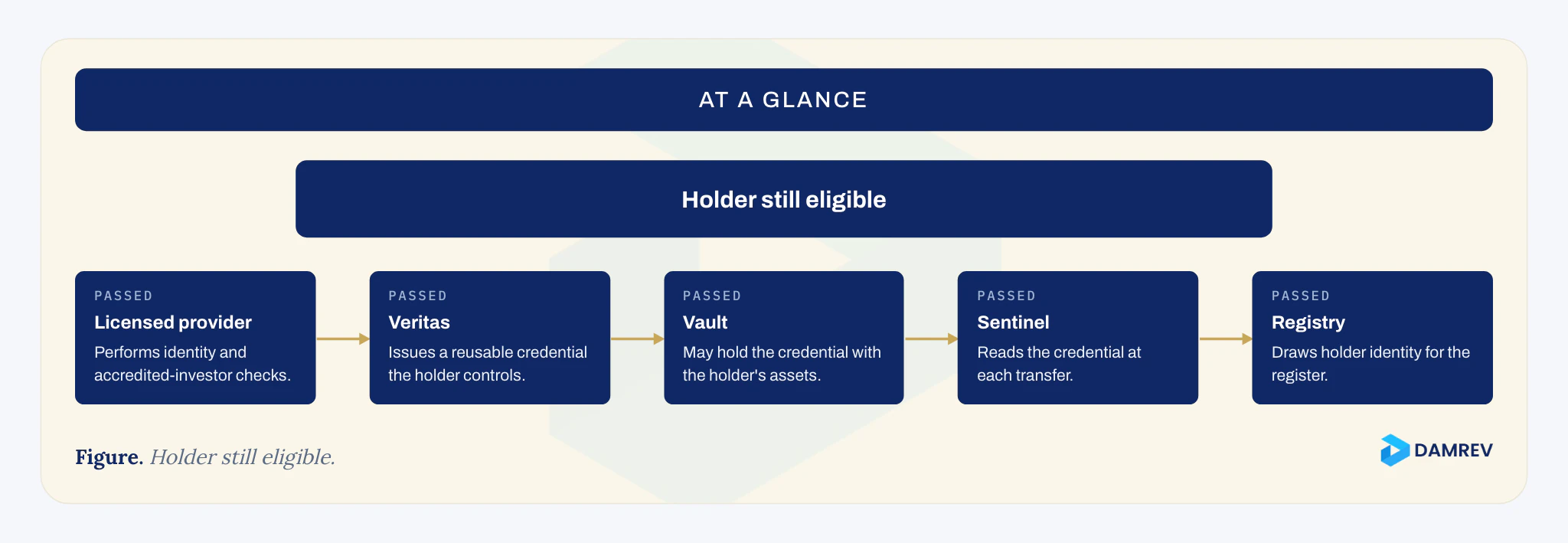
Run the scenario. Licensed provider, then Veritas, then Vault, then Sentinel, then Registry. Choose a holder and run the scenario.
  • Run the scenario
  • Licensed provider: Performs identity and accredited-investor checks.
  • Veritas: Issues a reusable credential the holder controls.
  • Vault: May hold the credential with the holder's assets.
  • Sentinel: Reads the credential at each transfer.
  • Registry: Draws holder identity for the register.
Run the scenario. Licensed provider, then Veritas, then Vault, then Sentinel, then Registry. Choose a holder and run the scenario.

Choose a holder and run the scenario.

Step by step

What happens at each step?

One verification, reused by every engine that needs it, and a decision at every transfer.

  1. Step one

    Who performs the identity check?

    The identity verification provider, integrated through Veritas. The provider performs identity and accredited-investor checks and collects identity documents and, where required, biometric data. DAMREV receives the verification result and the data needed to meet its obligations, not the underlying biometric templates.


    Read about screening and onboarding

  2. Step two

    What does the holder receive?

    A reusable verifiable credential that the holder stores and controls. Veritas issues it, aligned with the World Wide Web Consortium (W3C) Verifiable Credentials data model, and uses Stellar to anchor issuers for credential issuance. The holder can present the credential again without repeating the check.

    Read about Veritas

  3. Step three

    How do other engines use the credential?

    They read it from Veritas at the point they need it, rather than re-running the check. Veritas states nine consumers: Stratum, Sentinel, Sentry, Portal, Registry, Agora, Conduit, Lyceum and Vault. Portal, for example, confirms identity and eligibility from Veritas before it shows a holder any material.

    Read about Portal

  4. Step four

    How is eligibility enforced at transfer?

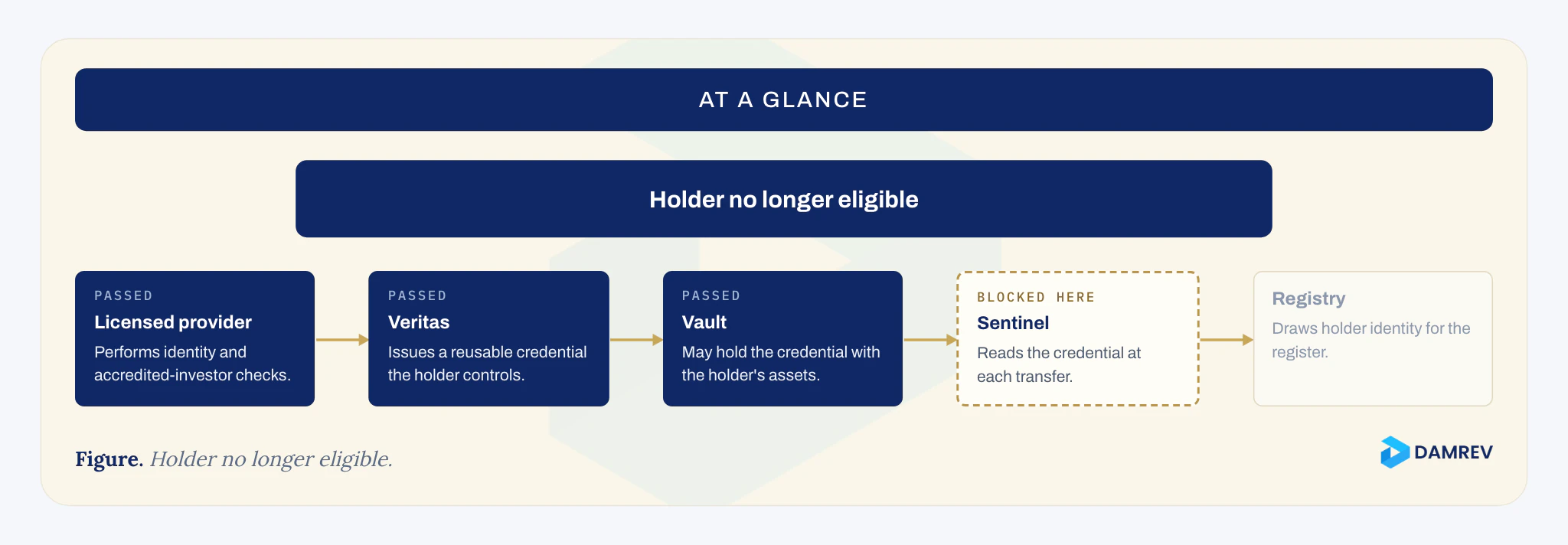
    By Sentinel, on-chain, every time. At the point of a transfer Sentinel reads the relevant credentials from Veritas and applies the rule set that governs the asset. The transfer proceeds only when the rules are satisfied; otherwise it is blocked and does not settle.

    Read about Sentinel

  5. Step five

    Who sets the eligibility rules?

    The issuer, jurisdiction by jurisdiction. The rules configure per jurisdiction, so one instrument can carry different eligibility conditions for holders in different places. Counsel settles what the rules must say, and Sentinel applies them.

    Jurisdictions attach their own conditions to transfers, not only to onboarding. In South Africa, the Financial Intelligence Centre's Directive 9 of 2024, which applies the travel rule to crypto asset transfers, took effect on 30 April 20251.

    Read about jurisdictions

Eligibility is checked at the transfer itself, not only at onboarding, because jurisdictions attach their own conditions to transfers.

The standard

Which standard does the credential follow?

The World Wide Web Consortium's Verifiable Credentials model. Veritas follows it, and the related models for credential exchange and digital identity, so a credential is portable and machine-verifiable. Following a model is alignment. It is never a claim of certification.

  • W3C RecommendationVerifiable Credentials 2.0Published on 15 May 2025: credentials that are cryptographically secure, privacy respecting and machine-verifiable2.
  • Credential exchangeOpenID for Verifiable CredentialsVeritas is aligned with this model, never certified against it.
  • Digital identityISO/IEC 18013-5Veritas is aligned with this model, never certified against it.
  • Digital identityeIDAS 2.0Veritas is aligned with this model, never certified against it.

Configuration

What does the client configure, and what is fixed?

The issuer decides who may hold the instrument and where. How identity is established and when it is checked are fixed, so every programme carries the same assurance.

The client configures

  • The eligibility rules for each asset, set by the issuer
  • How those rules differ by jurisdiction
  • Which engines of the platform the programme uses

Fixed by the platform

  • Identity checks performed by a licensed provider, not by DAMREV
  • Credentials controlled by the holder
  • Eligibility checked at every transfer, not only at onboarding
  • A transfer that fails the rules does not settle

Common questions

What else do people ask?

Short answers to the questions people ask most about this topic.

Does DAMREV perform KYC checks itself?

A licensed verification provider performs them. Veritas integrates the provider and issues the result as a credential, and DAMREV Labs, LLC provides the software.

Does a holder need to be checked again for each transfer?

The credential is checked at each transfer, not re-created. The holder is verified once, and Sentinel reads the credential from Veritas every time the instrument changes hands.

Is Veritas certified against W3C Verifiable Credentials?

Veritas is aligned with the W3C model, and with the related identity models it names. Alignment means following the published model, never certification.

What happens when a holder stops being eligible?

The next transfer is checked against the rules as they stand. Sentinel decides at the moment of each transfer, so a holder who no longer meets the rules cannot receive the instrument.

Where next

The pages below pick up where this one ends. Start with the one closest to where your asset or programme stands today.

References

  1. 1.Financial Intelligence Centre, joint advisory on Directive 9 of 2024. https://www.fic.gov.za/2025/04/17/joint-advisory-directive-9-of-2024-on-implementation-of-the-travel-rule-to-enhance-transparency-in-crypto-asset-transactions-takes-effect-on-30-april-2025/
  2. 2.World Wide Web Consortium, "Verifiable Credentials 2.0 is a W3C standard". https://www.w3.org/press-releases/2025/verifiable-credentials-2-0/

Last updated:

Ready to build on programmable infrastructure?

Tell us what you want to tokenize. We will show you how DAMREV can run it.


