



The asset and the claim
What is financed, and what the investor holds a claim on, established before any technology is introduced.
- Counsel
- General partner
Section
Structuring
The instrument classes DAMREV structures, and the four situations that bring most clients here.
Not sure which page answers your question? A structuring review starts with that conversation.
Start a Structuring ReviewSection
Services
The ladder, from a paid first look to a programme DAMREV operates for you.
Not sure which page answers your question? A structuring review starts with that conversation.
Start a Structuring ReviewSection
Platform
Eight capabilities and twenty named engines. DAMREV runs its own instruments on it.
Not sure which page answers your question? A structuring review starts with that conversation.
Start a Structuring ReviewSection
Tokenized IPO
A tokenized listing is a listing first. This section is about whether yours is ready.
Not sure which page answers your question? A structuring review starts with that conversation.
Start a Structuring ReviewSection
Compliance
Written to be read by a regulator, a counterparty or an auditor without a call first.
The Americas & the Caribbean
Europe
Not sure which page answers your question? A structuring review starts with that conversation.
Start a Structuring ReviewSection
Insights
The published record. Papers, positions and the vocabulary, all dated.
Not sure which page answers your question? A structuring review starts with that conversation.
Start a Structuring ReviewNot sure which page answers your question? A structuring review starts with that conversation.
Start a Structuring ReviewHow it works across the platform
Every DAMREV programme runs the same five stages, from the asset and the claim to servicing for life, on a platform built in five architecture layers on the Stellar network. Twenty engines each perform one defined function and hand off to one another in a stated order, so every control has a named owner and a place on the record.
The problem
Because institutions already have systems, permissions and counterparties that work. A single product adopted whole forces them to replace those in order to gain what they lack, and it hides which component performs which control.
Tokenization changes how an instrument is recorded and moved. It does not change what the instrument is: three divisions of the Securities and Exchange Commission (SEC) stated in January 2026 that the format in which a security is issued does not affect the application of the federal securities laws1.
When a regulator or an auditor asks which component checked eligibility, which one minted, and which one kept the register, the answer on DAMREV is a named engine with a stated function.
The sequence
The same five stages, in the same order, for every asset class. The deal is made before anything is encoded, the instrument is encoded before anything is issued, and servicing runs for the life of the instrument.
What is financed, and what the investor holds a claim on, established before any technology is introduced.
The vehicle, the ranking and the control framework, settled with counsel and the appointed regulated parties.
Rights, eligibility, transfer controls and servicing logic, encoded once and enforced from then on.
Minting under the issuer's authority, and a register of holders kept from the first issue.
Distributions, corporate actions and reporting, for as long as the instrument exists.
The layers and the hand-offs
Settlement at the base and application and operations at the top. Each engine belongs to exactly one layer and reads what it needs from another engine rather than sourcing it again. Select an engine to see what it depends on and what consumes it.
Application and operations
Token economy
Identity, compliance and security
Financial infrastructure
Settlement
Stellar ledger, with Soroban contract logicFinal at ledger close
The base
Stellar closes a ledger roughly every five seconds with finality at close, and any account can issue an asset natively, with authorisation flags and clawback available to the issuer2. For a regulated instrument, final settlement and issuer-level controls are the properties that count.
Franklin Templeton's Franklin OnChain U.S. Government Money Fund launched on Stellar in April 2021, the first money market fund registered in the United States to use a public blockchain as the official system of record for transactions and share ownership4. DAMREV cites it as evidence of what the network can carry, not as a relationship.
A transfer
It passes through the engines in a fixed order. If the asset's rules are satisfied, the transfer settles on Stellar; if not, it is blocked before settlement. Nothing in the path depends on DAMREV holding the asset or the key.
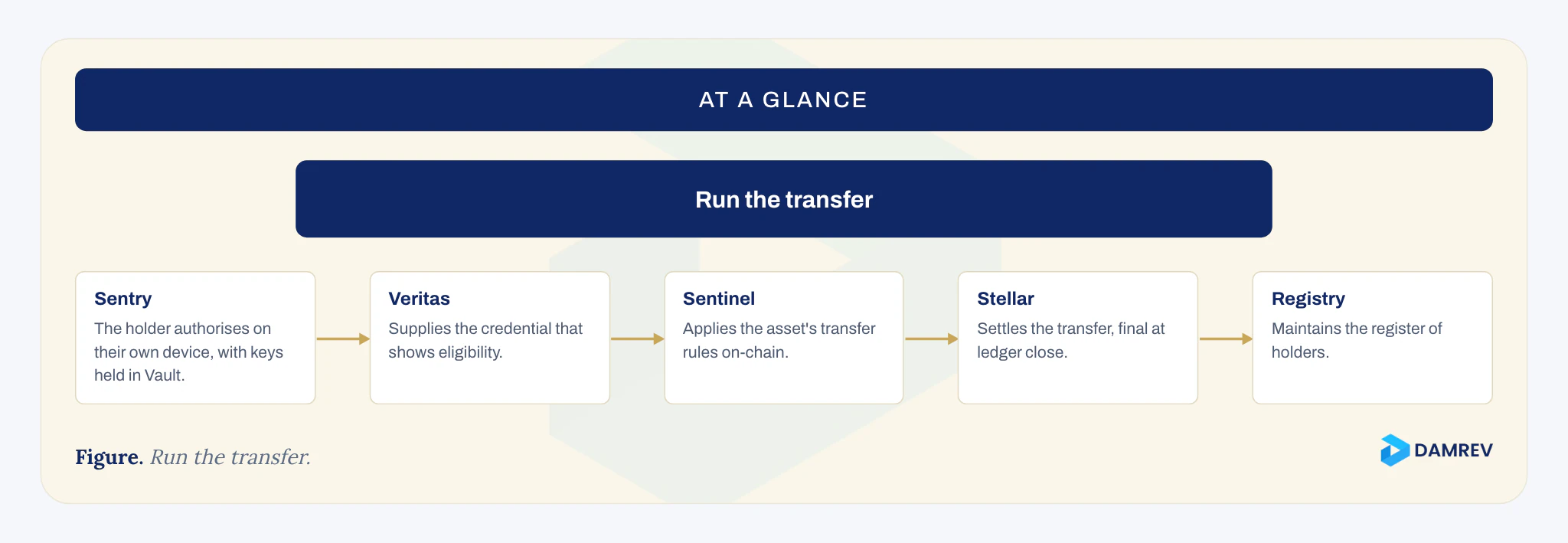
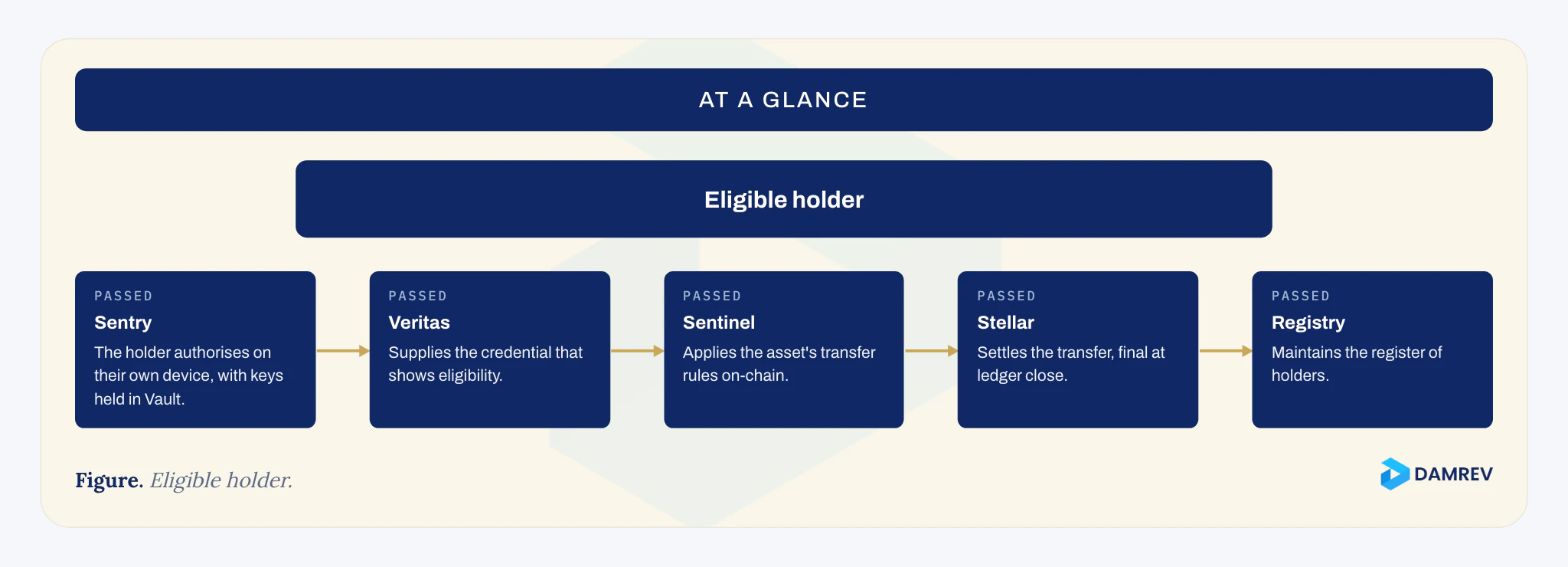

Choose a holder and run the transfer.
The platform is non-custodial: the user holds the keys in Vault, and signing happens on the user's device. Because a Stellar ledger is final at close2, the control has to act before settlement rather than after it, which is why Sentinel's check sits in the contract logic of the transfer itself.
Integration
Yes. DAMREV can serve as the whole programme stack, or connect selected engines into an existing architecture. Where a programme already has a licensed identity provider, a qualified custodian or an appointed transfer agent, that party keeps its role.
Illustration: a programme adds issuance and the register. Forge and Registry join, and bring Veritas and Sentinel because they depend on them. Each engine that joins brings the engines it depends on, and nothing else.
Responsibility
The parties appointed to hold them, with permissions held entity by entity.
A related party through common ownership, it assesses each smart contract and renders a signed attestation.
No party holds both powers
Acts on that verdict on-chain, in the contract logic of every transfer.
DAMREV does not issue securities, act as general partner, manage funds or give investment advice. It is not a party to any transaction, holds no client assets, effects no trades and introduces no parties to one another.
Common questions
Short answers to the questions people ask most about this topic.
Stellar, with Soroban running the contract logic on the same ledger3. Settlement runs in the asset each jurisdiction permits, such as USDC, EURC, a licensed local stablecoin, tokenized deposits, or fiat through a bank. The group issues none of them.
No. DAMREV can serve as the whole programme stack or connect selected engines into an existing architecture. The dependencies each engine states show which engines travel together: Forge, for example, depends on Veritas and Sentinel.
Deployment is recorded engine by engine in capability status records, kept apart from the roadmap. Those records are being prepared, so this page describes how the platform is designed to work and marks no capability as live.
The platform is non-custodial. The user holds the keys in Vault and signs on their own device through Sentry. DAMREV holds no client assets, and institutions integrate their own qualified custody.
Layers describe how the platform is built, which is what engineers, auditors and counsel need. Families group the same twenty engines by what a buyer is trying to do. The engines and their functions are the same in both views.
The sequence is the order in which a programme is built and run. The layers are where each function sits in the platform. Every stage of the sequence draws on engines from several layers.
Through the programme record. Every decision, input, encoded rule and approval stays attached to it, so the operating instrument can be traced back to the terms that authorised it.
Where next
The pages below pick up where this one ends. Start with the one closest to where your asset or programme stands today.
Last updated:
Insights

Since 17 September 2026 a tokenized securities venue may run automated liquidity pools in tokenized listed stock without registering as an exchange, on conditions.

The GENIUS Act binds payment stablecoin issuers from 18 January 2027, not the firms that hold or settle in stablecoins. Service providers follow in 2028.

The CLARITY Act stalled on a 49 to 50 vote, so tokenized securities stay with the Securities and Exchange Commission, as before.

Guernsey's guidance of 24 July 2026 lets a fund or issuer record and transfer its investments as tokens, under the regimes already applying to it.
Tell us what you want to tokenize.
We will show you how DAMREV can run it.
