Article · Law, Regulation & Policy
SEC & CFTC Authority After the CLARITY Act Failed to Advance
Jurisdiction over a tokenized security stays with the Securities and Exchange Commission (SEC), exactly as it was before the Senate vote, and the reach of the Commodity Futures Trading Commission (CFTC) stays with commodities, commodity derivatives, and fraud in commodity markets3, 5.
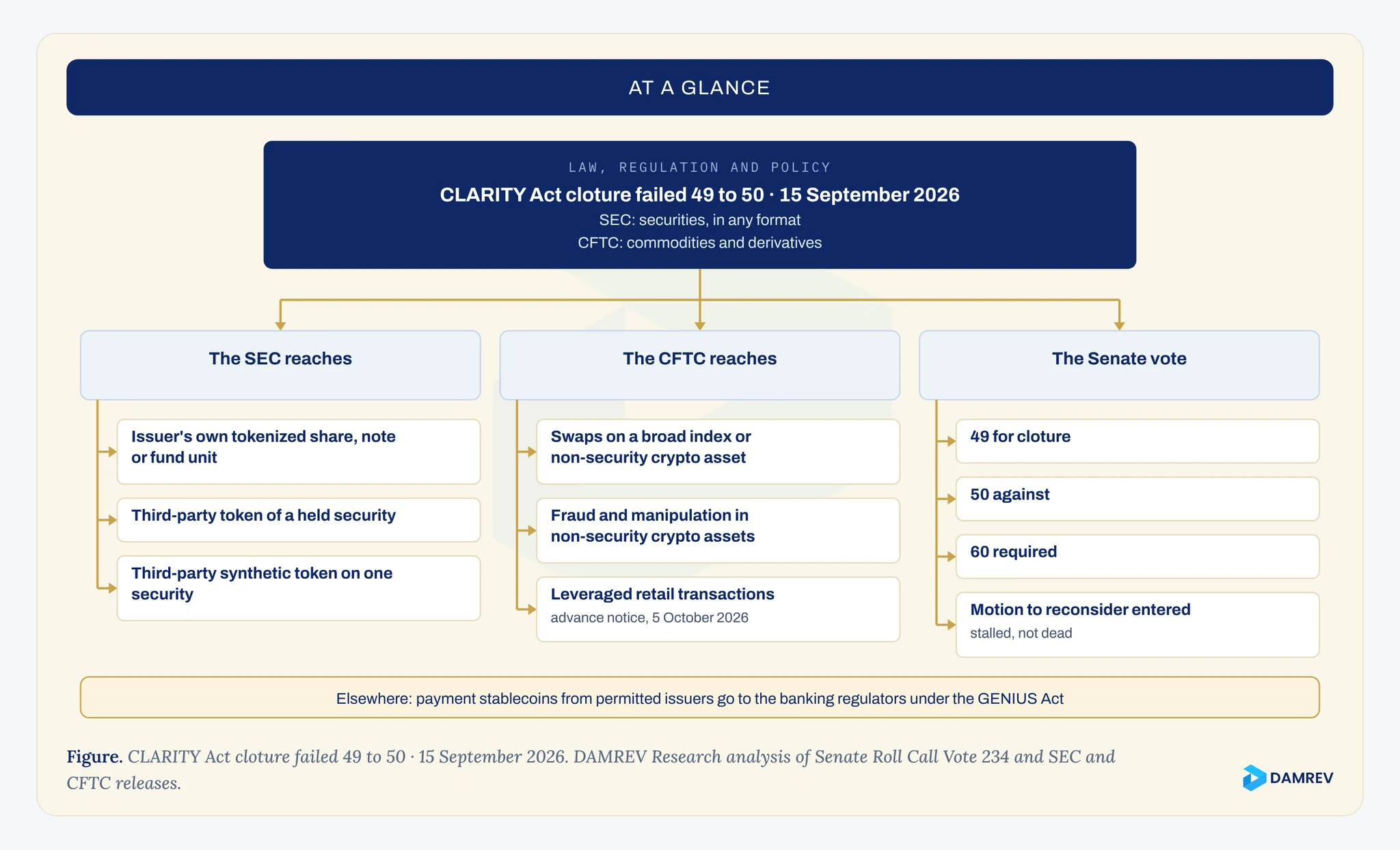
The CLARITY Act would have redrawn that line for some crypto assets, but cloture failed 49 to 50 on 15 September 2026 and a motion to reconsider was entered, so the bill is stalled rather than dead1, 2.


In this article
01 · The vote
What happened to the CLARITY Act on 15 September 2026?
The Senate declined to take up the CLARITY Act. Cloture on the motion to proceed to H.R. 3633 failed 49 to 50, short of the 60 votes required, and a motion to reconsider was entered the same day1, 2.
The vote was procedural. The Senate was not voting on the bill's text but on whether to end debate on proceeding to it, and that needs three fifths of the Senate1. It received 49 votes in favour, 50 against, with one senator not voting1.
The floor record shows what happened next. Senator Tillis entered a motion to reconsider the vote by which cloture was not invoked2. Entering that motion keeps the question available to the Senate, so the bill is stalled rather than dead.
- Votes for cloture on the motion to proceed to H.R. 36331
- 49
- Votes against1
- 50
- Votes required, three fifths of the Senate1
- 60
What the vote changed is narrow. The bill's subject is a statutory route for some crypto assets to be treated as digital commodities under the CFTC. That route does not exist in law today. The answer to who regulates a tokenized instrument is the answer the existing statutes already gave.
02 · The SEC's reach
Who regulates a tokenized security now?
The SEC regulates a tokenized security now. A security does not stop being a security because it is recorded on a ledger, and the SEC said so in a staff statement in January 2026 and in a Commission interpretation in March 20263, 4.
The staff statement of 28 January 2026 put it plainly: "The format in which a security is issued or the methods by which holders are recorded does not affect application of the federal securities laws"4. The Commission's interpretive release, effective 23 March 2026, carried the same principle into a Commission document3.
A security is a security regardless of whether it is issued, or otherwise represented, offchain or onchain.3
The consequences run through the whole life of the instrument. An offer of a tokenized share or note must be registered or exempt under the Securities Act.
A venue that trades it is within the exchange and broker-dealer regime unless exempted, as the innovation exemption of 17 September 2026 now does for one narrow case, and the transfer agent and custody rules apply as they would to the paper form3, 4.
The SEC's proposal of 18 August 2026, Regulation Crypto Assets, does not change this. It is a proposal, and it addresses crypto assets sold under investment contracts, where the asset is not itself a security. It is not a regime for issuing or trading tokenized securities8.
03 · The CFTC's reach
What can the CFTC do without new legislation?
Without new legislation, the CFTC can do more than before, but within the same statute. The CFTC oversees commodity derivatives and polices fraud and manipulation in commodity markets, and on 5 October 2026 it began a rulemaking on retail crypto transactions under existing powers5.
The Commodity Exchange Act has not changed. What has changed is how the CFTC is using it.
Its advance notice of 5 October 2026 concerns transactions under Section 2(c)(2)(D), the provision that reaches retail commodity transactions that are leveraged, margined, or financed5. The Chairman described the aim as bringing crypto asset transactions into the CFTC's "uniform national market regulatory framework" using "the CFTC's existing statutory authorities"5.
Commodity derivatives
Futures, options on futures, and swaps on non-security crypto assets sit with the CFTC under the existing Act.
Fraud and manipulation
The CFTC can act against fraud and manipulation in the market for a commodity, including a crypto asset that is a commodity.
Retail leveraged transactions
Section 2(c)(2)(D) is the base for the advance notice of 5 October 2026, with comments due 60 days after publication5.
Guidance on classification
The CFTC's guidance in the SEC's March 2026 release is that it and its staff administer the Act consistently with that interpretation3.
Staff relief runs alongside the rulemaking. On 17 September 2026 the CFTC's Market Participants Division issued Staff Letter No. 26-25, widening earlier no-action relief for software providers that passively let users trade through registered intermediaries9. A staff letter states what staff will not recommend; it binds neither the Commission nor a court, and it can be withdrawn.
None of this reaches a tokenized security. An advance notice is the earliest stage of rulemaking, before any proposed rule text, and the instruments it addresses are crypto assets that are not securities5.
04 · Where they meet
Where do the two agencies meet?
The SEC and the CFTC meet at the edges: a token that gives synthetic exposure may be a security-based swap or a swap, and the agencies are working jointly on that line. They have also agreed how to coordinate, without changing either statute6, 7.
| Instrument | Agency | Basis | Source |
|---|---|---|---|
| Share, note, or fund unit issued as a token by its issuer | SEC | It is a security; format does not change that | 3, 4 |
| Third-party token representing a held security | SEC | A security, such as a tokenized security entitlement | 4 |
| Third-party token giving synthetic exposure to one security | SEC | Typically a security-based swap or linked security | 4, 7 |
| Swap on a broad index or a non-security crypto asset | CFTC | A swap under the Commodity Exchange Act | 7 |
| Non-security crypto asset traded for cash | CFTC for fraud and manipulation, and for leveraged retail transactions | Section 2(c)(2)(D); advance notice of 5 October 2026 | 3, 5 |
| Payment stablecoin from a permitted issuer | Banking regulators under the Guiding and Establishing National Innovation for US Stablecoins Act (GENIUS Act) | Excluded from the securities and commodities laws by that Act, from its effective date | 10 |
The agencies signed a memorandum of understanding on 11 March 2026 to guide their coordination6. It is a coordination agreement, not a transfer of authority.
Their joint request for comment of June 2026 asked how the definitions of swap and security-based swap should be read, which is the boundary that decides who oversees a synthetic token7. Comments closed on 24 August 2026; as of 7 October 2026 neither agency had published a proposal arising from it7.

05 · What it does not establish
What does the current position not establish?
As of 7 October 2026, the SEC interpretation, the proposals, and the CFTC advance notice read here do not settle the status of every crypto asset, give the CFTC authority over securities, or make any of the agencies' current positions permanent. Interpretations, proposals, and advance notices can all be revised by later Commissions3, 5, 8.
The current position rests on instruments of different strength. The statutes are fixed until Congress acts. The March interpretation binds the SEC's reading but can be withdrawn. Regulation Crypto Assets is a proposal and the CFTC's notice is an advance notice; neither binds anyone yet3, 5, 8.
For tokenized securities the position is settled under current law. The CLARITY Act's main subject is the treatment of crypto assets that are not securities. A tokenized share, note, or fund unit is regulated as a security today, and the vote did nothing to change that.
What the vote leaves open is the boundary for everything else. How much of the spot market for non-security crypto assets the CFTC can reach by rule, and how synthetic tokens are classified, are questions the agencies are working on under existing law, through the advance notice and the joint request for comment5, 7.
Common questions
What else do people ask?
Short answers to the questions people ask most about this topic.
Can the Senate vote on the CLARITY Act again this Congress?
Yes. Cloture on the motion to proceed failed 49 to 50 on 15 September 2026, and Senator Tillis entered a motion to reconsider the vote, which allows the Senate to return to it; the bill lapses only if the Congress ends without acting on it1, 2.
Does the CFTC regulate tokenized stocks?
No. A tokenized stock is a security, and securities sit with the SEC3, 4. A token that only gives synthetic exposure may be a security-based swap or a swap, and the definition decides which agency is responsible7.
What did the CFTC announce on 5 October 2026?
An advance notice of proposed rulemaking on crypto asset transactions under Section 2(c)(2)(D) of the Commodity Exchange Act, using its existing authority. Comments are due 60 days after Federal Register publication5.
Did the SEC and CFTC agree on which crypto assets are commodities?
They coordinated. The SEC's March 2026 interpretation sets out categories of crypto assets, and the CFTC's guidance in the same release is that it administers the Commodity Exchange Act consistently with it3. An interpretation does not change either statute.
Where should you go next?
The pages below pick up where this one ends. Start with the one closest to where your asset or programme stands today.
- The SEC's Innovation Exemption of 17 September 2026: What Tokenized Securities Venues & Tokenized NMS Stock May Now DoSince 17 September 2026 a tokenized securities venue may run automated liquidity pools in tokenized listed stock without registering as an exchange, on conditions.
- When the GENIUS Act Takes Effect: 18 January 2027 & 18 July 2028The GENIUS Act binds payment stablecoin issuers from 18 January 2027, not the firms that hold or settle in stablecoins. Service providers follow in 2028.
- What the SEC's January 2026 Statement Means for Tokenized SecuritiesOn 28 January 2026 three divisions of the US Securities and Exchange Commission said a tokenized security is still a security, whatever its format.
- JurisdictionsThe rules for tokenized finance in the twelve jurisdictions where the group works, mapped to where each group entity sits, claiming no permission.
References
- 1.United States Senate, Roll Call Vote 234, 119th Congress, 2nd Session, on cloture on the motion to proceed to H.R. 3633, 15 September 2026. https://www.senate.gov/legislative/LIS/roll_call_votes/vote1192/vote_119_2_00234.htm
- 2.United States Senate, floor activity log, 15 September 2026. https://www.senate.gov/legislative/LIS/floor_activity/09_15_2026_Senate_Floor.htm
- 3.US Securities and Exchange Commission, "Application of the Federal Securities Laws to Certain Types of Crypto Assets and Certain Transactions Involving Crypto Assets", Release No. 33-11412, with guidance from the Commodity Futures Trading Commission, effective 23 March 2026. https://www.sec.gov/files/rules/interp/2026/33-11412.pdf
- 4.SEC Divisions of Corporation Finance, Investment Management, and Trading and Markets, "Statement on Tokenized Securities", 28 January 2026. https://www.sec.gov/newsroom/speeches-statements/corp-fin-statement-tokenized-securities-012826
- 5.Commodity Futures Trading Commission, press release 9307-26, advance notice of proposed rulemaking on crypto asset transactions, 5 October 2026. https://www.cftc.gov/PressRoom/PressReleases/9307-26
- 6.Commodity Futures Trading Commission, press release 9192-26, "CFTC and SEC Announce Historic Memorandum of Understanding Between Agencies", 11 March 2026. https://www.cftc.gov/PressRoom/PressReleases/9192-26
- 7.Commodity Futures Trading Commission and Securities and Exchange Commission, "Joint Request for Comment on Further Definition of 'Swap' and 'Security-Based Swap' and on Alternative Compliance", 91 Fed. Reg. 37833, 24 June 2026. https://www.federalregister.gov/documents/2026/06/24/2026-12743/joint-request-for-comment-on-further-definition-of-swap-and-security-based-swap-and-on-alternative
- 8.US Securities and Exchange Commission, "Regulation Crypto Assets", proposed rule, Release No. 33-11434, 18 August 2026. https://www.sec.gov/files/rules/proposed/2026/33-11434.pdf
- 9.Commodity Futures Trading Commission, Market Participants Division, CFTC Letter No. 26-25, no-action position on introducing broker and associated person registration for passive software providers, 17 September 2026. https://www.cftc.gov/csl/26-25/download
- 10.Guiding and Establishing National Innovation for US Stablecoins Act, Public Law 119-27, 18 July 2025. https://www.govinfo.gov/content/pkg/PLAW-119publ27/html/PLAW-119publ27.htm
This article is analysis of public sources, not legal advice. Last updated: