


Article · Law, Regulation & Policy
Jersey: When a Tokenized Asset Is a Virtual Asset, & When It Is Not
In Jersey, a token that represents a real-world asset, such as a share, a bond, a commodity, or a unit in a fund, is treated as a tokenized real-world asset under the regimes that already govern that asset, not as a virtual asset issuance1.
Under Jersey tokenization regulation, the Jersey Financial Services Commission (JFSC) decides each case on substance over form, and issuing a new virtual asset follows a separate route1, 2.


01 · The approach
How does Jersey decide what a token is?
Jersey decides what a token is by what it represents, not what it is called. The Jersey Financial Services Commission assesses each application case by case on substance over form, and applies the regime that governs the underlying activity1.
Jersey has no single tokenization statute. It has guidance, first published on 28 August 2024 and revised on 13 July 2026, that explains how the Commission applies Jersey's existing laws to tokens that represent real-world assets1.
The same release in 2024 updated the separate guidance for issuers of initial coin and token offerings, so that the two routes are kept apart2.
Our position is to assess each application on a case-by-case basis with an overarching principle of substance over form.1
The guidance gives its own example of why the test is substance. It treats "the issuance of a tokenised equity differently from the issuance of a tokenised bond", and it tells applicants to "consider the appropriate regulations which apply to the service and/or activities of the business"1.
A tokenized fund unit goes to the funds regime; a tokenized security is read against the Commission's guidance on securities issued by Jersey companies1.
02 · The line
Where is the line between a tokenized asset and a virtual asset?
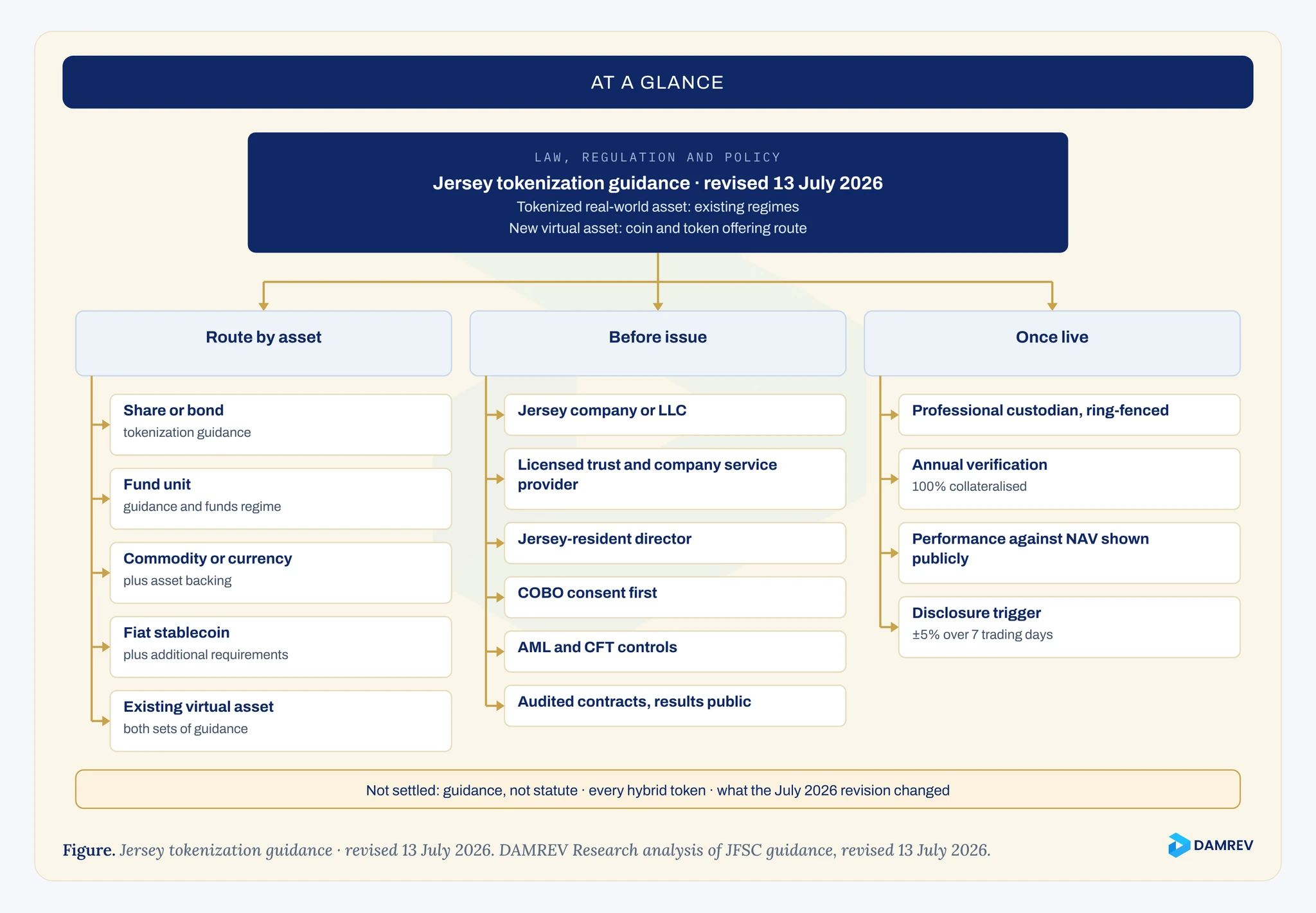
In Jersey the line sits at the asset: a token that represents an existing real-world asset follows the tokenization guidance. Issuing a new virtual asset follows the coin and token offering route, and tokenizing an existing virtual asset engages both1.
The guidance says in terms that it "is limited in its application to the issuance of tokenised RWAs and is not relevant for applications related to the issuance of virtual assets"1. It then closes the obvious gap: "Where an existing virtual asset (or basket of existing virtual assets) is tokenised, this guidance note should also be applied"1.
| What the token represents | Route under the guidance | Source |
|---|---|---|
| A share or a bond | Tokenization guidance, read with the guidance on securities issued by Jersey companies | 1 |
| A unit in a fund | Tokenization guidance and the existing Jersey funds regime | 1 |
| A commodity, currency, or other asset | Tokenization guidance, with the further requirements for asset backing | 1 |
| A fiat currency, as a stablecoin | Tokenization guidance, with additional requirements; not a virtual asset for its purposes | 1 |
| A new virtual asset with no underlying asset | The initial coin and token offering guidance, not this one | 1, 2 |
| An existing virtual asset, or a basket of them | Both sets of guidance | 1 |
The stablecoin line is the least expected. For the purposes of the guidance, "stablecoins are not considered virtual assets", and Section 7 sets out what an issuer must add, including details of the collateral, the custody arrangements, and how authorised participants issue and redeem1.
03 · Before issue
What must an issuer have in place before it issues?
Before it issues, a token issuer in Jersey must be a Jersey company or limited liability company (LLC), administered by a licensed trust and company service provider, with a Jersey-resident director from that provider, and must have consent under the Control of Borrowing Order and the listed controls in place, including published smart contract audits1.
Section 5 applies to every issuer of tokenized real-world assets. The core of it is structural: the issuer must be "administered through a trust and company service provider (TCSP) licensed by the JFSC", and it must "receive consent under the Control of Borrowing (Jersey) Order 1958 (COBO) from the JFSC before it undertakes the token issuance"1.
Administration and governance
The issuer is a Jersey company or Jersey LLC, administered by a licensed trust and company service provider; its Jersey-resident director is a natural person and a principal person of that provider1.
Consent before issue
COBO consent from the Commission comes before the token issuance, not after it1.
Financial crime controls
The issuer applies all relevant anti-money laundering and counter-terrorist financing requirements1.
Audited contracts
All smart contracts deployed in the year are audited, and the results are made public1.
Fair documents
Marketing material, including the information memorandum, must be clear, fair, and not misleading, and any difference between the token's rights and the asset's rights must be disclosed1.
The Commission sets itself a service level. For the lower-risk applications defined in Section 10.2, with complete submissions, it aims to respond within five business days, and it will accept drafts where an omission does not materially affect the substance1.
04 · Once live
What does the JFSC expect once the token is live?
Once a token is live, the JFSC expects proof that it is backed, and openness about its price. The underlying assets must be held by a professional custodian, ring-fenced, verified annually by a qualified third party, and the token's performance against net asset value shown publicly1.
Section 6 carries the ongoing conditions, which the guidance ties to the COBO consent1. Their purpose is to keep the token and the asset it represents from drifting apart.
- Independent verification of the underlying assets, published within three months of the financial year end, confirming the tokens are 100% collateralised and ring-fenced1
- Annual
- The premium or discount to expected price, over consecutive trading days, that the guidance's model disclosure uses as its trigger1
- ±5% · 7 days
- The Commission's target response for complete, lower-risk applications1
- 5 business days
The custody condition is strict. Underlying assets must be "held by a professional custodian with accountability in an equivalent jurisdiction", and "ring-fenced and not lent out for additional yield unless expressly agreed by the JFSC"1. The issuer must also display publicly "the performance of the token against NAV"1.
These conditions are part of what the consent requires in Jersey, which gives an investor a regulator to ask when the backing is in doubt.

05 · What it does not establish
What does the Jersey guidance not establish?
As of 7 October 2026, the Jersey guidance read here is guidance on how consent is given, not a statute. The guidance does not say what the July 2026 revision changed, settle every hybrid token, or replace the funds and securities regimes it points to1.
| Question | Jersey | Guernsey | Source |
|---|---|---|---|
| Form of the rules | Guidance on existing law, applied through consent | Guidance note on existing law | 1, 3 |
| How a token is classified | Case by case, substance over form | By the investment it represents | 1, 3 |
| Fund unit token a virtual asset? | Follows the funds regime under the tokenization guidance | Not a virtual asset if it only represents a fund interest | 1, 3 |
| Smart contract audit | Required, results published | Not required; control framework and disclosure instead | 1, 3 |
| Stablecoins | Covered, with additional requirements | Outside the guidance | 1, 3 |
The revision of 13 July 2026 is the first gap. The guidance page records the date, but neither the page nor any Commission notice we found lists what changed. This article reads the guidance as it stood on 7 October 2026, and it should not be read as a summary of the revision.
The second gap is classification at the edges. A token that is partly a claim on an asset and partly a native virtual asset is left to the Commission's case-by-case judgement1. The guidance tells an issuer where to start; it does not classify every token in advance.
And it decides nothing about title. Whether a holder owns the asset, or only a claim against the issuer, depends on the instrument and on Jersey law, which the guidance takes as given.
Common questions
What else do people ask?
Short answers to the questions people ask most about this topic.
Does a Jersey issuer of tokenized real-world assets need a licence of its own?
The guidance requires the issuer to be a Jersey company or Jersey LLC, administered by a trust and company service provider licensed by the JFSC, with a Jersey-resident director who is a principal person of that provider, and to obtain consent under the Control of Borrowing (Jersey) Order 1958 before it issues1.
Is a stablecoin a virtual asset under the Jersey guidance?
For the purposes of the guidance note, no. It defines stablecoins as tokens whose value is tied to a fiat currency and states that they are not considered virtual assets for its purposes, with additional application requirements1.
How quickly does the JFSC respond?
For the lower-risk applications the guidance defines in Section 10.2, with complete submissions, it aims to respond within five business days1.
What changed in the revision of 13 July 2026?
The guidance page records the revision date but does not list the changes, and we have not found a published summary of them. The article reads the guidance as it stands on 7 October 20261.
Where should you go next?
The pages below pick up where this one ends. Start with the one closest to where your asset or programme stands today.
- Guernsey's Tokenization Guidance of 24 July 2026Guernsey's guidance of 24 July 2026 lets a fund or issuer record and transfer its investments as tokens, under the regimes already applying to it.
- Does Tokenizing a Security Change Whether It Is a Security?In the United States, the European Union, Guernsey, and Jersey, tokenizing a security does not change whether it is one, only which one is held.
- Proof & ServicingKeeping an instrument working for life: distributions, corporate actions, transfers, and reporting follow the encoded terms, and every event is evidenced.
- JurisdictionsThe rules for tokenized finance in the twelve jurisdictions where the group works, mapped to where each group entity sits, claiming no permission.
References
- 1.Jersey Financial Services Commission, "Tokenisation of real world assets (RWAs)", guidance, published 28 August 2024, revised 13 July 2026. https://www.jerseyfsc.org/industry/guidance-and-policy/tokenisation-of-real-world-assets-rwas/
- 2.Ogier, "New tokenisation guidance published by the Jersey Financial Services Commission", 2024. https://www.ogier.com/news-and-insights/insights/new-tokenisation-guidance-published-by-the-jersey-financial-services-commission/
- 3.Guernsey Financial Services Commission, Guidance Note on the Tokenisation of Investments and Other Assets in the Bailiwick of Guernsey, July 2026. https://www.gfsc.gg/sites/default/files/media/helix-file/Guidance%20-%20Tokenisation%20of%20Investments%20%28July%202026%29.pdf
This article is analysis of public sources, not legal advice. Last updated:




