


Article · Law, Regulation & Policy
Does Tokenizing a Security Change Whether It Is a Security?
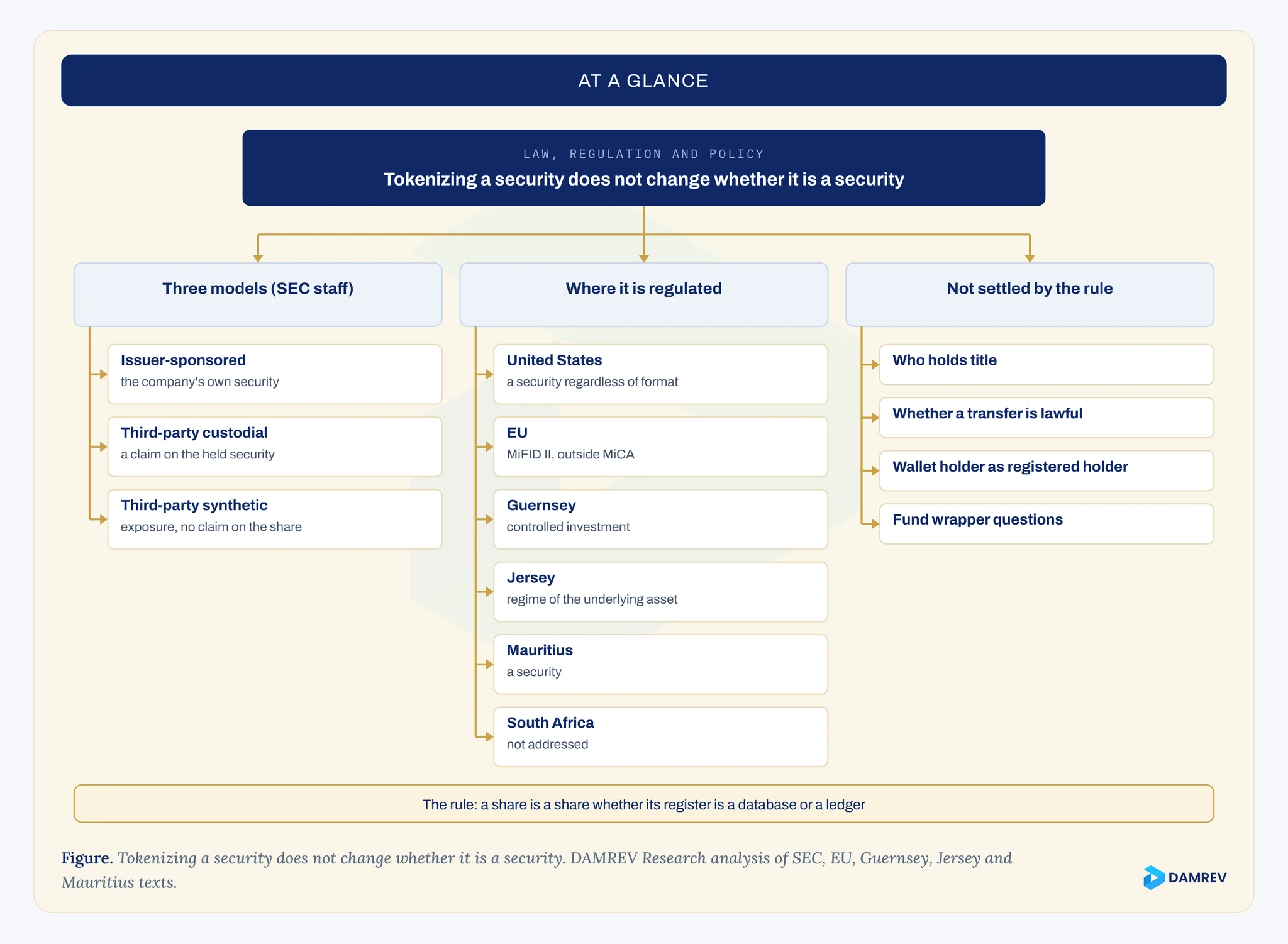
No. Tokenized securities regulation in the United States, the European Union (EU), Guernsey, and Jersey starts from one rule: the format in which a security is recorded does not change whether it is a security or which law applies to it1, 2, 4, 6, 7, 8.
What tokenization can change is which security the holder owns: a token issued by a third party may be a different security from the share it refers to, with a different issuer and different rights1, 2.


01 · The answer
Does recording a security on a ledger change the law that applies to it?
Recording a security on a ledger does not change the law that applies to it: a share is a share whether its register is a database or a ledger. The staff of the Securities and Exchange Commission (SEC) said so in January 2026 and the Commission in March 2026, and EU law and the Guernsey and Jersey regulators agree1, 2, 4, 7, 8.
The principle has become the common starting point for regulators. In the United States, the staff statement of 28 January 2026 opens on it, and adds that "regardless of its format, the Securities Act requires that every offer and sale of a security must be registered" or exempt1.
The format in which a security is issued or the methods by which holders are recorded does not affect application of the federal securities laws.1
The Commission's interpretation, effective 23 March 2026, put it more briefly: "A security is a security regardless of whether it is issued, or otherwise represented, offchain or onchain"2. It went further than format. "All devices and instruments that have the economic characteristics of a security are securities regardless of format or label"2.
The more useful question is a different one, and it is where most of the confusion lies: when a security is tokenized, is the token still the same security?
02 · Three models
Is the token the same security as the share it refers to?
A token is the same security as the share it refers to only when the issuer issues it. The SEC staff separate three models, and in two of them a third party is the issuer of a different security, even though the token refers to the same company's shares1.
| Model | Who issues the token | What the holder owns | Source |
|---|---|---|---|
| Issuer-sponsored | The company, issuing its security in the format of a crypto asset | The company's security itself | 1 |
| Third-party custodial | A third party that holds the underlying security | A claim on the held security, such as a tokenized security entitlement | 1 |
| Third-party synthetic | A third party, issuing its own security | Synthetic exposure, such as a linked security or a security-based swap, with no claim on the underlying share | 1 |
In the first model, the holder has the company's rights directly: votes, dividends, a place on the register. In the second, the holder has whatever the third party's terms give, and depends on the third party's custody of the share. In the third, the holder has a contract with the third party and nothing in the company at all1.
For anyone holding or buying a token, the questions follow directly: who issued it, and what do its terms say the holder owns? The answer sits in the token's documents, not in its name, its ticker, or the exchange that lists it.
The SEC's innovation exemption of 17 September 2026 shows how much rides on this. It admits issuer-sponsored and third-party tokens that carry "the same rights and privileges" as the share, and excludes synthetic tokens altogether3. Tokenizing did not change the law. The choice of model changed what the holder bought.
03 · Europe
How does the European Union answer the question?
The European Union answers the question the same way, through the definitions. The Markets in Crypto-Assets Regulation (MiCA) excludes crypto-assets that qualify as financial instruments, and the definition of a financial instrument in the Markets in Financial Instruments Directive (MiFID II) expressly includes instruments issued by means of distributed ledger technology4, 5.
The EU built the principle into its statutes rather than leaving it to interpretation. MiCA's Article 2(4) provides that the regulation "does not apply to crypto-assets that qualify as one or more of the following", the first of which is "financial instruments"4.
The distributed ledger technology (DLT) Pilot Regime itself, Regulation (EU) 2022/858, amended the MiFID II definition so that it covers financial instruments "issued by means of distributed ledger technology"5.
Technology neutral
The guidelines of the European Securities and Markets Authority (ESMA) say "the technological format of crypto-assets should not be considered a determining factor" in deciding whether one is a financial instrument6.
Same rules
Competent authorities are to ensure "similar activities and assets are subject to the same rules regardless of their form"6.
Two regimes, one boundary
A tokenized share or bond falls under MiFID II and the prospectus rules; MiCA covers only crypto-assets that are not already covered by EU financial services law4, 6.
The European test therefore runs the same direction as the American one. The question is always what the instrument is, and the ledger is never the answer. The DLT Pilot Regime does not alter this. It relaxes some market infrastructure rules for venues and settlement systems that use distributed ledgers, but the instruments traded on them remain financial instruments5.
04 · Across jurisdictions
Do the other jurisdictions the group works in agree?
The other jurisdictions the group works in broadly agree: Guernsey, Jersey, and Mauritius each regulate a tokenized security under the regime for the security, not the regime for virtual assets. South Africa's drafts do not address the point7, 8, 9.
| Jurisdiction | Position | Status | Source |
|---|---|---|---|
| United States | A security regardless of format | Staff statement; Commission interpretation | 1, 2 |
| European Union | A financial instrument under MiFID II, outside MiCA | In force | 4, 5 |
| Guernsey | A controlled investment; a fund-interest token is not a virtual asset | Guidance | 7 |
| Jersey | Substance over form, under the regime for the underlying asset | Guidance | 8 |
| Mauritius | A security token is regulated as a security | Guidance | 9 |
| South Africa | Not addressed in the draft exchange control texts | Consultation | 11 |
The uniformity is useful but it has limits. Each jurisdiction reaches the same answer by its own route, and the route matters at the edges.
Guernsey asks what investment the token represents7. Jersey decides case by case on substance and attaches conditions to its consent8. Mauritius draws the line between its securities law and its virtual asset statute9.
The Mauritian text is the most explicit of the three. Its guidance notes define security tokens as securities under the Securities Act "represented in digital format", and state that "the VAITOS Act does not apply to digital representations of securities which fall under the purview of the SA"9.
A token that is a share is regulated as a share, and a venue that trades it needs a securities licence rather than a virtual asset licence9.

05 · What it does not establish
What does this principle not establish?
As of 7 October 2026, the statements, regulations, and guidance read here do not settle who owns what, make a transfer lawful, or turn a wallet holder into a registered holder. Those questions depend on the model, the instrument's terms, and the law of the register1, 10.
Not title
Whether a token holder owns the security, or a claim on someone who does, depends on the model and the documents, not on the regulator's classification1.
Not transferability
Restrictions on resale and investor eligibility travel with the security, whatever the ledger allows1, 10.
Not registration
A wallet address alone does not meet a transfer agent's record-keeping duties, as one law firm review notes10.
Not the fund question
A product that wraps third-party securities can raise investment company questions of its own10.
The principle closes one argument and opens several more. Nobody can now credibly claim that a ledger takes a security outside securities law. But the reverse claim is also wrong: a token that refers to a security is not necessarily that security.
For an issuer, the decision that matters is made before the first token exists. It is the choice of model, which fixes who the issuer is, what the holder owns, and which obligations follow.
Common questions
What else do people ask?
Short answers to the questions people ask most about this topic.
Is a tokenized share regulated by MiCA in the European Union?
No. MiCA does not apply to crypto-assets that qualify as financial instruments under MiFID II, and MiFID II's definition of a financial instrument includes instruments issued by means of distributed ledger technology4, 5.
If a third party tokenizes my company's shares, are the tokens my company's shares?
Not necessarily. In the SEC staff's analysis, a third party's token may be a security entitlement to the share it holds, or its own security giving synthetic exposure, and in either case the third party, not the company, is its issuer1.
Does putting a security on a public blockchain make it freely transferable?
No. Transfer restrictions, investor eligibility rules, and registration requirements that apply to the security apply to the token1, 2.
Can a crypto asset stop being a security?
In the SEC's March 2026 interpretation, an investment contract can end when the issuer has fulfilled its promises of essential managerial efforts. That concerns crypto assets sold under investment contracts, not tokenized shares or notes, which are securities in their own right2.
Where should you go next?
The pages below pick up where this one ends. Start with the one closest to where your asset or programme stands today.
- What the SEC's January 2026 Statement Means for Tokenized SecuritiesOn 28 January 2026 three divisions of the US Securities and Exchange Commission said a tokenized security is still a security, whatever its format.
- Security Tokens in Mauritius: The Securities Act, Not the VAITOS ActIn Mauritius a security token is a security under the Securities Act 2005, and the virtual asset law of 2021 excludes it.
- Equity & Pre-Listing InstrumentsHow private shares, convertibles, and pre-listing instruments become tokenized equity whose register applies transfer restrictions and processes corporate actions.
- Tokenized or ConventionalWhere tokenized and conventional listings actually differ, and the three questions that decide which route suits your company.
References
- 1.SEC Divisions of Corporation Finance, Investment Management, and Trading and Markets, "Statement on Tokenized Securities", 28 January 2026. https://www.sec.gov/newsroom/speeches-statements/corp-fin-statement-tokenized-securities-012826
- 2.US Securities and Exchange Commission, "Application of the Federal Securities Laws to Certain Types of Crypto Assets and Certain Transactions Involving Crypto Assets", Release No. 33-11412, effective 23 March 2026. https://www.sec.gov/files/rules/interp/2026/33-11412.pdf
- 3.US Securities and Exchange Commission, Order Granting Exemptions for Tokenized Securities Venues, Exchange Act Release No. 34-106402, 17 September 2026. https://www.sec.gov/files/rules/exorders/2026/34-106402.pdf
- 4.Regulation (EU) 2023/1114 on markets in crypto-assets (MiCA), Article 2(4)(a) and Article 2(5). https://eur-lex.europa.eu/legal-content/EN/TXT/HTML/?uri=CELEX:32023R1114
- 5.Regulation (EU) 2022/858 on a pilot regime for market infrastructures based on distributed ledger technology, Article 18, amending Article 4(1)(15) of Directive 2014/65/EU (MiFID II). https://eur-lex.europa.eu/legal-content/EN/TXT/HTML/?uri=CELEX:32022R0858
- 6.European Securities and Markets Authority, Guidelines on the conditions and criteria for the qualification of crypto-assets as financial instruments, ESMA75453128700-1323, 19 March 2025, paragraphs 11 and 12. https://www.esma.europa.eu/sites/default/files/2025-03/ESMA75453128700-1323_Guidelines_on_the_conditions_and_criteria_for_the_qualification_of_CAs_as_FIs.pdf
- 7.Guernsey Financial Services Commission, Guidance Note on the Tokenisation of Investments and Other Assets in the Bailiwick of Guernsey, July 2026. https://www.gfsc.gg/sites/default/files/media/helix-file/Guidance%20-%20Tokenisation%20of%20Investments%20%28July%202026%29.pdf
- 8.Jersey Financial Services Commission, "Tokenisation of real world assets (RWAs)", revised 13 July 2026. https://www.jerseyfsc.org/industry/guidance-and-policy/tokenisation-of-real-world-assets-rwas/
- 9.Financial Services Commission, Mauritius, Updated Guidance Notes on Security Token Offerings and Security Token Trading Systems, 15 March 2023. https://www.fscmauritius.org/media/137664/updated-guidance-notes-on-security-token-offerings-and-security-token-trading-systems-cc-150323.pdf
- 10.Skadden, "Tokenized securities: untangling legal and regulatory knots", April 2026. https://www.skadden.com/insights/publications/2026/04/tokenized-securities
- 11.South African Reserve Bank, Draft Crypto Assets Manual (PDF), August 2026. https://www.resbank.co.za/content/dam/sarb/publications/media-releases/2026/draft-crypto-manual.pdf
This article is analysis of public sources, not legal advice. Last updated:




