



Readiness
The board, controls, accounts and existing register are brought to the standard a public market expects.
Section
Structuring
The instrument classes DAMREV structures, and the four situations that bring most clients here.
Not sure which page answers your question? A structuring review starts with that conversation.
Start a Structuring ReviewSection
Services
The ladder, from a paid first look to a programme DAMREV operates for you.
Not sure which page answers your question? A structuring review starts with that conversation.
Start a Structuring ReviewSection
Platform
Eight capabilities and twenty named engines. DAMREV runs its own instruments on it.
Not sure which page answers your question? A structuring review starts with that conversation.
Start a Structuring ReviewSection
Tokenized IPO
A tokenized listing is a listing first. This section is about whether yours is ready.
Not sure which page answers your question? A structuring review starts with that conversation.
Start a Structuring ReviewSection
Compliance
Written to be read by a regulator, a counterparty or an auditor without a call first.
The Americas & the Caribbean
Europe
Not sure which page answers your question? A structuring review starts with that conversation.
Start a Structuring ReviewSection
Insights
The published record. Papers, positions and the vocabulary, all dated.
Not sure which page answers your question? A structuring review starts with that conversation.
Start a Structuring ReviewNot sure which page answers your question? A structuring review starts with that conversation.
Start a Structuring ReviewGuide
A tokenized initial public offering (IPO) is a listing whose shares are issued, recorded and transferred as tokens. The listing rules, governance and investor protection stay exactly as they are; what changes is that the register, eligibility and transfer restrictions travel inside the instrument. DAMREV prepares that structure before distribution and operates the instrument afterwards.
The definition
A public offering of a company's shares in which the shares exist as tokens on a ledger. The company still prepares, discloses and lists as it would conventionally. The difference is the form of the instrument, and with it how the register is kept and how transfers are checked.
Leaves the operation of the shares to a chain of intermediaries. The transfer agent keeps the register, brokers and custodians hold positions for investors, and each party reconciles its records against the others. Transfer restrictions and eligibility checks are applied by whichever party handles the transaction.
Moves those rules into the instrument. Who may hold the share, when it may move, and how corporate actions reach holders are encoded once and applied at every event. The register is the ledger, not a copy of it.
The idea behind the model is older than the technology. An IPO applies regulation, governance and investor protection to the raising of capital. DAMREV applies the same discipline to tokenized instruments, so a tokenized listing is judged by the standard of a listing, not by the standard of a token sale.
The regulator's view
That the format does not change the law. On 28 January 2026 the Divisions of Corporation Finance, Investment Management, and Trading and Markets at the US Securities and Exchange Commission (SEC) issued a Statement on Tokenized Securities, separating issuer-sponsored from third-party-sponsored models2.
The three models the statement distinguishes
Choose a model
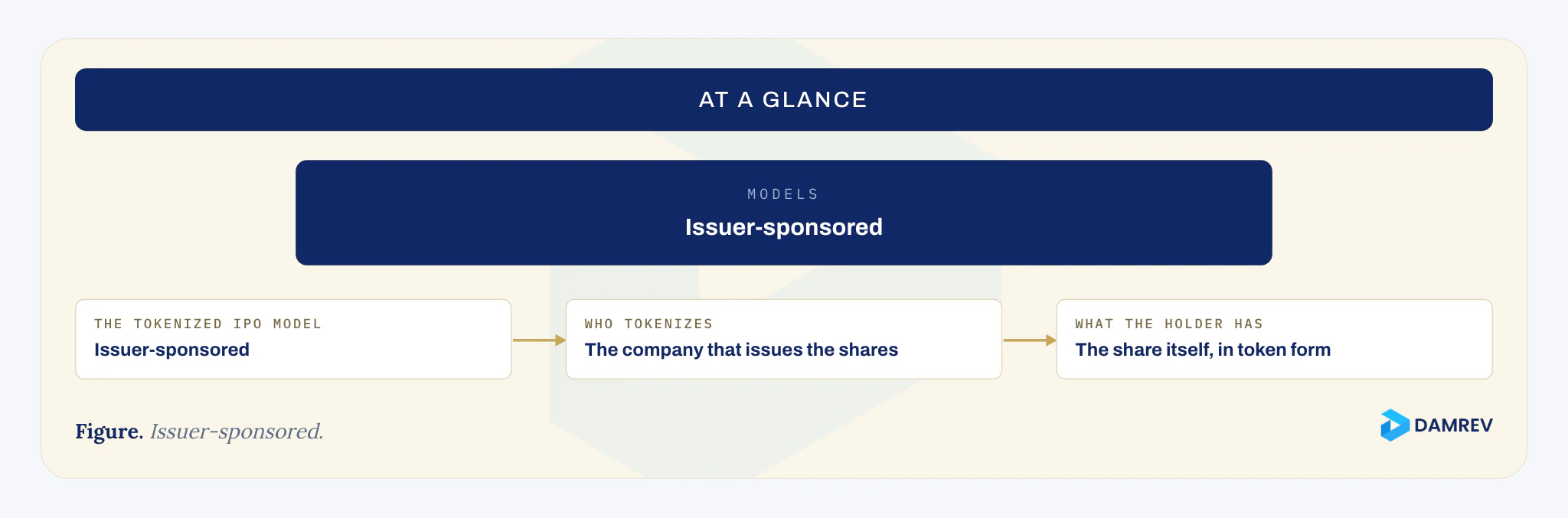
The model a tokenized IPO uses: the company issues its own shares as tokens.
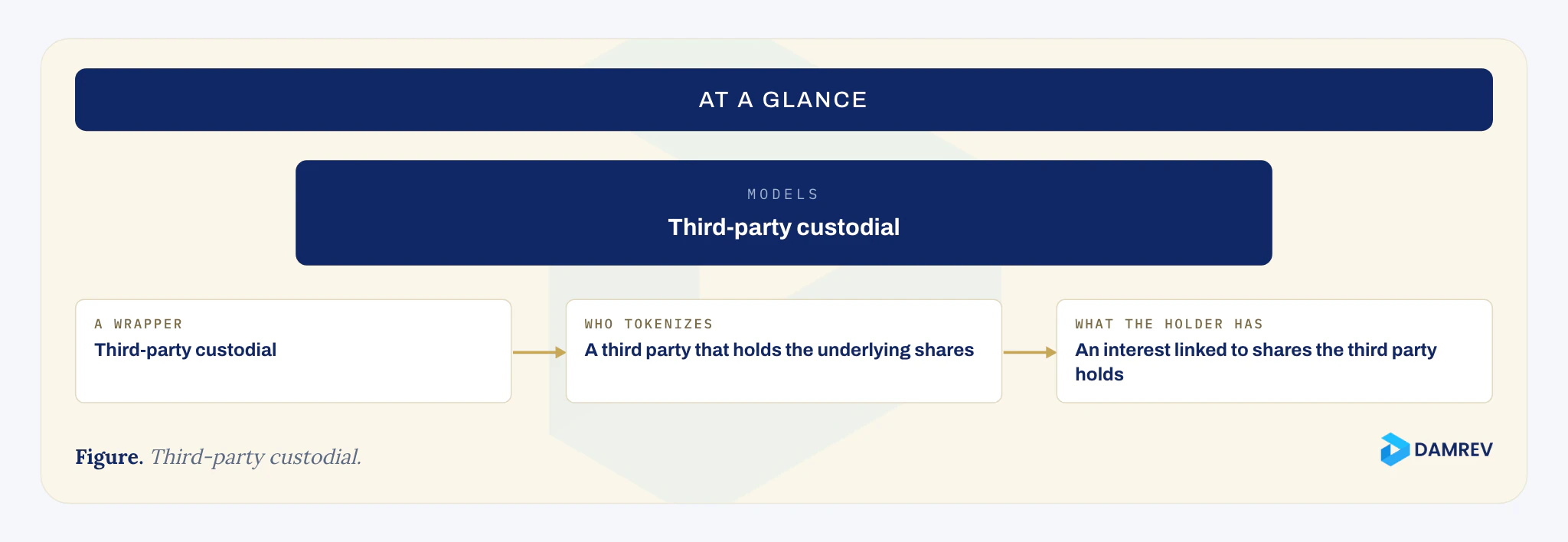
A wrapper around shares already issued, not an offering by the company.
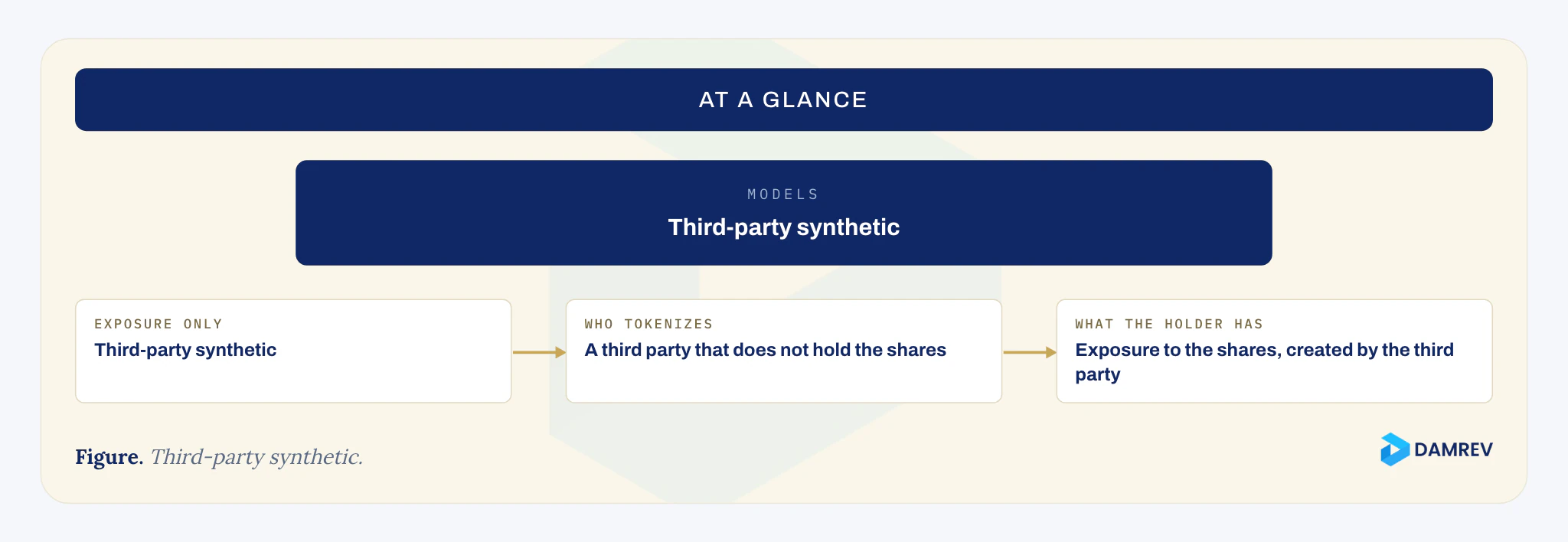
Not an offering of the company's shares at all.
The sequence
The steps of any listing, with the instrument prepared alongside them. Servicing continues for the life of the shares.
The board, controls, accounts and existing register are brought to the standard a public market expects.
Counsel settles the share class, the offering route and the jurisdictions the offer will reach.
The company appoints the listing venue's required advisers and the intermediaries the offer needs.
The prospectus or offering document is prepared and reviewed as the law and the venue require.
Eligibility, transfer restrictions and corporate actions are encoded into the share class.
A licensed provider verifies investors, and Veritas carries each result as a credential.
Shares are allocated through the appointed intermediaries, Forge issues, Registry records, and the venue admits them.
Dividends, corporate actions and reporting run against the register for as long as the shares exist.
What stays and what changes
Everything that protects an investor stays. What changes is the way the shares are operated, so the rules are enforced at every transfer rather than reconciled after it, and every party reads one record.
Stellar also lets an issuer set authorisation flags and use clawback on the assets it issues3, which is how a restricted share class is enforced at the ledger. Soroban smart contracts have run natively on the same ledger since February 20244.
Settlement runs in the asset each jurisdiction permits, which the group does not issue, and the fiat leg of any on-ramp is operated by a licensed third-party provider through Conduit.
Who does what
The listing venue admits the shares and supervises trading under its rules. The appointed intermediaries carry the regulated functions. The company issues. DAMREV builds and operates the software that carries the instrument, and is not a party to any transaction.
The company does
Issues the shares and makes the disclosures.
It does not
Delegate its disclosure obligations to the technology.
Counsel does
Settles the structure, the class and the offering route.
It does not
Operate the instrument.
The listing venue does
Admits the shares and applies its rules to trading.
It does not
Structure the company's instrument.
Appointed intermediaries do
Advise, place, hold and keep records as the law requires.
They do not
Hand their regulated functions to DAMREV.
The verification provider does
Performs identity and eligibility checks.
It does not
Decide the eligibility criteria.
The assessor does
Assesses smart contracts and signs an attestation, as a validator and a related party through common ownership.
It does not
Enforce, mint, sign or settle.
DAMREV does
Prepares the structure and builds and operates the software.
It does not
Issue securities, act as broker or exchange, or introduce parties.
DAMREV's part
Before the offer, DAMREV prepares the structure behind a pre-IPO programme and the instrument that will carry the listed shares. After it, DAMREV operates that instrument for its whole life, under one mandate from the Structuring Review onwards.
Beyond the United States
Each jurisdiction applies its securities law to the shares and its own rules to the service providers around the token. No licence is claimed for any DAMREV entity, and permissions across the group are held entity by entity.
Malta applies the Markets in Crypto-Assets Regulation (MiCA) as a member state of the European Union (EU). Its transitional measures for crypto-asset service providers expired on 30 June 2026, and a provider of crypto-asset services in Malta now needs a licence from the Malta Financial Services Authority5.
For a tokenized listing reaching investors in Malta, the shares remain under securities law, and every provider of crypto-asset services around them needs its own permission.
Crypto assets were declared financial products under the Financial Advisory and Intermediary Services (FAIS) Act by General Notice 1350 of 19 October 2022. Licensing of crypto asset service providers by the Financial Sector Conduct Authority (FSCA) began on 1 June 2023, and by 21 January 2026 it had received 512 applications and approved 3006.
The Financial Intelligence Centre's Directive 9 of 2024 applies the travel rule to crypto asset transfers and took effect on 30 April 20257.
The Virtual Asset and Initial Token Offering Services Act 2021 came into force on 7 February 2022. The Financial Services Commission licenses virtual asset service providers in five classes and registers issuers of initial token offerings, who must publish a signed white paper and give purchasers a 72-hour withdrawal right8.
DAMREV Capital Partners, the group's issuer and general partner, is incorporated in Mauritius. Which entity holds which permission is set out on the jurisdictions page.
Worked example
An illustrative case, not a client and with no figures: a private company with a pre-listing share class decides to list, and wants its listed shares issued and recorded as tokens from the first day.
01
02
03
04
05
Common questions
Short answers to the questions people ask most about this topic.
Yes. It is a public offering of shares under the same securities law and listing rules; only the form of the shares differs. The SEC has stated that format does not affect the application of the federal securities laws2.
The listing venue admits companies. DAMREV prepares the structure and builds and operates the instrument, and it is not an exchange, a broker or a party to any transaction.
Registry keeps it and performs the transfer-agent function as software. Where the law requires an appointed transfer agent, that agent keeps its role.
Yes, where the structure provides for it. Counsel settles how existing holdings are brought across, and the register is reconciled once before the tokenized class takes over.
They stay in the instrument. Sentinel applies whatever restrictions the share class carries at every transfer, using eligibility from Veritas.
It is a listing under the same rules. Regulation, governance and investor protection apply in full, and tokenization changes how the shares are operated, not what the company owes investors.
That depends on the company, the venue and the jurisdictions, so the answer is specific to each programme, and the Structuring Review gives it. DAMREV charges for orchestration of the programme, servicing for the life of the instrument, and success tied to capital actually settled.
Where next
The pages below pick up where this one ends. Start with the one closest to where your asset or programme stands today.
Last updated:
Insights

Since 17 September 2026 a tokenized securities venue may run automated liquidity pools in tokenized listed stock without registering as an exchange, on conditions.

The GENIUS Act binds payment stablecoin issuers from 18 January 2027, not the firms that hold or settle in stablecoins. Service providers follow in 2028.

The CLARITY Act stalled on a 49 to 50 vote, so tokenized securities stay with the Securities and Exchange Commission, as before.

Guernsey's guidance of 24 July 2026 lets a fund or issuer record and transfer its investments as tokens, under the regimes already applying to it.
Tell us what you want to tokenize.
We will show you how DAMREV can run it.
