



Classify the token
A token with the features of a Security under FSMR Schedule 1 is a Digital Security, and the FSRA may deem a token a Security under section 58(2)(b)1.
Section
Structuring
The instrument classes DAMREV structures, and the four situations that bring most clients here.
Not sure which page answers your question? A structuring review starts with that conversation.
Start a Structuring ReviewSection
Services
The ladder, from a paid first look to a programme DAMREV operates for you.
Not sure which page answers your question? A structuring review starts with that conversation.
Start a Structuring ReviewSection
Platform
Eight capabilities and twenty named engines. DAMREV runs its own instruments on it.
Not sure which page answers your question? A structuring review starts with that conversation.
Start a Structuring ReviewSection
Tokenized IPO
A tokenized listing is a listing first. This section is about whether yours is ready.
Not sure which page answers your question? A structuring review starts with that conversation.
Start a Structuring ReviewSection
Compliance
Written to be read by a regulator, a counterparty or an auditor without a call first.
The Americas & the Caribbean
Europe
Not sure which page answers your question? A structuring review starts with that conversation.
Start a Structuring ReviewSection
Insights
The published record. Papers, positions and the vocabulary, all dated.
Not sure which page answers your question? A structuring review starts with that conversation.
Start a Structuring ReviewNot sure which page answers your question? A structuring review starts with that conversation.
Start a Structuring ReviewJurisdictions · The Middle East and Asia
In Abu Dhabi Global Market (ADGM), the treatment of tokenized assets depends on the instrument's legal classification, the issuer, the offering arrangements, and the regulated functions performed. The licences, approvals, and exemptions that apply are assessed for each structure.
Inside ADGM, settlement can run in bank fiat or in an accepted fiat-referenced token on its listed network, and retail participation on a multilateral trading facility requires an Approved Prospectus written for retail investors.
DAMREV Labs, LLC, organised in Wyoming, builds and operates the software, and the regulated functions sit with licensed partners, entity by entity. No DAMREV entity claims a regulatory permission in Abu Dhabi on this page.
Position as of 14 November 2026
The framework
This page covers Abu Dhabi Global Market (ADGM), where the Financial Services Regulatory Authority (FSRA) regulates digital securities under the Financial Services and Markets Regulations 2015 (FSMR) and its rulebooks. Rules for fiat-referenced tokens have applied since 1 January 2026, and rules for staking virtual assets were finalised on 29 April 20261, 2, 3.
The FSRA issues its digital securities guidance under section 15(2) of FSMR, and it decides case by case whether a token is a Security1. A digital asset with the features of a Security under FSMR Schedule 1 is a Digital Security, and the FSRA may deem a token to be a Security under section 58(2)(b) of FSMR1.
Shares, Debentures, Sukuk, and Units in a Collective Investment Fund are all Securities, so each keeps its rulebook when it moves onto a ledger1.
The FSRA finalised its framework for regulated activities involving fiat-referenced tokens (FRTs) on 31 October 2025, and the FSRA Rules (Fiat-Referenced Tokens) and the matching Fees Rules took effect on 1 January 20262.
The FSRA finalised a separate framework for the staking of virtual assets on 29 April 20263. The FSRA made both frameworks and enforces them2, 3, 4.
Virtual Assets and Utility Tokens sit outside the securities perimeter: the 2020 guidance treats them as commodities, not Specified Investments1. The ADGM Registration Authority (RA) runs its own public consultations, listed beside the FSRA's on the ADGM consultations page5.
The rules
The securities regime is settled, and the token rules are recent. FSMR 2015 and the FSRA rulebooks are in force, the fiat-referenced token rules took effect on 1 January 2026, staking rules were finalised on 29 April 2026, the 2020 digital securities paper is guidance, and three consultations have no final rules seen1, 2, 3, 5.
| Instrument | Date | Status |
|---|---|---|
| Financial Services and Markets Regulations 2015 and FSRA rulebooks1 | 2015 | Law in force |
| FSRA Guidance: Regulation of Digital Securities Activities in ADGM1 | 24 February 2020 | Guidance |
| FSRA Rules (Fiat-Referenced Tokens) and Fees Rules (FRT)2 | Finalised 31 October 2025; effective 1 January 2026 | Law in force |
| FSRA Consolidated List of Accepted Fiat-Referenced Tokens6 | 1 September 2026 | Published list |
| FSRA Rules (Staking)3 | Finalised 29 April 2026 | Finalised; effective date not stated |
| Consultation Paper 12 of 2025, Funds Framework5 | Closed 30 January 2026 | Consultation; no outcome seen |
| Consultation Paper 6 of 2026, Fees and General Rulebooks5 | Closed 6 November 2026 | Consultation; no final rules seen |
| Consultation Paper 5 of 2026, decentralised finance (DeFi) Risk Management Guidance5 | Closes 30 November 2026 | Open consultation; not binding |
Settled law covers FSMR 2015, the rulebooks, the fiat-referenced token rules, and the staking rules, while the Digital Securities Guidance of 24 February 2020 remains published guidance1, 2, 3. Consultation Paper 5 of 2026 is open, and Consultation Papers 6 of 2026 and 12 of 2025 have closed with no final rules or outcome seen5.
Classification
Classification follows the features of the instrument, not the technology. A token with the features of a Security is a Digital Security, and the FSRA may deem a token a Security. Fund units, debentures, and sukuk are Securities, Virtual Assets and Utility Tokens are commodities, and the FSRA's list of accepted fiat-referenced tokens names USDC and USDT1, 2, 6.
The test sits in FSMR Schedule 1, and the deeming power sits in section 58(2)(b) of FSMR, which the FSRA applies case by case1. A Unit in a Collective Investment Fund is a Security, and so are a Debenture and a Sukuk, so tokenized fund units and tokenized debt carry the rules of their asset class1.
The FSRA's funds register shows how a tokenized fund appears in practice: Investment Grade Tokenised Fund (OEIC) Ltd, an exempt fund, was registered on 8 September 2025 and withdrawn on 24 August 20267.
How it works
In ADGM, the steps set out here run in five stages. Classify the token under FSMR, prepare an Approved Prospectus or rely on an Exempt Offer, place custody with a holder of a Financial Services Permission for Providing Custody, admit the security to a licensed venue, and settle through a Recognised Clearing House or a Digital Settlement Facility1.
A token with the features of a Security under FSMR Schedule 1 is a Digital Security, and the FSRA may deem a token a Security under section 58(2)(b)1.
A public offer of Securities needs an Approved Prospectus, applied for at least 20 days ahead, unless an Exempt Offer applies. The FSRA generally expects the issuer to be incorporated in ADGM1.
Custody needs a Financial Services Permission (FSP) for Providing Custody, including as a Digital Settlement Facility (DSF), held apart from the venue it serves1.
Trading runs on a multilateral trading facility (MTF) under an FSP, or on a Recognised Investment Exchange (RIE) under a Recognition Order, with a Sponsor appointed for listing1.
Licences
An issuer needs no licence but needs an Approved Prospectus or an Exempt Offer. A multilateral trading facility needs a Financial Services Permission, a Recognised Investment Exchange needs a Recognition Order, a custodian needs a permission for Providing Custody, and licensed intermediaries deal in Digital Securities within their existing permission1.
Custody is kept apart from trading. A Recognised Investment Exchange may run primary and secondary markets, but custody must sit in a separately licensed entity, and a Digital Settlement Facility must be separate from the businesses it serves1.
Licensed intermediaries may deal in Digital Securities within their FSP after notifying their supervisor, but they may not run a service that functions as an RIE or an MTF1.
Who regulates what
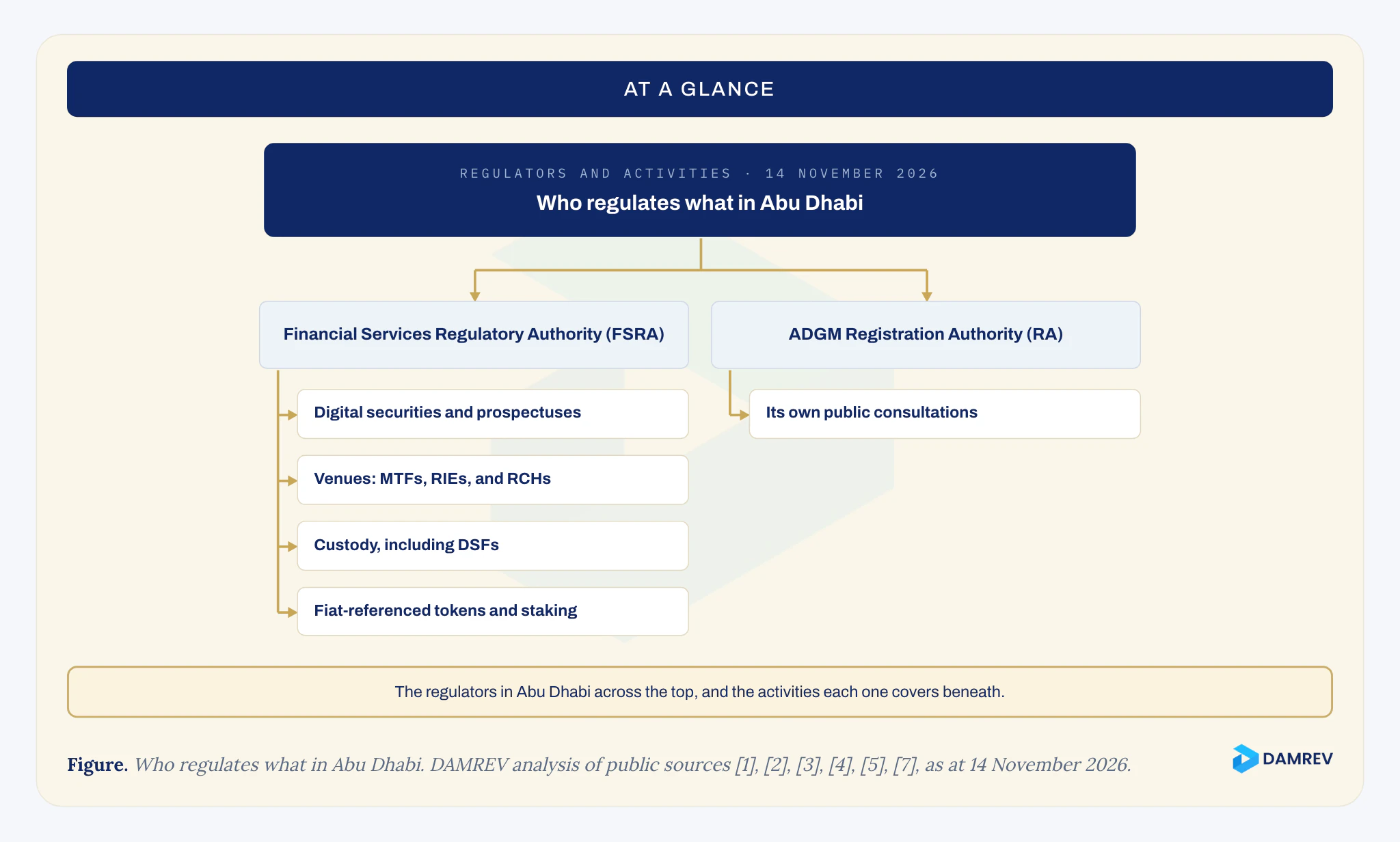
Inside ADGM, the FSRA regulates digital securities, trading venues, custody, fiat-referenced tokens, and staking. It issues guidance under FSMR, decides case by case whether a token is a Security, and enforces its frameworks. The ADGM Registration Authority runs its own public consultations, separate from the FSRA's1, 2, 3, 5.
Investor access
Retail investors can trade Digital Securities on a multilateral trading facility only under an Approved Prospectus written for retail investors. A facility may also trade securities from a non-retail Exempt Offer, or securities already admitted to a Recognised Investment Exchange. Offers are priced in fiat currency, and subscriptions may be paid in Accepted Virtual Assets1.
Settlement
Inside ADGM, settlement can run in bank fiat or in one of nine accepted fiat-referenced tokens, each on its listed networks only. The FSRA list of 1 September 2026 names EURC, PYUSD, RLUSD, USD1, USDC, USDG, USDP, USDT, and USDU. Digital Securities settle through a Recognised Clearing House or a Digital Settlement Facility6, 1.
The network matters as much as the token. USDC is listed on Stellar, Solana, and Ethereum, among others, while USDT and EURC are not listed on Stellar6.
A firm handling these tokens for clients needs an FSRA Financial Services Permission and follows the Client FRT rules6, 2. The list also states that inclusion does not mean acceptance for clients outside ADGM6.
Sandbox and pilots
ADGM offers RegLab, a controlled environment in which startups and regulated firms test innovative fintech solutions, and the ADGM Digital Lab, with an application programming interface (API) Gateway and a Digital Testing Environment. The RegLab page gives no current application window, so an intake date cannot be assumed from it8.
Risks and controls
ADGM's regime is in force and enforced. An issuer weighs the prospectus timetable, the separation of custody from trading, the capital an exchange holds, the HAYVN enforcement precedent, open consultations, and the narrower stablecoin position for clients onshore in the United Arab Emirates (UAE), which the ADGM list does not cover1, 4, 5, 6.
Seven risks
Choose a risk
The risk
A public offer of Securities needs an Approved Prospectus applied for at least 20 days ahead unless an Exempt Offer applies, which sets the offer's timetable1.
What the rules require
A public offer of Securities needs an Approved Prospectus applied for at least 20 days ahead, unless an Exempt Offer applies1.
The risk
Trading and safekeeping sit in different entities: a Recognised Investment Exchange's custody is in a separately licensed entity, and a Digital Settlement Facility stays separate from the businesses it serves1.
What the rules require
Custody for a Recognised Investment Exchange sits in a separately licensed entity, and a Digital Settlement Facility must be separate from the businesses it serves1.
The risk
Activity through an unlicensed entity can bring fines: the FSRA fined the HAYVN group and its former chief executive 8.85 million US dollars, partly for arranging through an unlicensed special purpose vehicle4.
What the rules require
On 14 April 2025 the FSRA fined the HAYVN group and its former chief executive 8.85 million US dollars in total, for breaches that included arranging through an unlicensed special purpose vehicle4.
The risk
Fee and rulebook terms can still change: Consultation Paper 5 of 2026 is open until 30 November 2026, and the Consultation Paper 6 revisions are not final5.
What the rules require
Consultation Paper 5 of 2026 is open until 30 November 2026, and fee and general rulebook revisions under Consultation Paper 6 of 2026 are not final5.
The risk
Settlement for onshore UAE clients runs in licensed UAE dirham tokens or registered foreign tokens, and foreign tokens are limited to registered issuers and virtual asset purchases9.
What the rules require
Under the Central Bank of the UAE (CBUAE) Payment Token Services Regulation, onshore settlement runs in licensed UAE dirham tokens or registered foreign tokens, and foreign tokens are limited to registered issuers and virtual asset purchases9.
Our position
DAMREV Labs, LLC, a Wyoming company, builds and operates the software. It is not licensed as a financial services or virtual asset firm, and no DAMREV entity claims a regulatory permission in Abu Dhabi.
The regulated functions sit with licensed partners, entity by entity, and this page names none of them. It sets out the public rules in Abu Dhabi as at 14 November 2026, and it is analysis of public sources, not legal advice. Nothing on it is an offer of any service in Abu Dhabi.
Common questions
Short answers to the questions people ask most about this topic.
No. A token with the features of a Security under FSMR Schedule 1 is a Digital Security, and fund units, debentures, and sukuk are all Securities. The FSRA decides case by case and may deem a token a Security under section 58(2)(b) of FSMR.
The Financial Services Regulatory Authority regulates digital securities, trading venues, custody, fiat-referenced tokens, and staking inside ADGM, and it enforces those frameworks. The ADGM Registration Authority runs its own public consultations.
The FSRA list of 1 September 2026 names nine fiat-referenced tokens: EURC, PYUSD, RLUSD, USD1, USDC, USDG, USDP, USDT, and USDU. Each is accepted on its listed networks only, and USDT and EURC are not listed on Stellar.
Yes, under an Approved Prospectus written for retail investors. A multilateral trading facility may also trade Digital Securities from a non-retail Exempt Offer. Offers are priced in fiat currency, with subscriptions payable in Accepted Virtual Assets.
No. A multilateral trading facility may not settle Digital Securities itself and uses a Recognised Clearing House or a Digital Settlement Facility. A Recognised Investment Exchange keeps custody in a separately licensed entity, and a settlement facility must be separate from the businesses it serves.
No. The FSRA list of accepted fiat-referenced tokens, dated 1 September 2026, states that inclusion does not mean acceptance for clients outside ADGM.
Yes. On 14 April 2025 it fined the HAYVN group and its former chief executive 8.85 million US dollars in total, for breaches that included arranging through an unlicensed special purpose vehicle.
No. DAMREV Labs, LLC does not hold a financial services or virtual asset licence, and no DAMREV entity claims a regulatory permission in Abu Dhabi. Regulated functions sit with licensed partners, entity by entity.
Where next
Abu Dhabi sits within the Middle East and Asia group of DAMREV's jurisdictions. These pages compare it with its neighbours and set out how settlement and compliance are designed.
Position as of 14 November 2026: the law and sources on this page are stated as at that date. Last updated:
Insights

Since 17 September 2026 a tokenized securities venue may run automated liquidity pools in tokenized listed stock without registering as an exchange, on conditions.

The GENIUS Act binds payment stablecoin issuers from 18 January 2027, not the firms that hold or settle in stablecoins. Service providers follow in 2028.

The CLARITY Act stalled on a 49 to 50 vote, so tokenized securities stay with the Securities and Exchange Commission, as before.

Guernsey's guidance of 24 July 2026 lets a fund or issuer record and transfer its investments as tokens, under the regimes already applying to it.
Tell us what you want to tokenize.
We will show you how DAMREV can run it.