



Classify the token
Apply MAS's substance-over-form approach and its case studies to decide whether the token is a share, a debenture, a CIS unit, or a DPT1.
Section
Structuring
The instrument classes DAMREV structures, and the four situations that bring most clients here.
Not sure which page answers your question? A structuring review starts with that conversation.
Start a Structuring ReviewSection
Services
The ladder, from a paid first look to a programme DAMREV operates for you.
Not sure which page answers your question? A structuring review starts with that conversation.
Start a Structuring ReviewSection
Platform
Eight capabilities and twenty named engines. DAMREV runs its own instruments on it.
Not sure which page answers your question? A structuring review starts with that conversation.
Start a Structuring ReviewSection
Tokenized IPO
A tokenized listing is a listing first. This section is about whether yours is ready.
Not sure which page answers your question? A structuring review starts with that conversation.
Start a Structuring ReviewSection
Compliance
Written to be read by a regulator, a counterparty or an auditor without a call first.
The Americas & the Caribbean
Europe
Not sure which page answers your question? A structuring review starts with that conversation.
Start a Structuring ReviewSection
Insights
The published record. Papers, positions and the vocabulary, all dated.
Not sure which page answers your question? A structuring review starts with that conversation.
Start a Structuring ReviewNot sure which page answers your question? A structuring review starts with that conversation.
Start a Structuring ReviewJurisdictions · The Middle East and Asia
In Singapore, the treatment of tokenized assets depends on the instrument's legal classification, the issuer, the offering arrangements, and the regulated functions performed. The licences, approvals, and exemptions that apply are assessed for each structure.
Settlement can run in Singapore dollars or other fiat through a bank, digital payment tokens are handled under Payment Services Act licences, and offers reach investors through a registered prospectus or an exemption, such as an offer to institutional or accredited investors.
DAMREV Labs, LLC, organised in Wyoming, builds and operates the software, and the regulated functions sit with licensed partners, entity by entity. No DAMREV entity claims a regulatory permission in Singapore on this page.
Position as of 14 November 2026
The framework
Singapore regulates tokenized capital markets products under its existing securities laws. The Monetary Authority of Singapore (MAS) applies the Securities and Futures Act 2001 (SFA) and the Financial Advisers Act 2001 (FAA) to them, regulates digital payment token (DPT) services under the Payment Services Act 2019 (PS Act), and takes a technology-neutral, substance-over-form approach1, 2.
MAS's Guide on the Tokenisation of Capital Markets Products, last updated on 14 November 2025, replaces the earlier Guide on Digital Token Offerings1.
MAS describes the Guide as a general reference, not a binding statement, so each obligation comes from the statutes1. Those statutes can reach acts outside Singapore: section 339 of the SFA and section 6(2) of the FAA apply where an act has a substantial effect in Singapore1.
Providers that serve only customers outside Singapore fall under the digital token service provider (DTSP) regime in Part 9 of the Financial Services and Markets Act 2022 (FSMA), in force since 30 June 20253. MAS is also the authority consulting on a single-currency stablecoin regime, drafted as amendments to the PS Act4.
The rules
The statutes are settled and the stablecoin regime is not. The SFA, the FAA, and the PS Act are in force, the DTSP regime has applied since 30 June 2025, the Tokenisation Guide is guidance, and the stablecoin amendments and the CIS Code amendments are consultations with no final rules1, 2, 3, 4, 6.
| Instrument | Date | Status |
|---|---|---|
| Securities and Futures Act 2001 and Financial Advisers Act 20011 | 2001 | Law in force |
| Payment Services Act 2019, DPT services2 | 2019 | Law in force |
| Financial Services and Markets Act 2022, Part 9, DTSP regime3 | In force from 30 June 2025 | Law in force |
| Guide on the Tokenisation of Capital Markets Products1 | 14 November 2025 | Guidance; not a binding statement |
| Consultation Paper P014-2026, Code on Collective Investment Schemes amendments6 | July 2026; closed 10 August 2026 | Consultation; proposals not binding |
| Draft PS Act amendments for the single-currency stablecoin framework4 | 1 September to 16 October 2026 | Consultation; no effective date stated |
Project Guardian, Global Layer One (GL1), BLOOM, and the SGD Testnet are industry initiatives, not law7, 8, 9. The Guardian Fixed Income and Funds Frameworks are industry frameworks rather than rules, so a structure built on them still answers to the SFA and FAA7, 1.
The Guide replaced the Guide on Digital Token Offerings and keeps its case studies illustrative1.
Classification
MAS classifies tokens by substance, using illustrative case studies in its Guide. A company ownership token is a share, a pooled portfolio token is a CIS unit, loan and bond-claim tokens illustrate debentures, and a US dollar-pegged token with a redemption right may fall under the PS Act1.
The case studies cover the main categories. Case 1 treats a token of company ownership as a share, and Case 6 treats a token of a pooled portfolio as a unit in a CIS1. Cases 2 and 5 use a platform-funded loan token and a claim on a bond held through a trust to illustrate debentures1.
Case 3 discusses a diamond token with a buy-back obligation under debentures, and Case 7 discusses fractional interests in gold under CIS units and asset-backed tokens1.
For stablecoins, Case 4 places a US dollar-pegged token with a redemption right potentially under the PS Act1. Under the stablecoin proposal, stablecoins of issuers that MAS has not licensed would be treated as DPTs4.
How it works
In Singapore, the steps set out here run in five stages. Classify the token by substance, prepare a registered prospectus or rely on an exemption, license the platform or have the market approved or recognised, license the custodian and the adviser, and choose a settlement asset the rules permit1.
Apply MAS's substance-over-form approach and its case studies to decide whether the token is a share, a debenture, a CIS unit, or a DPT1.
An offer of tokenized securities, securities-based derivatives, or CIS units complies with SFA Part 13, generally with a registered prospectus unless an exemption applies1.
A primary market platform may need a capital markets services (CMS) licence, and an organised market generally needs approval as an approved exchange or recognition as a recognised market operator (RMO), unless exempt1.
Custody of specified products needs a CMS licence unless exempt, and advice needs a financial adviser's licence or an exemption1.
Licences
Each regulated function carries its own MAS licence or exemption. Issuers follow the SFA Part 13 offer rules, platforms need a CMS licence or market approval or recognition, custodians of specified products need a CMS licence, advisers need a financial adviser's licence, and DPT custody sits under a PS Act licence1, 2.
Control decides custody. MAS states that control of a token can exist even where a person holds only one of several keys or key shards, so a key-sharing arrangement can still be custody1.
Holders of a CMS licence are exempt from the financial adviser's licence but must notify MAS1. For DPTs, Bsquared Technology's Major Payment Institution licence covered DPT services until MAS revoked it2.
Under the stablecoin proposal, only issuers holding a MAS licence could describe themselves as licensed MAS-regulated stablecoin issuers4.
Who regulates what
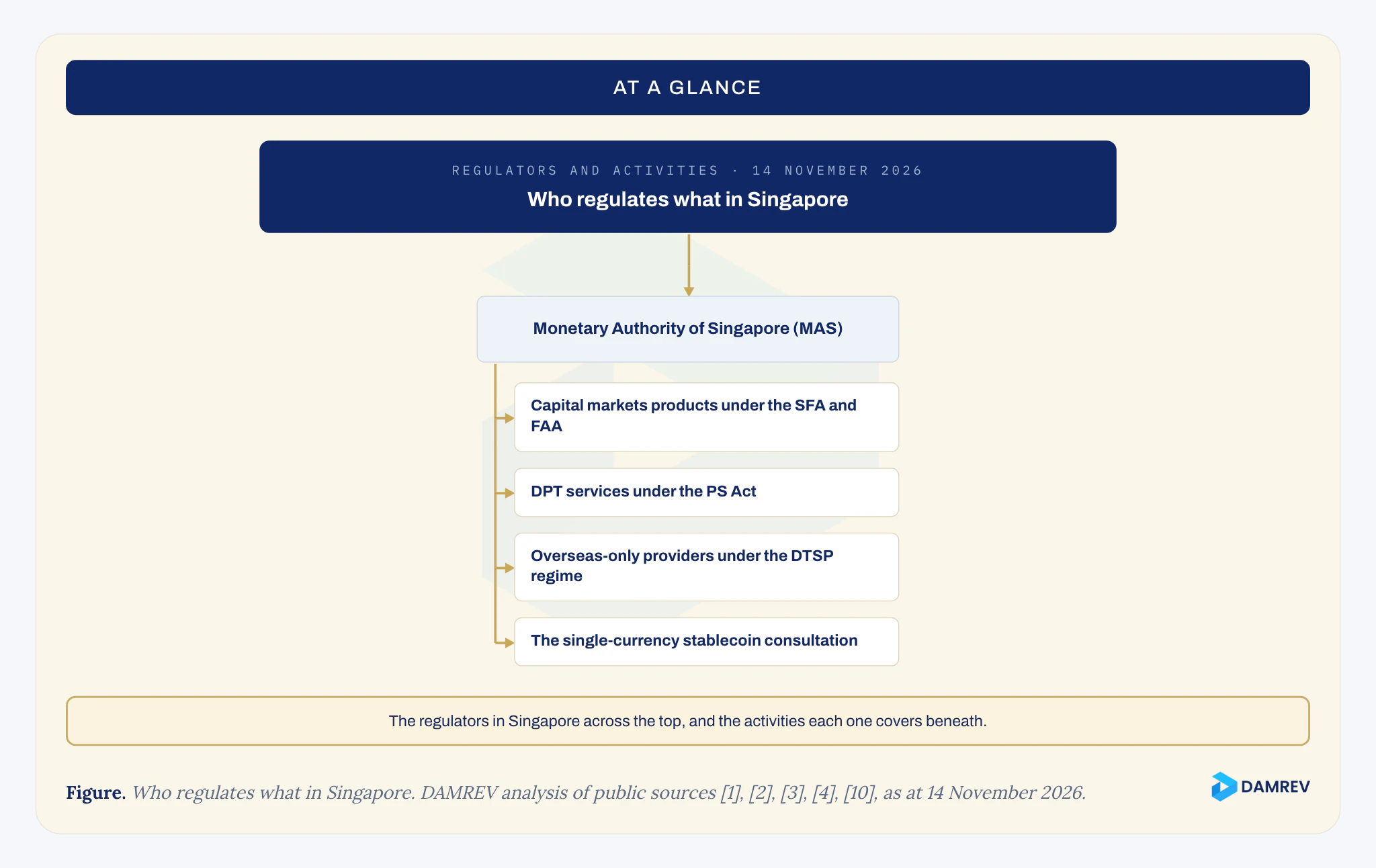
In Singapore, MAS administers the SFA and FAA for tokenized capital markets products, regulates DPT services under the PS Act and overseas-only providers under the DTSP regime, and leads the stablecoin consultation. Its Future of Finance Institute supports innovation, while MAS continues to set policy1, 2, 3, 4, 10.
MAS's enforcement extends to licence revocation: it revoked the Major Payment Institution licence of Bsquared Technology with effect from 14 May 20262.
Investor access
Offers of tokenized securities reach investors through a registered prospectus or an exemption. The exemptions include small personal offers up to 5 million Singapore dollars in 12 months, private placements to up to 50 persons in 12 months, and offers to institutional or accredited investors. Complex tokenized products carry enhanced safeguards1.
Settlement
Settlement in Singapore can run in Singapore dollars or other fiat through a bank, with no stablecoin-specific condition. USDC and USDT are handled as DPTs, with consumer safeguards, by firms licensed under the PS Act. Wholesale central bank digital currency (CBDC) is available to institutional investors in trials only, and no MAS-regulated stablecoin exists1, 4, 11.
Tokenised MAS Bill TD26100F, issued on 23 September 2026, settled in wholesale CBDC on the SGD Testnet11. DBS, OCBC, and UOB completed live interbank overnight lending in Singapore dollar wholesale CBDC on 13 November 20259. BLOOM is a MAS initiative to extend settlement capabilities, and, like the SGD Testnet, it is an industry initiative, not law8, 9.
Custody, transfer, and exchange of DPTs need a PS Act licence, such as a Major Payment Institution licence5, 2. The stablecoin consultation that ran from 1 September to 16 October 2026 sets no effective date, so settlement in a MAS-regulated stablecoin is not available as at 14 November 20264.
Sandbox and pilots
MAS describes three sandbox options: Sandbox, Sandbox Express, and Sandbox Plus. Its page, last updated on 29 April 2024, does not state whether applications are open. MAS's Guide adds that offerings of tokenized capital markets products would ordinarily fall outside the sandbox, so an offer still follows the SFA12, 1.
MAS announced the Future of Finance Institute (FFI) on 25 June 2026, focused initially on artificial intelligence and tokenization, and MAS continues to set policy10. The FFI commenced operations on 3 November 202613.
The wholesale testing work runs through industry initiatives rather than a sandbox: Project Guardian, GL1, BLOOM, and the SGD Testnet are not law7, 8, 9.
Risks and controls
Singapore's regime is in force and actively supervised. An issuer weighs MAS's licence revocation record, its strict line on overseas-only providers, the proposed stablecoin conditions, the reach of Singapore law to acts outside Singapore, custody by key share, and the limits of guidance. A reply from MAS to an enquiry is not an approval2, 3, 4, 1.
Six risks
Choose a risk
The risk
MAS can take a licence away: it revoked Bsquared Technology's Major Payment Institution licence from 14 May 2026, citing weak risk management and false or misleading information2.
What the rules require
MAS revoked Bsquared Technology's Major Payment Institution licence with effect from 14 May 2026, citing weak risk management and false or misleading information given to MAS2.
The risk
A provider with business only outside Singapore generally cannot obtain a DTSP licence, since MAS states that as a general rule it does not issue one3.
What the rules require
MAS states that, as a general rule, it does not issue a DTSP licence, citing money laundering risk and the limits of supervising offshore business3.
The risk
The proposal prohibits interest on MAS-regulated stablecoins and requires stress testing and recovery and wind-down plans, conditions an issuer may face if it is adopted4.
What the rules require
The proposal would prohibit interest on MAS-regulated stablecoins and require stress testing and recovery and wind-down plans4.
The risk
Acts done outside Singapore can still fall under section 339 of the SFA and section 6(2) of the FAA where they have a substantial effect in Singapore1.
What the rules require
Section 339 of the SFA and section 6(2) of the FAA can reach acts outside Singapore that have a substantial effect in Singapore1.
Our position
DAMREV Labs, LLC, a Wyoming company, builds and operates the software. It is not licensed as a financial services or virtual asset firm, and no DAMREV entity claims a regulatory permission in Singapore.
The regulated functions sit with licensed partners, entity by entity, and this page names none of them. It sets out the public rules in Singapore as at 14 November 2026, and it is analysis of public sources, not legal advice. Nothing on it is an offer of any service in Singapore.
Common questions
Short answers to the questions people ask most about this topic.
No. MAS applies a technology-neutral, substance-over-form approach. A company ownership token is a share and a pooled portfolio token is a unit in a collective investment scheme, so the Securities and Futures Act and the Financial Advisers Act apply as they would to the same product off the ledger.
The Monetary Authority of Singapore. It administers the Securities and Futures Act and the Financial Advisers Act for capital markets products, the Payment Services Act for digital payment token services, and the digital token service provider regime for providers serving only overseas customers.
No. MAS's Guide on the Tokenisation of Capital Markets Products, last updated on 14 November 2025, is a general reference, not a binding statement. It replaced the Guide on Digital Token Offerings, and obligations come from the statutes.
No. MAS consulted from 1 September to 16 October 2026 on Payment Services Act amendments for single-currency stablecoins, and no effective date is set. Under the proposal, stablecoins of unlicensed issuers would be treated as digital payment tokens.
Small personal offers up to 5 million Singapore dollars in 12 months, private placements to up to 50 persons in 12 months, and offers to institutional or accredited investors. Complex tokenized products also require enhanced safeguards, including investment knowledge assessments.
Such providers fall under the digital token service provider regime, in force since 30 June 2025. MAS states that, as a general rule, it does not issue that licence, citing money laundering risk and the limits of supervising offshore business.
In a trial. Tokenised MAS Bill TD26100F, issued on 23 September 2026, settled in wholesale central bank digital currency on the SGD Testnet, and Tokenised MAS Bills are open only to institutional investors.
No. DAMREV Labs, LLC does not hold a financial services or virtual asset licence, and no DAMREV entity claims a regulatory permission in Singapore. Regulated functions sit with licensed partners, entity by entity.
Where next
Singapore sits within the Middle East and Asia group of DAMREV's jurisdictions. These pages compare it with its neighbours and set out how settlement and compliance are designed.
Position as of 14 November 2026: the law and sources on this page are stated as at that date. Last updated:
Insights

Since 17 September 2026 a tokenized securities venue may run automated liquidity pools in tokenized listed stock without registering as an exchange, on conditions.

The GENIUS Act binds payment stablecoin issuers from 18 January 2027, not the firms that hold or settle in stablecoins. Service providers follow in 2028.

The CLARITY Act stalled on a 49 to 50 vote, so tokenized securities stay with the Securities and Exchange Commission, as before.

Guernsey's guidance of 24 July 2026 lets a fund or issuer record and transfer its investments as tokens, under the regimes already applying to it.
Tell us what you want to tokenize.
We will show you how DAMREV can run it.
