


Comparison
Tokenized or Conventional
Choose a tokenized listing when your shares carry eligibility or transfer rules worth enforcing at every transfer, and your venue and intermediaries can work with a tokenized instrument. Choose a conventional listing when they cannot, or when the rules are simple. The investor protections are identical on either route.

Side by side
Where do the two routes actually differ?
In how the shares are operated, not in what the company owes investors. A conventional listing keeps the register and applies restrictions through intermediaries who reconcile their records. A tokenized listing encodes them into the instrument, so they are applied at every transfer and recorded as they happen.
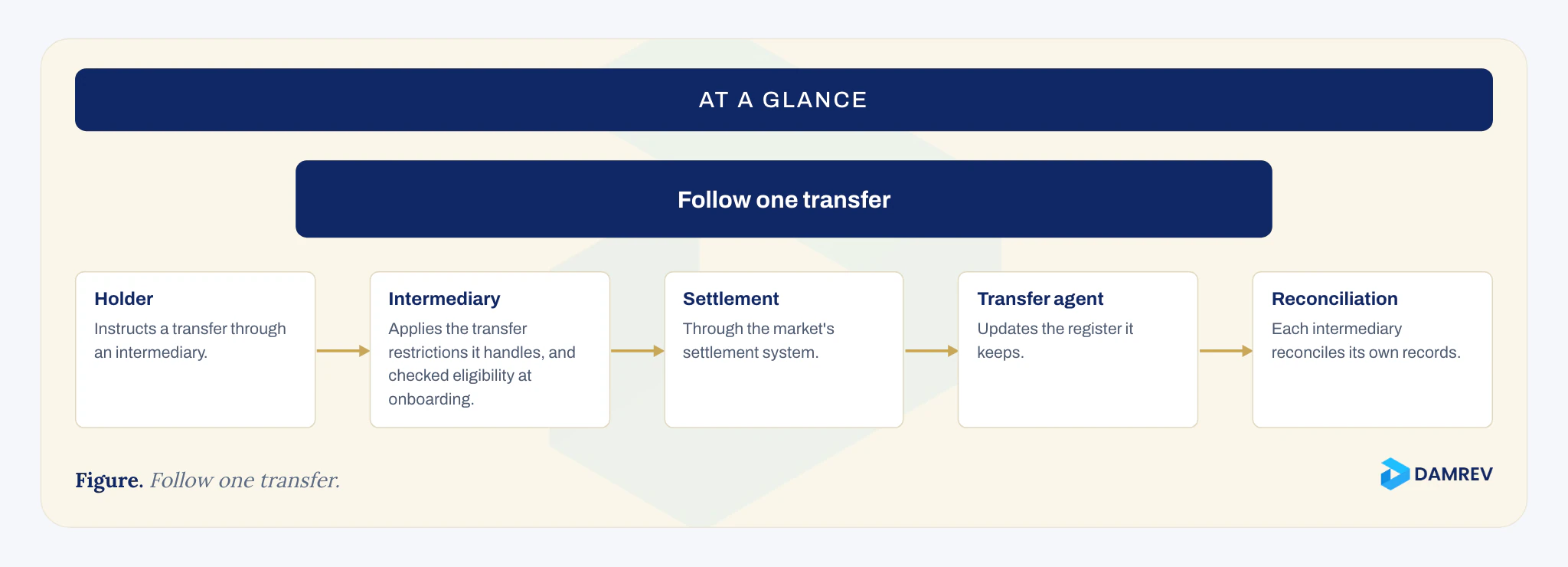
- Follow one transfer
- Holder: Instructs a transfer through an intermediary.
- Intermediary: Applies the transfer restrictions it handles, and checked eligibility at onboarding.
- Settlement: Through the market's settlement system.
- Transfer agent: Updates the register it keeps.
- Reconciliation: Each intermediary reconciles its own records.
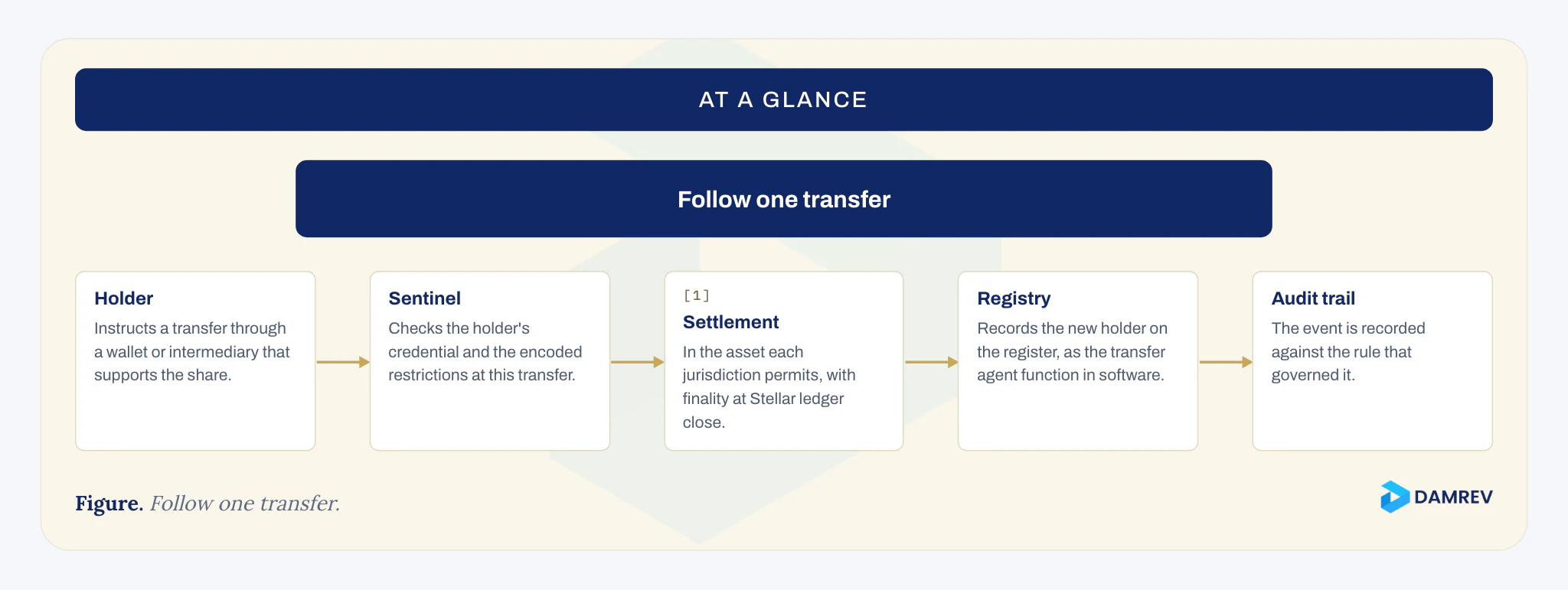
- Follow one transfer
- Holder: Instructs a transfer through a wallet or intermediary that supports the share.
- Sentinel: Checks the holder's credential and the encoded restrictions at this transfer.
- Settlement: In the asset each jurisdiction permits, with finality at Stellar ledger close. ([1])
- Registry: Records the new holder on the register, as the transfer agent function in software.
- Audit trail: The event is recorded against the rule that governed it.
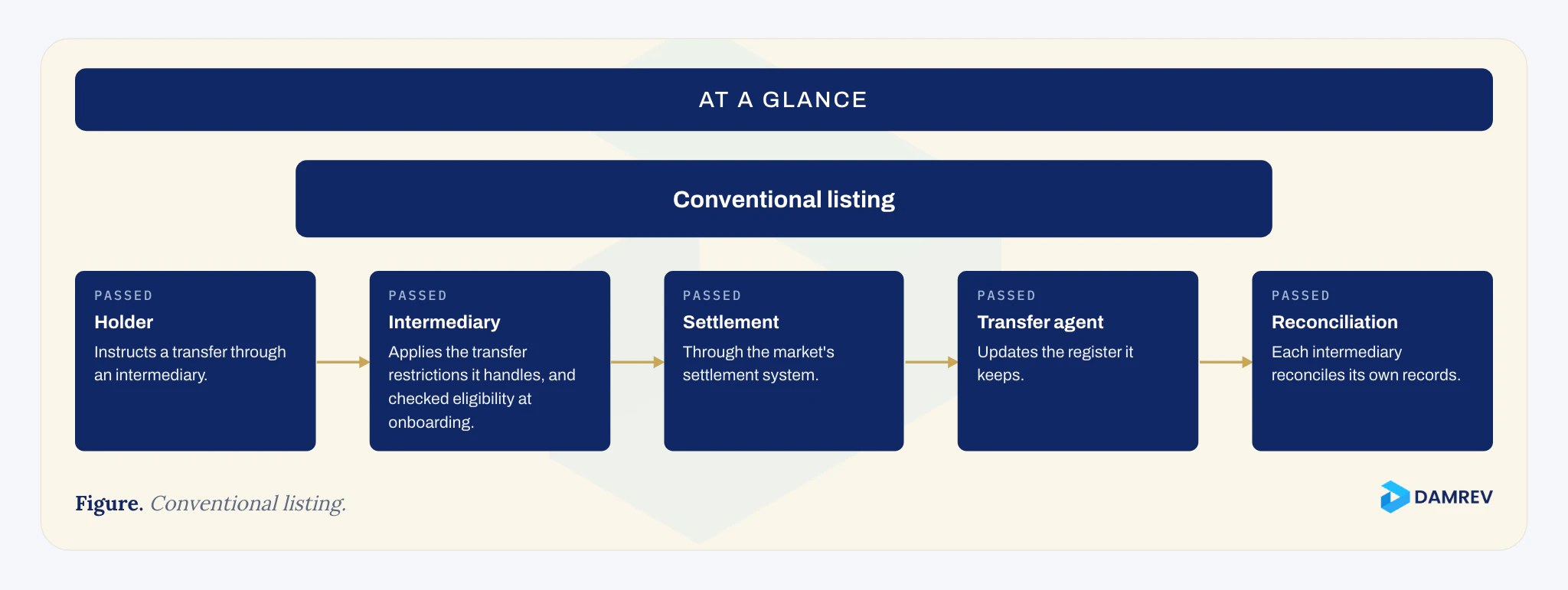
- Conventional listing
- Holder: Instructs a transfer through an intermediary. (Passed)
- Intermediary: Applies the transfer restrictions it handles, and checked eligibility at onboarding. (Passed)
- Settlement: Through the market's settlement system. (Passed)
- Transfer agent: Updates the register it keeps. (Passed)
- Reconciliation: Each intermediary reconciles its own records. (Passed)

- Tokenized listing on DAMREV
- Holder: Instructs a transfer through a wallet or intermediary that supports the share. (Passed)
- Sentinel: Checks the holder's credential and the encoded restrictions at this transfer. (Passed)
- Settlement: In the asset each jurisdiction permits, with finality at Stellar ledger close. (Passed, [1])
- Registry: Records the new holder on the register, as the transfer agent function in software. (Passed)
- Audit trail: The event is recorded against the rule that governed it. (Passed)
Choose a route and follow one transfer through it.
Point by point
Six points where the routes differ
Conventional listing
Kept by the transfer agent, with each intermediary reconciling its own records.
Tokenized listing on DAMREV
Kept by Registry, which performs the transfer-agent function as software.
Conventional listing
Applied by the party handling the transfer.
Conventional listing
Checked by each intermediary at onboarding.
Tokenized listing on DAMREV
Verified by a licensed provider, carried as a credential and checked at each transfer.
Conventional listing
Through the market's settlement system.
Tokenized listing on DAMREV
In the asset each jurisdiction permits, with finality at Stellar ledger close1.
Conventional listing
Processed from records that must be reconciled.
Tokenized listing on DAMREV
Processed against the register as it stood on the record date.
Conventional listing
Assembled from several parties' records.
Tokenized listing on DAMREV
Every event recorded against the rule that governed it.
Decision guide
How do you decide which route suits your listing?
Three questions decide it. If the answer to the first is no, choose a conventional listing for now. If the answers to the second and third are yes, a tokenized listing is worth the work. The Structuring Review answers all three for your company.
Question 1
Can your intended venue and intermediaries work with a tokenized instrument?
Question 2
Do your shares carry eligibility or transfer rules that must hold after listing?
Question 3
Will your holders be able to hold and transfer a tokenized share?
The limit
The question behind all three is whether the company is ready to list at all. Readiness of the board, the controls, the accounts and the register decides both routes, and tokenization does not shorten it.
What stays the same
What stays the same whichever route you choose?
The law and the obligations. The route changes how the shares are operated, not what the company owes investors.
- Securities lawApplies in full on either route. The format of the shares does not change it.
- Listing rulesSet by the venue on either route, and the venue's own rules decide admission.
- Holder protectionsRegistration or exemption, disclosure, eligibility and fair treatment of holders apply on either route.
Common questions
What else do people ask?
Short answers on the comparison: whether a tokenized listing is cheaper or faster, whether a company can start conventional and tokenize later, whether investors get more protection, and which venues accept tokenized listings.
Is a tokenized listing cheaper or faster?
It depends on the programme, and the Structuring Review gives that view for yours. Readiness work is the same on both routes and usually takes the most time.
Can a company start conventional and tokenize later?
It can, where the venue, the intermediaries and the company's documents allow it. Counsel settles how an existing register is brought into a tokenized class.
Does a tokenized listing give investors more protection?
It gives the same legal protection. What it adds is enforcement of the agreed rules at every transfer and a register that records each event as it happens.
Which venues accept tokenized listings?
That is settled for each programme with the venue itself during structuring. DAMREV names no venue here, and the venue's own rules decide admission.
Where next
Where should you go next?
The pages below pick up where this one ends. Start with the one closest to where your asset or programme stands today.
- Tokenized IPOWhat a tokenized initial public offering is, what stays the same as a conventional listing, and how DAMREV prepares and operates the instrument.
- Risks & Failure ModesA register of the ways a tokenized listing can fail, each with the control that addresses it and the party holding it.
- The Securities RegisterHow Registry keeps the register of holders from issuance onwards, performs the transfer-agent function as software, and handles corporate actions.
- Equity & Pre-Listing InstrumentsHow private shares, convertibles, and pre-listing instruments become tokenized equity whose register applies transfer restrictions and processes corporate actions.
References
- 1.Chainstack, "What is Stellar". https://chainstack.com/what-is-stellar/ Also: Stellar developer documentation, "Control access to an asset", https://developers.stellar.org/docs/tokens/control-asset-access
- 2.US Securities and Exchange Commission, Statement on Tokenized Securities, 28 January 2026. https://www.sec.gov/newsroom/speeches-statements/corp-fin-statement-tokenized-securities-012826-statement-tokenized-securities
- 3.European Securities and Markets Authority, statement on the end of transitional periods under MiCA. https://www.esma.europa.eu/sites/default/files/2026-04/ESMA75-113276571-1679_Statement_on_the_end_of_transitional_periods_under_MiCA.pdf
Last updated:




