



Classify the token
Economic reality, not the name, controls: a tokenized share is an equity security, and a third-party linked token is the third party's own security1.
Section
Structuring
The instrument classes DAMREV structures, and the four situations that bring most clients here.
Not sure which page answers your question? A structuring review starts with that conversation.
Start a Structuring ReviewSection
Services
The ladder, from a paid first look to a programme DAMREV operates for you.
Not sure which page answers your question? A structuring review starts with that conversation.
Start a Structuring ReviewSection
Platform
Eight capabilities and twenty named engines. DAMREV runs its own instruments on it.
Not sure which page answers your question? A structuring review starts with that conversation.
Start a Structuring ReviewSection
Tokenized IPO
A tokenized listing is a listing first. This section is about whether yours is ready.
Not sure which page answers your question? A structuring review starts with that conversation.
Start a Structuring ReviewSection
Compliance
Written to be read by a regulator, a counterparty or an auditor without a call first.
The Americas & the Caribbean
Europe
Not sure which page answers your question? A structuring review starts with that conversation.
Start a Structuring ReviewSection
Insights
The published record. Papers, positions and the vocabulary, all dated.
Not sure which page answers your question? A structuring review starts with that conversation.
Start a Structuring ReviewNot sure which page answers your question? A structuring review starts with that conversation.
Start a Structuring ReviewJurisdictions · The Americas and the Caribbean
In the United States, the treatment of tokenized assets depends on the instrument's legal classification, the issuer, the offering arrangements, and the regulated functions performed. The licences, approvals, and exemptions that apply are assessed for each structure.
Settlement can run in US dollars through a bank, and who may invest depends on whether an offering is registered or made under an exemption.
DAMREV Labs, LLC, organised in Wyoming, builds and operates the software, and the regulated functions sit with licensed partners, entity by entity. No DAMREV entity claims a regulatory permission in the United States on this page.
Position as of 14 November 2026
The framework
The United States regulates tokenized securities under its existing securities laws, because the format in which a security is issued does not change how those laws apply. Payment stablecoins sit under a separate statute, the GENIUS Act, and Wyoming adds its own law on digital assets, bank custody, and special purpose depository institutions1, 2, 3, 4.
The Securities and Exchange Commission (SEC) Divisions of Corporation Finance, Trading and Markets, and Investment Management jointly issued a Staff Statement on Tokenized Securities on 28 January 20261. It confirms that the Securities Act, the Exchange Act, and the Investment Company Act apply to a security whatever its format, and that tokenized stock remains an equity security1.
Payment stablecoins sit under the GENIUS Act, Public Law 119-27, enacted on 18 July 2025, with rulemaking by federal regulators, the Treasury Secretary, and state regulators2. The Office of the Comptroller of the Currency (OCC) issued its final rule implementing the Act on 21 October 20265.
Wyoming's digital assets law has been effective since 1 July 20193, its Special Purpose Depository Institutions Act has been in force since 1 October 20194, and the Wyoming Stable Token Commission issues the Frontier Stable Token (FRNT)6.
The rules
The federal securities laws are settled and apply whatever the format. The GENIUS Act is enacted but not yet in force, Commission orders give relief on their own terms, staff no-action positions such as the DTC letter may be modified or revoked, and Regulation Crypto Assets and several stablecoin rules remain proposals1, 2, 7, 9, 10.
| Instrument | Date | Status |
|---|---|---|
| Securities Act, Exchange Act, and Investment Company Act1 | Long-standing; format neutrality confirmed 28 January 2026 | Law in force |
| GENIUS Act, Public Law 119-272 | Enacted 18 July 2025; effective 18 January 20275 | Enacted, not yet in force |
| OCC final rule implementing the GENIUS Act5 | 21 October 2026; effective 18 January 2027 | Final rule, not yet in force |
| Nasdaq tokenized securities order, Release 34-1050477 | 18 March 2026 | Commission order in force |
| Innovation exemption order, Release 34-1064028, 11 | 17 September 2026; runs for five years | Commission order in force |
| SEC staff Statement on Tokenized Securities1 | 28 January 2026 | Staff guidance |
| Depository Trust Company (DTC) pilot no-action letter9 | 11 December 2025 | Staff guidance; may be modified or revoked |
| Regulation Crypto Assets, File S7-2026-2710 | Proposed 18 August 2026; comments closed 20 October 2026 | Proposed rule, not law |
| Federal Deposit Insurance Corporation (FDIC), Treasury, and Federal Reserve GENIUS Act proposals12, 13, 14 | April 2026 to 29 September 2026 | Proposals, not law |
| New York Department of Financial Services (NYDFS) stablecoin regulation15 | Proposed 9 June 2026 | Proposal, not law |
| Wyoming digital assets law, W.S. 34-29-101 to 1043 | Effective 1 July 2019 | State law in force |
| Wyoming Special Purpose Depository Institutions Act4 | Effective 1 October 2019 | State law in force |
| Wyoming Stable Token Amendments, SF002116 | Signed 6 March 2026 | State law in force |
| Wyoming Digital Taxonomy Act, HB016017 | Died in Senate committee 3 March 2026 | Failed bill |
Staff no-action positions such as the DTC letter may be modified or revoked at any time9. The FDIC, Treasury, and Federal Reserve proposals implement parts of the GENIUS Act alongside the OCC's final rule, and the NYDFS proposal of 9 June 2026 is a state regulation that sits alongside the Act12, 13, 14, 15.
On 15 September 2026 the US Senate did not invoke cloture on the CLARITY Act, by 49 votes to 50, and the bill was not enacted. Tokenized securities remain subject to applicable federal and state law, and any regulatory relief applies only within its own terms.
Classification
Classification follows economic reality, not the name or the technology. A tokenized share remains an equity security, a fund share recorded on a ledger remains a fund share, and a third-party linked token is the third party's own security. A payment stablecoin from a permitted issuer is neither a security nor a commodity1, 2, 18.
The staff statement separates issuer-sponsored tokens from third-party models1. A third party that sponsors a synthetic token may itself be an investment company, and structured notes linked to a security typically fall within the security-based swap exclusion1.
No SEC or Commodity Futures Trading Commission (CFTC) statement specific to tokens backed by physical assets had been published as at 14 November 2026. Under the staff statement, economic reality, not the name, controls1.
How it works
The steps set out here for a tokenized structure in the United States run in five stages. Classify the token by its economic reality, register the offering or rely on an exemption, keep the securityholder record through a transfer agent, use a venue and a custodian acting within their permissions, and choose a settlement asset the law permits1.
Economic reality, not the name, controls: a tokenized share is an equity security, and a third-party linked token is the third party's own security1.
Licences
Each regulated function carries its own registration or charter. Issuers register offerings or rely on exemptions, venues need exchange status or the innovation exemption, broker-dealers answer to the Financial Industry Regulatory Authority (FINRA), custodians act as broker-dealers, banks, or trust companies, and payment stablecoin issuers must be permitted issuers1, 25, 2, 8, 21.
Under the order of 18 March 2026, Nasdaq may trade tokenized securities in the DTC pilot7.
On 12 December 2025 the OCC conditionally approved five national trust bank charters22. Wyoming banks that opt in under W.S. 34-29-104 may act as qualified custodian, must maintain control, and may not rehypothecate, and three special purpose depository institutions (SPDIs) file call reports with the Wyoming Division of Banking3, 26.
Only a permitted payment stablecoin issuer may issue a payment stablecoin in the United States, with penalties of up to 1 million US dollars for each knowing violation2.
Who regulates what
The SEC regulates tokenized securities, offerings, venues, and transfer agents, and FINRA supervises broker-dealers. The OCC and other federal and state regulators implement the GENIUS Act for payment stablecoins, the CFTC runs a tokenized collateral pilot, and in Wyoming the Division of Banking supervises SPDIs and runs a fintech sandbox1, 25, 2, 27, 26, 28.
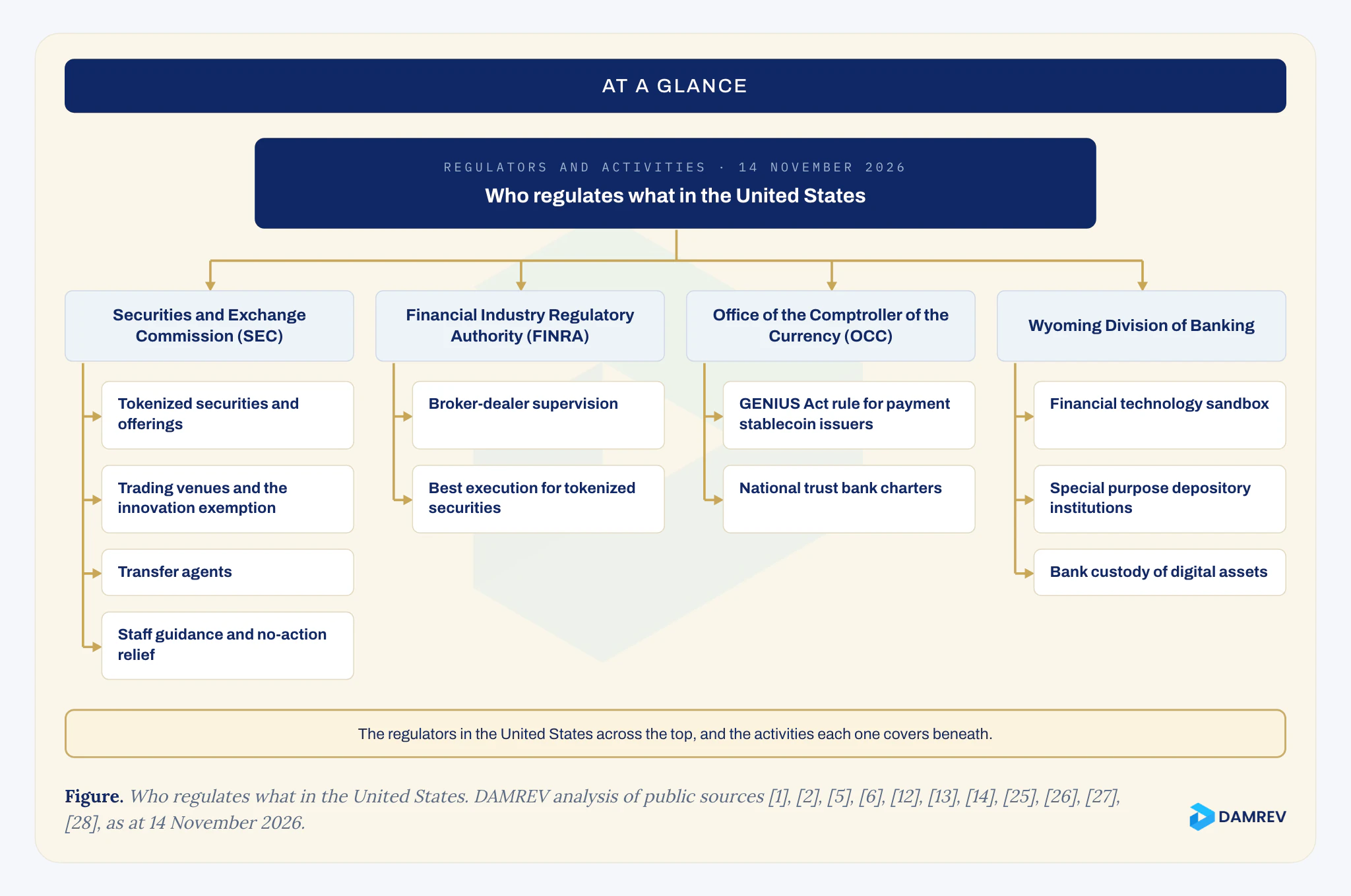
Three SEC divisions, Corporation Finance, Trading and Markets, and Investment Management, issued the staff statement jointly1. The GENIUS Act gives rulemaking to federal regulators, the Treasury Secretary, and state regulators; the OCC's rule is final, while the FDIC, Treasury, and Federal Reserve have issued proposals2, 5, 12, 13, 14.
At state level, the Wyoming Stable Token Commission issues FRNT, which has been public since 7 January 2026 and is overcollateralised at 102 percent6.
Investor access
Access depends on how the offering is made, not on the token. A registered offering reaches the public, as a registered tokenized money market fund shows, while exempt offerings carry limits on amount, solicitation, and purchaser status. The SEC is consulting on adding a professional credential to accredited investor status1, 19, 18, 29.
Settlement
Settlement can run in US dollars through a bank for every class of investor, or in a US dollar stablecoin from a supervised domestic issuer. No comparability determination or accepted list for foreign stablecoins had been published as at 14 November 2026, and outside Wyoming, handling client funds needs state licences or a charter2, 23, 24.
The GENIUS Act and the OCC's implementing rule take effect on 18 January 2027. Issuance of payment stablecoins in the United States is limited to permitted issuers, with separate requirements for foreign issuers. The general prohibition on digital asset service providers offering payment stablecoins from non-permitted issuers begins on 18 July 2028, subject to statutory conditions and exceptions.
Before the GENIUS Act's effective date of 18 January 2027, SEC staff apply a two percent broker-dealer haircut to a US dollar stablecoin issued by a state money transmitter, a state trust company, or a national trust bank that meets reserve, redemption, and attestation conditions24.
National banks need no state money transmitter licence32, Wyoming exempts the custody and transmission of digital assets33, and the GENIUS Act limits stablecoin custody to supervised entities2.
In the derivatives market, the CFTC runs a pilot letting futures commission merchants accept bitcoin, ether, and USDC as margin28. In securities, the DTC pilot covers Russell 1000 securities, US Treasuries, and major index exchange-traded funds9.
Sandbox and pilots
Pilot routes exist at federal and state level, each within its own terms. The innovation exemption runs for five years and covers tokenized NMS stock only, the DTC pilot runs under staff no-action relief, the CFTC runs a tokenized collateral pilot, and the Wyoming Division of Banking runs a fintech sandbox27, 8, 9, 28.
Risks and controls
The securities laws are settled, and the Nasdaq order and the innovation exemption order are in force on their own terms. An issuer weighs revocable staff positions, exemptions bounded by their own terms, the GENIUS Act's dated limits on stablecoins from non-permitted issuers, state licensing outside Wyoming, and an enforcement record that continues on fraud2, 11, 9, 34.
Five risks
Choose a risk
The risk
Staff no-action positions, the DTC letter included, can be modified or revoked at any time, so a structure built on them has no fixed footing, and the DTC relief lapses three years after launch9.
What the rules require
Staff no-action positions, including the DTC letter, may be modified or revoked at any time, and the DTC relief lapses three years after launch9.
The risk
Only tokenized NMS stock benefits from the innovation exemption, so linked securities, security-based swaps, fund units, and debt need another basis11.
What the rules require
The innovation exemption covers tokenized NMS stock only, not linked securities, security-based swaps, fund units, or debt11.
The risk
From three years after enactment, digital asset service providers may not offer US persons a payment stablecoin from a non-permitted issuer, subject to exceptions, which limits its use in a structure2.
What the rules require
From three years after enactment, digital asset service providers may not offer US persons a payment stablecoin from a non-permitted issuer, subject to exceptions2.
Our position
DAMREV Labs, LLC, a Wyoming company, builds and operates the software. It is not licensed as a financial services or virtual asset firm, and no DAMREV entity claims a regulatory permission in the United States.
The regulated functions sit with licensed partners, entity by entity, and this page names none of them. It sets out the public rules in the United States as at 14 November 2026, and it is analysis of public sources, not legal advice. Nothing on it is an offer of any service in the United States.
Common questions
Short answers to the questions people ask most about this topic.
No. SEC staff confirmed on 28 January 2026 that the format in which a security is issued does not affect how the federal securities laws apply. Offers and sales still need registration or an exemption.
The SEC regulates tokenized securities, venues, and transfer agents, and FINRA supervises broker-dealers. Payment stablecoins sit under the GENIUS Act; Wyoming's Division of Banking supervises special purpose depository institutions.
No. On 15 September 2026 the Senate did not invoke cloture on the bill, by 49 votes to 50, and it was not enacted.
The Act and the OCC's implementing rule take effect on 18 January 2027. Issuance is limited to permitted issuers, and the general prohibition on digital asset service providers offering payment stablecoins from non-permitted issuers begins on 18 July 2028, subject to statutory conditions and exceptions.
On stated terms. The innovation exemption of 17 September 2026 relieves a Tokenized Securities Venue from the exchange definition for tokenized NMS stock only, for five years.
US dollars through a bank, for all investors, or a US dollar stablecoin from a supervised domestic issuer meeting the conditions SEC staff set.
Through a registered offering, yes. The Franklin OnChain U.S. Government Money Fund is a registered fund open to US individuals from 20 US dollars. Exempt offerings carry their own limits on solicitation and on who may buy.
No. DAMREV Labs, LLC does not hold a financial services or virtual asset licence, and no DAMREV entity claims a regulatory permission in the United States. Regulated functions sit with licensed partners, entity by entity.
Where next
The United States sits within the Americas and Caribbean group of DAMREV's jurisdictions. These pages compare it with its neighbours and set out how settlement and compliance are designed.
Position as of 14 November 2026: the law and sources on this page are stated as at that date. Last updated:
Insights

Since 17 September 2026 a tokenized securities venue may run automated liquidity pools in tokenized listed stock without registering as an exchange, on conditions.

The GENIUS Act binds payment stablecoin issuers from 18 January 2027, not the firms that hold or settle in stablecoins. Service providers follow in 2028.

The CLARITY Act stalled on a 49 to 50 vote, so tokenized securities stay with the Securities and Exchange Commission, as before.

Guernsey's guidance of 24 July 2026 lets a fund or issuer record and transfer its investments as tokens, under the regimes already applying to it.
Tell us what you want to tokenize.
We will show you how DAMREV can run it.
