


Jurisdictions · Africa
Kenya
In Kenya, the treatment of tokenized assets depends on the instrument's legal classification, the issuer, the offering arrangements, and the regulated functions performed. The licences, approvals, and exemptions that apply are assessed for each structure.
Kenya shillings settle through Kenyan banks, exchanges may list only stablecoins the Central Bank of Kenya has approved from licensed issuers, and an offer that could reach 100 persons needs regulatory approval.
No DAMREV entity claims a regulatory permission in Kenya on this page.
Position as of 14 November 2026

The framework
What does Kenya's framework cover?
Kenya licenses virtual asset services under the Virtual Asset Service Providers Act, 2025 (VASP Act) and its 2026 Regulations, through two regulators. The Capital Markets Authority (CMA) covers exchanges, offerings, and tokenization, the Central Bank of Kenya (CBK) covers wallets, payments, and stablecoins, and tokenized securities stay under capital markets law1, 2.
The VASP Act, Act No. 20 of 2025, commenced on 4 November 20251, 3. The VASP Regulations, 2026 were gazetted on 22 July 2026, as Legal Notice No. 134 of 20262, 4. The Act names the CMA, the CBK, and any public body designated by gazette notice as the relevant regulatory authorities1.
The Act draws its boundary through the definition: "virtual asset" excludes digital representations of fiat currency, securities, and other financial assets1. A tokenized share or bond therefore stays under capital markets law, while a physical-asset-backed token that is not a security or other financial asset falls under the tokenization regime1, 2.
The Regulations reach offshore firms too: a person is deemed to operate in Kenya if it targets Kenyan consumers or derives income from Kenya, with or without a physical presence2.
The rules
Which rules apply in Kenya, and how settled are they?
Kenya's position is settled law. The VASP Act has been in force since 4 November 2025, the Regulations were gazetted on 22 July 2026, and the transition for existing providers ended on 4 November 2026. The CBK checklist and joint notices are guidance, and the CMA's request for proposals is open until 30 November 20261, 2, 3, 4, 7.
| Instrument | Date | Status |
|---|---|---|
| VASP Act, 2025, Act No. 20 of 20251 | Commenced 4 November 20253 | Law in force |
| VASP Regulations, 2026, Legal Notice No. 134 of 20262 | Gazetted 22 July 20264 | Law in force |
| Capital Markets (Public Offers, Listings and Disclosures) Regulations, 2023, Legal Notice No. 1726 | 27 October 2023 | Law in force |
| Finance Act, 2025, excise duty at 10 percent on virtual asset provider fees8 | Effective 1 July 2025 | Law in force |
| Joint CBK and CMA public notice3 | 18 November 2025 | Guidance |
| Joint CBK and CMA public notice on operationalising the Regulations4 | 13 November 2026 | Guidance |
| CBK VASP licensing checklist5 | November 2026 | Guidance |
| CMA request for proposals on capital markets regulations7 | Comments by 30 November 2026 | Consultation |
Classification
How are different token types classified in Kenya?
Classification in Kenya follows the statutory exclusion. A tokenized share, bond, or other security stays under capital markets law and its public offer rules. A physical-asset-backed token that is not a security falls under the tokenization regime, and a stablecoin falls under the CBK's stablecoin regime1, 6, 2.
- Physical-asset tokensA physical-asset-backed token that is not a security or other financial asset falls under the tokenization regime, which requires clear legal rights, verifiable valuation, and evidence of title2.
- StablecoinsStablecoins fall under the CBK regime: the CBK licenses issuance, approves stablecoins and reserve custodians, and may restrict stablecoins issued offshore2.
The tokenization regime sets three conditions for a physical-asset-backed token: clear legal rights, verifiable valuation, and evidence of title2. The same token structured as a security falls under capital markets law instead, because the Act excludes digital representations of securities and other financial assets1.
A tokenized debt instrument that is a security falls under the public offer rules, with CMA approval for any public offer1, 6. The CBK approves stablecoins and their reserve custodians2.
How it works
How does a tokenized instrument become regulated in Kenya?
The steps set out here for a tokenized structure in Kenya run in five stages. Classify the token against the statutory exclusion, form a Kenyan company that meets the licensing conditions, hold the tokenization licence, obtain CMA approval for each offering, and list the token on a licensed token issuance platform1, 2.
Form the applicant
A company registered under the Companies Act, with a Kenyan office, a Kenyan bank account, and at least three directors1.
Hold the licence
The tokenization licence needs paid-up capital of KES 10m and a fee of KES 500,000, and the CMA decides within 30 days of complete documents2.
Approve each offering
Each offering needs separate CMA approval, with a white paper disclosing target market, transfer restrictions, and limits by investor type2.
Create and list the token
Tokens are created on distributed ledger technology, distributed through a primary offering, and listed on a licensed token issuance platform2.
Licences
Which licence does each role need in Kenya?
Paid-up capital varies by licence, and the investment adviser licence requires none. The CMA licenses tokenization offering providers, token issuance platforms, exchanges, brokers, and investment advisers, and the CBK licenses wallet providers. Each extra activity adds 50 percent of the highest category's capital, and the application fee is KES 100,000 per activity2, 5.
No separate custodian category appears: custody sits with the CBK's "Virtual Asset Wallet Provider" licence, and client assets must be segregated and protected from the licensee's creditors2, 1. Outsourcing needs regulator approval 30 days before implementation, and the licensee remains responsible where third parties perform due diligence2, 5.
The tokenization licence, formally the "Virtual Asset Offering Provider: Virtual Asset Tokenization" licence, permits structuring and offering tokenized assets2. A licensee must start business within 12 months of grant2.
Who regulates what
Who regulates what in Kenya?
Two regulators share the regime. The CMA licenses exchanges, brokers, advisers, managers, offering providers, and tokenization and token issuance platforms, and approves public offers. The CBK licenses custodial wallets, payment processors, and stablecoin issuance, approves stablecoins and reserve custodians, and authorises currency conversion1, 2, 6.
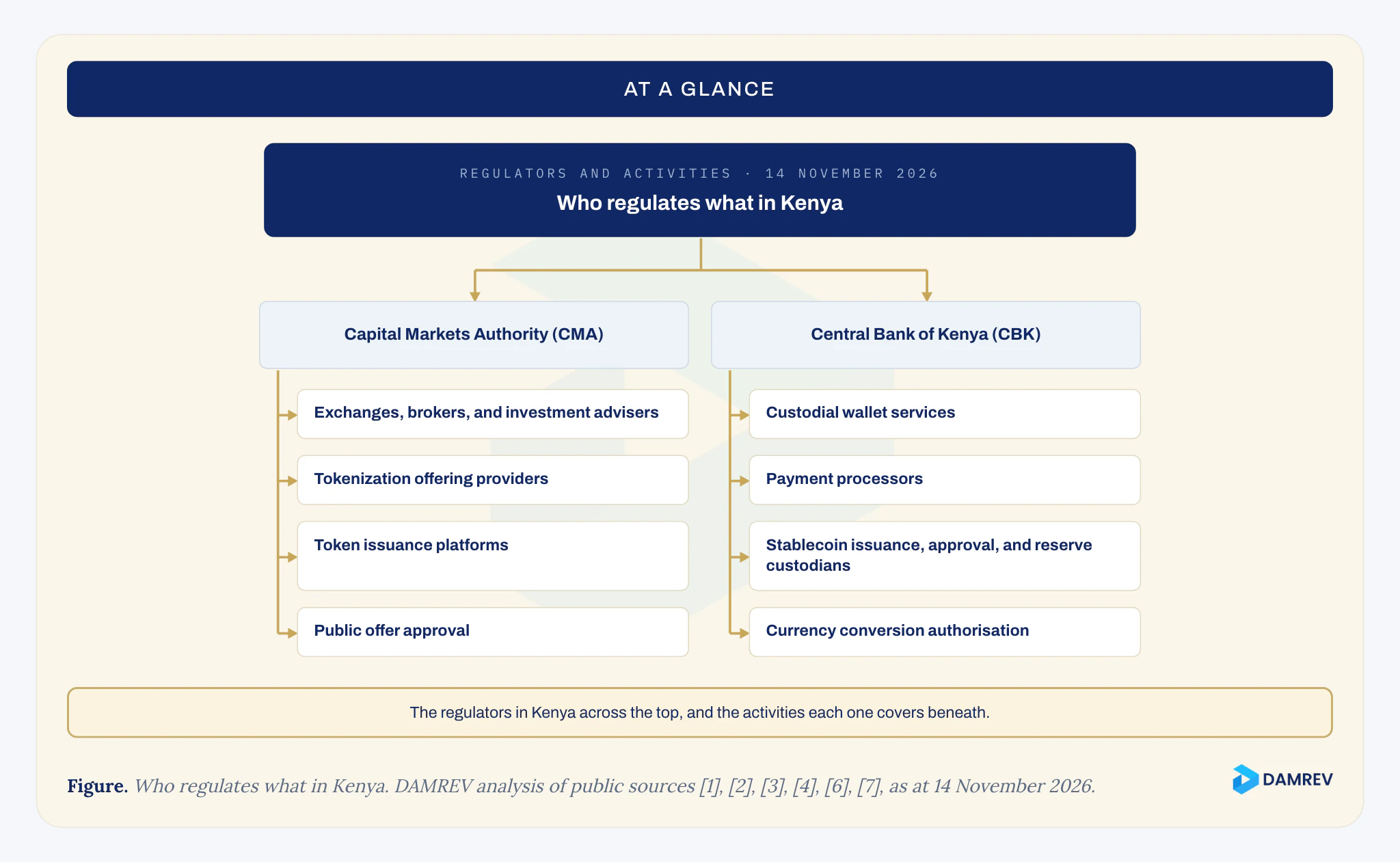
- Who regulates what in Kenya
- Kenya
- Capital Markets Authority (CMA)
- Exchanges, brokers, and investment advisers
- Tokenization offering providers
- Token issuance platforms
- Public offer approval
- Central Bank of Kenya (CBK)
- Custodial wallet services
- Payment processors
- Stablecoin issuance, approval, and reserve custodians
- Currency conversion authorisation
- Capital Markets Authority (CMA)
- The regulators in Kenya across the top, and the activities each one covers beneath.
- Source: DAMREV analysis of public sources [1], [2], [3], [4], [6], [7], as at 14 November 2026.
The Act also allows any public body designated by gazette notice to act as a relevant regulatory authority1. The CBK and the CMA act together through joint public notices, issued on 18 November 2025 and 13 November 20263, 4. The CMA cautioned the public on 16 entities, including crypto firms, on 15 September 20267.
Investor access
How do investors access tokenized products in Kenya?
Investor access in Kenya turns on the public offer threshold. The CMA must approve any public offer, and an offer that could reach 100 persons is public. Private offers are limited to 100 identified persons with no public advertising, and a sophisticated investor includes anyone subscribing at least KES 1m6.
- Private offersPrivate offers are limited to 100 identified persons, with no public advertising, and a sophisticated investor includes anyone subscribing at least KES 1m6.
- Disclosure and advertisingWhite papers disclose target market, transfer restrictions, and limits by investor type, and advertising must give a fair indication of risks2.
Settlement
How does settlement work in Kenya?
Settlement in Kenya runs in Kenya shillings through commercial banks. Exchanges may list only CBK-approved stablecoins from licensed issuers, and none held a licence at 13 November 2026, so USDT and USDC cannot be listed. Converting virtual assets to or from foreign currency needs annual CBK authorisation2, 4.
The CBK licenses wallet custody, payment processors, and stablecoin issuers, while the CMA licenses exchanges and transfer services1, 5, 2. The CBK may direct intermediaries to restrict stablecoins issued outside Kenya2. Bank-settled shillings work today, while on-chain stablecoin settlement depends on CBK approvals that no issuer yet holds2, 4.
Sandbox and pilots
Is there a sandbox or pilot route in Kenya?
The CMA runs a Regulatory Sandbox, and in January 2025 it admitted a firm to test tokenized securities trading, starting with real estate. Outside the sandbox, the tokenization route under the Regulations runs through the licence and separate CMA approval for each offering9, 2.
The CMA announced the admission in a press release of 2 January 20259.
Risks and controls
What should an issuer weigh in Kenya?
Kenya's regime is in force, and licensing is open. An issuer weighs the capital and fees for each activity, the local substance the CBK inspects, the reach of the Regulations to offshore firms, the penalties for unlicensed activity, and the untested boundary between the CMA and CBK regimes, including the CBK's power over offshore stablecoins1, 5, 2.
Six risks
Choose a risk
The risk
A firm outside Kenya is treated as operating there if it targets Kenyan consumers or derives income from Kenya, even with no physical presence2.
What the rules require
A person targeting Kenyan consumers or deriving income from Kenya is deemed to operate there, with or without physical presence2.
Our position
Where does DAMREV stand?
No DAMREV entity claims a regulatory permission in Kenya, and no group entity holds a Kenyan licence.
This page sets out Kenya's public rules as at 14 November 2026. It is analysis of public sources, not legal advice, and nothing on it is an offer of, or an invitation to use, any service in Kenya.
Common questions
What else do people ask?
Short answers to the questions people ask most about this topic.
When did Kenya's virtual asset regime come into force?
The VASP Act, 2025 commenced on 4 November 2025. The Regulations were gazetted on 22 July 2026, as Legal Notice No. 134 of 2026. Existing providers had one year to comply, a window that ended on 4 November 2026, and the joint notice of 13 November 2026 sets no transitional deadline.
Who regulates virtual assets in Kenya?
The Capital Markets Authority licenses exchanges, brokers, advisers, managers, offering providers, and tokenization and token issuance platforms. The Central Bank of Kenya licenses custodial wallets, payment processors, and stablecoin issuance, and approves stablecoins and their reserve custodians.
Is a tokenized share or bond a virtual asset in Kenya?
No. The VASP Act excludes digital representations of securities and other financial assets from "virtual asset", so a tokenized share or bond stays under capital markets law, and any public offer needs CMA approval under the public offer regulations of 2023.
What does the tokenization licence require in Kenya?
Paid-up capital of KES 10m and a KES 500,000 fee. The licence permits structuring and offering tokenized assets, each offering needs separate CMA approval, and tokens are listed on a licensed token issuance platform. The CMA decides within 30 days of complete documents.
Which stablecoins can be listed in Kenya?
Only CBK-approved stablecoins from licensed issuers. None held a licence at 13 November 2026, so USDT and USDC cannot be listed, and the CBK may restrict stablecoins issued outside Kenya.
Does the regime apply to firms outside Kenya?
Yes. The Regulations deem a person to operate in Kenya if it targets Kenyan consumers or derives income from Kenya, with or without physical presence. Unlicensed activity carries fines of up to KES 25m for companies and personal liability for directors.
Does DAMREV hold a licence in Kenya?
No. No group entity holds a Kenyan licence, and nothing on this page is an offer of, or invitation to use, any service in Kenya.
Where next
Where should you go next?
Kenya sits within the African group of DAMREV's jurisdictions. These pages compare it with its neighbours and set out how settlement and compliance are designed.
- JurisdictionsAll twelve jurisdiction pages in one place, grouped by region, each stating its rules as at 14 November 2026.
- BotswanaBotswana's non-bank regulator licenses virtual asset service providers under the Virtual Assets Act, 2025, and pula settles through banks without exchange controls.
- Stablecoins & Payment InfrastructureHow a payment token is structured around its reserve: a licensed issuer, minting against confirmed reserve, eligibility checks at each transfer, and proof of reserve.
- Compliance by Design Position PaperThe compliance by design position paper: what code can enforce in a tokenized instrument, and what only law and licence decide, across twelve jurisdictions.
References
- 1.Virtual Asset Service Providers Act, 2025, Act No. 20 of 2025 (Central Bank of Kenya copy). https://www.centralbank.go.ke/wp-content/uploads/2026/11/Virtual-Asset-Service-Providers-Act-2025.pdf
- 2.Virtual Asset Service Providers Regulations, 2026, Legal Notice No. 134 of 2026 (Central Bank of Kenya copy). https://www.centralbank.go.ke/wp-content/uploads/2026/11/The-Virtual-Asset-Service-Providers-Regulations-2026.pdf
- 3.Central Bank of Kenya and Capital Markets Authority, Public Notice on the Virtual Asset Service Providers Act 2025, 18 November 2025. https://www.centralbank.go.ke/uploads/press_releases/665231223_Public%20Notice%20on%20the%20Virtual%20Assets%20Service%20Providers%20Act%202025.pdf
- 4.Central Bank of Kenya and Capital Markets Authority, Public Notice on the operationalisation of the VASP Regulations, 2026, 13 November 2026. https://www.centralbank.go.ke/wp-content/uploads/2026/11/CBK-CMA-Public-Notice-Operationalisation-of-the-VASP-Regulations-2026-.pdf
- 5.Central Bank of Kenya, VASP Licensing Checklist, November 2026. https://www.centralbank.go.ke/wp-content/uploads/2026/11/VASPs-Licensing-checklist.pdf
- 6.Capital Markets (Public Offers, Listings and Disclosures) Regulations, 2023, Legal Notice No. 172 (Capital Markets Authority copy). https://www.cma.or.ke/download/34/regulations/5018/the-capital-market-public-offers-listing-an_231109_112250.pdf
- 7.Capital Markets Authority, press release index. https://www.cma.or.ke/category/press-release/
- 8.Kenya Revenue Authority, public notice on excise duty introduced by the Finance Act, 2025. https://www.kra.go.ke/news-center/public-notices/2236-imposition-of-excise-duty-on-excisable-goods-services-introduced-by-the-finance-act,-2025
- 9.Capital Markets Authority, press release, 2 January 2025. https://www.cma.or.ke/?p=5523
Position as of 14 November 2026: the law and sources on this page are stated as at that date. Last updated: