


Jurisdictions · Europe
Malta
In Malta, a tokenized financial instrument keeps its legal nature and stays under MiFID II, while crypto-assets fall under the EU Markets in Crypto-Assets Regulation (MiCA), both supervised by the Malta Financial Services Authority (MFSA). Settlement can run in euro through a bank, or in a MiCA-authorised e-money token.
No DAMREV entity claims a regulatory permission in Malta on this page.
Position as of 14 November 2026

The framework
What does Malta's framework cover?
Malta runs two regimes side by side, and the token decides which applies. A token representing a share, bond, or fund unit stays a financial instrument under MiFID II and the Investment Services Act. A crypto-asset that is not a financial instrument falls under MiCA and Malta's Markets in Crypto-Assets Act, Cap. 6471, 2, 3.
- E-money tokensA stablecoin pegged to one currency is issued as an e-money token4
- Open boundaryWhether a fractionalised real-world asset is a financial instrument is still under MFSA consultation1
The MFSA states the principle plainly: tokenisation "does not inherently change legal nature of an asset"1. That sentence decides most of the analysis.
The ledger changes how an instrument is recorded and transferred; it does not change which rulebook applies. A tokenized bond is a bond, a tokenized fund unit is a fund unit, and each carries the investor protections of its asset class.
Cap. 647 has been in force since 30 June 2024, and it gives effect in Malta to MiCA, the EU regulation for crypto-assets that are not financial instruments3. The MFSA issued its MiCA Rulebook, with amendments to its Financial Institutions Rulebook, on 11 March 20254.
The rules
Which rules apply in Malta, and how settled are they?
The position is clearest for crypto-assets and tokenized fund units, and still open for tokenized real-world assets. MiCA and Cap. 647 are law, the transition to them ended on 30 June 2026, the MFSA's fund unit papers are guidance, and its tokenisation consultation is not binding1, 2, 3, 5.
| Instrument | Date | Status |
|---|---|---|
| Markets in Crypto-Assets Act, Cap. 647 | In force since 30 June 2024 | Law in force3 |
| End of the MiCA transitional period in Malta | 30 June 2026 | Law in force; the transition has ended5 |
| MFSA MiCA Rulebook and Financial Institutions Rulebook amendments | 11 March 2025 | Published rulebook4 |
| MFSA position paper on transfer agency for tokenised fund units | 12 June 2025 | Guidance2 |
| MFSA position paper on tokenised fund units as collateral | 10 March 2026 | Guidance2 |
| MFSA and FIAU letter on the transition to crypto-asset licences | 25 June 2026 | Guidance5 |
| MFSA Consultation 02-2026 on tokenisation | Issued 15 May 2026, closed 30 June 2026 | Consultation; proposals not binding1 |
| DLT Pilot Regime, Regulation (EU) 2022/858 | Applied since 23 March 2023 | EU law in force6 |
| ESMA recommendation to make the DLT Pilot Regime permanent | 25 June 2025 | Proposal, not law7 |
| European Commission Market Infrastructure Package | 4 December 2025 | Proposal, not law8 |
Tokenized fund units sit inside the existing fund and MiFID II framework, with the distributed ledger as "a technological and transactional layer", and the fund administrator keeping the official register2. Each fund share class maps to its own segregated token2.
The Market Infrastructure Package would amend the DLT Pilot Regulation and move supervision of crypto-asset service providers to ESMA, but it is a proposal and changes nothing today8.
Classification
How are different token types classified in Malta?
Classification follows the asset, not the technology. Fund unit tokens are financial instruments and, in the MFSA's words, "highly likely" complex instruments. Tokenized debt follows the same technology-neutral rule. A single-currency stablecoin is an e-money token. Fractionalised real-world assets are the one category the MFSA has left open1, 2, 4.
- Fund unitsFinancial instruments, highly likely complex; one segregated token per share class2
- Debt instrumentsSame technology-neutral principle; the MFSA is asking which MiFID II and CSDR rules obstruct them1
- Physical-asset tokensWhether fractionalisation makes them financial instruments is open1
- Single-currency stablecoinsIssued as e-money tokens4
For tokenized debt, the MFSA applies the same principle and asks the market which parts of MiFID II and the Central Securities Depositories Regulation obstruct it, which is a question about friction, not about classification1.
For a token backed by a physical asset, the MFSA says it is "important to assess the extent to which fractionalisation of Real-World Assets would result in these products qualifying as Financial Instruments"1. Until that is settled, each structure is classified on its own facts.
How it works
How does a tokenized instrument become regulated in Malta?
Every structure in Malta follows the same sequence. Classify the token, constitute the vehicle, map each regulated function to its authorisation, disclose the technology in the offering documents, and choose a settlement asset the rules permit. The classification step decides every step after it1, 2, 4.
Constitute the vehicle
A collective investment scheme issuing tokenized units is constituted under the Investment Services Act, 1994, and its administrator keeps the official register2.
Disclose the technology
Offering documents set out the ledger, wallet and custody arrangements, transfer limits, and technology and operational risks2.
Licences
Which licence does each role need in Malta?
Each regulated function carries its own authorisation from the MFSA. Asset-referenced token issuers are authorised, e-money token issuers sit under the Financial Institutions Rulebook, platforms and custodians need crypto-asset service provider authorisation, and distributors of tokenized fund units need MiFID II authorisation2, 4.
- Asset-referenced token issuerMFSA authorisation; crypto-asset white papers notified to the MFSA4
- E-money token issuerChapter 3 of the Financial Institutions Rulebook4
- Platform operator or custodianCrypto-asset service provider authorisation under the MiCA Act4
- Distributor of tokenized fund unitsMiFID II authorisation, conduct, and prudential rules2
Custody is the strictest point. Crypto-asset custody may not be outsourced or delegated to entities that are not authorised crypto-asset service providers5. The DLT Pilot Regulation defines "DLT market infrastructure", and the MFSA uses that definition, but its consultation names no Maltese DLT market infrastructure1.
Who regulates what
Who regulates what in Malta?
The MFSA is the single financial regulator for both regimes. The Financial Intelligence Analysis Unit supervises anti-money laundering, and at EU level the European Securities and Markets Authority (ESMA) reviews national authorisations and issues opinions on crypto-asset services4, 5, 10, 11.
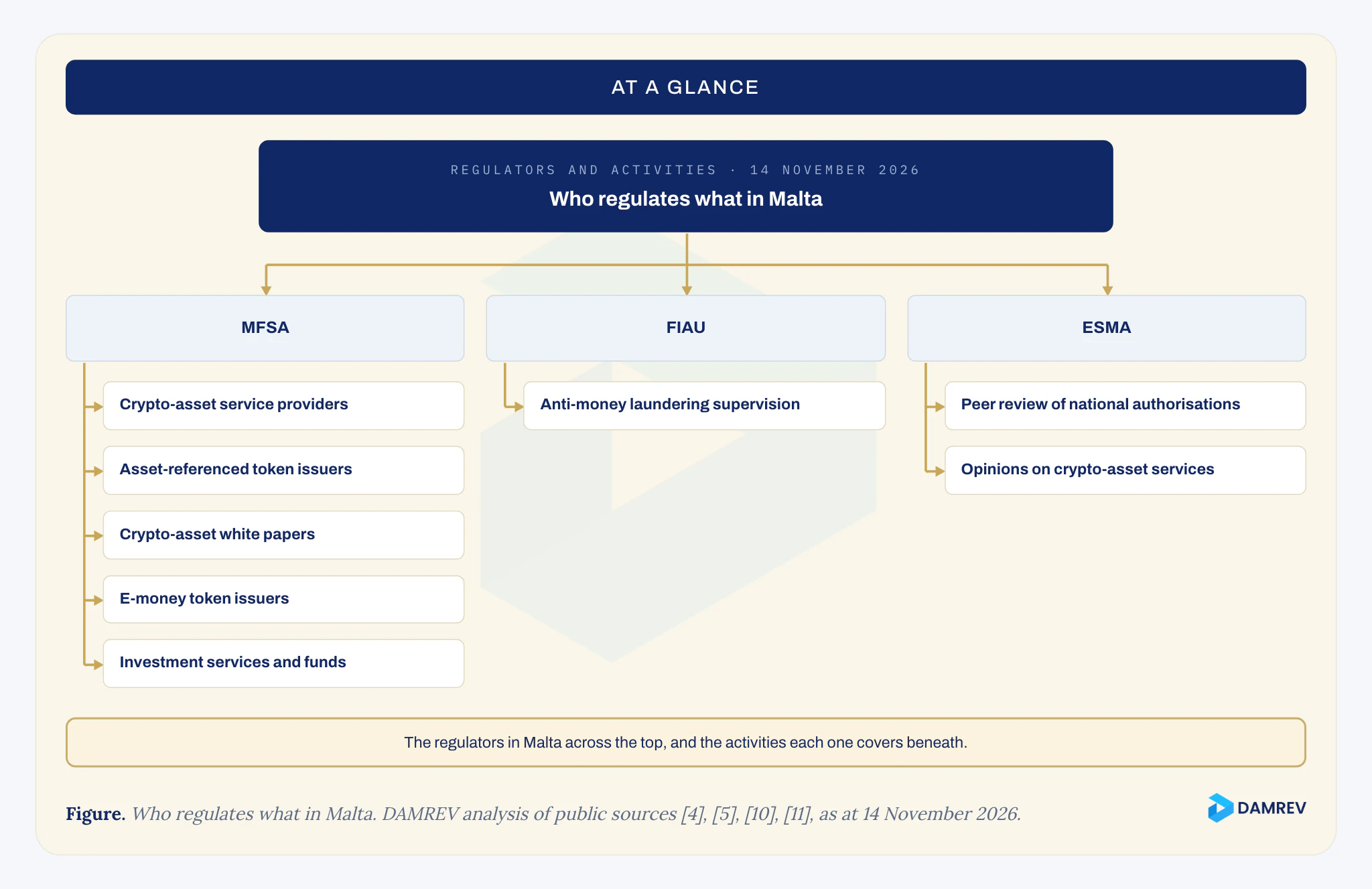
- Who regulates what in Malta
- Malta
- MFSA
- Crypto-asset service providers
- Asset-referenced token issuers
- Crypto-asset white papers
- E-money token issuers
- Investment services and funds
- FIAU
- Anti-money laundering supervision
- ESMA
- Peer review of national authorisations
- Opinions on crypto-asset services
- MFSA
- The regulators in Malta across the top, and the activities each one covers beneath.
- Source: DAMREV analysis of public sources [4], [5], [10], [11], as at 14 November 2026.
Investor access
How do investors access tokenized products in Malta?
Retail investors can hold tokenized fund units, and the protections of the fund regime come with them. Each retail investor is assessed for suitability, and the offering documents must disclose the ledger, custody arrangements, transfer limits, and technology risks. Crypto-asset white papers are notified to the MFSA2, 4.
- SuitabilityRetail investors in tokenized fund units are assessed for suitability2
- DisclosureOffering documents name the ledger, custody, transfer limits, and technology risks2
- White papersCrypto-asset white papers follow the MiCA Rulebook notification process4
Because the MFSA regards tokens of fund units as highly likely to be complex instruments, the suitability test is the gate for retail distribution2. Its consultation asks the market which investor protection measures to prioritise for tokenized real-world assets1. ESMA has asked national authorities to watch the promotion of unregulated services within crypto-asset firms11.
Settlement
How does settlement work in Malta?
Settlement in Malta can run in euro through a bank or in a MiCA-authorised e-money token. The ESMA register lists USDC and EURC as authorised e-money tokens, and USDT does not appear. Under the DLT Pilot Regime, central bank money is preferred where practical6, 9, 12.
ESMA's Opinion of 8 October 2026 states that crypto-asset service providers should not provide services for e-money tokens that are not MiCA-compliant10. Under the DLT Pilot Regime, payments are made in central bank money, including in tokenized form, where practical, and otherwise in commercial bank money or e-money tokens6.
The Eurosystem's Pontes link between distributed ledger platforms and TARGET Services had its initial launch on 21 September 202613.
Sandbox and pilots
Is there a sandbox or pilot route in Malta?
The MFSA runs a FinTech Regulatory Sandbox that allows time-limited testing of technology-enabled financial innovation under prescribed conditions. Its consultation of 15 May 2026 asked which asset class suits Malta's first tokenisation pilot, so a pilot route is under discussion but not yet set1, 14.
Risks and controls
What should an issuer weigh in Malta?
Malta's regime is in force and actively supervised. An issuer weighs strict custody rules, the valuation gap between fund cycles and real-time collateral, ESMA's scrutiny of authorisations, an active enforcement record, and the open classification of real-world asset tokens. None of the published guidance amounts to an approval1, 2, 5, 11, 15.
Six risks
Choose a risk
The risk
Crypto-asset custody stays with authorised crypto-asset service providers, because it may not be outsourced or delegated to any entity that is not one5.
What the rules require
Crypto-asset custody may not be outsourced or delegated to entities that are not authorised crypto-asset service providers5
The risk
Fund units valued on fixed net asset value cycles can diverge from real-time collateral, and the MFSA expects an independent valuer for illiquid instruments2.
What the rules require
The MFSA flags the gap between fixed net asset value cycles and real-time collateral, and expects an independent valuer for illiquid instruments2
The risk
MFSA authorisations face ESMA review: its 2025 peer review found material issues not fully resolved at one authorisation, including governance and conflicts of interest11.
What the rules require
ESMA's 2025 peer review found some material issues not fully resolved at one MFSA authorisation, covering conflicts of interest, governance, intragroup arrangements, technology architecture, and promotion of unregulated services11
The risk
The MFSA uses its enforcement powers actively, reporting 134 enforcement actions, 926,485 euro in penalties, and 49 public warnings in 202415.
What the rules require
In 2024 the MFSA reported 134 enforcement actions, 926,485 euro in penalties, more than 200 inspections, and 49 public warnings15
Our position
Where does DAMREV stand?
DAMREV Labs, LLC, a Wyoming company, builds and operates the software. It is not licensed as a financial services or virtual asset firm, and no DAMREV entity claims a regulatory permission in Malta.
The regulated functions sit with licensed partners, entity by entity, and this page names none of them. It sets out the public rules in Malta as at 14 November 2026, and it is analysis of public sources, not legal advice. Nothing on it is an offer of any service in Malta.
Common questions
What else do people ask?
Short answers to the questions people ask most about this topic.
Does tokenisation change how an instrument is regulated in Malta?
No. The MFSA states that tokenisation does not change the legal nature of an asset. A tokenized share, bond, or fund unit stays a financial instrument under MiFID II, and a fund issuing tokenized units is constituted under the Investment Services Act, with its administrator keeping the official register.
Who regulates tokenized assets in Malta?
The Malta Financial Services Authority supervises both financial instruments and crypto-assets. It authorises crypto-asset service providers and asset-referenced token issuers, receives crypto-asset white papers, and supervises e-money token issuers. The Financial Intelligence Analysis Unit supervises anti-money laundering, and ESMA reviews national authorisations at EU level.
Is the MiCA transition over in Malta?
Yes. Malta's MiCA transitional period ended on 30 June 2026. Firms that provided crypto-asset services under the earlier regime needed crypto-asset service provider authorisation under the Markets in Crypto-Assets Act, Cap. 647, in force since 30 June 2024, to continue.
Which stablecoins can be used for settlement in Malta?
Euro through a bank, or a MiCA-authorised e-money token. The ESMA register lists USDC and EURC as authorised e-money tokens, and USDT does not appear. ESMA's Opinion of 8 October 2026 says crypto-asset service providers should not service e-money tokens that are not MiCA-compliant.
Can retail investors hold tokenized fund units in Malta?
Yes, with the fund regime's protections. Retail investors need a suitability assessment, and the MFSA regards tokens of fund units as financial instruments that are highly likely to be complex. Offering documents must disclose the ledger, custody arrangements, transfer limits, and technology and operational risks.
Can crypto-asset custody be outsourced in Malta?
Only to another authorised crypto-asset service provider. The MFSA and the FIAU state that crypto-asset custody may not be outsourced or delegated to entities that are not authorised crypto-asset service providers, which keeps client assets inside the supervised perimeter.
Is a tokenized real-world asset a financial instrument in Malta?
It depends on the structure. The MFSA's Consultation 02-2026 asks how far fractionalisation of real-world assets makes them financial instruments, and it has not yet decided. Until it does, each structure is classified on its own facts.
Does DAMREV hold a licence in Malta?
No. DAMREV Labs, LLC does not hold a financial services or virtual asset licence, and no DAMREV entity claims a regulatory permission in Malta. Regulated functions sit with licensed partners, entity by entity.
Where next
Where should you go next?
Malta sits within the European group of DAMREV's jurisdictions. These pages compare it with its neighbours and set out how settlement and compliance are designed.
- JurisdictionsAll twelve jurisdiction pages in one place, grouped by region, each stating its rules as at 14 November 2026.
- SwitzerlandSwitzerland's distributed ledger technology law, licensed venues that settle in Swiss franc central bank money, and the status of the stablecoin bill.
- Stablecoins & Payment InfrastructureHow a payment token is structured around its reserve: a licensed issuer, minting against confirmed reserve, eligibility checks at each transfer, and proof of reserve.
- Compliance by Design Position PaperThe compliance by design position paper: what code can enforce in a tokenized instrument, and what only law and licence decide, across twelve jurisdictions.
References
- 1.MFSA, Consultation Document 02-2026, "Tokenisation of Financial Instruments and Real World Assets in Malta", 15 May 2026. https://www.mfsa.mt/wp-content/uploads/2026/05/Tokenisation-of-Financial-Instruments-and-Real-World-Assets-in-Malta.pdf
- 2.MFSA, Position Paper, "Potential Use of Tokenisation of Fund Units: Tokenised Fund Units as Collateral within Permissioned DLT Networks", 10 March 2026. https://www.mfsa.mt/wp-content/uploads/2026/03/MFSA-Position-Paper-Potential-Use-of-Tokenisation-of-Fund-Units-Tokenised-Fund-Units-as-Collateral-within-Permissioned-DLT-Networks.pdf
- 3.legislation.mt, Cap. 647, Markets in Crypto-Assets Act. https://legislation.mt/eli/cap/647/20241230/eng
- 4.MFSA, "Circular to the Industry on the Issuance of the Markets in Crypto-Assets (MiCA) Rulebook and Amendments to the Financial Institutions Rulebook", 11 March 2025. https://mfsa.mt/wp-content/uploads/2025/03/Circular-to-the-Industry-on-the-Issuance-of-the-Markets-in-Crypto-Assets-MiCA-Rulebook-and-Amendments-to-the-Financial-Institutions-Rulebook.pdf
- 5.MFSA and FIAU, "Dear CEO Letter: VFA Licence and Transition to CASP under the Markets in Crypto-Assets Act (MiCA Act)", 25 June 2026. https://www.mfsa.mt/wp-content/uploads/2026/06/Dear-CEO-Letter-VFA-Licence-and-Transition-to-CASP-under-the-Markets-in-Crypto-Assets-Act-MiCA-Act.pdf
- 6.Regulation (EU) 2022/858, DLT Pilot Regime. https://eur-lex.europa.eu/legal-content/EN/TXT/HTML/?uri=CELEX:32022R0858
- 7.ESMA, "ESMA suggests amendments to the DLT Pilot Regime to make it permanent", 25 June 2025. https://www.esma.europa.eu/press-news/esma-news/esma-suggests-amendments-dlt-pilot-regime-make-it-permanent
- 8.MFSA Circular, "EU Commission Market Infrastructure Package (MIP) Proposal as part of the Savings and Investment Union (SIU)", 11 December 2025. https://www.mfsa.mt/wp-content/uploads/2025/12/EU-Commission-Market-Infrastructure-Package-MIP-Proposal-as-part-of-the-Savings-and-Investment-Union-SIU.pdf
- 9.ESMA, interim MiCA register, e-money token white papers. https://www.esma.europa.eu/sites/default/files/2024-12/EMTWP.csv
- 10.ESMA, Opinion on the provision of crypto-asset services in relation to non-MiCA-compliant asset-referenced tokens and e-money tokens, ESMA75-113276571-1742, 8 October 2026. https://www.esma.europa.eu/sites/default/files/2026-10/ESMA75-113276571-1742%5FOpinion%5Fon%5Fthe%5Fprovision%5Fof%5Fcrypto%5Fasset%5Fservices%5Fin%5Frelation%5Fto%5Fnon-MiCA-compliant%5Fasset-referenced%5Ftokens%5Fand%5Fe-money%5Ftokens.pdf
- 11.ESMA, "ESMA identifies opportunities to strengthen MiCA authorisations", 10 July 2025. https://www.esma.europa.eu/press-news/esma-news/esma-identifies-opportunities-strengthen-mica-authorisations
- 12.ESMA, Markets in Crypto-Assets Regulation (MiCA). https://www.esma.europa.eu/esmas-activities/digital-finance-and-innovation/markets-crypto-assets-regulation-mica
- 13.European Central Bank, Pontes. https://www.ecb.europa.eu/paym/target/pontes/html/index.en.html
- 14.MFSA, "The MFSA FinTech Regulatory Sandbox", 29 July 2020. https://www.mfsa.mt/publication/the-mfsa-fintech-regulatory-sandbox/
- 15.MFSA, "MFSA Welcomes ESMA Peer Review on CASP Authorisation and Supervision", 10 July 2025. https://www.mfsa.mt/news-item/mfsa-welcomes-esma-peer-review-on-casp-authorisation-and-supervision/
Position as of 14 November 2026: the law and sources on this page are stated as at that date. Last updated:




