



Assess
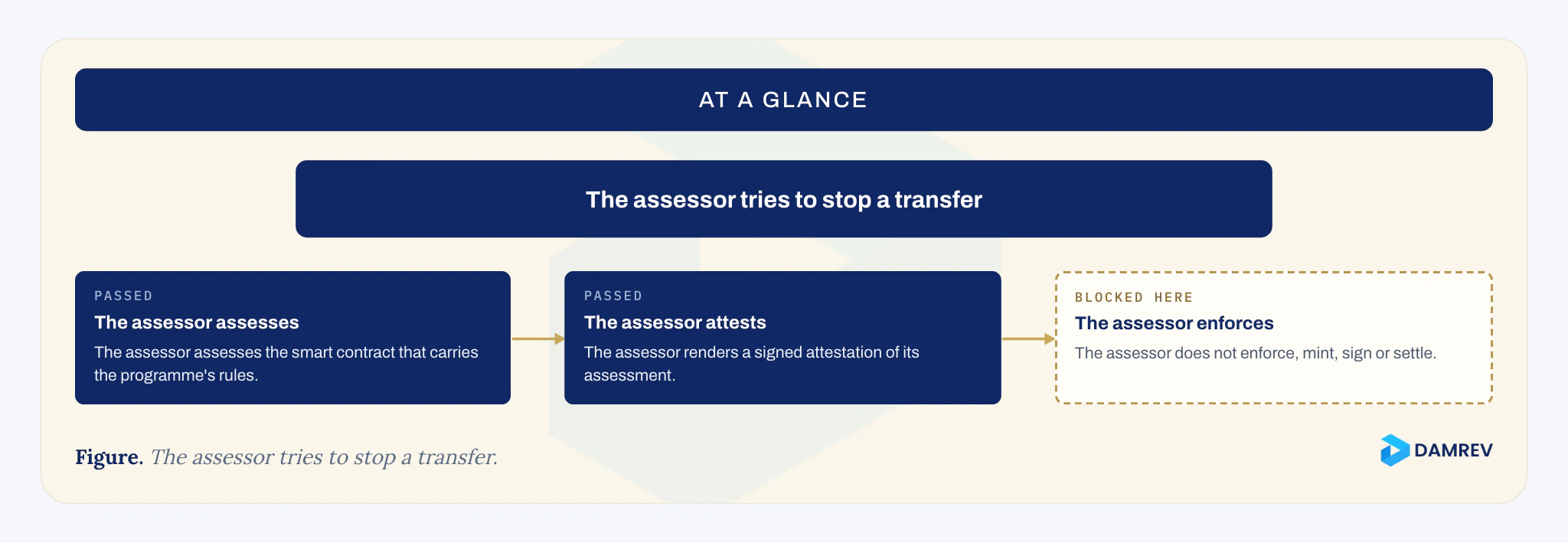
The assessor assesses the smart contract that carries the programme's rules.
Section
Structuring
The instrument classes DAMREV structures, and the four situations that bring most clients here.
Not sure which page answers your question? A structuring review starts with that conversation.
Start a Structuring ReviewSection
Services
The ladder, from a paid first look to a programme DAMREV operates for you.
Not sure which page answers your question? A structuring review starts with that conversation.
Start a Structuring ReviewSection
Platform
Eight capabilities and twenty named engines. DAMREV runs its own instruments on it.
Not sure which page answers your question? A structuring review starts with that conversation.
Start a Structuring ReviewSection
Tokenized IPO
A tokenized listing is a listing first. This section is about whether yours is ready.
Not sure which page answers your question? A structuring review starts with that conversation.
Start a Structuring ReviewSection
Compliance
Written to be read by a regulator, a counterparty or an auditor without a call first.
The Americas & the Caribbean
Europe
Not sure which page answers your question? A structuring review starts with that conversation.
Start a Structuring ReviewSection
Insights
The published record. Papers, positions and the vocabulary, all dated.
Not sure which page answers your question? A structuring review starts with that conversation.
Start a Structuring ReviewNot sure which page answers your question? A structuring review starts with that conversation.
Start a Structuring ReviewTrust centre
DAMREV's smart contracts are assessed by a party that does not enforce them. A smart contract assessor assesses each contract and renders a signed attestation; Sentinel, DAMREV's compliance engine, acts on that verdict on-chain. The assessor renders the verdict, the enforcer acts on it, and no party holds both powers.
The problem
Because a party that holds both powers can pass its own work, and nothing in the process would show it. Splitting the powers means an attestation must come from one party before another will act, and each is accountable for its own half.
How it works
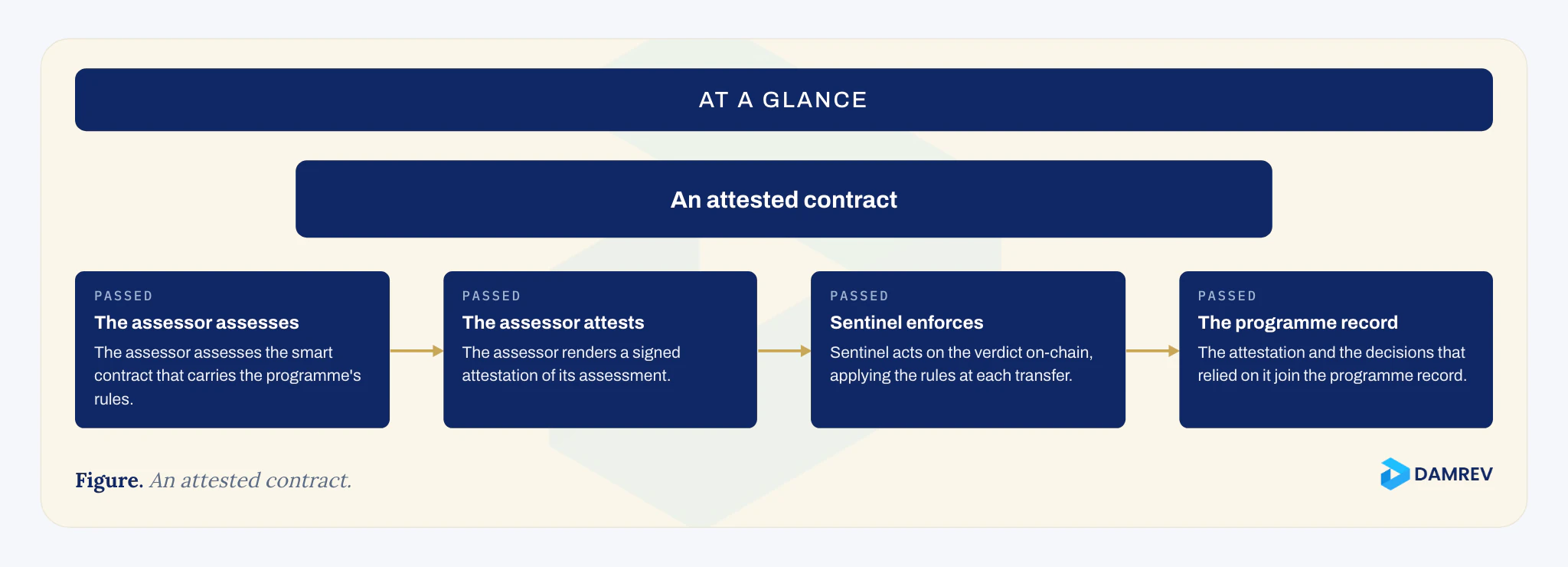
In steps, each held by a different party. A smart contract assessor assesses the contract, the assessor signs an attestation, Sentinel enforces the verdict on-chain at each transfer, and the result joins the programme record.
The assessor assesses the smart contract that carries the programme's rules.
The assessor renders a signed attestation of its assessment.
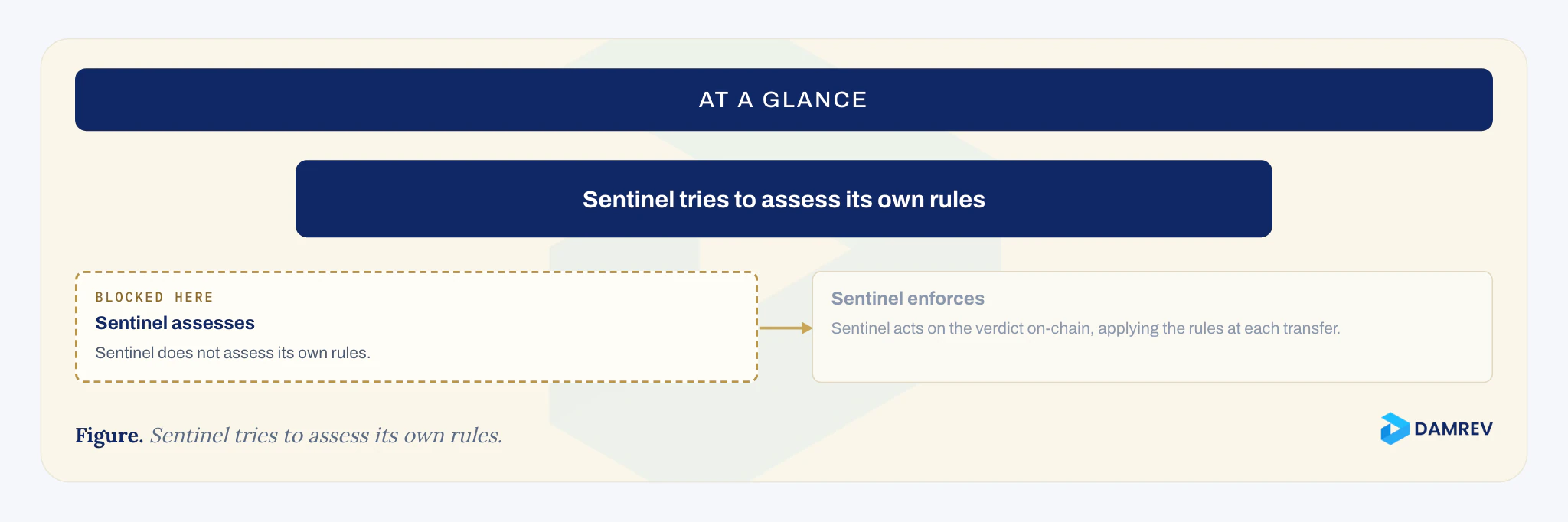
Sentinel acts on the verdict on-chain, applying the rules at each transfer.
The attestation and the decisions that relied on it join the programme record.
The related-party relationship
The assessor and DAMREV share common ownership. The separation of powers holds because the assessor only assesses and attests and Sentinel only enforces, not because the two are unrelated. The conflicts page sets out how this and the group's other relationships are handled.
Disclosure
The smart contract assessor is a separate entity with its own role, set up as a validator for tokenized finance, with DAMREV as its first client. The two share common ownership, so the relationship is disclosed as related-party, and a reader should weigh each attestation with that disclosure in mind.
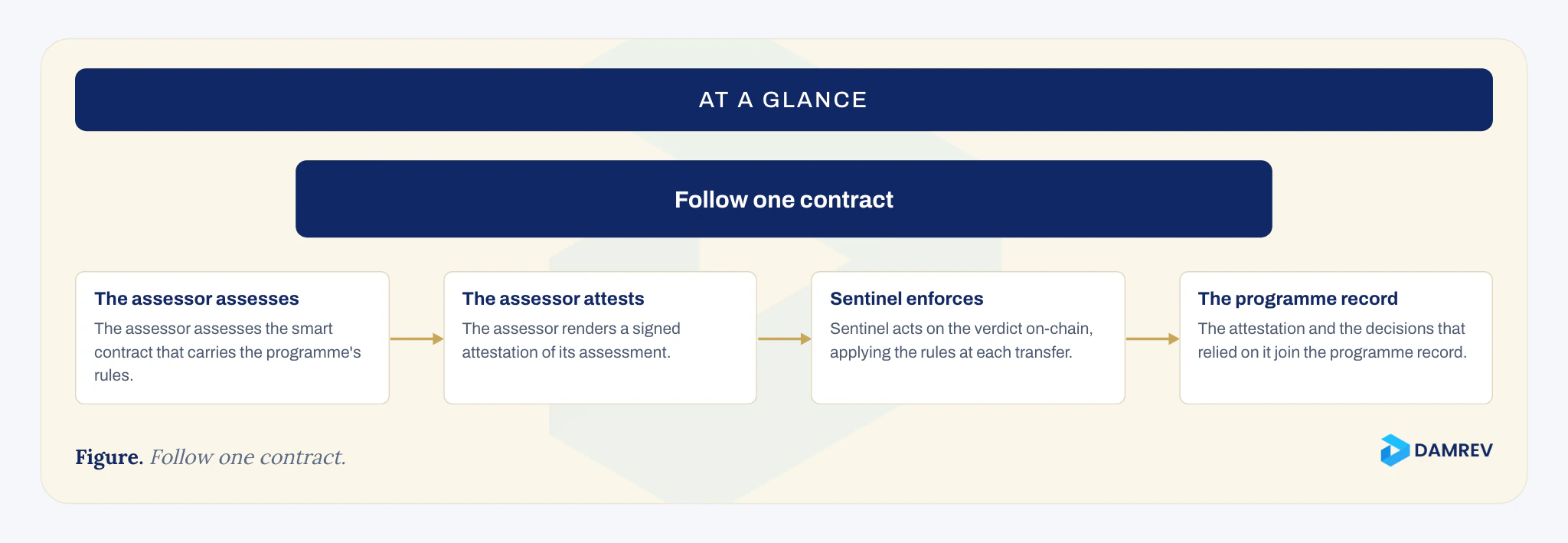
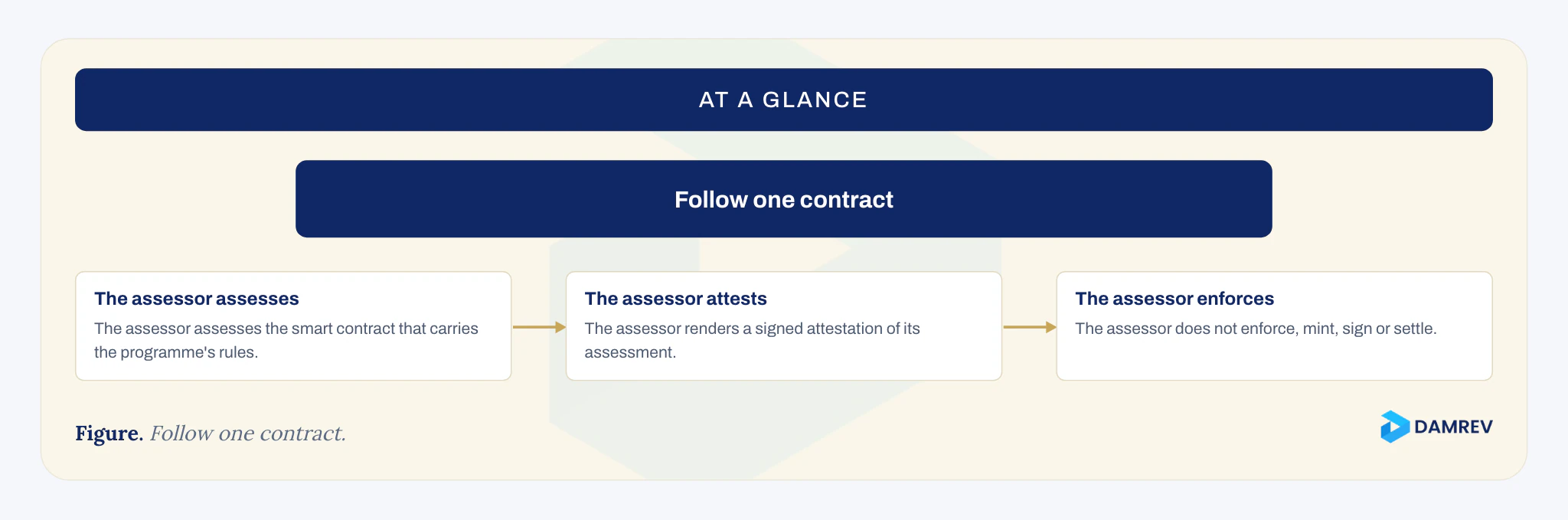
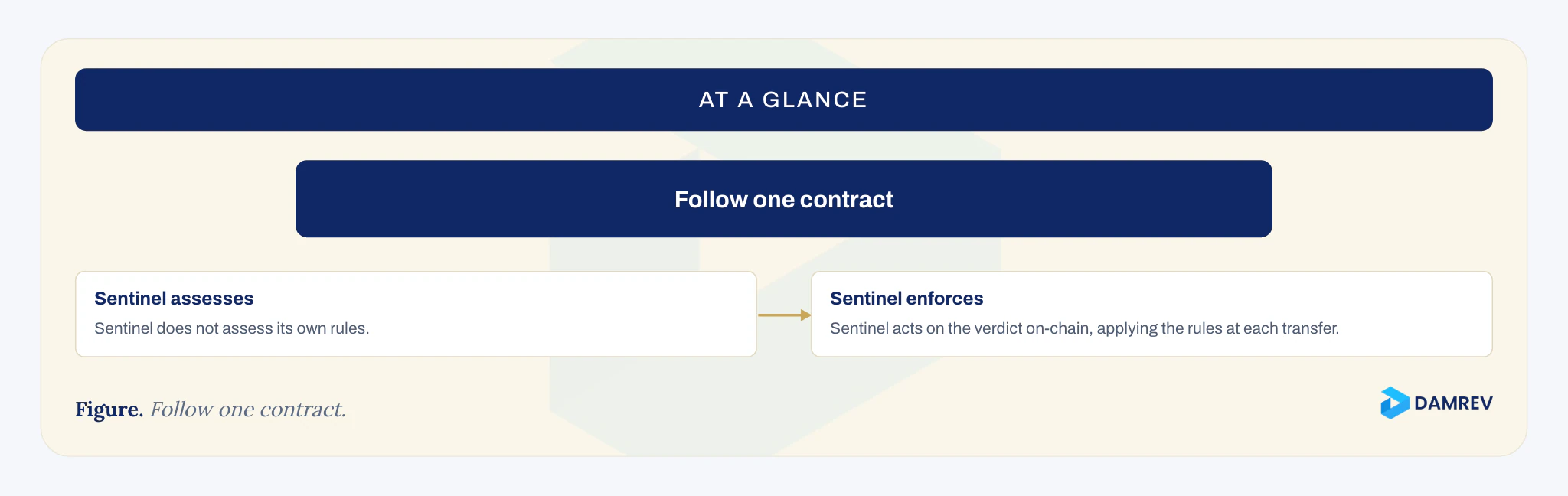
Choose a case and follow one contract through the two powers.
Evidence
Enough for a reader to confirm who assessed what, and what was enforced as a result.
01
02
03
04
05
On request
Name the programme and your role when you ask. Each box opens the contact page for that request.
Common questions
Short answers on validation: whether DAMREV validates its own smart contracts, whether a smart contract assessor can change a contract or stop a transfer, why the assessor is disclosed as a related party, and where enforcement actually happens.
A smart contract assessor, a separate entity, assesses them and renders a signed attestation. Sentinel then enforces on-chain. DAMREV's platform enforces; it does not mark its own work.
The assessor assesses and attests only. It does not enforce, mint, sign or settle. Enforcement is Sentinel's function.
Because the two share common ownership. The disclosure lets a reader weigh the attestation with that relationship in view, and the separation of powers is kept in the functions each party performs.
On-chain. Sentinel applies the transfer rules in contract logic on Stellar and Soroban at the moment of each transfer, reading eligibility from Veritas.
Where next
The pages below pick up where this one ends. Start with the one closest to where your asset or programme stands today.
Last updated:
Insights

Since 17 September 2026 a tokenized securities venue may run automated liquidity pools in tokenized listed stock without registering as an exchange, on conditions.

The GENIUS Act binds payment stablecoin issuers from 18 January 2027, not the firms that hold or settle in stablecoins. Service providers follow in 2028.

The CLARITY Act stalled on a 49 to 50 vote, so tokenized securities stay with the Securities and Exchange Commission, as before.

Guernsey's guidance of 24 July 2026 lets a fund or issuer record and transfer its investments as tokens, under the regimes already applying to it.
Tell us what you want to tokenize.
We will show you how DAMREV can run it.
