Skip to content
DAMREV
Start a Structuring Review

Guide

Token Classes We Issue

A token's class is decided by the rights it carries and the way it is offered, and on DAMREV that decision belongs to the issuer and its counsel. DAMREV then encodes the rules that follow from it: who may hold the token, how it moves, and how it is serviced. DAMREV does not classify what it services.

Asset to holder

Where does a token's class come from?

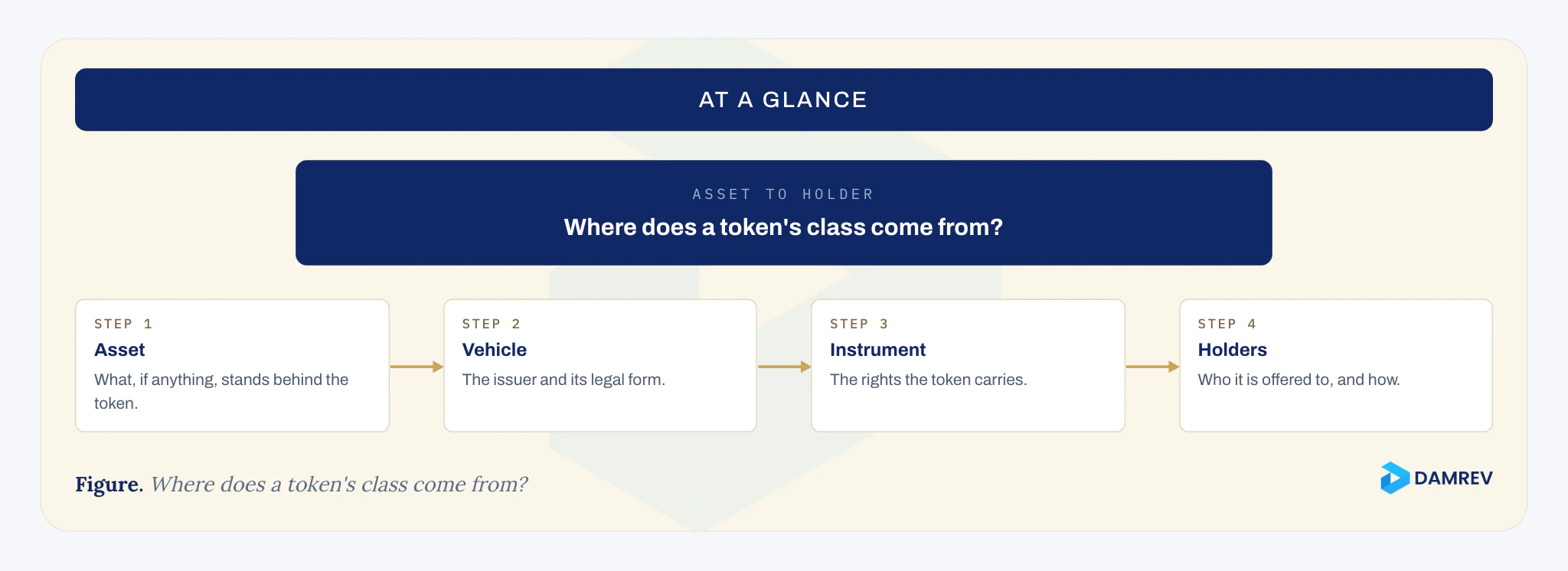
From the path between the asset and the holder. What the asset is, which vehicle issues against it, what the instrument promises, and who may hold it together decide the class. Change any link and the class can change with it, so the path is mapped first.

Where does a token's class come from: Step 1, Asset; Step 2, Vehicle; Step 3, Instrument; Step 4, Holders.
  • Where does a token's class come from?
  • Asset: What, if anything, stands behind the token. (Step 1)
  • Vehicle: The issuer and its legal form. (Step 2)
  • Instrument: The rights the token carries. (Step 3)
  • Holders: Who it is offered to, and how. (Step 4)
Where does a token's class come from: Step 1, Asset; Step 2, Vehicle; Step 3, Instrument; Step 4, Holders.

The four classes

How do security, utility, payment and asset-backed tokens differ?

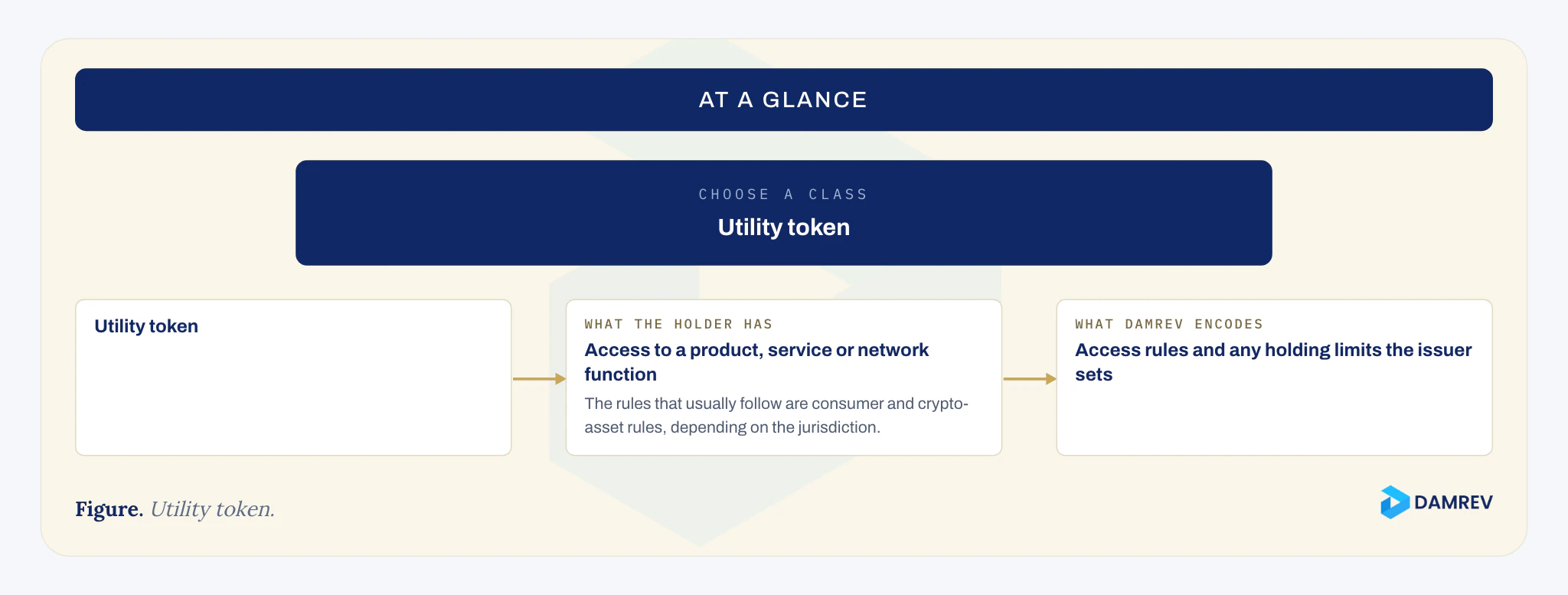
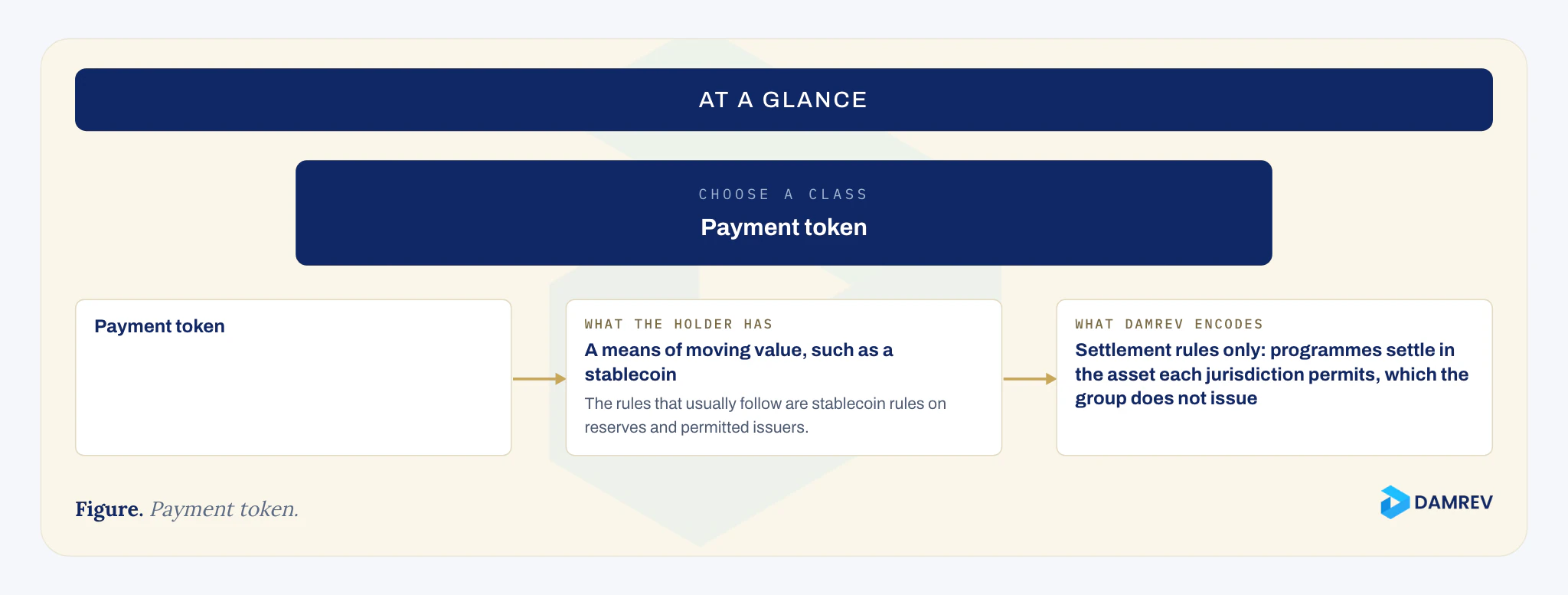
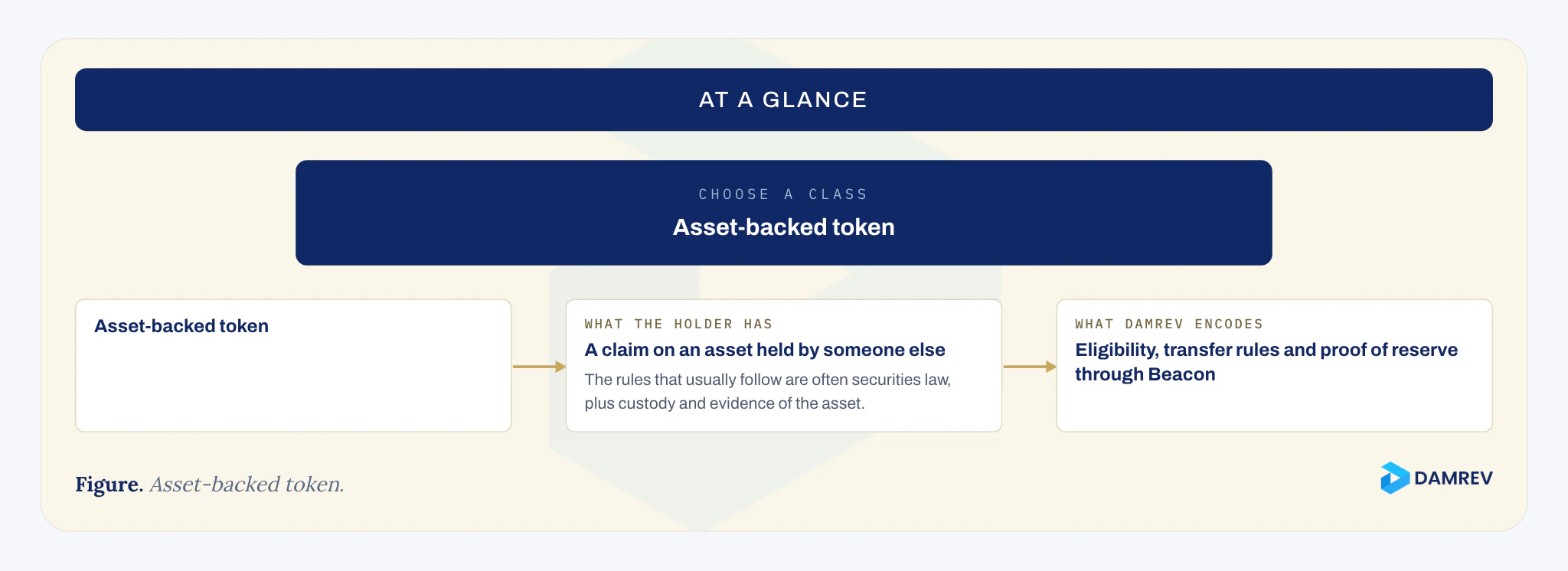
By what the holder receives. A security token carries investment rights, a utility token gives access to a product or service, a payment token is used to move value, and an asset-backed token represents a claim on something held elsewhere. Choose a class to compare.

Four classes

Choose a class

Security token. What the holder has: Investment rights: equity, debt or a share of returns. The rules that usually follow are securities law on offer, disclosure, eligibility and transfer. What DAMREV encodes: Eligibility, transfer restrictions, the register and corporate actions.
  • Security token
  • Security token
  • Investment rights: equity, debt or a share of returns: The rules that usually follow are securities law on offer, disclosure, eligibility and transfer. (What the holder has)
  • Eligibility, transfer restrictions, the register and corporate actions (What DAMREV encodes)
Security token. What the holder has: Investment rights: equity, debt or a share of returns. The rules that usually follow are securities law on offer, disclosure, eligibility and transfer. What DAMREV encodes: Eligibility, transfer restrictions, the register and corporate actions.

The question counsel asks: does it carry the rights of a security, or is it offered as an investment?

Not a legal test

These classes describe common usage. An asset-backed token is frequently a security; a utility token can become one if it is offered as an investment. The labels help a buyer and counsel start the conversation, and the classification that ends it belongs to counsel.

Read the position paper

Who decides

Who decides a token's class, and why does it matter?

The issuer and its counsel, for each instrument, and the class decides which rules apply: who may hold the token, how it may be offered, which permissions are needed, and what must be disclosed. A wrong class makes every one of those rules wrong.

Forge issues only under the issuer authority of the relevant entity, and Registry services instruments without classifying them. Where the group supplies the issuer, that entity is DAMREV Capital Partners, incorporated in Mauritius and separate from DAMREV.

Who decides

The issuer and its counsel determine the class of every instrument on DAMREV. DAMREV Labs, LLC does not issue securities and does not classify the instruments its software services.

United States

What do US rules say about tokenized securities and payment stablecoins?

That a tokenized security is still a security. On 28 January 2026 three divisions of the US Securities and Exchange Commission (SEC) stated that the format in which a security is issued does not affect the application of the federal securities laws1. Choose a model to see what the holder has.

Three models

Choose a model

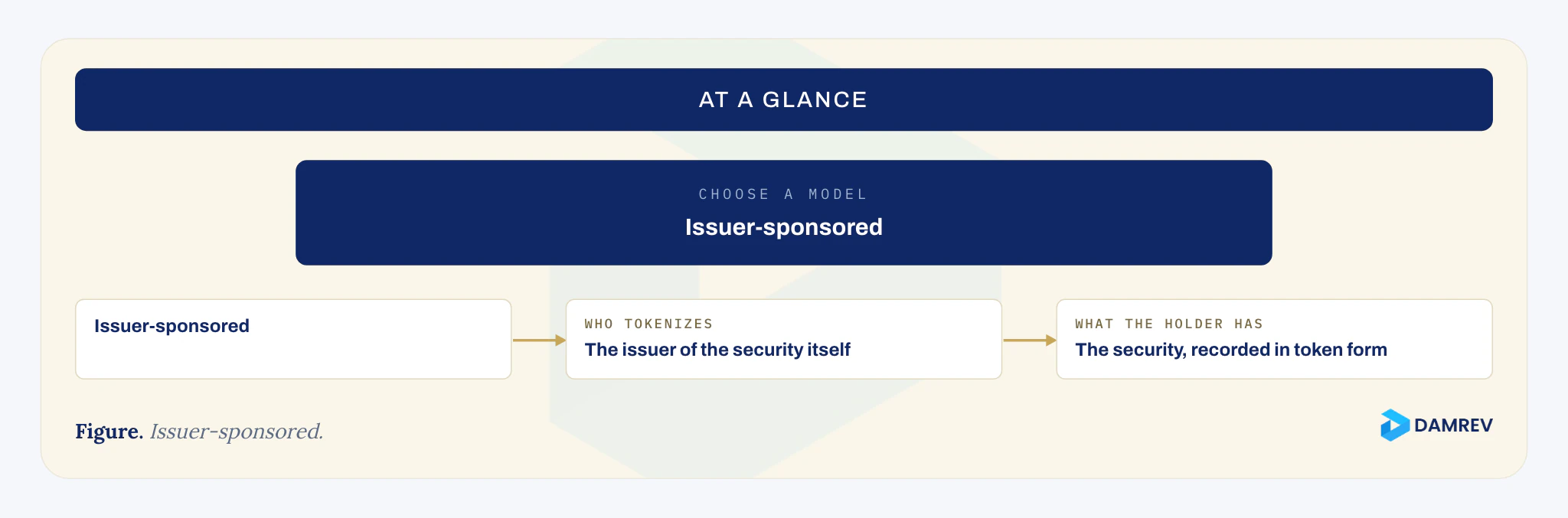
Issuer-sponsored. Who tokenizes: The issuer of the security itself. What the holder has: The security, recorded in token form.
  • Issuer-sponsored
  • Issuer-sponsored
  • The issuer of the security itself (Who tokenizes)
  • The security, recorded in token form (What the holder has)
Issuer-sponsored. Who tokenizes: The issuer of the security itself. What the holder has: The security, recorded in token form.

DAMREV's programmes are built for this model: the issuer, advised by counsel, issues its own instrument, and the token is the instrument.

Rules by jurisdiction

How do other jurisdictions treat token classes?

Each draws its own lines, and each reaches the service providers around a token as well as the token itself. DAMREV works across twelve jurisdictions in four regions. Choose one to see its rule and its dates; no licence, registration or approval is claimed for any DAMREV entity, and permissions are held entity by entity.

12 jurisdictions, 4 regions

Choose a jurisdiction

The Americas and the Caribbean

US

United States

Milestones

  1. 18 July 2025The GENIUS Act, for payment stablecoins, is signed2
  2. 28 January 2026The Statement on Tokenized Securities is issued1

The rule

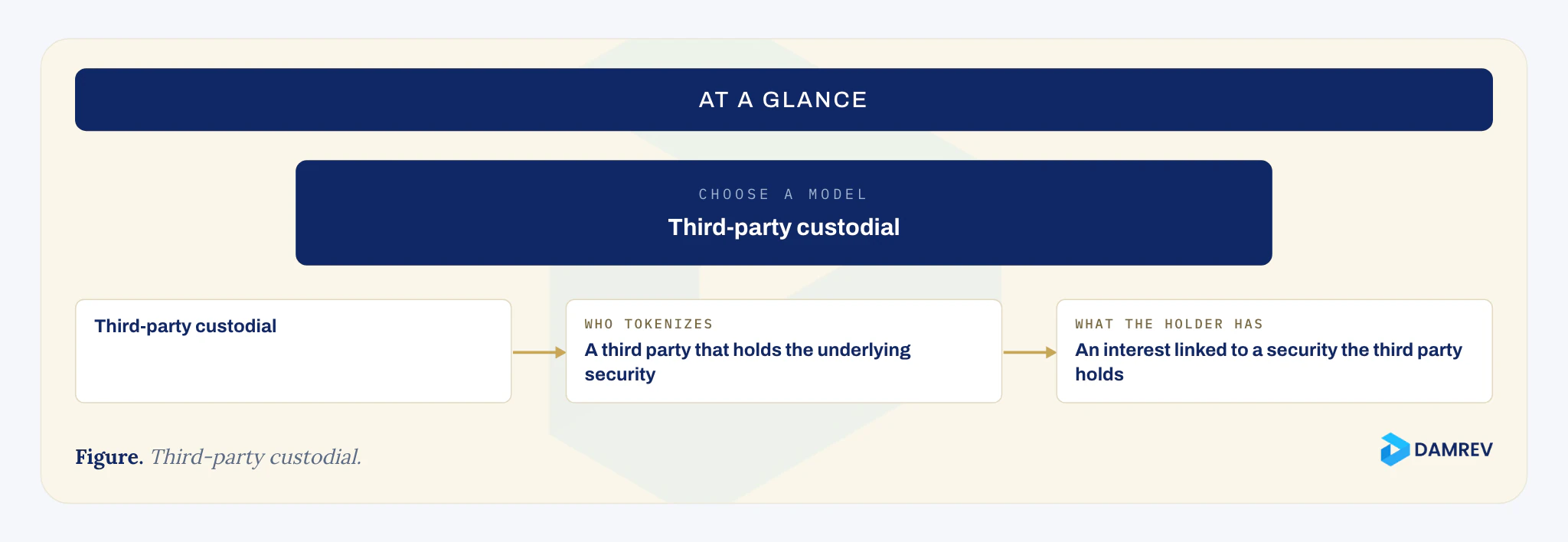
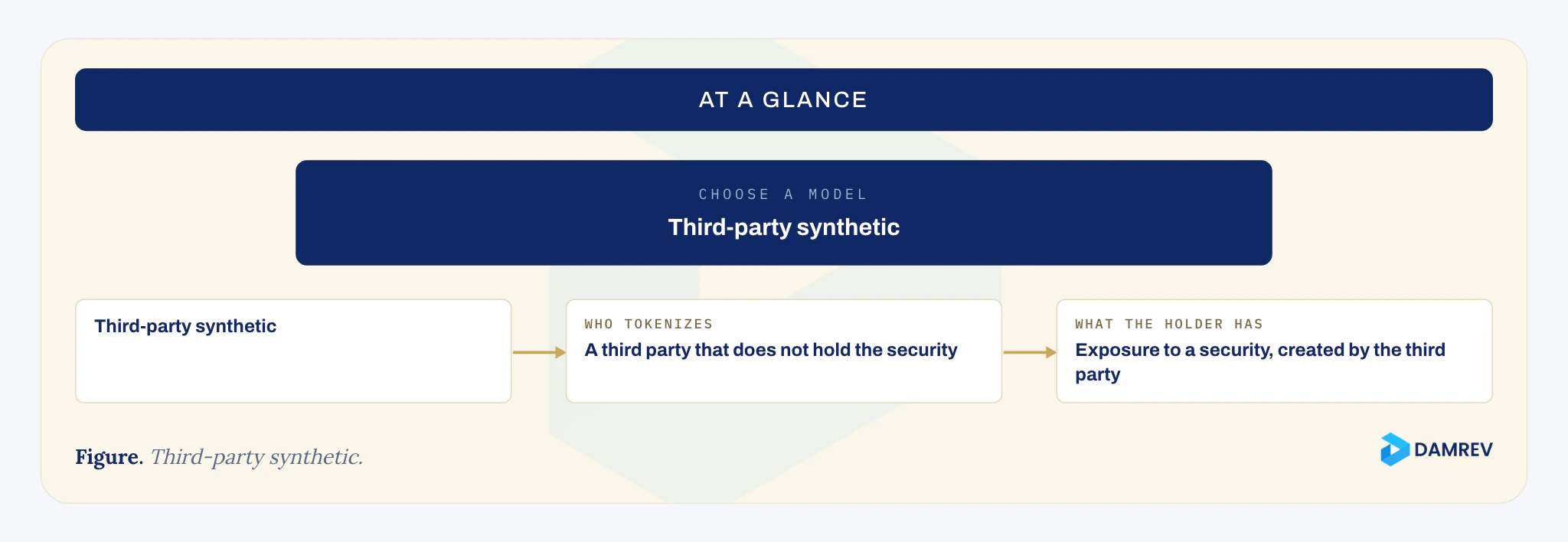
Tokenized securities are securities. On 28 January 2026 three divisions of the Securities and Exchange Commission (SEC) issued a Statement on Tokenized Securities that separates issuer-sponsored tokenized securities from third-party-sponsored ones, in custodial and synthetic models, and states that the format in which a security is issued does not affect the application of the federal securities laws1.

For a token's class

The US position turns on whether a token is a security, and on the separate regime for payment stablecoins.
Regulator
Securities and Exchange Commission, for securities
Key law and date
SEC Statement on Tokenized Securities, 28 January 20261; GENIUS Act, signed 18 July 20252
What it requires
Securities law applies whatever the format; payment stablecoin issuers hold reserves at least one-to-one
Group entity present
DAMREV Labs, LLC, organised in Wyoming; it builds and operates software

Read about jurisdictions

Once the class is set

What happens once the class is decided?

The rules that follow from the class are encoded, and the instrument applies them at every event, not only at issuance. Stellar lets an issuer set authorisation flags and use clawback on the assets it issues19, which is how the ledger itself enforces restrictions on a restricted class.

  1. Class determined

    The issuer and its counsel settle the class and the rules that follow.

  2. Eligibility

    A licensed provider verifies holders, and Veritas carries the result as a credential.

  3. Issuance

    Forge issues only after eligibility clears, under the issuer's authority.

  4. Transfer

    Sentinel applies the transfer rules on-chain at every transfer.

  5. Release

    Cadence applies any vesting, lock-up or release schedule.

  6. Register

    Registry records every holder and services the instrument.

The symbols

Which token symbols appear on this site?

$DREV and $ACAD are DAMREV's own symbols, and the settlement asset is chosen per jurisdiction from what local rules permit. Each is described by function only. No price, return, yield, listing or supply statement is made about any of them, and the mechanics of $DREV are restricted.

  • Primary token$DREVDAMREV's proposed primary token, not yet issued. Governance is designed to be earned by staking it.
  • Lyceum Academy$ACADThe Lyceum Academy token. It is unlisted.
  • Settlement assetChosen per jurisdictionFrom what local rules permit. The group issues none of them.

Worked example

How is a class decided and encoded in practice?

An illustrative case, not a client and with no figures: an asset manager wants a tokenized class of an existing fund, offered only to qualified investors in two jurisdictions.

Illustrative example

Illustrative: classifying a tokenized fund class

  1. 01

    Step 1: The asset and the claim

    Holders will own units in the fund, with a share of its returns, so the rights look like those of a security.
  2. 02

    Step 2: The class

    The manager's counsel determines the class in each jurisdiction and the offering route that follows.
  3. 03

    Step 3: The rules

    Counsel's conclusions become eligibility criteria, transfer restrictions and disclosure requirements.
  4. 04

    Step 4: The instrument

    DAMREV encodes those rules; Forge issues after eligibility clears, and Sentinel applies them at every transfer.
  5. 05

    Step 5: Servicing for life

    If the law or the investor base changes, counsel revisits the class and the encoded rules are updated through the approval path.

Common questions

What else do people ask?

Short answers to the questions people ask most about this topic.

Who decides whether a token is a security?

The issuer and its counsel. DAMREV encodes the rules that follow from their conclusion and does not classify the instruments it services.

Does DAMREV issue security tokens?

Issuers do. DAMREV Labs, LLC builds and operates software and does not issue securities. Where the group supplies the issuer, it is DAMREV Capital Partners, a separate entity incorporated in Mauritius.

Does putting a security on a blockchain change the rules?

The rules stay the same. In the United States, the SEC has stated that the format in which a security is issued does not affect the application of the federal securities laws1.

Can a utility token become a security?

It can, depending on its rights and how it is offered. That is a question for the issuer's counsel, and it is answered before anything is encoded.

Is $ACAD listed?

$ACAD is the Lyceum Academy token, and it is unlisted.

Does the group issue a stablecoin?

No. Settlement runs in the asset each jurisdiction permits, such as USDC, EURC, a licensed local stablecoin, tokenized deposits, or fiat through a bank. The group issues none of them. The group issues no payment token of its own.

What does $DREV do?

$DREV is DAMREV's proposed primary token, and governance is designed to be earned by staking it. It has not been minted, issued, offered or sold, and its other mechanics are restricted and are not published.

Where next

The pages below pick up where this one ends. Start with the one closest to where your asset or programme stands today.

References

  1. 1.US Securities and Exchange Commission, Statement on Tokenized Securities, 28 January 2026. https://www.sec.gov/newsroom/speeches-statements/corp-fin-statement-tokenized-securities-012826-statement-tokenized-securities
  2. 2.Greenberg Traurig, "GENIUS Act enacted, establishing a regulatory framework for payment stablecoins". https://www.gtlaw.com/en/insights/2025/7/genius-act-enacted-establishing-a-regulatory-framework-for-payment-stablecoins-issued-or-sold-in-the-united-states
  3. 3.National Law Review, "Wyoming launches first state-issued stable token". https://natlawreview.com/article/wyoming-launches-first-state-issued-stable-token
  4. 4.DLA Piper Africa, "FSCA update on licensing and supervision of crypto asset service providers". https://www.dlapiperafrica.com/en/south-africa/insights/2026/FSCA_Update_on_Licensing_and_Supervision_of_Crypto_Asset_Service_Providers
  5. 5.Financial Intelligence Centre, joint advisory on Directive 9 of 2024. https://www.fic.gov.za/2025/04/17/joint-advisory-directive-9-of-2024-on-implementation-of-the-travel-rule-to-enhance-transparency-in-crypto-asset-transactions-takes-effect-on-30-april-2025/
  6. 6.Central Bank of Kenya, "Public Notice: Commencement of the Virtual Assets Service Providers Act, 2025". https://www.centralbank.go.ke/uploads/press_releases/665231223_Public%20Notice%20on%20the%20Virtual%20Assets%20Service%20Providers%20Act%202025.pdf
  7. 7.Kenya Gazette Supplement No. 185 (Legislative Supplement No. 103), 22 July 2026: Legal Notice No. 134 of 2026, the Virtual Asset Service Providers Regulations, 2026, as summarised by TripleOKLaw (TL Advocates). https://tladvocates.com/2026/08/14/unpacking-the-gazetted-virtual-asset-service-providers-regulations-2026/ Also: Oraro & Company Advocates, "The Virtual Asset Service Providers Regulations, 2026", August 2026, https://www.oraro.co.ke/wp-content/uploads/2026/08/Virtual-Asset-Service-Providers-Regulations-2026.pdf
  8. 8.Non-Bank Financial Institutions Regulatory Authority, "Caution Against Transacting Business With Unlicensed Virtual Asset Service Providers (VASPs)". https://www.nbfira.org.bw/news/caution-against-transacting-business-with-unlicensed-virtual-asset-service-providers-vasps/ Also: Non-Bank Financial Institutions Regulatory Authority, "Guidance Note for VASPs on Implementation of AML/CFT Programmes", https://www.nbfira.org.bw/wp-content/uploads/2025/03/Guidance-Note-for-VASPs-Other-on-Implementation-of-AMLCFT-Programmes-.pdf
  9. 9.Bowmans, "Mauritius: an overview of the new regulatory framework of virtual assets and initial token offerings". https://bowmanslaw.com/insights/mauritius-an-overview-of-the-new-regulatory-framework-of-virtual-assets-and-initial-token-offerings/ Also: Financial Services Commission, the Virtual Asset and Initial Token Offering Services Act, https://www.fscmauritius.org/media/119928/the-virtual-asset-and-initial-token-offering-services-act.pdf
  10. 10.Government Gazette of Mauritius No. 59 of 13 August 2026, Legal Supplement: the Economic and Financial Measures (Miscellaneous Provisions) Act 2026 (Act No. 13 of 2026), section 56(c). https://mauritiusassembly.govmu.org/mauritiusassembly/wp-content/uploads/2026/08/Act1326.pdf Also: Laws of Mauritius, the Virtual Asset and Initial Token Offering Services Act 2021, section 34A, https://lawsofmauritius.govmu.org/portal/viewlegislationdocument/web/?doctitle=VmlydHVhbCBBc3NldCBhbmQgSW5pdGlhbCBUb2tlbiBPZmZlcmluZyBTZXJ2aWNlcyBBY3QgMjAyMQ%3D%3D&docnumber=&doctype=act
  11. 11.Cayman Islands Monetary Authority, "Amendments to the Virtual Asset (Service Providers) Act in Effect 1 April 2025". https://www.cima.ky/amendments-to-the-virtual-asset-service-providers-act-effective-1-april-2025 Also: Cayman Islands Monetary Authority, Virtual Asset (Service Providers) Act 2020 Commencement Order 2025, https://www.cima.ky/upimages/lawsregulations/VirtualAssetServiceProvidersAct2020CommencementOrder2025_1743361010.pdf
  12. 12.Swiss Federal Council, "Federal Council brings DLT Act fully into force". https://www.admin.ch/en/nsb?id=84035 Also: Swiss Financial Market Supervisory Authority, "FINMA licenses first DLT trading facility", https://www.finma.ch/en/news/2025/03/20250318-mm-dlt-handelssystem/
  13. 13.Jersey Financial Services Commission, "Virtual Asset Service Providers". https://www.jerseyfsc.org/news-and-events/virtual-asset-service-providers/ Also: Jersey Financial Services Commission, "Amendment to Schedule 2 Business Activities", https://www.jerseyfsc.org/news-and-events/schedule-2-business-activities/
  14. 14.Malta Financial Services Authority, Dear CEO letter, VFA licence and transition to CASP under MiCA, 25 June 2026. https://www.mfsa.mt/wp-content/uploads/2026/06/Dear-CEO-Letter-VFA-Licence-and-Transition-to-CASP-under-the-Markets-in-Crypto-Assets-Act-MiCA-Act.pdf
  15. 15.European Securities and Markets Authority, statement on the end of transitional periods under MiCA. https://www.esma.europa.eu/sites/default/files/2026-04/ESMA75-113276571-1679_Statement_on_the_end_of_transitional_periods_under_MiCA.pdf
  16. 16.Abu Dhabi Global Market, "ADGM enhances guidance on regulation of crypto asset activities". https://www.adgm.com/media/announcements/abu-dhabi-global-market-enhances-guidance-on-regulation-of-crypto-asset-activities Also: ADGM Financial Services Regulatory Authority, "Guidance: Regulation of Virtual Asset Activities in ADGM", https://assets.adgm.com/download/assets/Guidance+Virtual+Asset+Activities+in+ADGM+20231218.pdf/f7702902704711efa4c3fe3e7821af93
  17. 17.Singapore Government Gazette, "Financial Services and Markets (Digital Token Service Providers) Regulations 2025" (No. S 342). https://assets.egazette.gov.sg/2025/Legislative%20Supplements/Subsidiary%20Legislation%20Supplement/342.pdf
  18. 18.Securities and Futures Commission, "Circular on implementation of new licensing regime for virtual asset trading platforms". https://apps.sfc.hk/edistributionWeb/api/circular/list-content/circular/doc?lang=EN&refNo=23EC28 Also: Government of the Hong Kong Special Administrative Region, "Stablecoins Ordinance to commence operation on August 1, 2025", https://www.info.gov.hk/gia/general/202506/06/P2025060600275.htm
  19. 19.Chainstack, "What is Stellar". https://chainstack.com/what-is-stellar/ Also: Stellar developer documentation, "Control access to an asset", https://developers.stellar.org/docs/tokens/control-asset-access

Last updated:

Ready to build on programmable infrastructure?

Tell us what you want to tokenize. We will show you how DAMREV can run it.