



Form the issuer
The issuer must be a Jersey company or Jersey LLC, administered by a trust company business (TCB) holding a JFSC licence1.
Section
Structuring
The instrument classes DAMREV structures, and the four situations that bring most clients here.
Not sure which page answers your question? A structuring review starts with that conversation.
Start a Structuring ReviewSection
Services
The ladder, from a paid first look to a programme DAMREV operates for you.
Not sure which page answers your question? A structuring review starts with that conversation.
Start a Structuring ReviewSection
Platform
Eight capabilities and twenty named engines. DAMREV runs its own instruments on it.
Not sure which page answers your question? A structuring review starts with that conversation.
Start a Structuring ReviewSection
Tokenized IPO
A tokenized listing is a listing first. This section is about whether yours is ready.
Not sure which page answers your question? A structuring review starts with that conversation.
Start a Structuring ReviewSection
Compliance
Written to be read by a regulator, a counterparty or an auditor without a call first.
The Americas & the Caribbean
Europe
Not sure which page answers your question? A structuring review starts with that conversation.
Start a Structuring ReviewSection
Insights
The published record. Papers, positions and the vocabulary, all dated.
Not sure which page answers your question? A structuring review starts with that conversation.
Start a Structuring ReviewNot sure which page answers your question? A structuring review starts with that conversation.
Start a Structuring ReviewJurisdictions · Europe
In Jersey, the treatment of tokenized assets depends on the instrument's legal classification, the issuer, the offering arrangements, and the regulated functions performed. The licences, approvals, and exemptions that apply are assessed for each structure.
Settlement can run in fiat through a Jersey registered bank, and the issuer must submit an information memorandum that meets prospectus-style content requirements.
DAMREV Labs, LLC, organised in Wyoming, builds and operates the software, and the regulated functions sit with licensed partners, entity by entity. No DAMREV entity claims a regulatory permission in Jersey on this page.
Position as of 14 November 2026
The framework
Jersey regulates tokenized real-world assets through issuer consent rather than a crypto statute. A Jersey company or limited liability company (LLC) needs the Jersey Financial Services Commission's (JFSC) prior consent under the Control of Borrowing (Jersey) Order 1958 (COBO), and virtual asset service providers register with the JFSC for anti-money laundering supervision1, 2.
The JFSC published its guidance "Tokenisation of real-world assets (RWAs)" on 28 August 2024 and revised it on 13 July 20261. The guidance excludes virtual asset issuance, pointing to the funds regime and other guidance instead1.
Virtual asset service provider (VASP) registration rests on Schedule 2 of the Proceeds of Crime (Jersey) Law 1999, recast by Amendment No. 6 from 30 January 20233. The anti-money laundering basis for VASPs is section 16 of the JFSC Handbook, in force since 31 October 20264. The JFSC assesses digital asset funds under its existing funds framework5.
The rules
COBO consent and VASP registration are settled law, and the RWA guidance, revised on 13 July 2026, sets the JFSC's conditions for consent. Section 16 of the JFSC Handbook has applied to VASPs since 31 October 2026. A draft law to replace COBO is lodged and not in force, so COBO remains the route1, 3, 4.
| Instrument | Date | Status |
|---|---|---|
| Control of Borrowing (Jersey) Order 19581, 6 | 1958 | Law in force |
| Proceeds of Crime (Jersey) Law 1999, Schedule 2 recast by Amendment No. 63 | 30 January 2023 | Law in force |
| JFSC Handbook, section 16, for VASPs4 | In force since 31 October 2026 | In force |
| JFSC guidance on tokenized real-world assets1 | 28 August 2024; revised 13 July 2026 | Guidance |
| JFSC digital asset pages on VASPs, digital asset funds, and initial coin or token offerings2, 5, 6 | Current pages | Guidance |
| Draft law to replace COBO | Lodged | Bill, not in force |
The RWA guidance's Section 6 requirements apply only to the COBO consent, and other Jersey laws may also apply to the same structure1. A draft law to replace COBO is lodged and not in force.
Classification
The JFSC applies substance over form: the description given to a token is not decisive. Tokenized securities and physical-asset-backed tokens fall within the RWA guidance, fund interests stay under the funds framework, and Jersey-issued tokens fully backed by cash or cash equivalents are treated as non-virtual assets1, 5, 6.
In the JFSC's words, "The description given to a token is not decisive"6. For a tokenized real-world asset, the underlying assets must sit with a professional custodian in an equivalent jurisdiction and be confirmed each year as "100% collateralised and ring-fenced"1. A fund application must state which register is the legal record of ownership5.
How it works
In Jersey, the steps set out here run in five stages. Form a Jersey company or LLC, appoint a JFSC-licensed trust company business with a Jersey-resident director, classify the token, obtain COBO consent with an information memorandum, register any virtual asset service, and settle in a permitted asset1, 2.
The issuer must be a Jersey company or Jersey LLC, administered by a trust company business (TCB) holding a JFSC licence1.
The issuer needs a Jersey-resident director who is a principal person of the TCB, and the TCB checks the issuer's governance, controls, and wind-down plans before appointment1.
The JFSC's prior COBO consent is needed before issuance, with an information memorandum that meets prospectus-style content requirements1.
Licences
Each role carries its own permission. The issuer needs COBO consent and a JFSC-licensed TCB as administrator, providers of exchange, transfer, or safekeeping for others need VASP registration, and promoters and service providers must consider VASP, investment business, or fund services business permissions. VASP registration is anti-money laundering supervision only1, 2, 5.
VASP registration is required before VASP activity begins, and it covers exchange, transfer, safekeeping, and issuer-related financial services done for others2, 3.
Firms offering exchange, transfer, or custody of virtual assets to third parties should consider VASP registration, and the TCB checks the issuer's governance, controls, and wind-down plans on an ongoing basis as well as before appointment5, 1.
Who regulates what
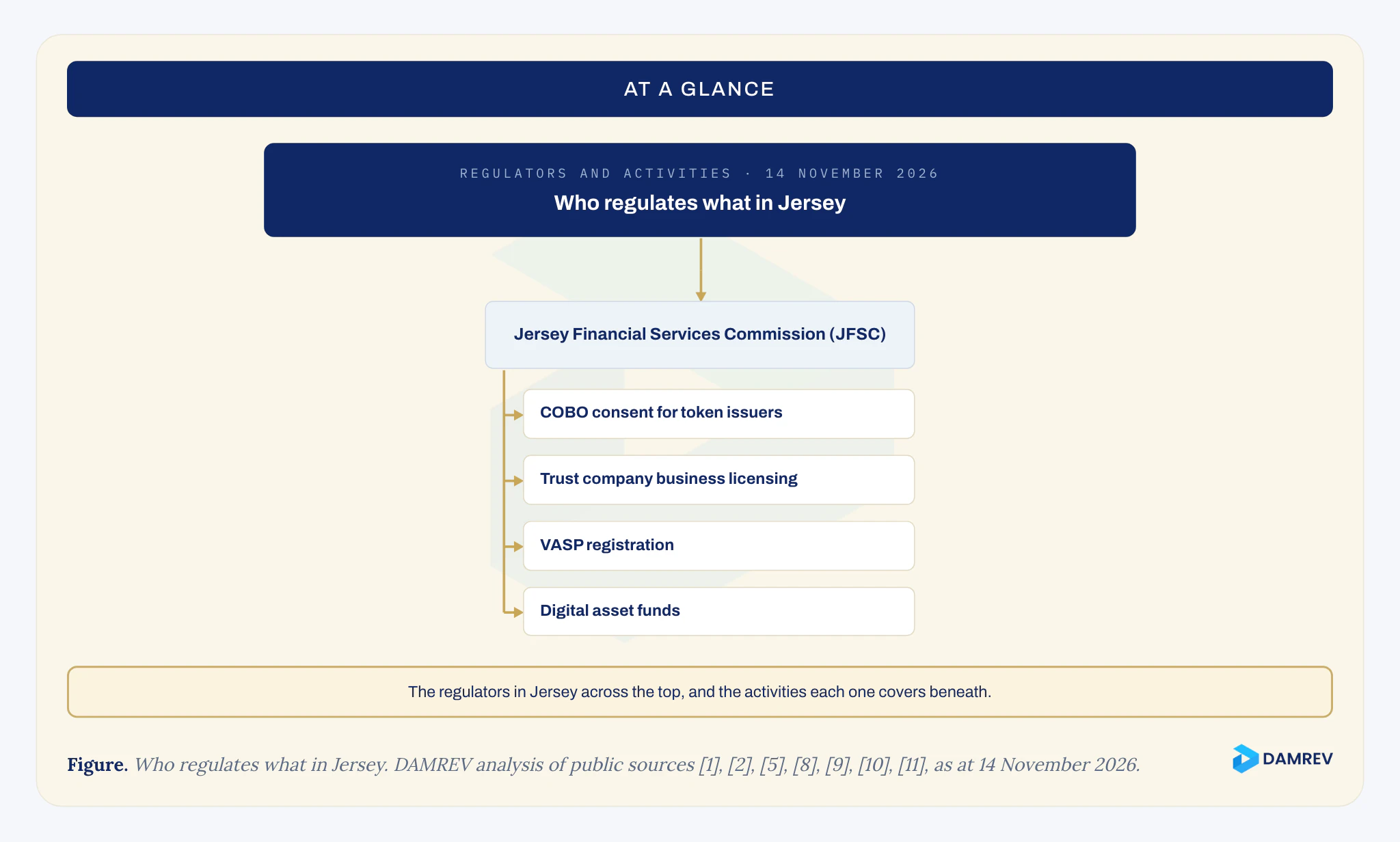
In Jersey, the JFSC grants the prior COBO consent a real-world asset token issuer needs, approves in advance any change of the issuer's administrator or resident director, licenses trust company businesses, registers VASPs for anti-money laundering supervision, and assesses digital asset funds under the existing funds framework. Its Innovation Hub covers fintech firms and VASPs1, 2, 5, 8.
Investor access
Investors buy from an issuer that has submitted an information memorandum meeting prospectus-style content requirements. Marketing must be clear, fair, and not misleading, and anti-money laundering, counter-terrorist financing, and counter-proliferation financing measures apply to anyone buying from or selling back to the issuer1, 6.
Issuers must also notify the JFSC of defaults1.
Settlement
Settlement can run in fiat through a Jersey registered bank, which needs no further permission. Jersey-issued tokens fully backed by cash or cash equivalents are treated as non-virtual assets, while USDC, USDT, and EURC are neither named nor restricted. Handling stablecoins for others needs only anti-money laundering-based VASP registration1, 2, 7, 12.
Sandbox and pilots
The JFSC Innovation Hub covers fintech firms and VASPs, and as at 14 November 2026 its page did not mention a sandbox. The published route is the ordinary application, and the JFSC targets 24 hours for qualifying Jersey Private Fund applications and five business days for lower-risk RWA applications1, 5, 8.
Risks and controls
Jersey's regime is in force and its supervisory record is strong. An issuer weighs the ongoing duties attached to COBO consent, the custody and verification of underlying assets, an anti-money laundering-only VASP regime, the open treatment of foreign stablecoins, and a lodged draft law to replace COBO1, 2, 10.
Seven risks
Choose a risk
The risk
Tokens rest on underlying assets that a professional custodian in an equivalent jurisdiction holds and that are independently checked within three months of year end1.
What the rules require
The underlying assets are held by a professional custodian in an equivalent jurisdiction and independently checked within three months of year end1.
The risk
COBO remains the route to consent, and the lodged draft law to replace it is not in force, so the basis for consent is open to change.
What the rules require
A draft law to replace COBO is lodged and not in force.
Our position
DAMREV Labs, LLC, a Wyoming company, builds and operates the software. It is not licensed as a financial services or virtual asset firm, and no DAMREV entity claims a regulatory permission in Jersey.
The regulated functions sit with licensed partners, entity by entity, and this page names none of them. It sets out the public rules in Jersey as at 14 November 2026, and it is analysis of public sources, not legal advice. Nothing on it is an offer of any service in Jersey.
Common questions
Short answers to the questions people ask most about this topic.
No. The JFSC applies substance over form, and the description given to a token is not decisive. Tokenized securities and physical-asset-backed tokens fall within its RWA guidance, and fund interests stay under the funds framework.
The Jersey Financial Services Commission. It grants consent under the Control of Borrowing (Jersey) Order 1958, licenses trust company businesses, registers virtual asset service providers, and assesses digital asset funds. Its Innovation Hub covers fintech firms and VASPs.
A Jersey company or LLC, administered by a JFSC-licensed trust company business, with a Jersey-resident director who is a principal person of that business, and the JFSC's consent under COBO before issuance. The JFSC must approve in advance any later change of that administrator or director.
No. VASP registration gives anti-money laundering supervision only, not conduct or prudential authorisation. Its anti-money laundering basis is section 16 of the JFSC Handbook, in force since 31 October 2026.
Fiat through a Jersey registered bank, which needs no further permission. Jersey-issued tokens fully collateralised by cash or cash equivalents are treated as non-virtual assets, and USDC, USDT, and EURC are neither named nor restricted. Handling stablecoins for others needs VASP registration.
The JFSC targets five business days for lower-risk RWA applications, and it may reject applications that are premature. It targets 24 hours for qualifying Jersey Private Fund applications.
With a professional custodian in an equivalent jurisdiction. The underlying assets are confirmed each year as "100% collateralised and ring-fenced", and independently checked within three months of year end.
No. DAMREV Labs, LLC does not hold a financial services or virtual asset licence, and no DAMREV entity claims a regulatory permission in Jersey. Regulated functions sit with licensed partners, entity by entity.
Where next
Jersey sits within the European group of DAMREV's jurisdictions. These pages compare it with its neighbours and set out how settlement and compliance are designed.
Position as of 14 November 2026: the law and sources on this page are stated as at that date. Last updated:
Insights

Since 17 September 2026 a tokenized securities venue may run automated liquidity pools in tokenized listed stock without registering as an exchange, on conditions.

The GENIUS Act binds payment stablecoin issuers from 18 January 2027, not the firms that hold or settle in stablecoins. Service providers follow in 2028.

The CLARITY Act stalled on a 49 to 50 vote, so tokenized securities stay with the Securities and Exchange Commission, as before.

Guernsey's guidance of 24 July 2026 lets a fund or issuer record and transfer its investments as tokens, under the regimes already applying to it.
Tell us what you want to tokenize.
We will show you how DAMREV can run it.
