

Step one
Accepts fiat
A user brings fiat in through Xago, the group's rand on-ramp and off-ramp partner in South Africa.
Section
Structuring
The instrument classes DAMREV structures, and the four situations that bring most clients here.
Not sure which page answers your question? A structuring review starts with that conversation.
Start a Structuring ReviewSection
Services
The ladder, from a paid first look to a programme DAMREV operates for you.
Not sure which page answers your question? A structuring review starts with that conversation.
Start a Structuring ReviewSection
Platform
Eight capabilities and twenty named engines. DAMREV runs its own instruments on it.
Not sure which page answers your question? A structuring review starts with that conversation.
Start a Structuring ReviewSection
Tokenized IPO
A tokenized listing is a listing first. This section is about whether yours is ready.
Not sure which page answers your question? A structuring review starts with that conversation.
Start a Structuring ReviewSection
Compliance
Written to be read by a regulator, a counterparty or an auditor without a call first.
The Americas & the Caribbean
Europe
Not sure which page answers your question? A structuring review starts with that conversation.
Start a Structuring ReviewSection
Insights
The published record. Papers, positions and the vocabulary, all dated.
Not sure which page answers your question? A structuring review starts with that conversation.
Start a Structuring ReviewNot sure which page answers your question? A structuring review starts with that conversation.
Start a Structuring ReviewNamed engine · Settlement layer
Fiat on-ramp and payments.
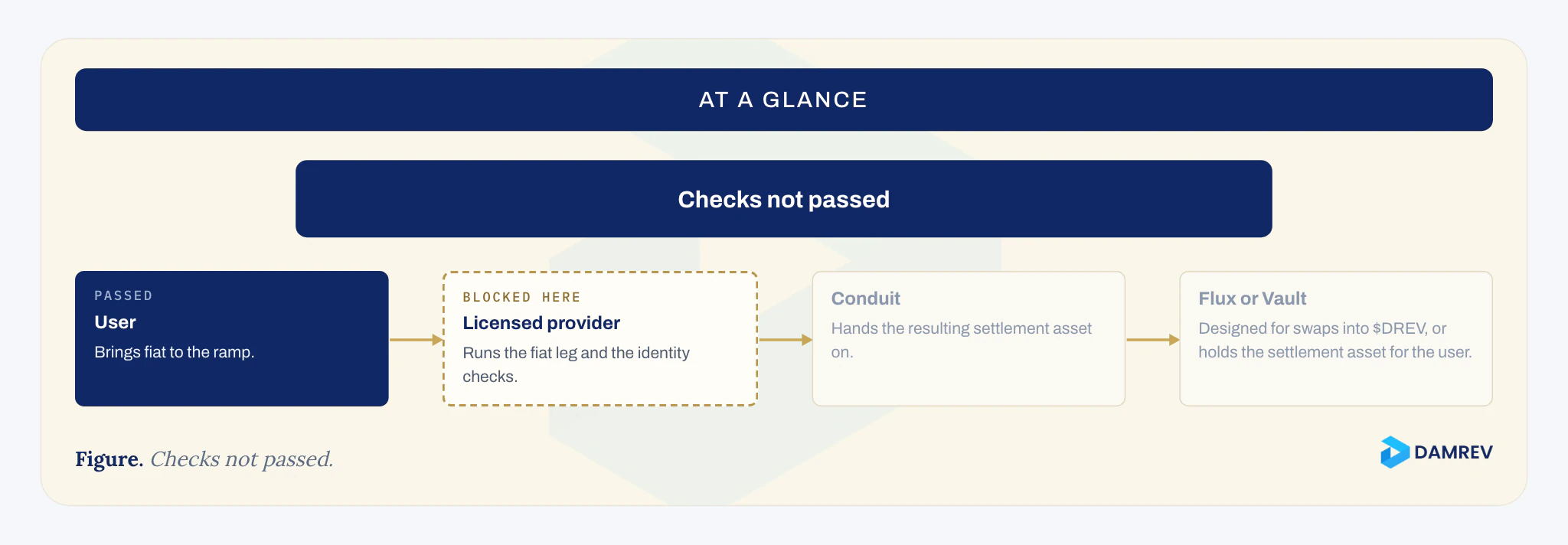
Conduit is how money enters the platform. A user brings fiat in through a licensed third-party on-ramp provider, which operates the fiat leg and performs the identity checks for the ramp, and Conduit hands the resulting settlement asset to Flux and Vault. The user, not an issuer, is party to the on-ramp.
Settlement runs in the asset each jurisdiction permits, such as USDC, EURC, a licensed local stablecoin, tokenized deposits, or fiat through a bank. The group issues none of them.
What it does
Conduit is the payments and ramps engine, the fiat on-ramp leg of the platform. It brings fiat in through a licensed third-party provider and passes the settlement asset to the engines that use it. The licensed provider operates the fiat leg, not DAMREV, and the user, not an issuer, is the party to the on-ramp.
How it works
Three steps, each with one job.
A user brings fiat in through Xago, the group's rand on-ramp and off-ramp partner in South Africa.
Identity checks on the ramp are the licensed provider's to perform.
Conduit passes the settlement asset to Flux for swaps and to Vault, where the user holds it.
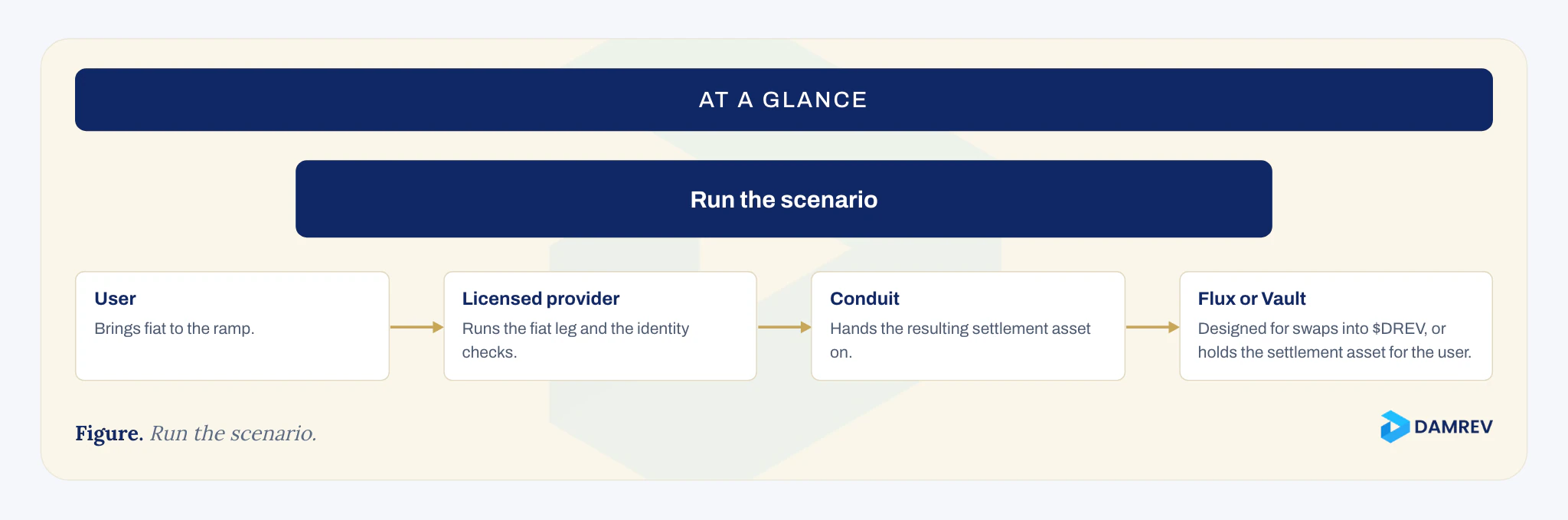
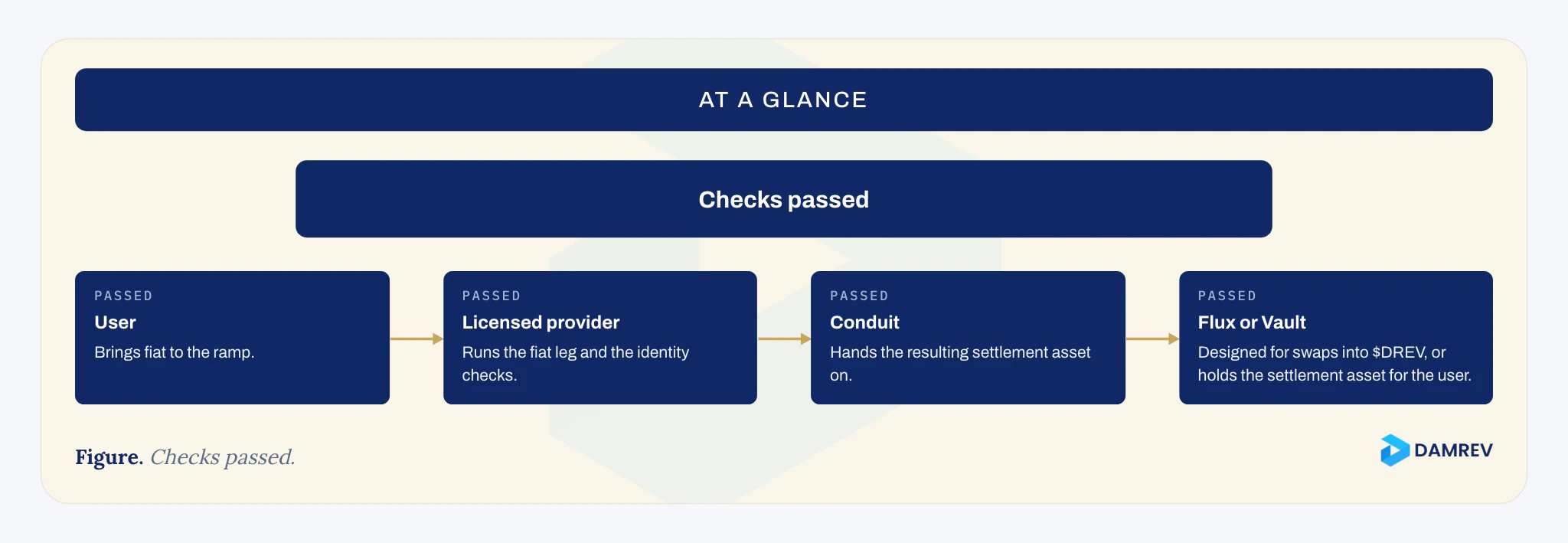
Choose a scenario and run it.
Where it fits
Conduit sits across the settlement and financial infrastructure layers. It depends on no other engine for its own work, because the licensed provider carries the fiat leg and the checks that go with it.
Fiat on-ramp and payments.
Depends on (0)
Flux is designed to take USDC from Conduit as the starting point of a swap into $DREV on the Stellar decentralised exchange. Vault takes the settlement asset into the user's non-custodial wallet, where the user holds the keys, and Vault names Conduit as its connection to on-ramps.
Two identity-layer engines touch the ramp as well. Veritas lists Conduit among the engines that read its credentials, and Sentry lists it among the engines that ask the user for a device-bound signature.
Standards and integrations
Controls
Conduit enforces the route by which money enters: fiat comes in only through the licensed provider, after that provider's identity checks, and leaves Conduit only as the settlement asset the jurisdiction permits, delivered to Flux or to the user's Vault.
Common questions
Short answers on Conduit: who operates the fiat on-ramp and who is party to it, what Conduit hands off, whether DAMREV issues the settlement asset, and who performs identity checks on the ramp.
Xago, the group's rand on-ramp and off-ramp partner in South Africa, operates it. DAMREV integrates the ramp and does not operate the fiat leg.
The settlement asset the jurisdiction permits, such as USDC, EURC, a licensed local stablecoin, tokenized deposits, or fiat through a bank. Conduit brings fiat in through the licensed provider and passes the settlement asset to Flux and Vault.
The user is, not an issuer. Conduit keeps that position on every ramp transaction.
No. Settlement runs in the asset each jurisdiction permits, such as USDC, EURC, a licensed local stablecoin, tokenized deposits, or fiat through a bank. The group issues none of them. Conduit moves the settlement asset; it does not create it.
The licensed provider does, as part of operating the ramp. Its result lets the user move the settlement asset onward through the platform.
Where next
The pages below pick up where this one ends. Start with the one closest to where your asset or programme stands today.
Last updated:
Insights

Since 17 September 2026 a tokenized securities venue may run automated liquidity pools in tokenized listed stock without registering as an exchange, on conditions.

The GENIUS Act binds payment stablecoin issuers from 18 January 2027, not the firms that hold or settle in stablecoins. Service providers follow in 2028.

The CLARITY Act stalled on a 49 to 50 vote, so tokenized securities stay with the Securities and Exchange Commission, as before.

Guernsey's guidance of 24 July 2026 lets a fund or issuer record and transfer its investments as tokens, under the regimes already applying to it.
Tell us what you want to tokenize.
We will show you how DAMREV can run it.