



The asset and the claim
The reserve is cash held by the bank, and each holder's claim is redemption at par under the token's terms.
Section
Structuring
The instrument classes DAMREV structures, and the four situations that bring most clients here.
Not sure which page answers your question? A structuring review starts with that conversation.
Start a Structuring ReviewSection
Services
The ladder, from a paid first look to a programme DAMREV operates for you.
Not sure which page answers your question? A structuring review starts with that conversation.
Start a Structuring ReviewSection
Platform
Eight capabilities and twenty named engines. DAMREV runs its own instruments on it.
Not sure which page answers your question? A structuring review starts with that conversation.
Start a Structuring ReviewSection
Tokenized IPO
A tokenized listing is a listing first. This section is about whether yours is ready.
Not sure which page answers your question? A structuring review starts with that conversation.
Start a Structuring ReviewSection
Compliance
Written to be read by a regulator, a counterparty or an auditor without a call first.
The Americas & the Caribbean
Europe
Not sure which page answers your question? A structuring review starts with that conversation.
Start a Structuring ReviewSection
Insights
The published record. Papers, positions and the vocabulary, all dated.
Not sure which page answers your question? A structuring review starts with that conversation.
Start a Structuring ReviewNot sure which page answers your question? A structuring review starts with that conversation.
Start a Structuring ReviewAsset class
A stablecoin is a reserve problem before it is a token problem, and the reserve is where DAMREV starts. DAMREV structures the reserve, the issuance and redemption policy, the treasury controls, the settlement logic and the proof framework, then builds the ramps and distribution interfaces against that model.
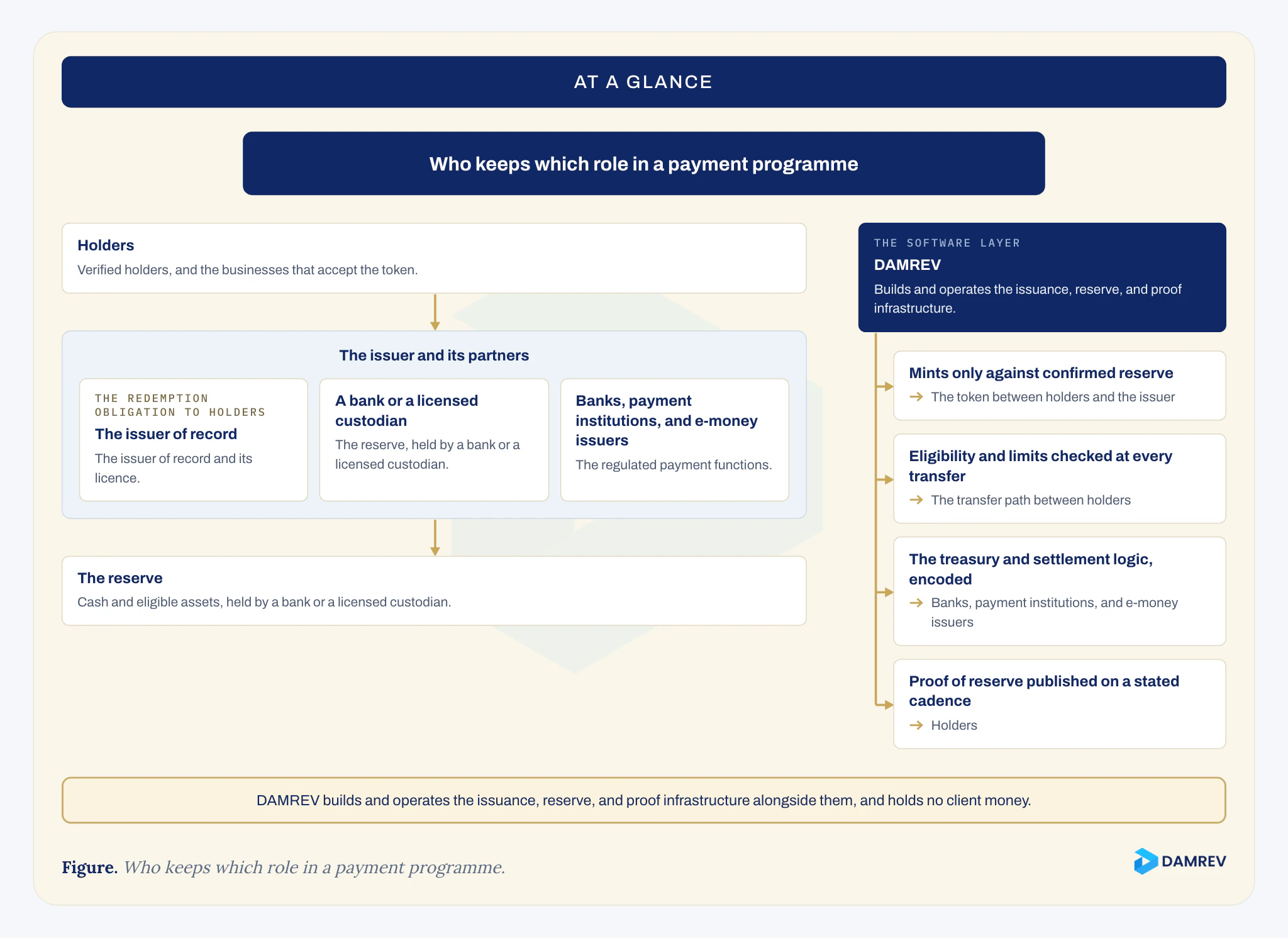
Banks, payment institutions and e-money issuers hold the fiat leg and perform the regulated payment functions.
In this class
Reserve-backed tokens and the payment infrastructure around them. The issuer of record is always a licensed party, and DAMREV structures and operates the programme around it.
From asset to holders
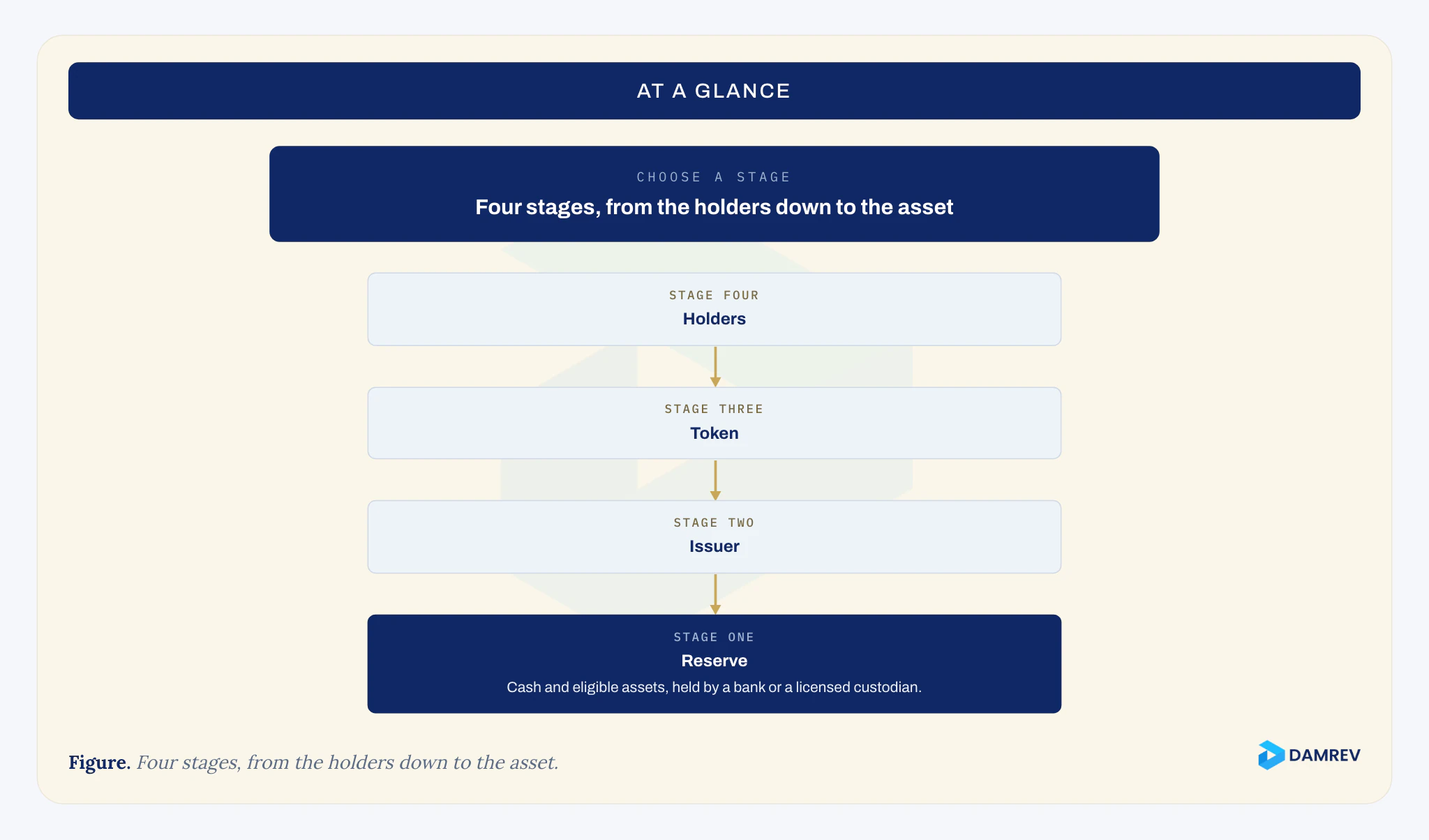
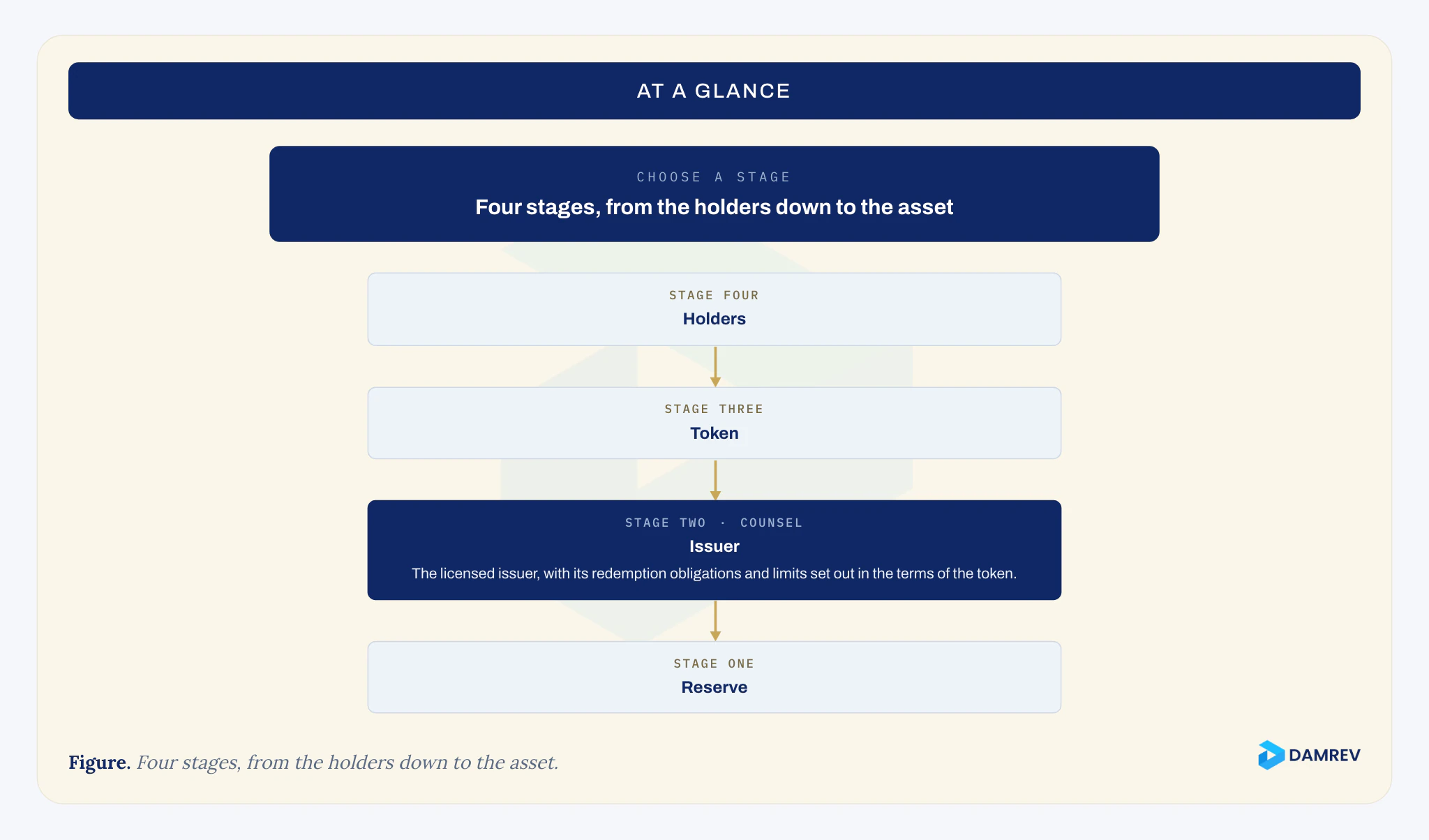
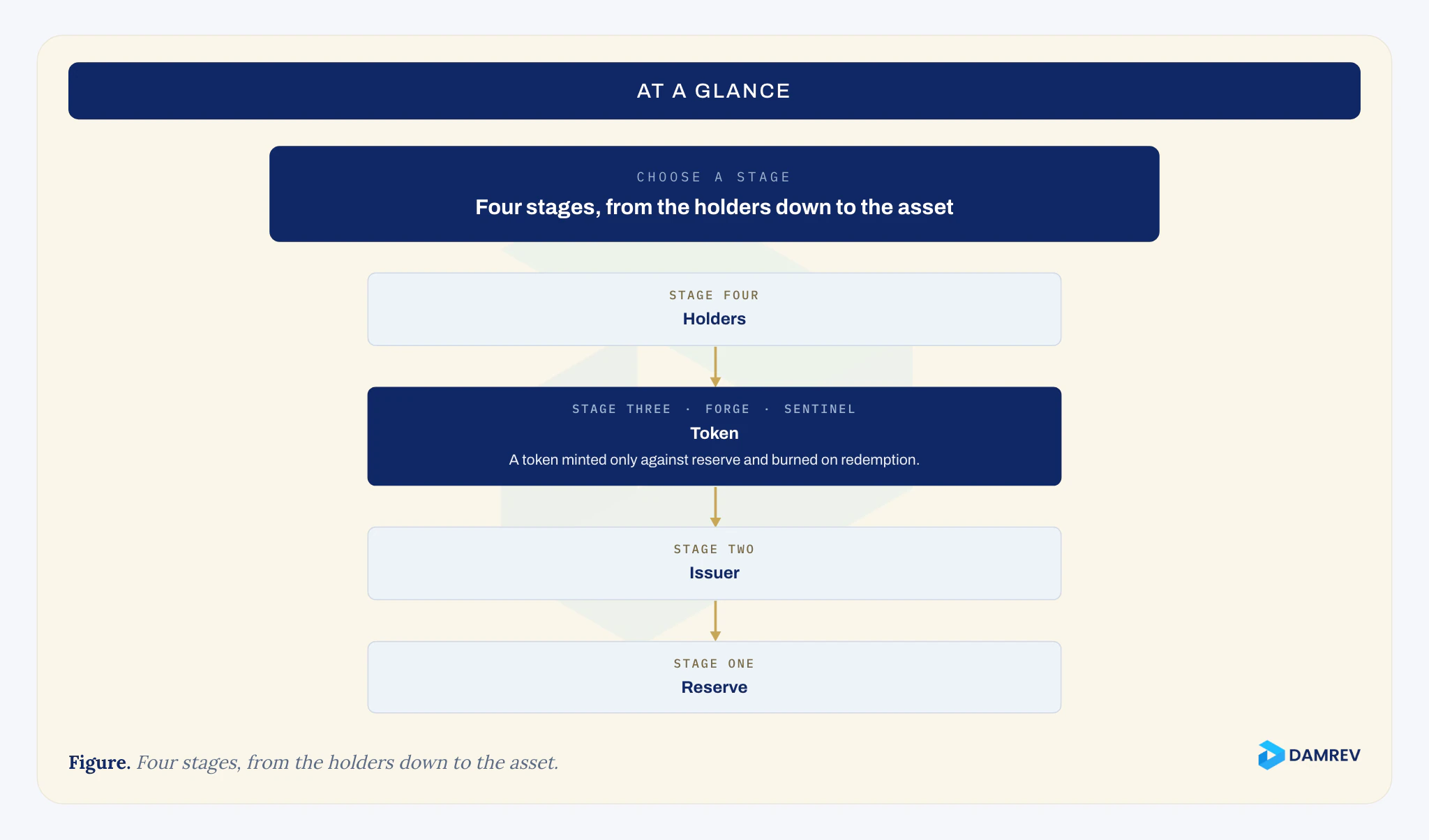
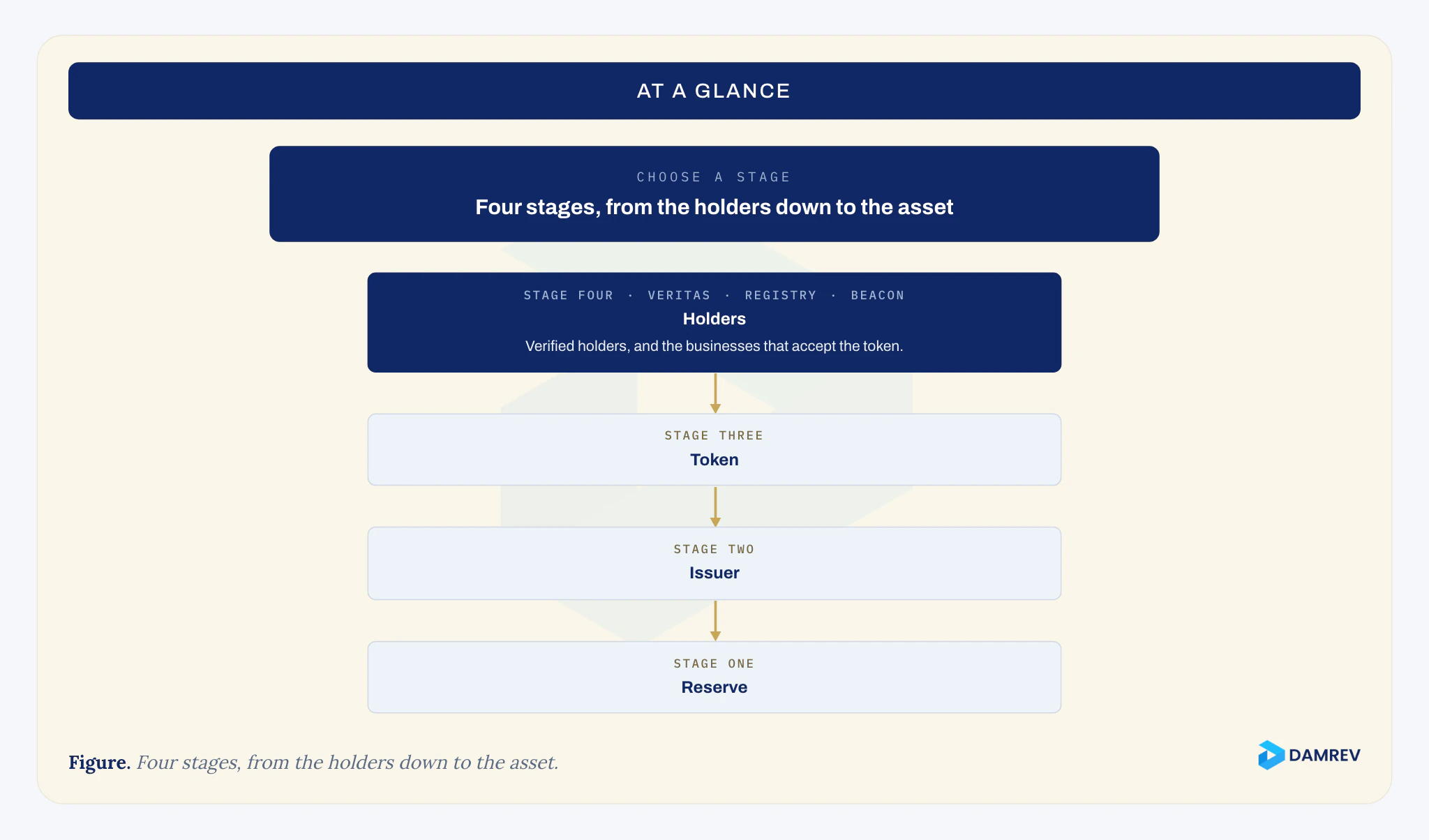
In four stages. A licensed partner holds the reserve, a licensed issuer issues against it, and verified holders use the token. Choose a stage to see what it holds in a payment programme and which engines carry it.
Four stages
Choose a stage
What DAMREV adds
Reserve
The reserve policy: what may be held, where, and how often it is verified, settled before anything is issued.
What DAMREV adds
Issuer
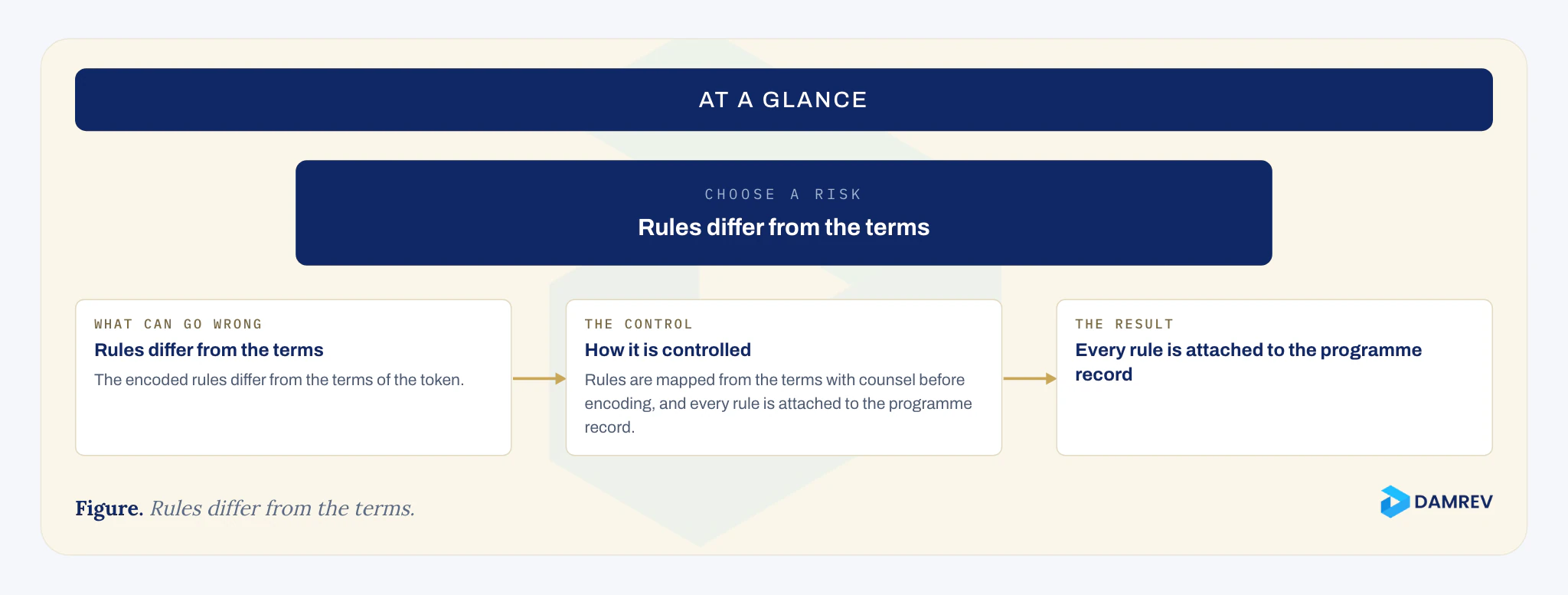
Counsel settles the issuer and its licence. DAMREV maps the issuance and redemption policy from the terms, and every rule is attached to the programme record.
How it works
The reserve policy sets the rules, and the engines apply them at every event. Nothing is minted that the reserve does not cover, and every redemption burns what it pays out. The issuer, the reserve holder, and the holders all read one record.
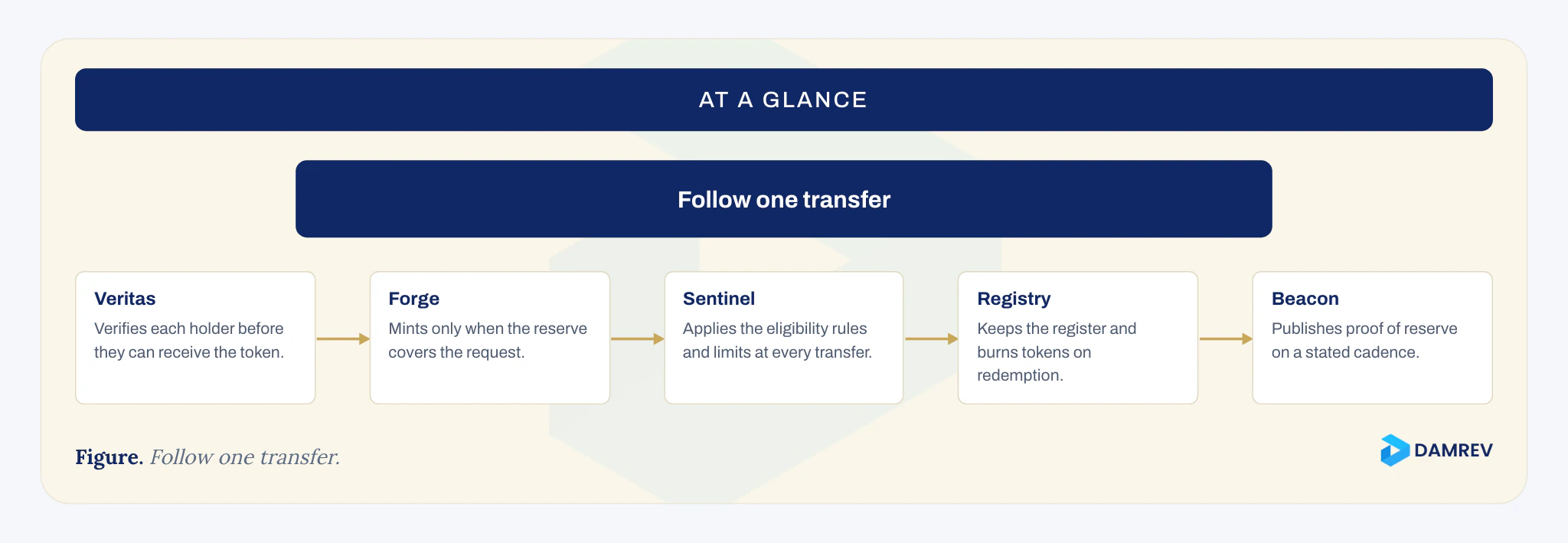
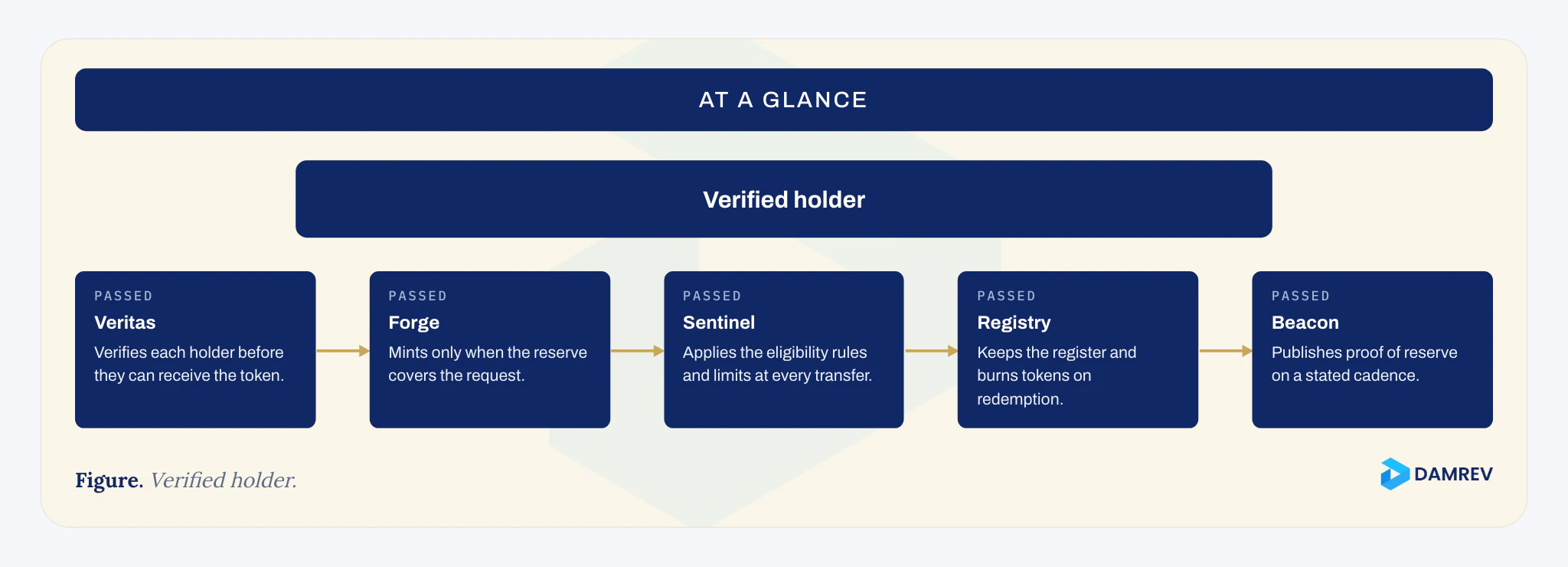
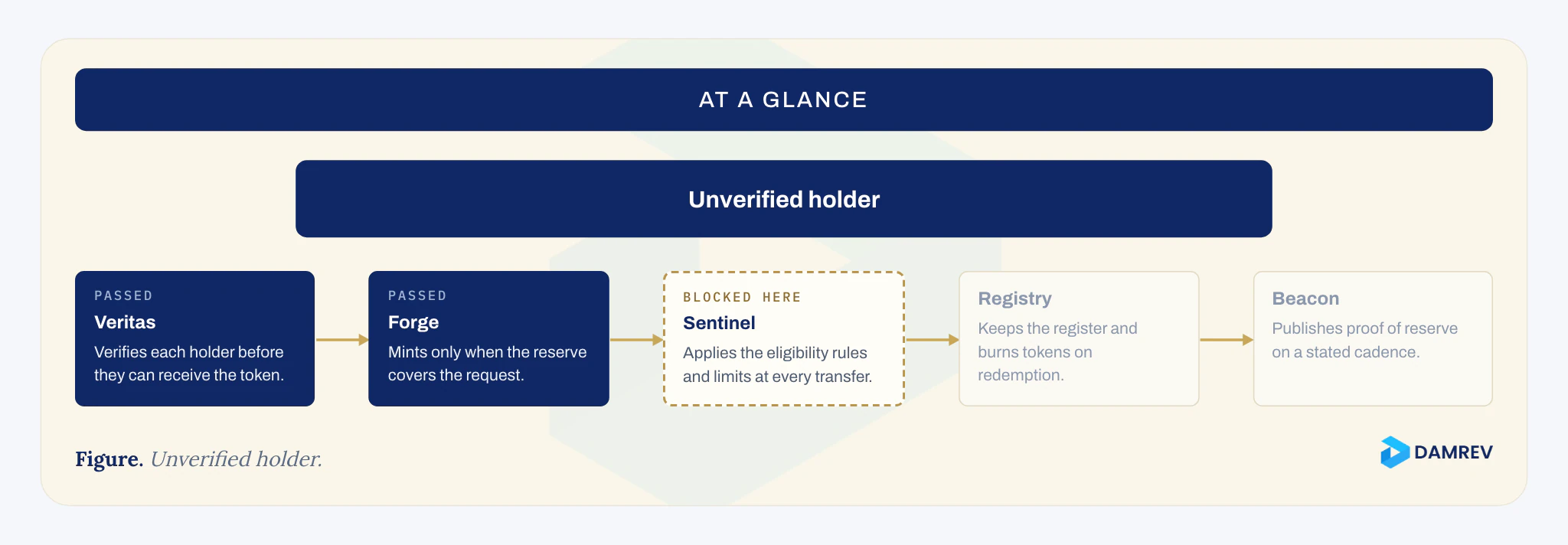
Choose a holder and follow one transfer.
Worked example
An illustrative case, not a client: a bank wants a payment token for its business clients, redeemable one-to-one, with transfers allowed only between verified accounts.
The reserve is cash held by the bank, and each holder's claim is redemption at par under the token's terms.
Counsel settles the issuer, its licence, and the redemption terms, and the reserve policy is written before any issuance.
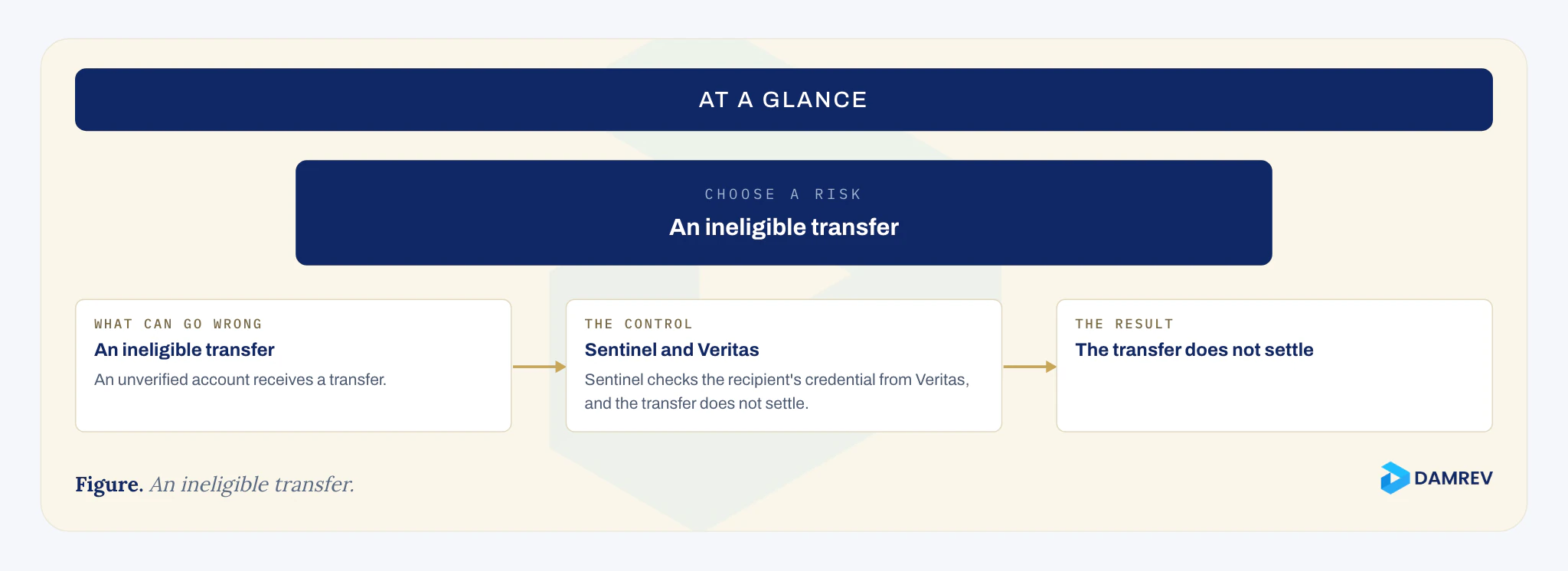
The token is encoded with the eligibility rules and limits, so a transfer to an unverified account does not settle.
Cash arrives through the bank, Beacon confirms the reserve, Forge mints, and Registry records each holder.
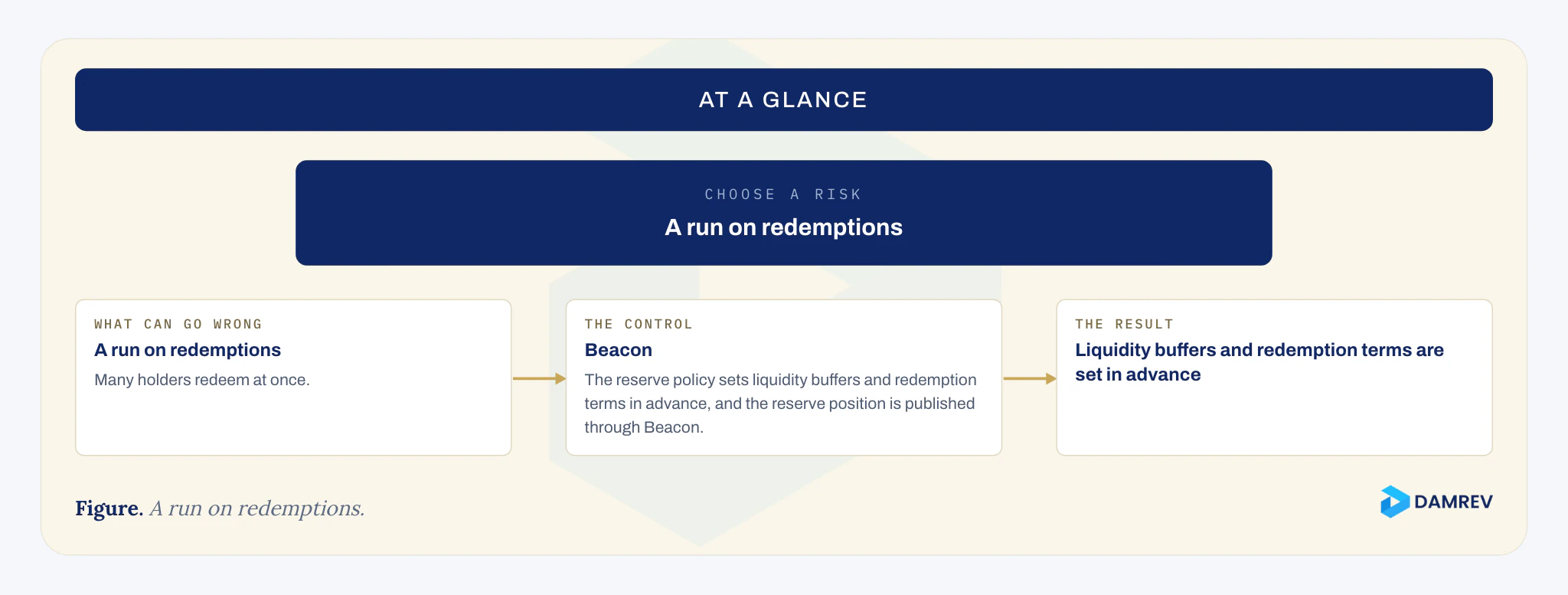
Redemptions burn tokens and pay out through the bank, and Beacon publishes proof of reserve on a stated cadence.
Rules by jurisdiction
Payment tokens sit inside each jurisdiction's own regime, and several now have rules written for them. DAMREV works across twelve jurisdictions in four regions. Choose one to see its rule, its dates, and what it means for a payment programme; the group entity present in each is stated with the rule.
12 jurisdictions, 4 regions
Choose a jurisdiction
The rule
Crypto assets were declared financial products under the Financial Advisory and Intermediary Services (FAIS) Act by General Notice 1350 of 19 October 2022. Licensing of crypto asset service providers by the Financial Sector Conduct Authority (FSCA) began on 1 June 2023, and as at 21 January 2026 the FSCA had received 512 applications and approved 3003.
For a payment token
The rule
The Virtual Asset Service Providers Act, 2025 (Act No. 20 of 2025) came into force on 4 November 2025 and makes the Central Bank of Kenya (CBK) and the Capital Markets Authority (CMA) responsible for licensing and supervising virtual asset service providers5.
For a payment token
The rule
The Virtual Assets Act, 2025 repealed and replaced the Virtual Assets Act, 2022. No person may carry on a virtual asset business without a virtual asset service provider licence issued by the Non-Bank Financial Institutions Regulatory Authority (NBFIRA)7.
For a payment token
Africa
MU
Milestones
The rule
The Virtual Asset and Initial Token Offering Services Act 2021 came into force on 7 February 2022. The Financial Services Commission (FSC) licenses virtual asset service providers in five classes: M for broker-dealers, O for wallet services, R for custodians, I for advisory and S for marketplaces8.
For a payment token
The rule
Tokenized securities are securities. On 28 January 2026 three divisions of the Securities and Exchange Commission (SEC) issued a Statement on Tokenized Securities that separates issuer-sponsored tokenized securities from third-party-sponsored ones, in custodial and synthetic models, and states that the format in which a security is issued does not affect the application of the federal securities laws10.
For a payment token
The Americas and the Caribbean
KY
Milestones
The rule
The Virtual Asset (Service Providers) Act, 2020 requires virtual asset service providers to register with the Cayman Islands Monetary Authority (CIMA). Since 1 April 2025, providers of virtual asset custody services and virtual asset trading platforms have needed a licence11.
For a payment token
The rule
The DLT Act came fully into force on 1 August 2021. It gives securities recorded on a distributed ledger a legal basis and allows DLT trading facilities authorised by the Swiss Financial Market Supervisory Authority (FINMA)12.
For a payment token
The rule
Since 30 January 2023, virtual asset service providers operating in or from Jersey have had to register with the Jersey Financial Services Commission (JFSC) under the island's proceeds of crime legislation13.
For a payment token
Europe
MT
Milestones
The rule
Malta applies the Markets in Crypto-Assets Regulation (MiCA) as a member state of the European Union (EU), and the Malta Financial Services Authority (MFSA) licenses crypto-asset service providers under it.
For a payment token
The Middle East and Asia
ADGM
Milestones
The rule
Abu Dhabi Global Market (ADGM) launched its crypto asset regulatory framework on 25 June 2018. A firm needs a Financial Services Permission from the Financial Services Regulatory Authority (FSRA) to carry on virtual asset regulated activities in or from ADGM16.
For a payment token
The Middle East and Asia
SG
Milestones
The rule
Since 30 June 2025, digital token service providers have been regulated under Part 9 of the Financial Services and Markets Act 2022, through regulations administered by the Monetary Authority of Singapore (MAS)17.
For a payment token
The rule
Since 1 June 2023, centralised virtual asset trading platforms have needed a licence from the Securities and Futures Commission (SFC). Since 1 August 2025, the Stablecoins Ordinance has applied a licensing regime to regulated stablecoin activities, supervised by the Hong Kong Monetary Authority18.
For a payment token
Risks and controls
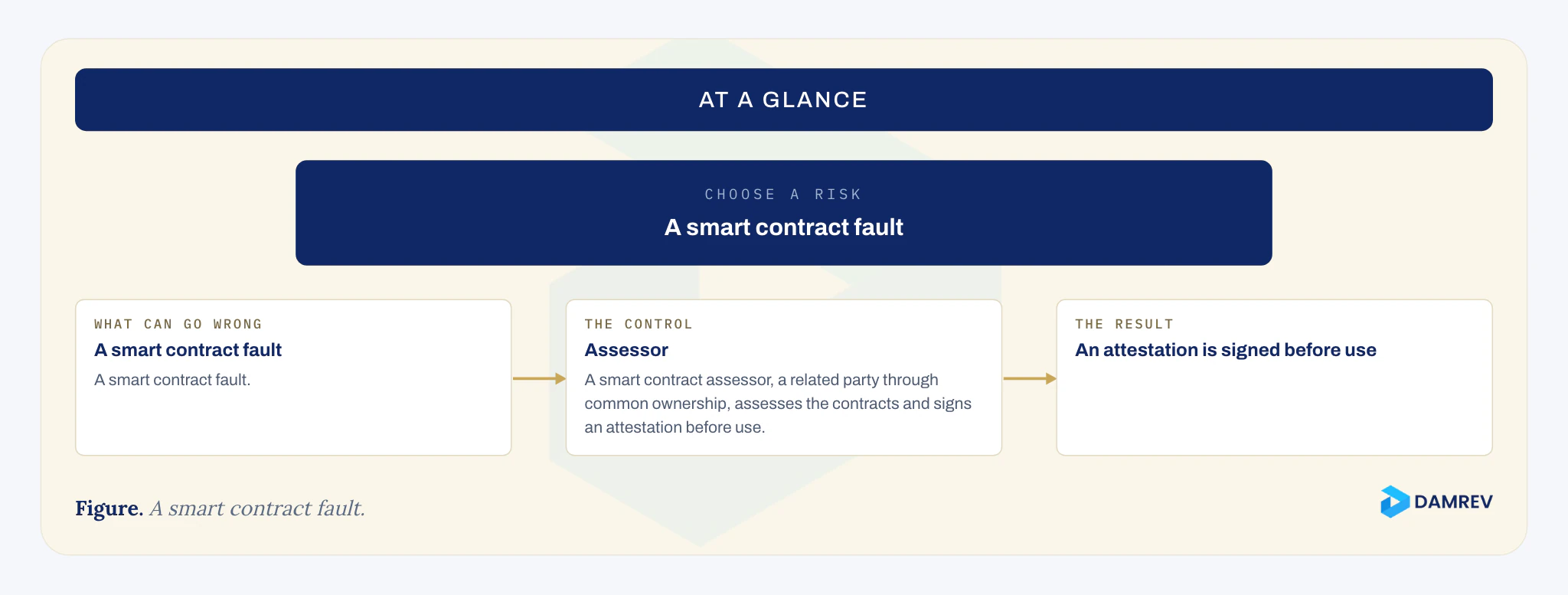
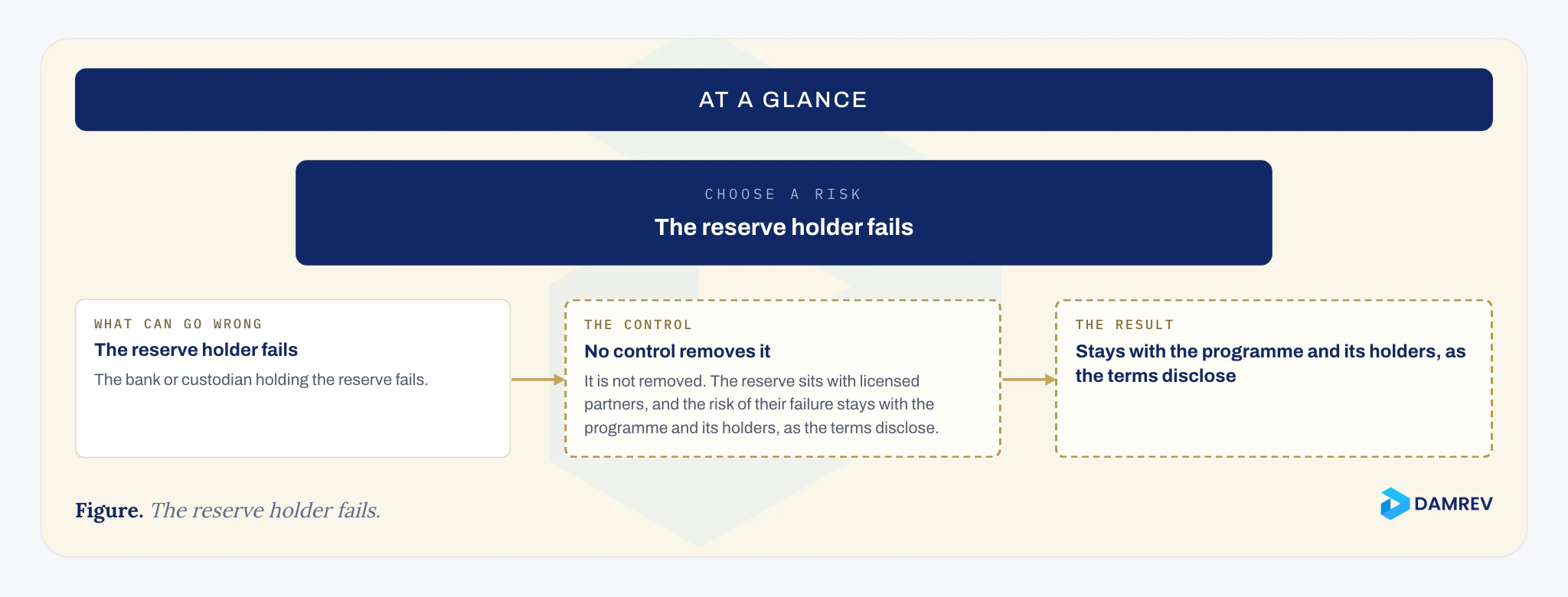
Most failures come from a reserve that does not cover what is in issue, or from rules that drift from the terms. Each has a control. Choose a risk to see it.
Six risks
Choose a risk
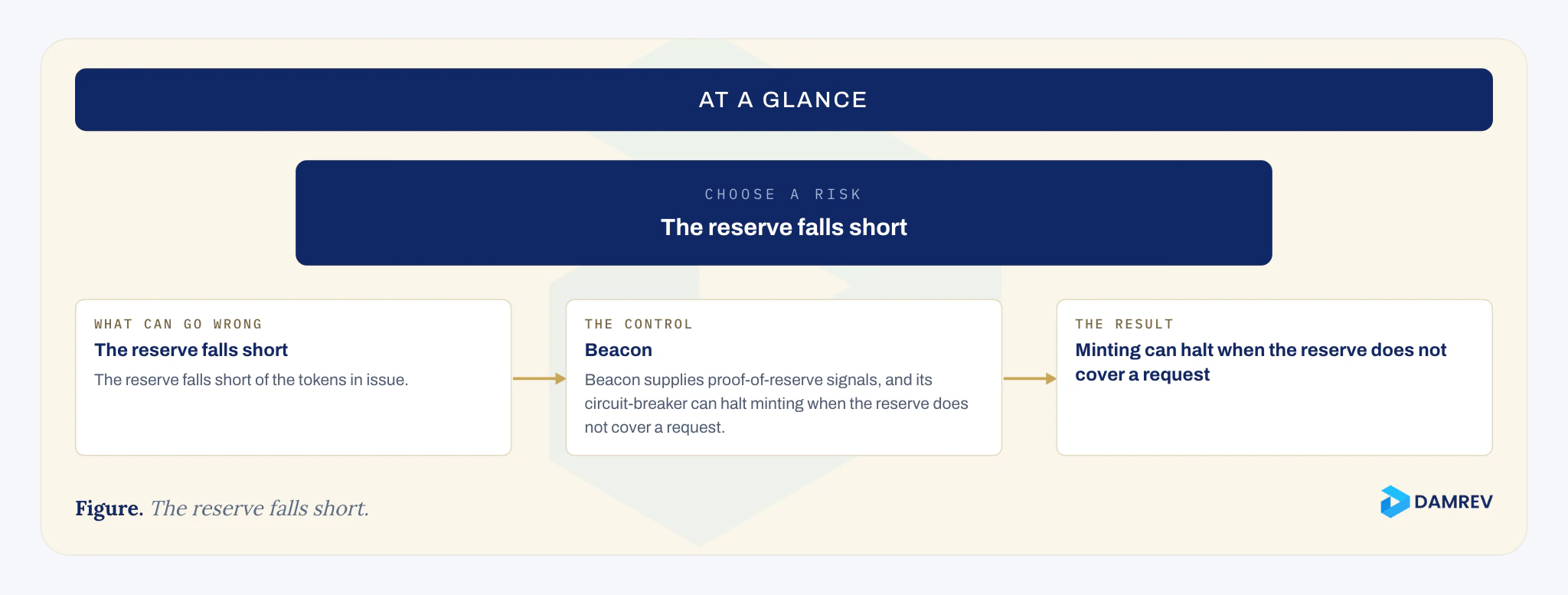
Who does what
Banks, payment institutions, and e-money issuers hold the fiat leg and perform the regulated payment functions. DAMREV builds and operates the issuance, reserve, and proof infrastructure alongside them, and holds no client money.
Position paper
Each position paper takes one question and sets out the evidence and the positions DAMREV holds on it. Each is read through the same steps as a whitepaper.
Common questions
Short answers on stablecoins: whether DAMREV issues the stablecoin, which stablecoin it uses for settlement, and how holders can verify the backing.
No. The issuer of record is a licensed party, and banks, payment institutions, or e-money issuers hold the fiat leg. DAMREV builds and operates the infrastructure and holds no client money.
None is fixed. Settlement runs in the asset each jurisdiction permits, such as USDC, EURC, a licensed local stablecoin, tokenized deposits, or fiat through a bank. The group issues none of them.
Beacon publishes proof of reserve and attestation on a stated cadence, so holders can check the backing rather than take it on trust.
Where next
The pages below pick up where this one ends. Start with the one closest to where your asset or programme stands today.
Last updated:
Insights

Since 17 September 2026 a tokenized securities venue may run automated liquidity pools in tokenized listed stock without registering as an exchange, on conditions.

The GENIUS Act binds payment stablecoin issuers from 18 January 2027, not the firms that hold or settle in stablecoins. Service providers follow in 2028.

The CLARITY Act stalled on a 49 to 50 vote, so tokenized securities stay with the Securities and Exchange Commission, as before.

Guernsey's guidance of 24 July 2026 lets a fund or issuer record and transfer its investments as tokens, under the regimes already applying to it.
Tell us what you want to tokenize.
We will show you how DAMREV can run it.
