


Skip to content
DAMREV
Start a Structuring Review

How it works across the platform

Device Security

Every transaction on DAMREV is signed on the user's own device. Sentry binds signing to the device's secure hardware, Vault holds the keys with the user, and the signed transaction then passes through the rules Sentinel applies. DAMREV never holds the keys and cannot sign on anyone's behalf, which keeps the platform non-custodial.

The flow

How does a transaction travel from the device to settlement?

A signing key that can be copied can be stolen, and a key held by a platform can be moved without its owner. The platform avoids both by keeping the key in the user's hands and the signature on the user's device, then checking the signed transaction against the rules before it settles.

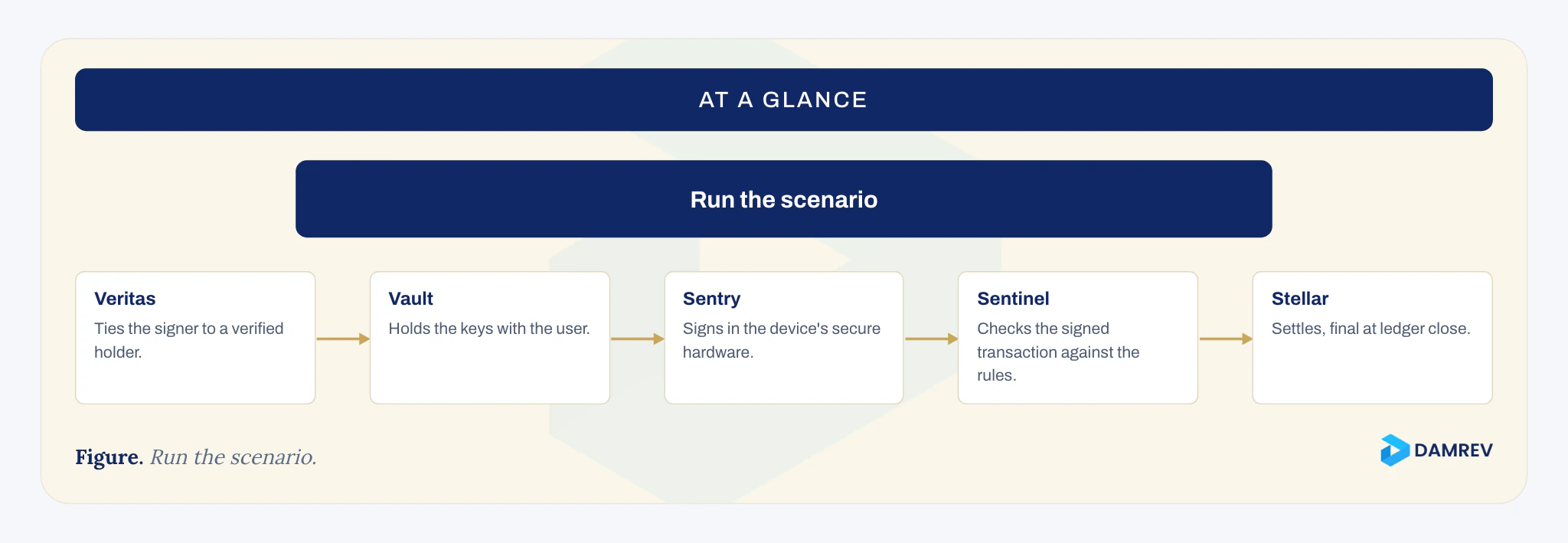
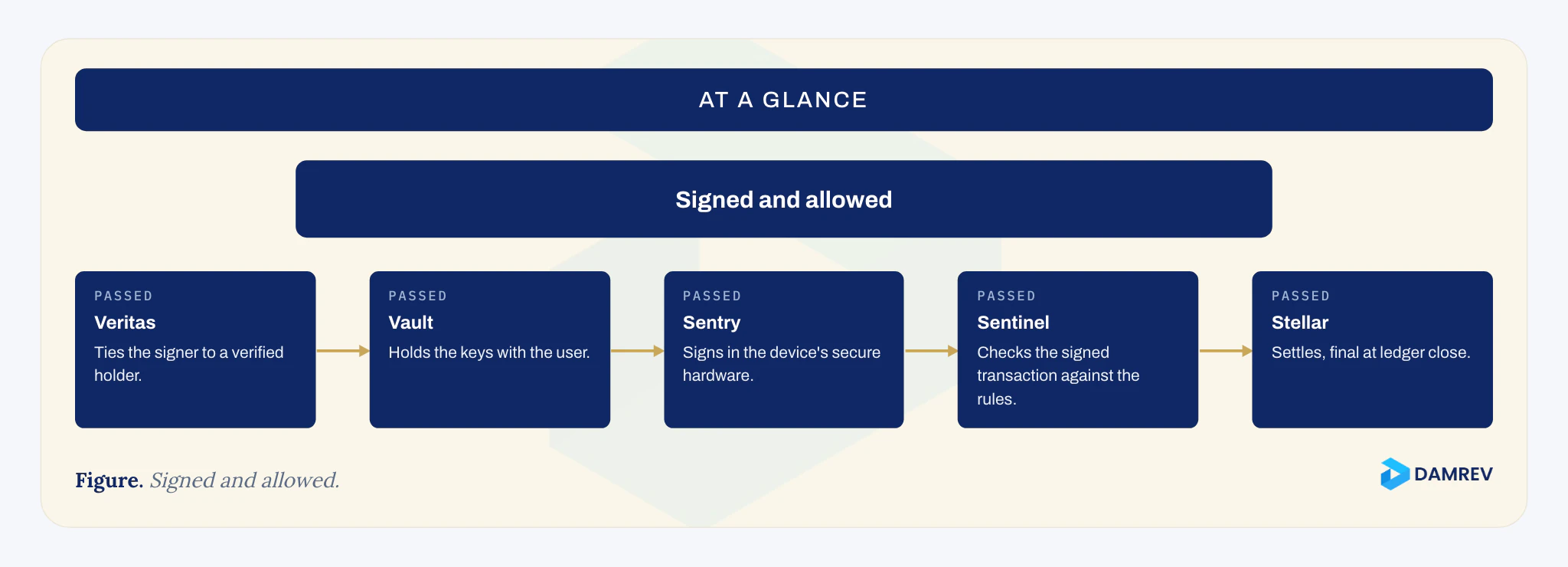
Run the scenario. Veritas, then Vault, then Sentry, then Sentinel, then Stellar. Choose a scenario and run it.
  • Run the scenario
  • Veritas: Ties the signer to a verified holder.
  • Vault: Holds the keys with the user.
  • Sentry: Signs in the device's secure hardware.
  • Sentinel: Checks the signed transaction against the rules.
  • Stellar: Settles, final at ledger close.
Run the scenario. Veritas, then Vault, then Sentry, then Sentinel, then Stellar. Choose a scenario and run it.

Choose a scenario and run it.

Step by step

Where is each part of a signature decided?

The key stays in the user's hands, the signature on the user's device, and the rules before settlement.

  1. Step one

    How is the signer tied to a verified holder?

    Through Veritas. Sentry reads identity from Veritas, so the device signing a transaction belongs to a holder whose checks were performed by the licensed provider. Vault may also hold the holder's Veritas credentials alongside their assets.


    Read about Veritas

  2. Step two

    Who holds the keys?

    The user. Vault is the non-custodial wallet engine: the user holds the keys to their assets, and the wallet pairs with Sentry for device-bound signing and with Conduit for on-ramps. DAMREV does not hold keys, so it cannot move an asset without its owner.

    Read about Vault

  3. Step three

    How is a transaction signed?

    On the device, in secure hardware. Sentry binds signing to the device's secure enclave or StrongBox hardware, and the user authorises the transaction there. The signature is produced on the device, so the key never needs to sit on a server where it could be copied.

    Sentry states five consumers: Forge, Flux, Agora, Conduit and Quorum. Staking for governance in Quorum is signed this way, and agents run by Praxis sign via Sentry too, so an automated action is authorised through the same device-bound path as a person's.

    Read about Sentry

  4. Step four

    What checks the signed transaction?

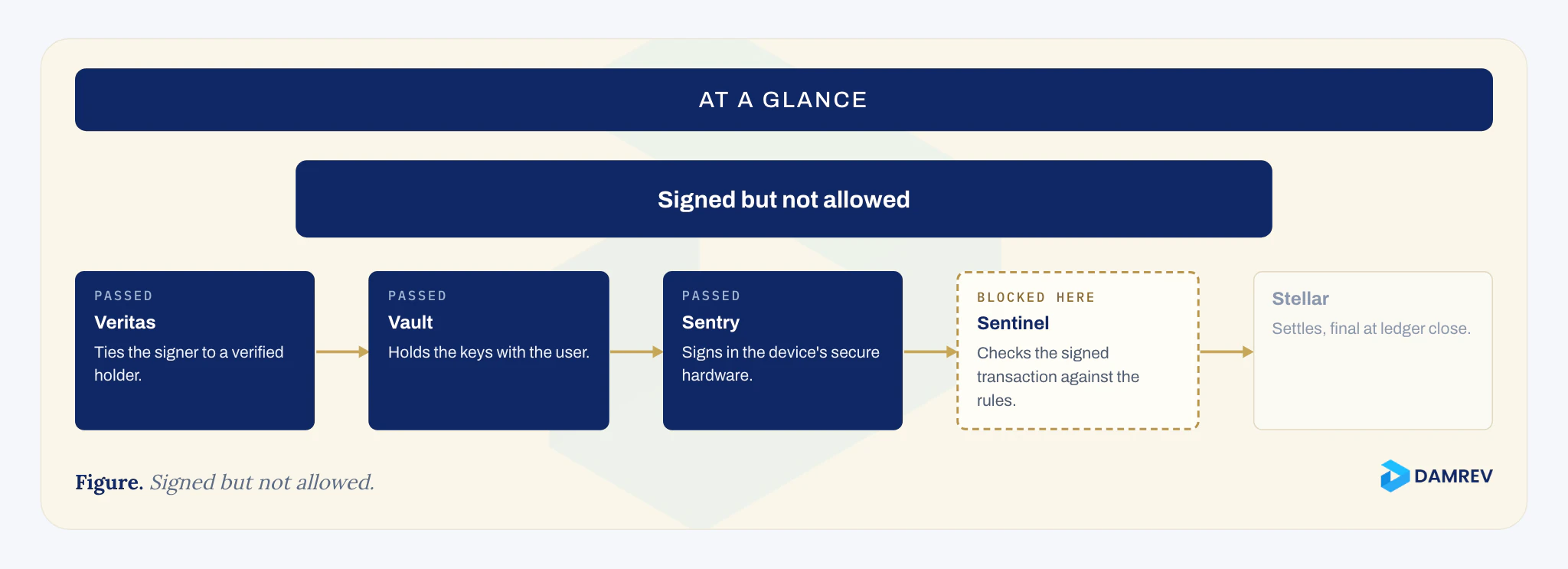
    Sentinel. A valid signature shows who authorised a transaction; it does not show that the transaction is allowed. Sentinel reads eligibility from Veritas and applies the asset's rules, and the transfer proceeds only when those rules are satisfied. The rules run in Soroban contract logic on the same ledger that settles the transfer1.

    Read about Sentinel

  5. Step five

    When is the transaction final?

    At ledger close. Stellar closes a ledger roughly every five seconds, with finality at close2. That is why authorisation sits on the device and the rules sit before settlement: once the ledger closes, the transfer is done.

    Read about settlement and liquidity

DAMREV never holds the keys and cannot sign on anyone's behalf, which keeps the platform non-custodial.

The principle

What principle governs device security?

Non-custody. The user controls the keys, the signature is produced where the user is, and the platform company holds nothing it could move. Institutions that need a custodian integrate their own qualified custody rather than handing keys to DAMREV.

Configuration

What does the client configure, and what is fixed?

A client shapes the roles and rules around signing. The signing path itself is fixed, because its value lies in never having an exception.

The client configures

  • Roles and access for its users, held in Stratum
  • Its own qualified custody, where an institution integrates one
  • The rules Sentinel applies to each signed transfer, set by the issuer

Fixed by the platform

  • Signing on the user's device, in secure hardware
  • Keys held by the user in Vault
  • No key held by DAMREV, and no signing on a user's behalf
  • Rules checked before settlement, not after

Common questions

What else do people ask?

Short answers on device security: whether DAMREV can sign a transaction for a user, what hardware Sentry uses, what happens if a device is lost, and whether a valid signature means a transfer will settle.

Can DAMREV sign a transaction for a user?

Only the user can sign. Signing happens on the user's device through Sentry, with keys the user holds in Vault, and DAMREV holds no keys.

What hardware does Sentry use?

The device's secure enclave or StrongBox hardware, which keeps the signing key bound to the device.

What happens if a device is lost?

The recovery model is an open build item. DAMREV describes no recovery service, because one that let DAMREV restore access would imply custody.

Does a valid signature mean a transfer will settle?

Only if the transfer also satisfies the rules. Sentinel reads eligibility from Veritas and blocks any transfer that fails the asset's rules.

References

  1. 1.Stellar Development Foundation, "Protocol 20 and smart contracts are live on Mainnet". https://stellar.org/blog/developers/protocol-20-and-smart-contracts-are-live-on-mainnet
  2. 2.Chainstack, "What is Stellar". https://chainstack.com/what-is-stellar/ Also: Stellar developer documentation, "Control access to an asset", https://developers.stellar.org/docs/tokens/control-asset-access

Last updated:

Ready to build on programmable infrastructure?

Tell us what you want to tokenize. We will show you how DAMREV can run it.


