



Identify the service
NBFIRA names exchange, transfer, custody, and brokerage of virtual assets as VASP services1.
Section
Structuring
The instrument classes DAMREV structures, and the four situations that bring most clients here.
Not sure which page answers your question? A structuring review starts with that conversation.
Start a Structuring ReviewSection
Services
The ladder, from a paid first look to a programme DAMREV operates for you.
Not sure which page answers your question? A structuring review starts with that conversation.
Start a Structuring ReviewSection
Platform
Eight capabilities and twenty named engines. DAMREV runs its own instruments on it.
Not sure which page answers your question? A structuring review starts with that conversation.
Start a Structuring ReviewSection
Tokenized IPO
A tokenized listing is a listing first. This section is about whether yours is ready.
Not sure which page answers your question? A structuring review starts with that conversation.
Start a Structuring ReviewSection
Compliance
Written to be read by a regulator, a counterparty or an auditor without a call first.
The Americas & the Caribbean
Europe
Not sure which page answers your question? A structuring review starts with that conversation.
Start a Structuring ReviewSection
Insights
The published record. Papers, positions and the vocabulary, all dated.
Not sure which page answers your question? A structuring review starts with that conversation.
Start a Structuring ReviewNot sure which page answers your question? A structuring review starts with that conversation.
Start a Structuring ReviewJurisdictions · Africa
In Botswana, the treatment of tokenized assets depends on the instrument's legal classification, the issuer, the offering arrangements, and the regulated functions performed. The licences, approvals, and exemptions that apply are assessed for each structure.
Settlement can run in Botswana pula or foreign currency through a Botswana bank, with exchange controls abolished in 1999, and stablecoin use runs through a virtual asset service provider holding a local licence.
No DAMREV entity claims a regulatory permission in Botswana on this page.
Position as of 14 November 2026
The framework
Botswana regulates virtual asset services through the Non-Bank Financial Institutions Regulatory Authority (NBFIRA), which applies the Virtual Assets Act, 2025 and licenses virtual asset service providers (VASPs). The Bank of Botswana regulates electronic payment service providers and runs a Regulatory Sandbox. Settlement in pula or foreign currency faces no exchange controls1, 2, 3.
NBFIRA handles virtual assets through a FinTech Department, and it named exchange, transfer, custody, and brokerage of virtual assets as VASP services in its public notice on PAA Capital (Proprietary) Limited, signed on 25 February 2026 and published on 27 February 20261. In that notice NBFIRA applied the Virtual Assets Act, 2025 as the law in force1.
On the payments side, the Bank of Botswana regulates electronic payment service providers, and the Electronic Payment Services (Amendment) Regulations, 2026 have been in effect since 2 April 20262. Those amended regulations do not mention stablecoins or virtual assets, and the Bank published its notice implementing them on 17 July 20262.
The Bank of Botswana runs its Regulatory Sandbox through its Digitalisation and Innovation Hub4, 5.
The rules
Botswana's virtual asset regime is settled law, applied by NBFIRA, and the 2026 payment regulations are in force. NBFIRA's anti-money laundering guidance and the Bank of Botswana's sandbox guidelines are published, while the National Payment Services Bill and the Non-Bank Lenders Bill, both of 2026, are still with the Attorney General's Chambers1, 2, 6, 5.
| Instrument | Date | Status |
|---|---|---|
| Virtual Assets Act, 2025, applied by NBFIRA1 | Applied in NBFIRA's notice of 25 February 2026 | Law in force |
| Electronic Payment Services (Amendment) Regulations, 2026, S.I. 46 of 20262 | In effect 2 April 2026 | Law in force |
| Abolition of exchange controls3 | 1999 | Exchange controls abolished |
| NBFIRA Guidance Note for VASPs on AML/CFT programmes6 | March 2025 | Guidance |
| Bank of Botswana Fintech Analytical Assessment Framework7 | 15 October 2025 | Published framework |
| Bank of Botswana Regulatory Sandbox Guidelines5 | November 2025 | Guidance |
| National Payment Services Bill, 20265 | With the Attorney General's Chambers for drafting since February 2026 | Bill, not law |
| Non-Bank Lenders Bill, 20265 | Returned to the Attorney General's Chambers on 9 February 2026 | Bill, not law |
The Bank of Botswana published its implementation notice for the amended payment regulations on 17 July 20262. Its Financial Stability Report of May 2026 records that neither the National Payment Services Bill nor the Non-Bank Lenders Bill is law, so payments reform remains at the drafting stage5.
The guidance layer sits beside the statute. NBFIRA's Guidance Note for VASPs on AML/CFT programmes dates from March 2025, the Bank of Botswana's Regulatory Sandbox Guidelines from November 2025, and its Fintech Analytical Assessment Framework from 15 October 20256, 5, 7.
How it works
For virtual asset services, the published regime sets a clear order. Identify whether the activity is a VASP service, hold an NBFIRA VASP licence, run an anti-money laundering programme to NBFIRA's guidance, check the electronic payment rules for any payment leg, and settle in pula or foreign currency through a bank1, 6, 2, 3.
NBFIRA names exchange, transfer, custody, and brokerage of virtual assets as VASP services1.
NBFIRA licenses VASPs under the Virtual Assets Act, 2025, and it can cancel a licence and order customer assets to be handed back or transferred1.
NBFIRA's Guidance Note of March 2025 sets out how VASPs implement AML/CFT programmes6.
Electronic payment service providers fall under the Bank of Botswana's regulations, amended with effect from 2 April 2026, and the amendment does not mention stablecoins or virtual assets2.
Licences
NBFIRA licenses VASPs in Botswana. For platform operators, custodians, and brokers, the services NBFIRA names as VASP services are exchange, transfer, custody, and brokerage of virtual assets, while electronic payment service providers answer to the Bank of Botswana under the 2026 payment regulations1, 2.
NBFIRA's public notice on PAA Capital (Proprietary) Limited shows the licence in operation: NBFIRA cancelled that firm's VASP licence and ordered customer assets to be handed back or transferred1.
NBFIRA published its Guidance Note for VASPs on the implementation of AML/CFT programmes in March 20256.
For distributors, NBFIRA names brokerage of virtual assets among the VASP services it licenses under the Virtual Assets Act, 20251. Where a service also moves payments electronically, the Bank of Botswana's Electronic Payment Services Regulations, as amended by S.I. 46 of 2026, apply to the electronic payment service provider2.
Who regulates what
NBFIRA regulates virtual assets: it licenses VASPs through its FinTech Department, issues anti-money laundering guidance, and cancels licences. The Bank of Botswana regulates electronic payment service providers, runs the Regulatory Sandbox through its Digitalisation and Innovation Hub, and monitors the financial stability risks of virtual assets1, 6, 2, 4, 5.
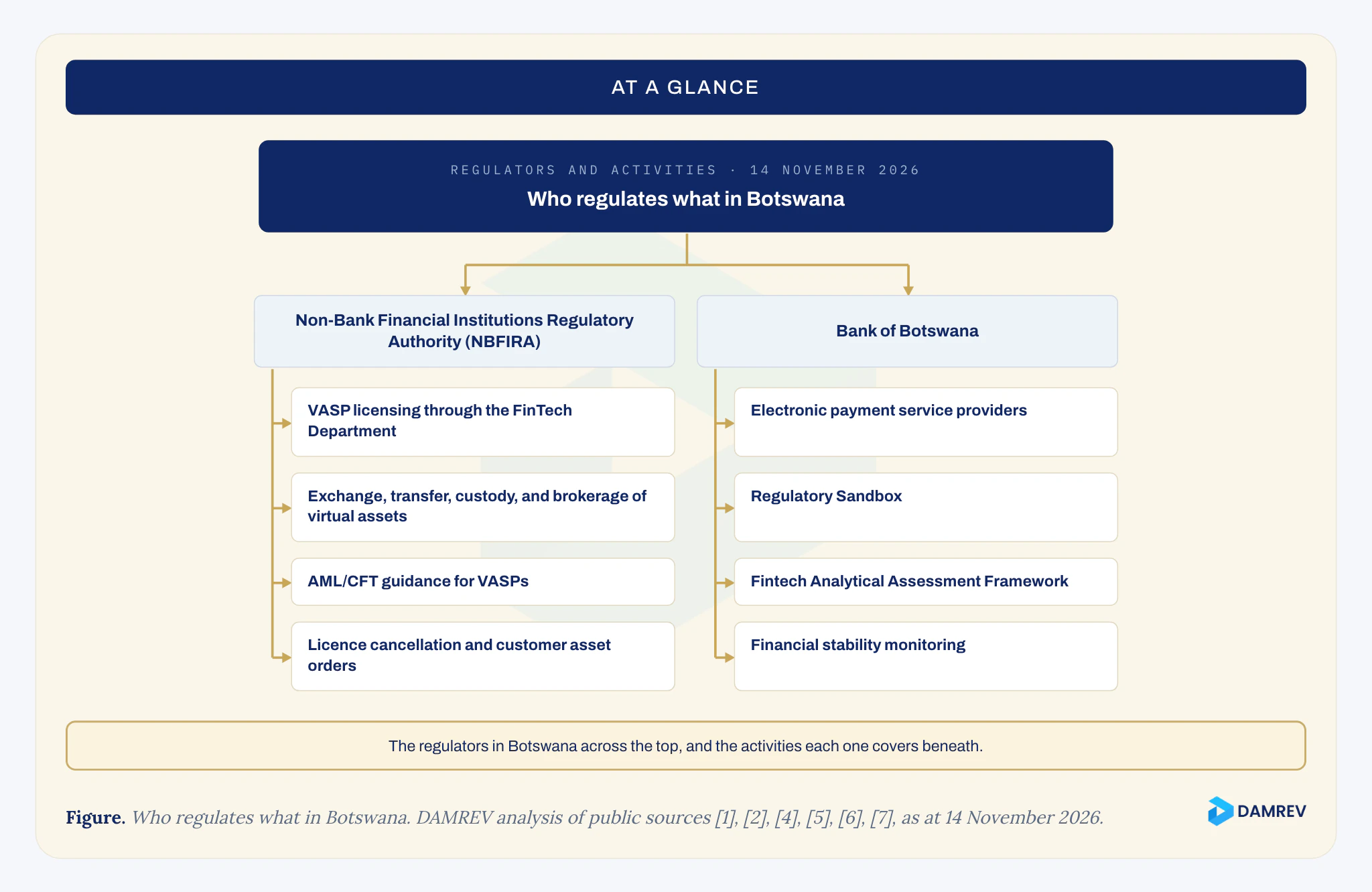
The Bank of Botswana's Financial Stability Report of May 2026 states that virtual assets elevate financial integrity monitoring challenges, and that the national risk assessment of October 2025 rated the risks "moderate but manageable"5. The Bank also published a Fintech Analytical Assessment Framework dated 15 October 20257.
NBFIRA, for its part, exercises its supervisory powers by public notice: its notice on PAA Capital (Proprietary) Limited was signed on 25 February 2026 and published on 27 February 20261.
Settlement
Settlement in Botswana can run in pula or foreign currency through a Botswana bank, because exchange controls were abolished in 1999. Stablecoins such as USDC or USDT are used only through an NBFIRA-licensed VASP. The amended electronic payment regulations do not mention stablecoins or virtual assets3, 1, 2.
The stablecoin route runs through the VASP licence: NBFIRA licenses VASPs, and it names exchange, transfer, custody, and brokerage of virtual assets as VASP services1. Payment-side reform is still a bill: the National Payment Services Bill, 2026 has been with the Attorney General's Chambers for drafting since February 20265.
Because no exchange controls apply and stablecoin use has a defined local VASP route, settlement in Botswana carries low complexity3, 1. Where a VASP licence is cancelled, NBFIRA can order customer assets to be handed back or transferred1.
As at 14 November 2026, Botswana had no stablecoin law and no accepted list of stablecoins, and stablecoins such as USDC or USDT are used only through an NBFIRA-licensed VASP1.
Sandbox and pilots
Yes, at the Bank of Botswana. Its Regulatory Sandbox was established in 2025 and became operational in March 2026. The first call for applications ran from 4 March 2026 to 31 March 2026, themed on digital banks, inclusive payments, and interoperability, and applications were under assessment as at May 20265, 4.
The sandbox runs under the Bank's Regulatory Sandbox Guidelines of November 2025, through its Digitalisation and Innovation Hub5, 4. The Bank also published a Fintech Analytical Assessment Framework, dated 15 October 20257.
The first call's three themes, digital banks, inclusive payments, and interoperability, do not name virtual assets, and the sandbox sits with the Bank of Botswana rather than with NBFIRA4, 5.
Risks and controls
Botswana's virtual asset regime is in force and enforced. A provider weighs NBFIRA's licence cancellation power, the AML/CFT programme it expects, the Bank of Botswana's view of virtual asset integrity risk, payment regulations that are silent on stablecoins, and payments reform that remains a bill1, 6, 5, 2.
Six risks
Choose a risk
The risk
NBFIRA can cancel a virtual asset service provider's licence, and customer assets then have to be handed back or moved to another provider1.
What the rules require
In February 2026 NBFIRA cancelled the VASP licence of PAA Capital (Proprietary) Limited and ordered customer assets to be handed back or transferred1.
The risk
A provider works in a sector the Bank of Botswana links to financial integrity monitoring challenges, with risks the October 2025 national risk assessment rated "moderate but manageable"5.
What the rules require
The Bank of Botswana states that virtual assets elevate financial integrity monitoring challenges, and the October 2025 national risk assessment rated the risks "moderate but manageable"5.
The risk
Payments and non-bank lending reform sits in two bills with the Attorney General's Chambers, so the rules in force today are the ones that apply5.
What the rules require
The National Payment Services Bill, 2026 and the Non-Bank Lenders Bill, 2026 are with the Attorney General's Chambers, and neither is law5.
Our position
No DAMREV entity claims a regulatory permission in Botswana, and DAMREV Labs, LLC is not licensed there as a financial services or virtual asset firm.
This page sets out Botswana's public rules as at 14 November 2026. It is analysis of public sources, not legal advice, and nothing on it is an offer of, or an invitation to use, any service in Botswana.
Common questions
Short answers to the questions people ask most about this topic.
The Non-Bank Financial Institutions Regulatory Authority licenses virtual asset service providers and handles virtual assets through a FinTech Department. The Bank of Botswana regulates electronic payment service providers and runs the Regulatory Sandbox.
NBFIRA names exchange, transfer, custody, and brokerage of virtual assets as VASP services. It applies the Virtual Assets Act, 2025 as the law in force, and it can cancel a licence and order customer assets to be handed back or transferred.
No. Exchange controls were abolished in 1999, so settlement can run in pula or foreign currency through a Botswana bank.
Only through an NBFIRA-licensed virtual asset service provider. The Electronic Payment Services (Amendment) Regulations, 2026 do not mention stablecoins or virtual assets, and the National Payment Services Bill, 2026 is not law.
Yes. The Bank of Botswana Regulatory Sandbox became operational in March 2026, and its first call ran from 4 March 2026 to 31 March 2026, themed on digital banks, inclusive payments, and interoperability. Applications were under assessment as at May 2026.
Yes. In February 2026 NBFIRA cancelled the VASP licence of PAA Capital (Proprietary) Limited and ordered customer assets to be handed back or transferred. NBFIRA's public notice of the cancellation was signed on 25 February 2026 and published on 27 February 2026.
Not yet in full. The Electronic Payment Services (Amendment) Regulations, 2026 have been in effect since 2 April 2026, but the National Payment Services Bill, 2026 has been with the Attorney General's Chambers for drafting since February 2026, and the Non-Bank Lenders Bill, 2026 was sent back there on 9 February 2026. Neither bill is law.
No. DAMREV Labs, LLC does not hold a financial services or virtual asset licence, and no DAMREV entity claims a regulatory permission in Botswana.
Where next
Botswana sits within the African group of DAMREV's jurisdictions. These pages compare it with its neighbours, and set out how compliance is designed.
Position as of 14 November 2026: the law and sources on this page are stated as at that date. Last updated:
Insights

Since 17 September 2026 a tokenized securities venue may run automated liquidity pools in tokenized listed stock without registering as an exchange, on conditions.

The GENIUS Act binds payment stablecoin issuers from 18 January 2027, not the firms that hold or settle in stablecoins. Service providers follow in 2028.

The CLARITY Act stalled on a 49 to 50 vote, so tokenized securities stay with the Securities and Exchange Commission, as before.

Guernsey's guidance of 24 July 2026 lets a fund or issuer record and transfer its investments as tokens, under the regimes already applying to it.
Tell us what you want to tokenize.
We will show you how DAMREV can run it.
