Skip to content
DAMREV
Start a Structuring Review

How it works across the platform

Issuance & Transfer Control

DAMREV controls the two moments that define an instrument: its creation and every change of hands. Forge mints only after Veritas and Sentinel clear eligibility and Beacon's circuit-breaker allows it, Cadence releases tokens only on the schedule set for the asset, and Sentinel applies the transfer rules on-chain at every transfer.

The flow

Which engines stand between an instrument and its holders?

A token issued wrongly, or moved to the wrong holder, is hard to recall once the ledger has closed. The platform therefore places its controls before each of those moments rather than after them, in a fixed order that runs from identity to the register.

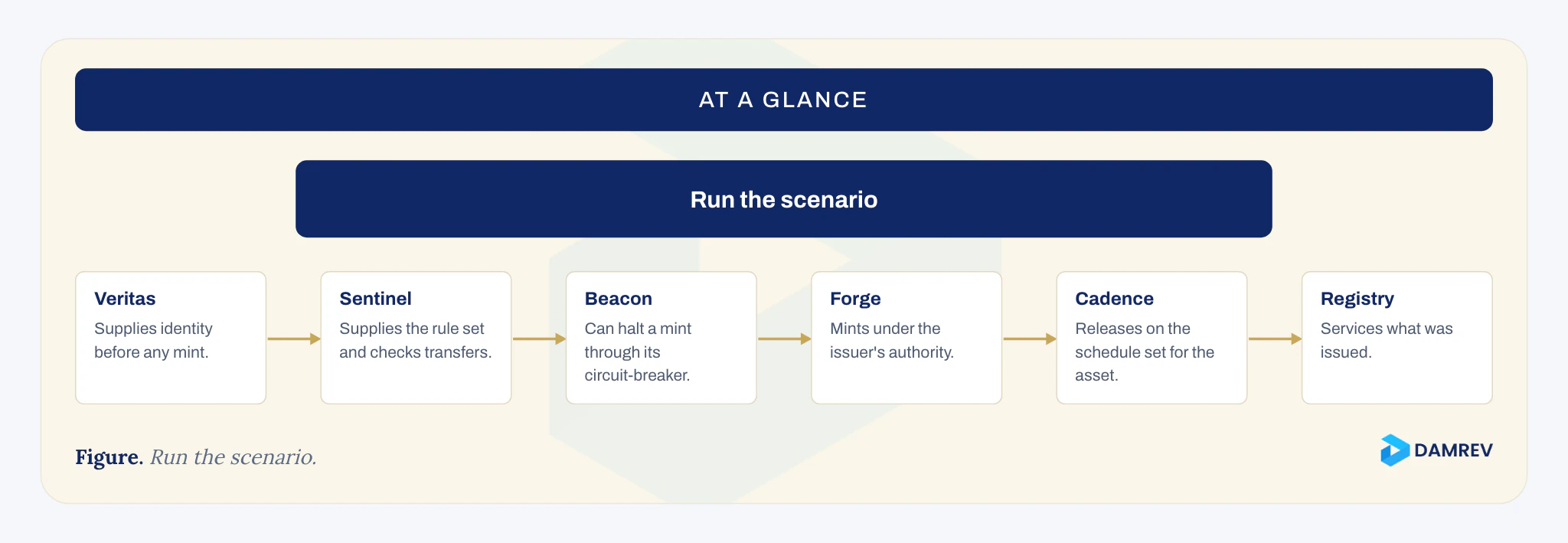
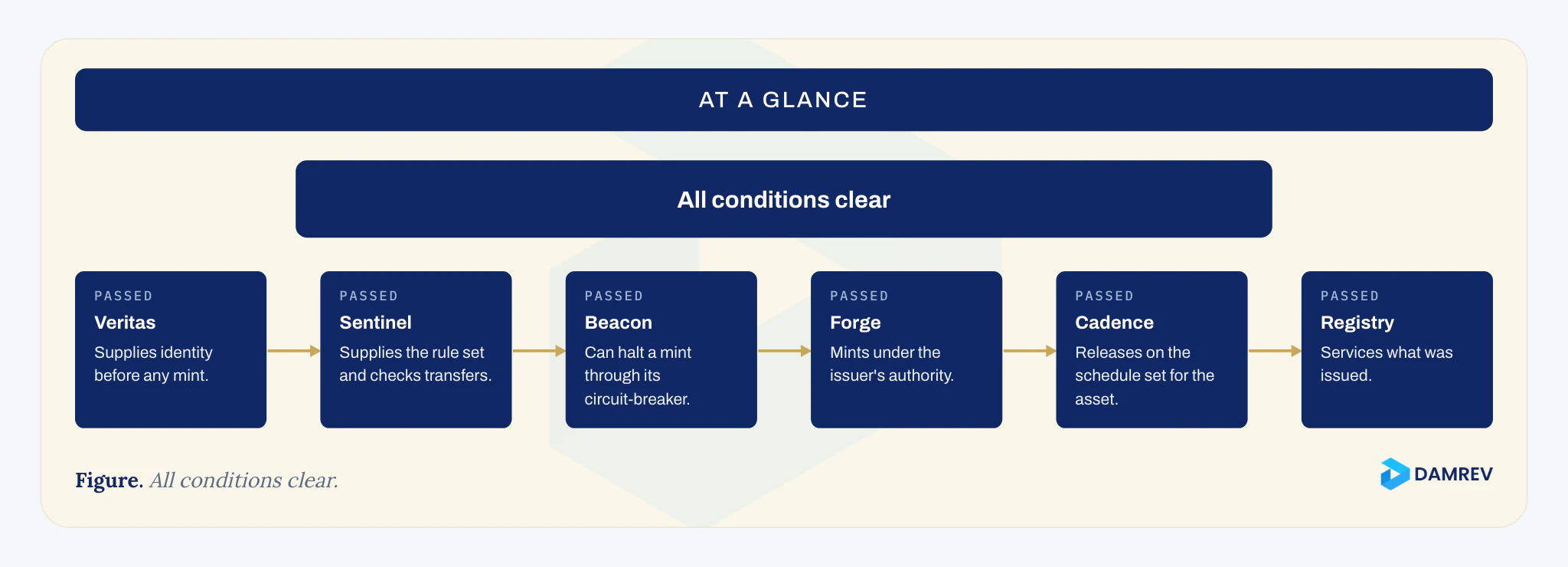
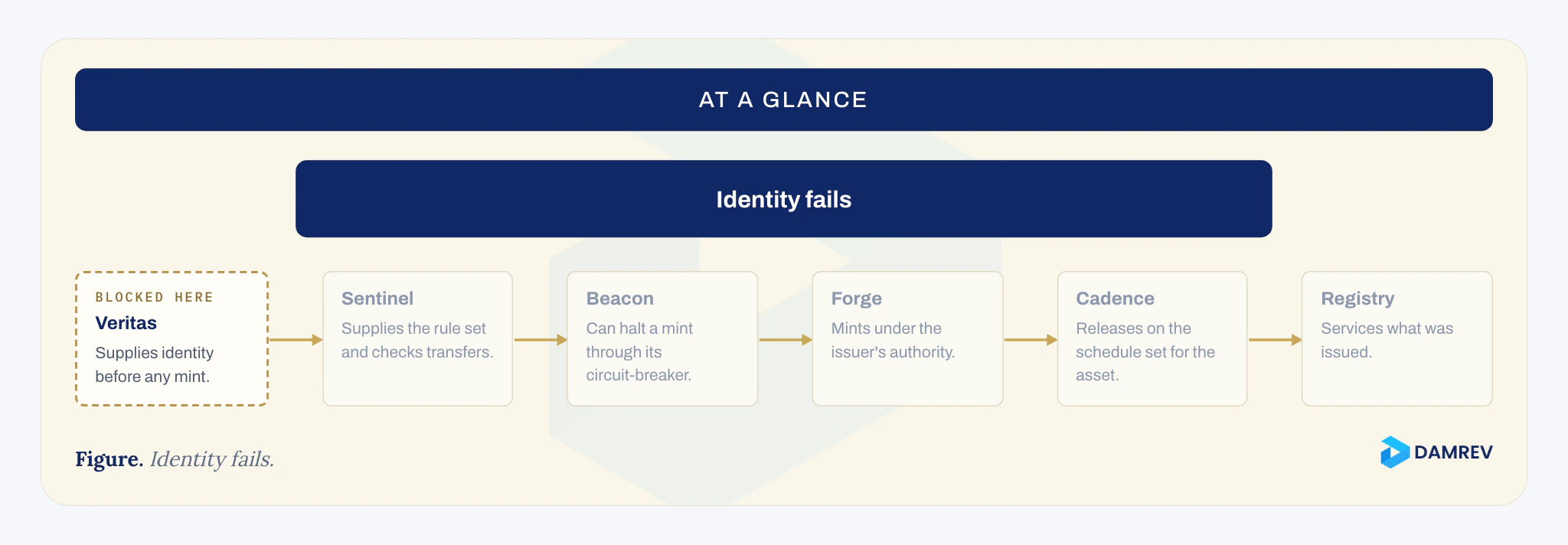
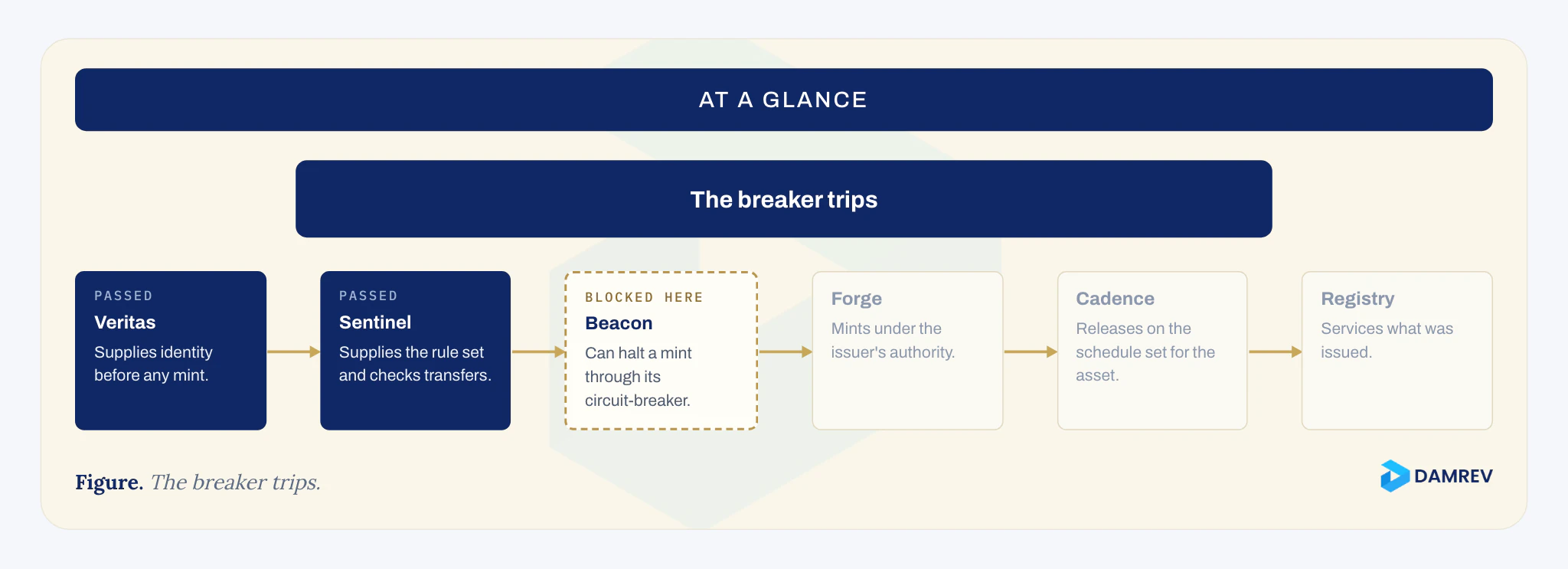
Run the scenario. Veritas, then Sentinel, then Beacon, then Forge, then Cadence, then Registry. Choose a scenario and run it.
  • Run the scenario
  • Veritas: Supplies identity before any mint.
  • Sentinel: Supplies the rule set and checks transfers.
  • Beacon: Can halt a mint through its circuit‑breaker.
  • Forge: Mints under the issuer's authority.
  • Cadence: Releases on the schedule set for the asset.
  • Registry: Services what was issued.
Run the scenario. Veritas, then Sentinel, then Beacon, then Forge, then Cadence, then Registry. Choose a scenario and run it.

Choose a scenario and run it.

Step by step

What stands before each mint and each transfer?

Five controls, in a fixed order, so no mint or transfer can skip a check.

  1. Step one

    What must clear before anything is minted?

    Identity and the rules. Forge depends on Veritas and Sentinel: it checks identity from Veritas and the rule set from Sentinel before any mint. Issuance is gated at the point of mint, so no token is created for a holder the rules would not allow.


    Read about Veritas

  2. Step two

    Can a mint be stopped by data?

    Yes. Beacon supports a mint circuit-breaker that can halt minting when a reserve or data condition is not met, and Forge reads that signal before issuance. A programme backed by reserves cannot mint past what its data supports.

    Read about Beacon

  3. Step three

    Under whose authority does Forge mint?

    The issuer's. Forge issues under the authority of the programme's issuing entity. DAMREV Labs, LLC builds and operates the software and issues nothing; in the group, DAMREV Capital Partners, incorporated in Mauritius, is the separate entity that can act as issuer and general partner. Issued tokens pass to Cadence, Registry and Agora.

    The platform does not classify what Forge issues. Nothing it mints is described as a security, commodity, currency or investment; classification is for the issuer and counsel.

    Read about Forge

  4. Step four

    How are release and vesting controlled?

    By Cadence, on the schedule set for the asset. Cadence holds the vesting and release schedule, and at each release Veritas and Sentinel confirm eligibility before tokens move. Vesting, lockups and distributions follow the rules set for the asset, and releases are recorded through Registry.

    Read about Cadence

  5. Step five

    How is every later transfer controlled?

    By Sentinel, at the moment of transfer. It reads eligibility from Veritas, applies the rule set that governs the asset, and enforces it in Soroban contract logic on the settlement layer. The transfer proceeds only when the rules are satisfied; otherwise it is blocked.

    Read about Sentinel

The controls sit before each moment rather than after it, because a token issued wrongly is hard to recall once the ledger has closed.

The law

What does the law say about tokenized issuance?

That token form does not change the law. Whether an instrument is a security, and which obligations attach to it, is decided by the issuer and counsel under the law that applies. The platform encodes the result and enforces it; it does not make the classification.

Configuration

What does the client configure, and what is fixed?

The issuer shapes the rules, the schedule and the conditions. The order of the controls is fixed, so no mint or transfer can skip a check.

The client configures

  • The rule set for each asset, per jurisdiction
  • The vesting, lockup and release schedule Cadence holds
  • The reserve or data conditions agreed for the programme
  • Whether secondary sales are listed through Agora

Fixed by the platform

  • No mint before Veritas and Sentinel clear eligibility
  • Minting only under the issuer's authority
  • Each release gated by Veritas and Sentinel
  • Every transfer checked against the rules before it settles

Common questions

What else do people ask?

Short answers to the questions people ask most about this topic.

Can Forge mint without an eligibility check?

Every mint follows an eligibility check. Forge depends on Veritas and Sentinel and checks both before it issues anything.

Does DAMREV issue the tokens?

The issuer does. Forge mints under the issuer's authority, and DAMREV Labs, LLC builds and operates the software without issuing securities.

Can a scheduled release reach an ineligible holder?

Cadence gates each release through Veritas and Sentinel, so eligibility is confirmed before any token moves.

Is Agora an exchange?

Agora is a marketplace and listing system that lists and matches sales behind an eligibility gate. It is never an exchange, an alternative trading system or a regulated venue, and it makes no price or liquidity guarantee.

Where next

The pages below pick up where this one ends. Start with the one closest to where your asset or programme stands today.

References

  1. 1.US Securities and Exchange Commission, Statement on Tokenized Securities, 28 January 2026. https://www.sec.gov/newsroom/speeches-statements/corp-fin-statement-tokenized-securities-012826-statement-tokenized-securities
  2. 2.Chainstack, "What is Stellar". https://chainstack.com/what-is-stellar/ Also: Stellar developer documentation, "Control access to an asset", https://developers.stellar.org/docs/tokens/control-asset-access
  3. 3.Stellar Development Foundation, "Protocol 20 and smart contracts are live on Mainnet". https://stellar.org/blog/developers/protocol-20-and-smart-contracts-are-live-on-mainnet

Last updated:

Ready to build on programmable infrastructure?

Tell us what you want to tokenize. We will show you how DAMREV can run it.