
Skip to content
DAMREV
Start a Structuring Review

How it works across the platform

Settlement & Liquidity

Value settles in the asset each jurisdiction permits, which the group does not issue, and a Stellar ledger closes roughly every five seconds with finality at close1. Conduit brings fiat in through a licensed provider, Flux routes swaps without custody, and Agora lists sales behind an eligibility gate. The user keeps custody; no price, rate or liquidity is promised.

The flow

How does value move from fiat to a settled position?

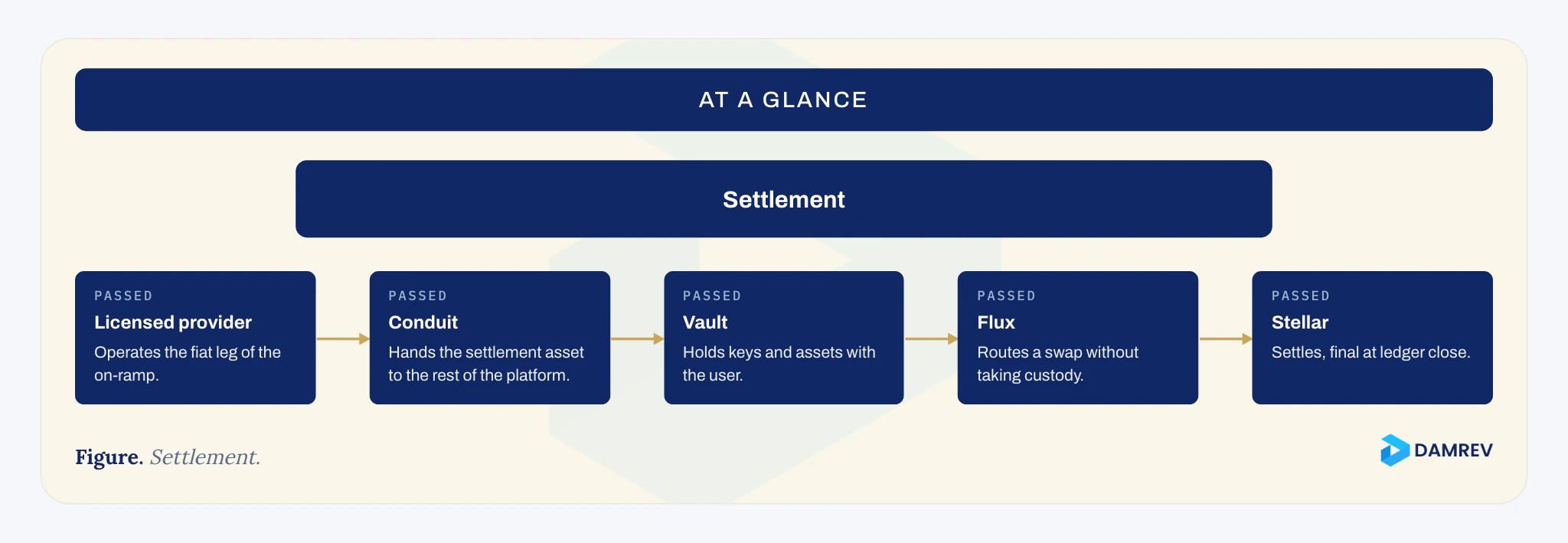
Settlement is where a tokenized instrument meets money, and where custody questions become sharp. The platform keeps each step with a named engine or licensed party, and keeps the user in control of their assets from the on-ramp to the closed ledger.

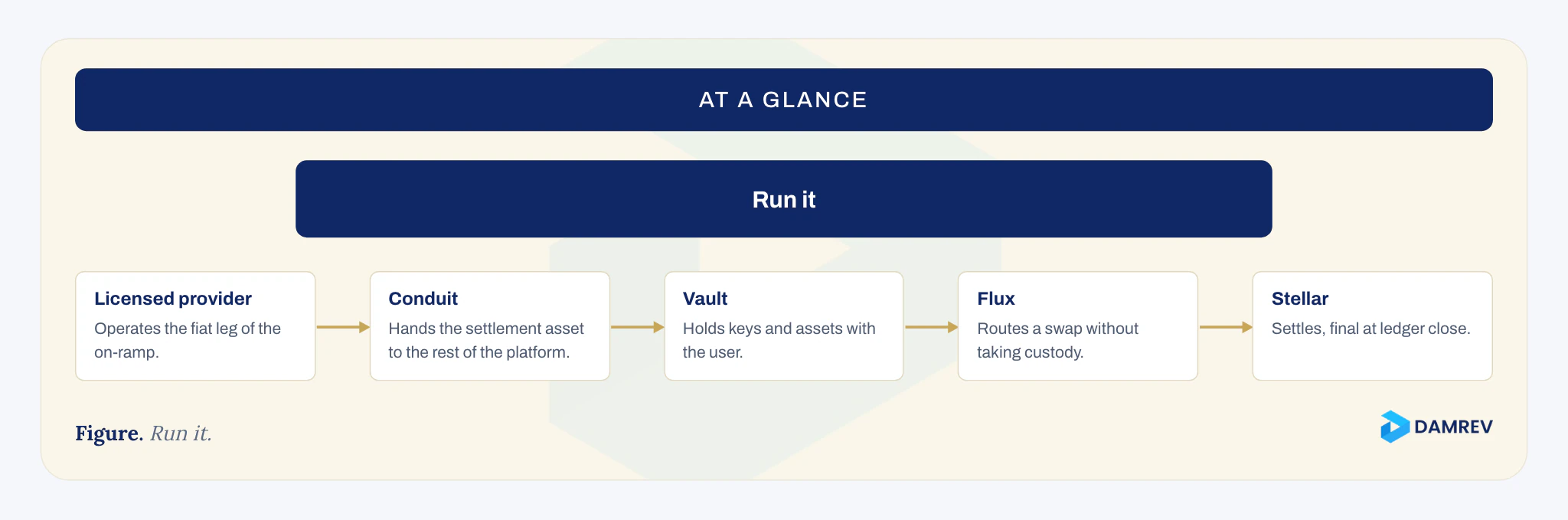
Run it. Licensed provider, then Conduit, then Vault, then Flux, then Stellar. Run it to follow value from fiat to a settled position.
  • Run it
  • Licensed provider: Operates the fiat leg of the on-ramp.
  • Conduit: Hands the settlement asset to the rest of the platform.
  • Vault: Holds keys and assets with the user.
  • Flux: Routes a swap without taking custody.
  • Stellar: Settles, final at ledger close.
Run it. Licensed provider, then Conduit, then Vault, then Flux, then Stellar. Run it to follow value from fiat to a settled position.

Run it to follow value from fiat to a settled position.

Step by step

Where does each step sit, and with whom?

Each step stays with a named engine or licensed party, and the user keeps custody throughout.

  1. Step one

    How does fiat enter the platform?

    Through Conduit, the settlement-layer engine, and a licensed third-party provider. The user brings fiat in through the licensed on-ramp provider, which also performs the identity checks on the ramp. Conduit then hands the settlement asset to Flux and Vault. The user, not an issuer, is the party to the on-ramp.


    Read about Conduit

  2. Step two

    Where does the user hold value?

    In Vault, with the keys. Vault is non-custodial: the user holds the keys to their assets, and the wallet pairs with Sentry for device-bound signing and with Conduit for ramps. DAMREV holds no customer funds, and institutions integrate their own qualified custody.

    Read about Vault

  3. Step three

    How does a swap work?

    Flux presents and routes it on a non-custodial interface to the Stellar decentralised exchange, with no minting at swap, while the user keeps custody. Flux depends on Conduit for USDC and on Vault for keys. Routing a swap is a function: Flux is not an exchange, a regulated venue or a broker.

    Read about Flux

  4. Step four

    When is settlement final?

    When the ledger closes. Stellar, public since 31 July 2014, runs the Stellar Consensus Protocol and closes a ledger roughly every five seconds with finality at close1. Soroban smart contracts, live on mainnet since February 2024, run natively on the same ledger2, so the transfer rule and the settlement happen in one place.

    Read about Sentinel

  5. Step five

    What does the platform offer for secondary liquidity?

    Functions, not a venue. Agora lists and matches sales on the secondary market behind an eligibility gate enforced by Veritas and Sentinel. Anchor locks collateral by smart contract, priced from Beacon and backstopped by Reserve. Reserve manages DAMREV's own treasury, never customer funds.

    Read about Agora

The user, not an issuer, is the party to the on-ramp, and DAMREV holds no customer funds at any step.

Liquidity functions

What does each liquidity function do, and what is it not?

Each is a function, not a venue. None makes a price, rate or liquidity promise.

  • Swap routingFluxRoutes a swap on the Stellar decentralised exchange, with the user keeping custody.What it is notAn exchange, a regulated venue or a broker. It makes no price or rate promise.
  • Listing systemAgoraLists and matches secondary sales behind an eligibility gate.What it is notAn exchange, an alternative trading system or a regulated venue. It makes no price or liquidity guarantee.
  • CollateralAnchorLocks collateral by smart contract, priced from Beacon and backstopped by Reserve.What it is notA lending product.
  • TreasuryReserveManages DAMREV's own treasury.What it is notA holder of customer funds.

The rules

What rules sit behind the settlement asset?

United States law now sets reserve rules for payment stablecoin issuers, and a registered fund has already used Stellar as its official record. Settlement runs in the asset each jurisdiction permits, and the group issues none of them, so the issuer's obligations under that law are the issuer's.

Configuration

What does the client configure, and what is fixed?

A client chooses which ramps, custody and liquidity functions its programme uses. The settlement network, the settlement unit and the custody line are fixed.

The client configures

  • Which ramps and payment flows the programme uses through Conduit
  • Whether an institution integrates its own qualified custody
  • Whether secondary sales are listed through Agora, and for which eligible holders
  • Whether collateral functions through Anchor are used

Fixed by the platform

  • Settlement in the asset each jurisdiction permits
  • The fiat leg operated by a licensed provider, not by DAMREV
  • The user keeps custody throughout
  • No price, rate or liquidity promise

Common questions

What else do people ask?

Short answers on settlement: whether DAMREV issues the settlement asset or holds funds during settlement, whether Flux or Agora is an exchange, and who operates the fiat leg.

Does DAMREV issue the settlement asset?

No. Settlement runs in the asset each jurisdiction permits, such as USDC, EURC, a licensed local stablecoin, tokenized deposits, or fiat through a bank. The group issues none of them.

Does DAMREV hold funds during settlement?

The platform is non-custodial and holds no customer funds. The user keeps the keys in Vault, and Reserve manages DAMREV's own treasury only.

Is Flux or Agora an exchange?

Both are functions, not venues. Flux routes a swap, and Agora is a marketplace and listing system behind an eligibility gate. Neither is an exchange, a broker or a regulated venue.

Who operates the fiat leg?

A licensed third-party provider. Conduit integrates it and hands the settlement asset to the rest of the platform.

References

  1. 1.Chainstack, "What is Stellar". https://chainstack.com/what-is-stellar/ Also: Stellar developer documentation, "Control access to an asset", https://developers.stellar.org/docs/tokens/control-asset-access
  2. 2.Stellar Development Foundation, "Protocol 20 and smart contracts are live on Mainnet". https://stellar.org/blog/developers/protocol-20-and-smart-contracts-are-live-on-mainnet
  3. 3.Greenberg Traurig, "GENIUS Act enacted, establishing a regulatory framework for payment stablecoins". https://www.gtlaw.com/en/insights/2025/7/genius-act-enacted-establishing-a-regulatory-framework-for-payment-stablecoins-issued-or-sold-in-the-united-states
  4. 4.Stellar Development Foundation, Franklin Templeton case study. https://stellar.org/case-studies/franklin-templeton

Last updated:

Ready to build on programmable infrastructure?

Tell us what you want to tokenize. We will show you how DAMREV can run it.