The case for tokenization
Why Do a Tokenized IPO
A tokenized IPO gives a company everything a conventional listing does, and a share built for the way capital moves today. The rules travel with the share, the register keeps itself current, and settlement is final within seconds. For a company seeking investors abroad, it opens a route that runs on one record, not a chain of intermediaries.

The advantages
What does a company gain by tokenizing its listing?
A listing that works harder. The share enforces its own rules, keeps its own record and settles on a public ledger, while the equity listing carries on exactly as before.
The largest markets are already moving: on 18 March 2026 the US Securities and Exchange Commission (SEC) approved a Nasdaq rule change letting securities trade on that exchange in tokenized form1.
- Compliance built into the shareEligibility and transfer rules are written into the share and checked at every transfer, day or night, not once at onboarding.
- One register, always currentEvery transfer is recorded the moment it settles. No reconciling between parties, and no competing versions of who owns what.
- Settlement in secondsTransfers settle in the asset each jurisdiction permits, and on the Stellar network the ledger closes roughly every five seconds and a transaction is final at close2.
- Distributions without the chaseDividends and corporate actions run against the register exactly as it stood on the record date, so every holder is treated on the same terms.
- Diligence on one recordEvery event is recorded against the rule that governed it. An institution's diligence team reads one record instead of assembling many.
- Every protection intactThe SEC has stated that format does not change how the federal securities laws apply3. Investors give up nothing and hold a better-run share.
Foreign investment
How does a tokenized listing open the door to foreign capital?
Foreign investors are already looking at the continent: UNCTAD puts foreign direct investment into Africa at about 70 billion US dollars in 20254. For a listed company, the question is how easily an investor in another country can hold its shares, lawfully and with confidence. A tokenized share answers it by carrying each country's rules inside the instrument.
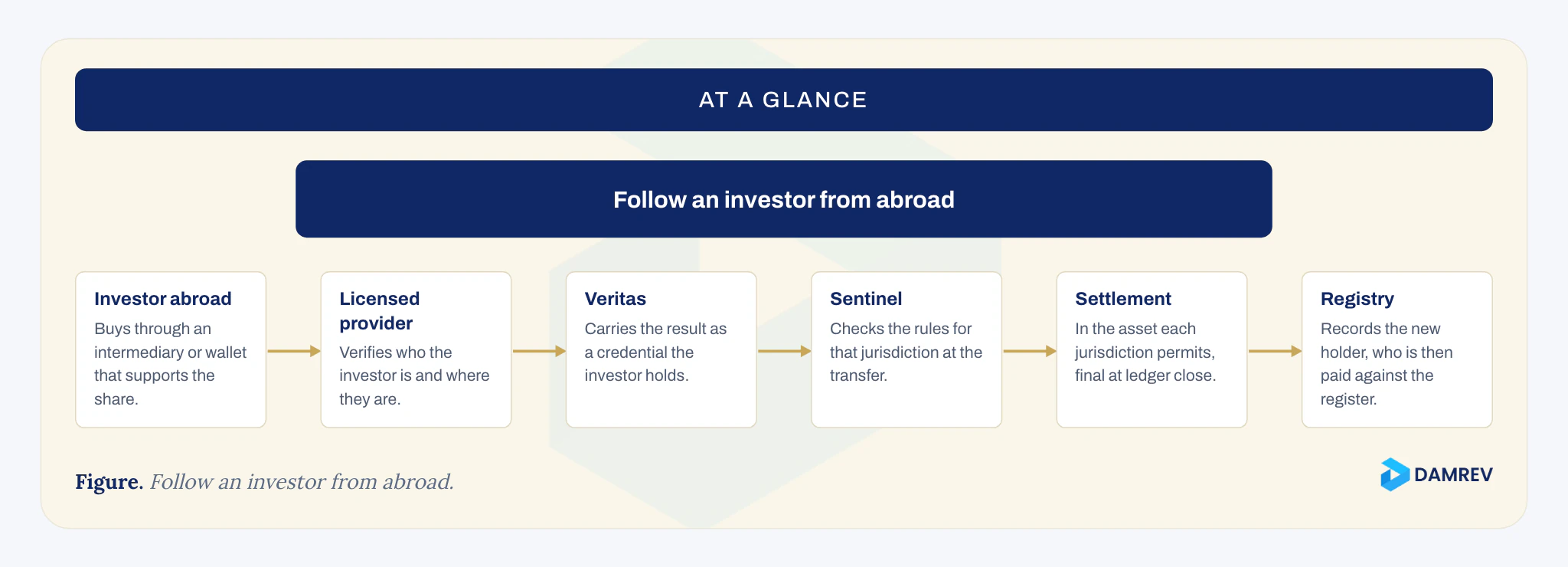
- Follow an investor from abroad
- Investor abroad: Buys through an intermediary or wallet that supports the share.
- Licensed provider: Verifies who the investor is and where they are.
- Veritas: Carries the result as a credential the investor holds.
- Sentinel: Checks the rules for that jurisdiction at the transfer.
- Settlement: In the asset each jurisdiction permits, final at ledger close.
- Registry: Records the new holder, who is then paid against the register.

- Eligible in their jurisdiction
- Investor abroad: Buys through an intermediary or wallet that supports the share. (Passed)
- Licensed provider: Verifies who the investor is and where they are. (Passed)
- Veritas: Carries the result as a credential the investor holds. (Passed)
- Sentinel: Checks the rules for that jurisdiction at the transfer. (Passed)
- Settlement: In the asset each jurisdiction permits, final at ledger close. (Passed)
- Registry: Records the new holder, who is then paid against the register. (Passed)

- Not eligible in their jurisdiction
- Investor abroad: Buys through an intermediary or wallet that supports the share. (Passed)
- Licensed provider: Verifies who the investor is and where they are. (Passed)
- Veritas: Carries the result as a credential the investor holds. (Passed)
- Sentinel: Checks the rules for that jurisdiction at the transfer. (Blocked here)
- Settlement: In the asset each jurisdiction permits, final at ledger close.
- Registry: Records the new holder, who is then paid against the register.
Choose a scenario and follow the investor.
- One share, open to many marketsEach country's eligibility rules, set by the issuer and its counsel, sit inside one share class. A new market adds its rules, not a new structure.
- Confidence at every transferThe rules hold after listing too, so a share only ever passes to an investor who may hold it, and every holder knows it.
- Settlement in a permitted assetSettlement runs in the asset each jurisdiction permits, such as USDC, EURC, a licensed local stablecoin, tokenized deposits, or fiat through a bank. The group issues none of them.
- The evidence institutions ask forForeign institutions run deep diligence before they invest. One verifiable record of every event, and the rule behind it, gives them their answers.
Every market has its own rules. DAMREV maps the regime, the regulator and the key law for each jurisdiction it works in, with its source, so a company can see where its investors could come from.
Position paper
Where does DAMREV stand on cross-border access?
How foreign investors reach South African and African assets through tokenization, how African investors reach international assets, what tokenization changes in that access, and what only the law can change.
- Position paperNew
Cross-Border Investor Access
Jurisdictions, 16 November 2026The DAMREV position on cross-border investor access through tokenization: exchange control, eligibility, settlement, registers and recognition. - Position paper
Compliance by Design
Compliance, 16 November 2026Writing transfer rules, eligibility conditions and intervention powers into code: what code can enforce, and what only law, licence and counsel decide. - Position paperNew
Custody & Key Management
Compliance, 16 November 2026Who holds a tokenized asset, how the keys are protected, and what happens when a key is lost or a custodian fails: the DAMREV position on custody. - Position paperNew
Proof of Reserves & Assurance
Compliance, 16 November 2026What an attestation, an audit, an oracle and an on-chain proof each establish about whether a tokenized asset exists and is backed, and what none of them can.
Built on firm ground
What keeps a tokenized listing credible?
The advantages hold because the boundaries are clear. Three principles apply to every programme, and they are the ones institutions check first.
- Home law respectedThe investor's own securities law and exchange controls apply in full. Counsel settles each market's requirements before the documents are fixed.
- A real market, honestly describedThe listing venue provides the market. DAMREV makes no promise on price or liquidity, and says so plainly.
- Regulated parties in regulated rolesAppointed intermediaries place the shares under their own permissions. DAMREV runs the infrastructure and does not sell the shares.
Common questions
What else do people ask?
Short answers on the case for a tokenized IPO: what its biggest advantage is, whether foreign investors can buy the shares, how holders abroad are paid, whether it gets around exchange controls, and whether it makes the shares more liquid.
What is the biggest advantage of a tokenized IPO?
A share that carries its own rules. That one change lets a company admit investors from several countries under one share class, with each country's rules checked at every transfer.
Can foreign investors buy the shares?
Yes, where their country's rules allow them to hold the shares. The issuer and its counsel set those rules, and they are checked at every transfer.
How are holders abroad paid?
Against the register as it stood on the record date, with settlement in the asset each jurisdiction permits, so a holder abroad is paid on exactly the same terms as a holder at home.
Does a tokenized listing get around exchange controls?
No, and that is part of its strength. Exchange controls and the investor's own securities law apply in full, and counsel settles what each market requires before the offering documents are fixed.
Will it make the shares more liquid?
The listing venue provides the market, and DAMREV makes no promise on price or liquidity. What tokenization adds is a share that eligible investors in more countries can hold and settle.
Where next
Where should you go next?
The pages below pick up where this one ends. Start with the one closest to where your asset or programme stands today.
- Tokenized or ConventionalWhere tokenized and conventional listings actually differ, and the three questions that decide which route suits your company.
- Listing ReadinessWhat a company needs before it lists, what a tokenized listing adds, and a check that shows where your company stands.
- Risks & Failure ModesA register of the ways a tokenized listing can fail, each with the control that addresses it and the party holding it.
- Tokenized IPO Position PaperDAMREV's position on tokenized initial public offerings: what current law allows, what it does not yet allow, and seven positions.
References
- 1.US Securities and Exchange Commission, order approving SR-NASDAQ-2025-072, Release No. 34-105047. https://www.sec.gov/files/rules/sro/nasdaq/2026/34-105047.pdf
- 2.Chainstack, "What is Stellar". https://chainstack.com/what-is-stellar/ Also: Stellar developer documentation, "Control access to an asset", https://developers.stellar.org/docs/tokens/control-asset-access
- 3.US Securities and Exchange Commission, Statement on Tokenized Securities, 28 January 2026. https://www.sec.gov/newsroom/speeches-statements/corp-fin-statement-tokenized-securities-012826-statement-tokenized-securities
- 4.UNCTAD, "Africa attracting investment in strategic industries; the challenge is turning it into broader development", World Investment Report 2026 press release, 7 July 2026. https://unctad.org/press-material/africa-attracting-investment-strategic-industries-challenge-turning-it-broader
Last updated: