

Article · Law, Regulation & Policy
Security Tokens in Mauritius: The Securities Act, Not the VAITOS Act
A security token in Mauritius is regulated as a security under the Securities Act 2005, not under the Virtual Asset and Initial Token Offering Services Act 2021 (VAITOS Act)1, 2. The VAITOS Act excludes digital representations of securities, and the Financial Services Commission's guidance notes set out how such tokens are offered and traded under securities law1.


01 · The line
Which law governs a security token in Mauritius?
The Securities Act 2005 governs a security token in Mauritius. A security token is a security in digital form, and the Virtual Asset and Initial Token Offering Services Act 2021 expressly leaves digital representations of securities to securities law1, 2.
Mauritius has two statutes that could reach a token, and the boundary between them is written into both the statute and the regulator's guidance.
The Virtual Asset and Initial Token Offering Services Act 2021, known as the VAITOS Act, defines a virtual asset as "a digital representation of value that may be digitally traded or transferred, and may be used for payment or investment purposes"2.
The same definition excludes "a digital representation of fiat currencies, securities and other financial assets that fall under the purview of the Securities Act"2.
The Financial Services Commission (FSC) applies that exclusion in its guidance on security tokens.
[T]he VAITOS Act does not apply to digital representations of securities which fall under the purview of the SA.1
That sentence decides the regime for any token that is a share, a debenture, a derivative, or a unit in a collective investment scheme. The token is offered under the Securities Act, traded on a venue licensed under the Securities Act, and supervised by the FSC as a security1.
02 · Two statutes
How do the two statutes divide the field?
The two Mauritian statutes divide the field by what the token is: a digital security goes to the Securities Act, and a virtual asset that is not a security, and an initial token offering of one, go to the VAITOS Act. The FSC administers both1, 2, 3.
| Question | Securities Act 2005 | VAITOS Act 2021 | Source |
|---|---|---|---|
| What it covers | Securities, including securities represented in digital format | Virtual assets and initial token offerings, excluding digital representations of securities | 1, 2 |
| Offering route | Public offer with a registered prospectus, or preferential offer | Initial token offering under the VAITOS Act | 1, 3 |
| Venue licence | Security token trading system, under section 11 | Virtual asset marketplace, a VAITOS licence class | 1, 2, 3 |
| Custody | FSC-licensed custodian for security tokens | Virtual asset custodian, a VAITOS licence class | 1, 2, 3 |
| Regulator | Financial Services Commission | Financial Services Commission | 1, 3 |
The practical consequence is that the classification question comes first, and everything else follows from it. An issuer cannot choose the VAITOS route for a token that is a security, and a VAITOS licence does not authorise a venue to trade security tokens1, 2.
The FSC updated its guidance notes after the VAITOS Act was passed, so that the two texts would not conflict. The current version is dated 15 March 2023, and it replaced a version of 23 August 20221, 4.
03 · Offering
Who may offer a security token, and to whom?
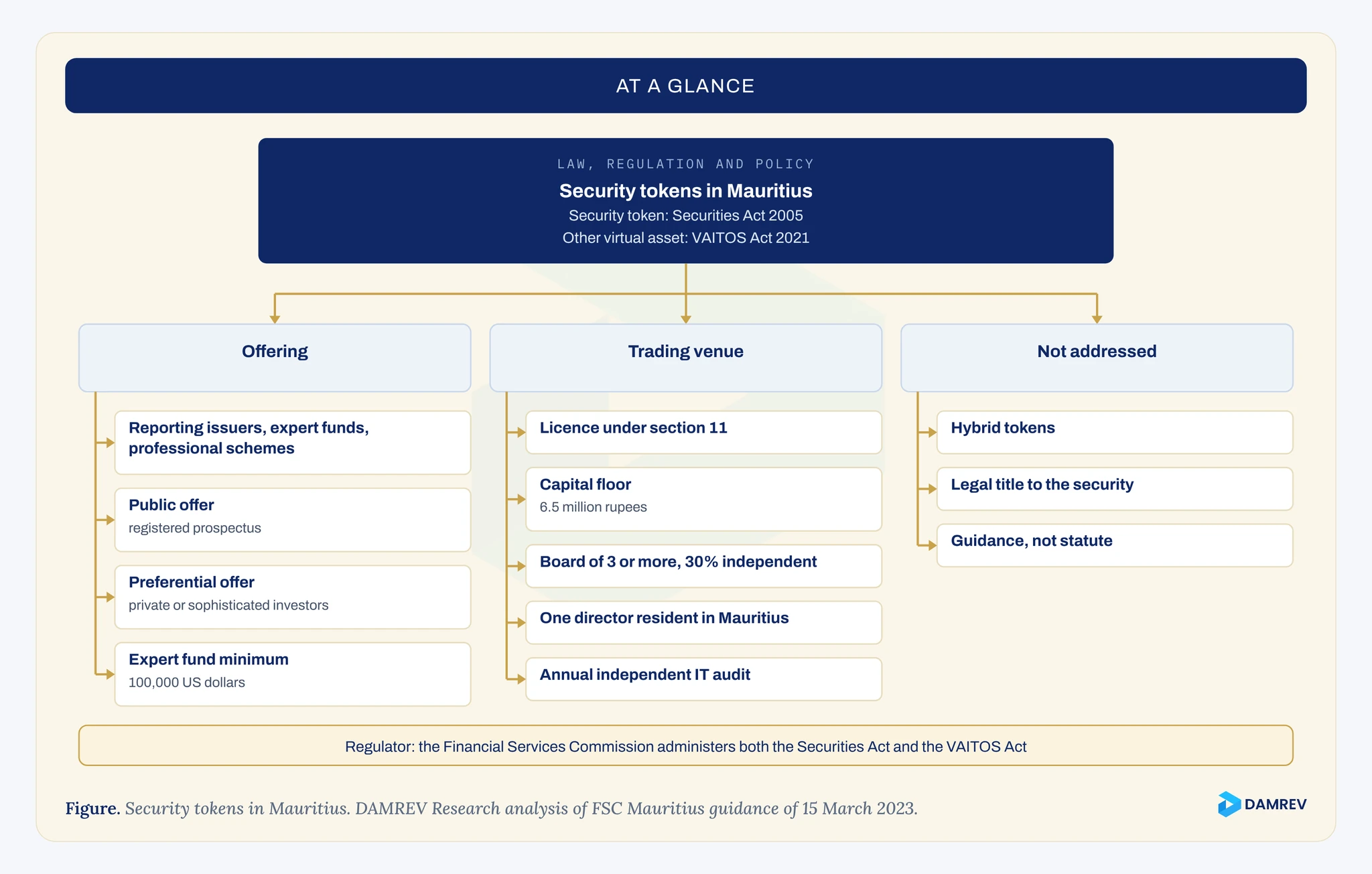
In Mauritius, reporting issuers, expert funds, and professional collective investment schemes may offer a security token, either to the public with a registered prospectus or by preferential offer, which covers private placements and offers to sophisticated investors1.
The guidance keeps the offering rules of the Securities Act and applies them to tokens. A public offer needs "a prospectus with the Commission in line with the SA"1. A preferential offer is "an offer or issue of securities that is a private placement" or one "made only to sophisticated investors"1.
The guidance names the rules that apply alongside the Act: the Securities (Public Offers) Rules 2007, the Securities (Disclosure Obligations of Reporting Issuers) Rules 2007, and the Securities (Preferential Offer) Rules 20171, 4. A reporting issuer that tokenizes its securities keeps its continuing disclosure duties in full.
Eligible issuers
Reporting issuers, expert funds, and professional collective investment schemes may make a security token offering1.
Public offer
A prospectus registered with the FSC under the Securities Act1.
Preferential offer
A private placement, or an offer only to sophisticated investors1.
Expert investors
Where an expert fund is used, an initial investment of no less than 100,000 US dollars1.
None of this is specific to tokens, and the guidance does not create a lighter route for them. An issuer who has offered securities in Mauritius before would recognise every step, and the token changes the form of the security, not the route to market.
04 · Trading
What does a security token trading venue need?
A security token trading venue in Mauritius needs a licence as a security token trading system under section 11 of the Securities Act, with minimum capital, independent directors, licensed custody, and an annual independent information technology (IT) audit1.
The FSC "shall license Security Token trading systems under section 11 of the SA"1. The conditions read like those for any securities market, with additions for the technology.
- The floor for minimum stated unimpaired capital of a security token trading system; the FSC may set a higher amount1
- 6.5 million Mauritian rupees
- The minimum board, at least 30% independent and one resident in Mauritius1
- 3 directors
- Audit of the system by an external and independent third party, at least once every year1
- Annual
Custody follows the securities model. Security tokens are to be held with an FSC-licensed custodian, and fiat with a licensed commercial bank in Mauritius; a trading system may hold tokens itself only with the FSC's prior approval, on the terms the FSC sets1.
For an issuer, the trading licence is the reason the classification matters most. A token admitted to a virtual asset marketplace is admitted to the wrong kind of venue if it is a security. A trading system must also meet the anti-money laundering requirements and maintain cybersecurity safeguards, which the annual audit is there to test1, 4.

05 · What it does not establish
What does the Mauritian position not establish?
As of 7 October 2026, the Securities Act and the FSC guidance notes read here do not decide every hybrid token, give the guidance the status of a statute, or settle title. They also say nothing about how a security token is taxed, which is a question for the reader's own adviser1.
| Question | Position | Source |
|---|---|---|
| Is a security token a virtual asset? | No; it is excluded from the VAITOS Act | 1, 2 |
| Is the guidance binding? | Guidance; breaches may bring sanctions, and failing to follow an FSC direction to comply is a contravention of the law | 1 |
| Is a token that partly represents a security a security token? | Not addressed in terms; depends on whether it is a security under the Securities Act | 1 |
| Does holding a token give legal title to the security? | Not addressed; depends on the instrument and the register | 1 |
| Has the guidance changed since 15 March 2023? | We found no later version; the FSC issued separate Guidance Notes on Stablecoins on 13 August 2026 under the VAITOS Act | 1, 5 |
The guidance has more force than most. Section 1.6 says breaches "may entail regulatory sanctions", and that the FSC "may direct any licensee to comply with the Guidance Notes or any part thereof and failure to do so, shall constitute a contravention of the law and may lead to prosecution"1.
The contravention attaches to ignoring a direction, not to the guidance itself, and how far that reaches is a question for counsel.
The hardest cases sit at the boundary. A token whose economics mix a security with something else must be classified under the Securities Act first, and the guidance gives no worked test for doing so.
The same applies to a token that represents an interest in a structure holding assets outside Mauritius, where the law of the asset's location may also decide what the holder owns.
Common questions
What else do people ask?
Short answers to the questions people ask most about this topic.
Does a security token issuer in Mauritius need a VAITOS licence?
Not for the security token itself. The VAITOS Act excludes digital representations of securities that fall under the Securities Act, and the FSC's guidance applies securities law to them1, 2.
Who may issue security tokens in Mauritius?
Under the guidance notes, reporting issuers, expert funds, and professional collective investment schemes, by public offer with a registered prospectus or by preferential offer1.
What licence does a venue for security tokens need?
A licence for a security token trading system under section 11 of the Securities Act, with minimum stated unimpaired capital of 6.5 million Mauritian rupees1.
Are the FSC's guidance notes binding?
They are guidance. Breaches may entail regulatory sanctions, and the FSC may direct a licensee to comply; failing to comply with such a direction is a contravention of the law1.
Where should you go next?
The pages below pick up where this one ends. Start with the one closest to where your asset or programme stands today.
- Does Tokenizing a Security Change Whether It Is a Security?In the United States, the European Union, Guernsey, and Jersey, tokenizing a security does not change whether it is one, only which one is held.
- South Africa's Draft Crypto Exchange Control Regime, Read as a WholeSouth Africa proposes to bring cross-border crypto asset transactions into exchange control through two drafts of April and August 2026. Neither is in force.
- Listing ReadinessWhat a company needs before it lists, what a tokenized listing adds, and a check that shows where your company stands.
- JurisdictionsThe rules for tokenized finance in the twelve jurisdictions where the group works, mapped to where each group entity sits, claiming no permission.
References
- 1.Financial Services Commission, Mauritius, Updated Guidance Notes on Security Token Offerings and Security Token Trading Systems, 15 March 2023. https://www.fscmauritius.org/media/137664/updated-guidance-notes-on-security-token-offerings-and-security-token-trading-systems-cc-150323.pdf
- 2.Virtual Asset and Initial Token Offering Services Act 2021 (Mauritius), Act No. 21 of 2021, Government Gazette No. 183, 16 December 2021, section 2 and Second Schedule. https://www.bom.mu/sites/default/files/virtual-asset-and-initial-token-offering-services-act-2021_0.pdf
- 3.CMS, "Expert Guide to Crypto Regulation: Mauritius", read 7 October 2026. https://cms.law/en/int/expert-guides/cms-expert-guide-to-crypto-regulation/mauritius
- 4.Financial Services Commission, Mauritius, Updated Guidance Notes on Security Token Offerings and Security Token Trading Systems, 23 August 2022 version. https://www.fscmauritius.org/media/84937/updated-guidance-notes-on-security-token-offerings-and-security-token-trading-systems.pdf
- 5.Financial Services Commission, Mauritius, communiqué on the Guidance Notes on Stablecoins, 13 August 2026. https://www.fscmauritius.org/media/b4ngbzrt/communique-_-guidance-notes-on-stablecoins-vf.pdf
This article is analysis of public sources, not legal advice. Last updated: