


Article · Law, Regulation & Policy
South Africa's Draft Crypto Exchange Control Regime, Read as a Whole
South Africa proposes to bring cross-border crypto asset transactions into exchange control through two drafts: the Draft Capital Flow Management Regulations of 17 April 2026 and the Draft Crypto Assets Manual of 3 August 20261, 3. Neither is in force.
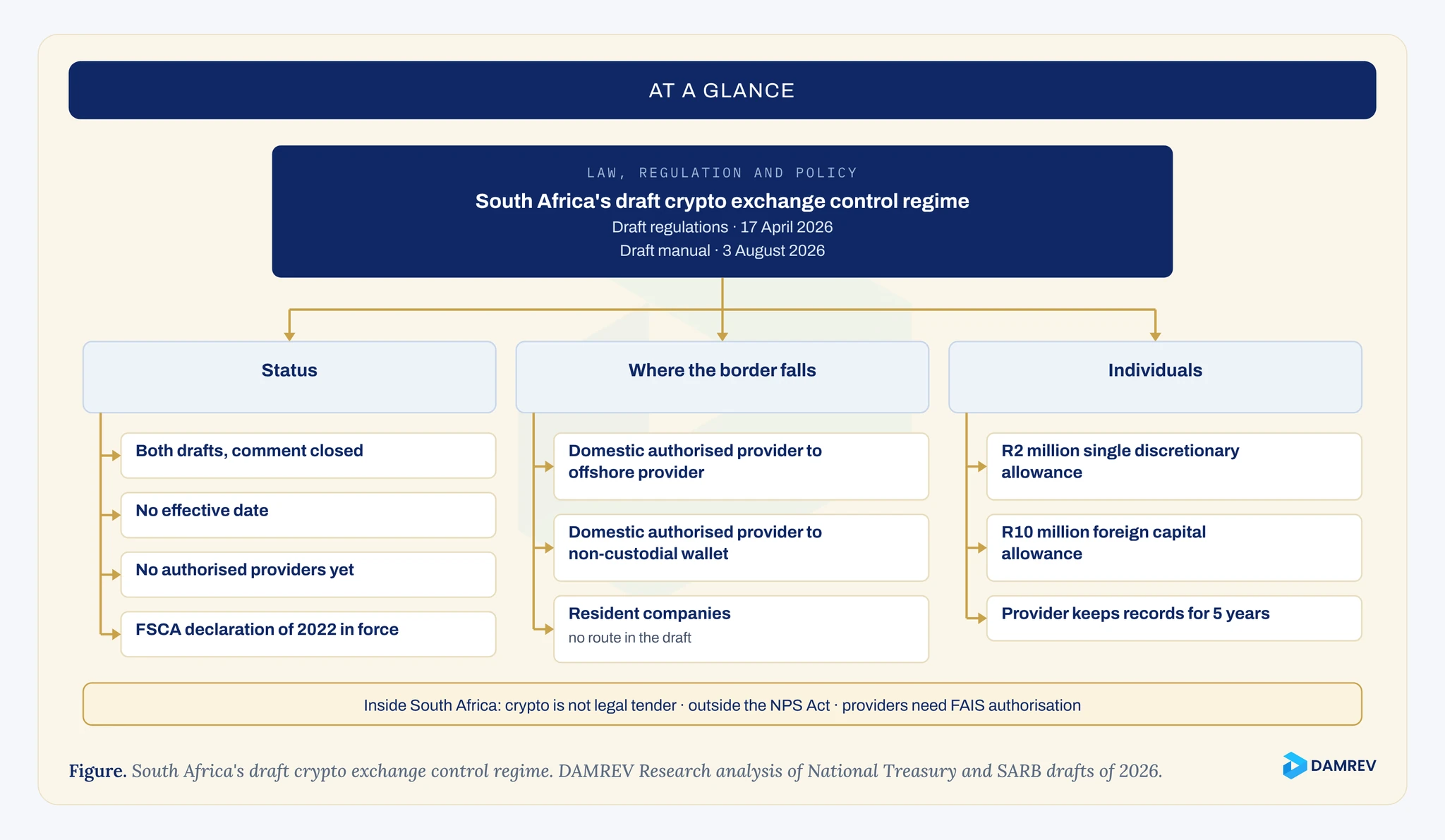
Read together, they would make the border the point where crypto leaves a South African authorised provider, let individuals use their existing allowances, and keep resident companies out3.


01 · The instruments
Which texts make up South Africa's draft regime?
South Africa's draft regime is made up of two drafts and two settled positions. The drafts are the Capital Flow Management Regulations and the Crypto Assets Manual1, 3. The first settled position is the 2022 declaration of the Financial Sector Conduct Authority (FSCA) under the Financial Advisory and Intermediary Services Act (FAIS Act)5.
The second settled position is the statement on payments by the South African Reserve Bank (SARB) and the FSCA4.
The drafts are best read as one instrument in two parts. The regulations set the legal frame for exchange control and bring crypto assets into it. The manual sets out how the draft frame works in practice for cross-border crypto transactions, and the SARB and National Treasury describe it as practical guidance on implementing the draft regulations3.
| Text | Issued by | Date | Status | Source |
|---|---|---|---|---|
| Draft Capital Flow Management Regulations, 2026 | National Treasury | 17 April 2026 | Consultation; comment closed 30 June 2026 after extension | 1, 2 |
| Draft Crypto Assets Manual for cross-border activities | SARB and National Treasury | 3 August 2026 | Consultation; comment closed 30 September 2026 | 3 |
| Declaration of crypto assets as a financial product | FSCA | 19 October 2022 | In force | 5 |
| Joint Communication on crypto assets for domestic payment purposes | SARB and FSCA | 28 May 2026 | Guidance | 4 |
The two layers do different work. Exchange control governs what may cross the border. The FAIS Act governs who may give advice or act as an intermediary in South Africa.
The draft regulations were published as Government Notice No. 7375 in Government Gazette No. 54520 on 17 April 20261. Under the drafts, a provider that serves South African clients and moves crypto offshore answers to both layers.
02 · The regulations
What do the draft regulations provide?
The draft Capital Flow Management Regulations cover the whole exchange control base. The draft replaces the Exchange Control Regulations of 1961 under the Currency and Exchanges Act, 1933, moves towards reporting rather than prior approval, and brings cross-border crypto asset transactions inside the regime1.
The SARB described the shift as "fewer transaction pre-approvals, a focus on reporting, the surveillance of high-impact and high-risk cross-border transactions"1. Crypto is one part of that change. The comment period was extended from 18 May to 30 June 20262. While the regulations remain a draft, they create no offence.
The enforcement side is strict. As commentators read the draft, contraventions carry fines of up to R1 million (South African rand), imprisonment of up to five years, or a sum equal to the value of the asset involved, whichever is greater, with wide powers of search and seizure1, 6. Those penalties are in a draft text, not in law.
The authorised provider is the hinge of the design. Exchange control has long worked through authorised dealers, the banks that report and police cross-border flows. The drafts create a parallel class for crypto, with the same function.
03 · The manual
Where does the border fall under the draft manual?
Under the draft manual, the border falls at the provider's edge: a transaction becomes an import or export of capital when crypto moves between a domestic authorised provider and an offshore provider, or from a domestic authorised provider to a non-custodial wallet7.
The manual draws the line by activity, not by asset type3. Under the draft, a transfer between two South African custodial wallets does not cross the border. A transfer to an offshore exchange, or to a wallet whose keys the holder controls, does7.
- A resident individual's single discretionary allowance a calendar year, usable for crypto under the draft manual7
- R2 million
- The foreign capital allowance a calendar year, for a taxpayer in good standing7
- R10 million
- The minimum period an authorised provider must keep transaction records7
- 5 years
Under the draft, individuals use the allowances they already have, through an authorised provider3, 7. Resident entities are treated differently: they may open South African custodial wallets but "may not enter into crypto asset transactions deemed as import or export of capital"7. For a South African fund, company, or trust, the draft offers no cross-border crypto route at all.
The reporting duty is broad. Authorised providers report "all data by reporting entities on transactions, irrespective of the amount", and monitor client wallets for contraventions7. The manual states that the technical reporting specifications are not yet available7.
The manual also restricts how providers run their own books: an authorised provider may not source crypto assets for operational purposes from other providers without prior approval, and a provider approved with conditions has six months to meet them7.
04 · Payments
What is the position on crypto payments inside South Africa?
In South Africa, crypto assets are not money and not legal tender. The SARB and FSCA say they fall outside the National Payment System Act, while those who provide crypto services must be authorised under FAIS4.
A crypto asset does not have legal tender status.4
The joint communication of 28 May 2026 is the domestic counterpart to the exchange control drafts. Crypto assets "are neither money as defined in the NPS Act nor funds and are therefore not legal tender"4.
Outside the payments law
Crypto assets "fall outside of the application of the NPS Act", so a crypto transfer is not a payment under it4.
Inside FAIS
Persons rendering financial services in relation to crypto assets must be authorised as financial services providers under section 8 of the FAIS Act4.
Stablecoins noted
The regulators record that stablecoins offer redemption into fiat currency at face value4.
Read with the drafts, the result is a regime that treats crypto as a financial product to be intermediated, and as a capital asset whose movement across the border is to be reported, but not as a means of payment.

05 · What it does not establish
What does the draft regime not establish?
As of 7 October 2026, the draft regulations and manual read here do not establish an effective date, a final text, or a list of authorised providers. They also do not say how a tokenized security is treated, or give resident companies a cross-border route1, 3, 7.
| Question | Position | Source |
|---|---|---|
| Are the regulations and manual in force? | No; both are drafts, with comment closed | 2, 3 |
| Do the drafts state an effective date? | No | 1, 3 |
| Is there an authorised provider class in law? | No; it exists only in the drafts | 7 |
| Can resident entities move crypto offshore? | Not under the draft manual as written | 7 |
| Is a tokenized security a crypto asset for these purposes? | Not addressed; the manual uses one definition for all crypto assets | 7 |
| Must crypto intermediaries hold a FAIS licence? | Yes, under the 2022 declaration | 4, 5 |
The tokenized security question is the gap that matters most for structured finance. The manual's definition of a crypto asset is broad: a digital representation of value, not issued by a central bank, using cryptography and distributed ledger technology7.
A share recorded on a ledger could fall within those words. Whether the drafts intend to put a tokenized share listed on the Johannesburg Stock Exchange (JSE), or a tokenized fund unit, into the crypto channel rather than the ordinary securities channel of exchange control, they do not say.
The drafts also say nothing about tax, which sits with the South African Revenue Service and is a question for each reader's own adviser.
As of 7 October 2026, the position in force is this: crypto services need FAIS authorisation, crypto assets have not been designated as payment instruments, and the 1961 regulations still govern exchange control.
Common questions
What else do people ask?
Short answers to the questions people ask most about this topic.
Are South Africa's crypto exchange control rules in force?
No. The Capital Flow Management Regulations and the Crypto Assets Manual are both drafts. Comment on the regulations closed on 30 June 2026 and on the manual on 30 September 20262, 3.
Do the draft regulations make holding crypto assets a crime?
No. The draft regulations are not in force, so they create no offence today. Comment on them closed on 30 June 20262.
How much crypto may an individual move offshore under the draft manual?
Up to R2 million a calendar year under the single discretionary allowance, and up to R10 million a calendar year under the foreign capital allowance for a taxpayer in good standing, each through an authorised provider7.
Can a South African company send crypto assets offshore under the drafts?
Not under the draft manual as written. Resident entities may hold South African custodial wallets but may not enter into crypto asset transactions deemed to be an import or export of capital3.
Is a stablecoin a payment instrument in South Africa?
Not today. The SARB and FSCA say crypto assets are not money under the National Payment System Act and have not designated any as a payment instrument4.
Where should you go next?
The pages below pick up where this one ends. Start with the one closest to where your asset or programme stands today.
- Security Tokens in Mauritius: The Securities Act, Not the VAITOS ActIn Mauritius a security token is a security under the Securities Act 2005, and the virtual asset law of 2021 excludes it.
- When the GENIUS Act Takes Effect: 18 January 2027 & 18 July 2028The GENIUS Act binds payment stablecoin issuers from 18 January 2027, not the firms that hold or settle in stablecoins. Service providers follow in 2028.
- Screening & OnboardingHow investors are verified by a licensed provider before holding anything and checked again at every transfer, with anti-money laundering, sanctions, and travel-rule obligations met.
- JurisdictionsThe rules for tokenized finance in the twelve jurisdictions where the group works, mapped to where each group entity sits, claiming no permission.
References
- 1.South African Reserve Bank, "Draft Capital Flow Management Regulations open for public comment", with National Treasury, Government Notice No. 7375, Government Gazette No. 54520, 17 April 2026. https://www.resbank.co.za/en/home/publications/publication-detail-pages/media-releases/2026/capital-flow-comment
- 2.National Treasury, "National Treasury extends public comment period for the Draft Capital Flow Management Regulations", 15 May 2026. https://www.gov.za/news/media-statements/national-treasury-extends-public-comment-period-draft-capital-flow-management
- 3.South African Reserve Bank and National Treasury, joint statement on the Draft Crypto Assets Manual for cross-border activities, 3 August 2026, and the Draft Crypto Assets Manual. https://www.resbank.co.za/en/home/publications/publication-detail-pages/media-releases/2026/crypto-assets
- 4.South African Reserve Bank and Financial Sector Conduct Authority, Joint Communication on crypto assets for domestic payment purposes, 28 May 2026. https://www.resbank.co.za/content/dam/sarb/what-we-do/payments-and-settlements/regulation-oversight-and-supervision/designation-notices/280526%20Joint%20Communication_Crypto%20assets%20for%20domestic%20payment%20purposes.pdf
- 5.Financial Sector Conduct Authority, Declaration of a crypto asset as a financial product under the Financial Advisory and Intermediary Services Act, General Notice 1350 of 2022, Government Gazette No. 47334, 19 October 2022. https://www.gov.za/sites/default/files/gcis_document/202210/47334gen1350.pdf
- 6.Polity, "Draft Capital Flow Management Regulations: crypto assets enter the exchange control arena", 6 May 2026. https://www.polity.org.za/article/draft-capital-flow-management-regulations-crypto-assets-enter-the-exchange-control-arena-2026-05-06
- 7.South African Reserve Bank, Draft Crypto Assets Manual (PDF), August 2026. https://www.resbank.co.za/content/dam/sarb/publications/media-releases/2026/draft-crypto-manual.pdf
This article is analysis of public sources, not legal advice. Last updated: