



Stage 01
The asset and the claim
The invoices and their collection history are described, and investors are to hold notes paid from collections.
Section
Structuring
The instrument classes DAMREV structures, and the four situations that bring most clients here.
Not sure which page answers your question? A structuring review starts with that conversation.
Start a Structuring ReviewSection
Services
The ladder, from a paid first look to a programme DAMREV operates for you.
Not sure which page answers your question? A structuring review starts with that conversation.
Start a Structuring ReviewSection
Platform
Eight capabilities and twenty named engines. DAMREV runs its own instruments on it.
Not sure which page answers your question? A structuring review starts with that conversation.
Start a Structuring ReviewSection
Tokenized IPO
A tokenized listing is a listing first. This section is about whether yours is ready.
Not sure which page answers your question? A structuring review starts with that conversation.
Start a Structuring ReviewSection
Compliance
Written to be read by a regulator, a counterparty or an auditor without a call first.
The Americas & the Caribbean
Europe
Not sure which page answers your question? A structuring review starts with that conversation.
Start a Structuring ReviewSection
Insights
The published record. Papers, positions and the vocabulary, all dated.
Not sure which page answers your question? A structuring review starts with that conversation.
Start a Structuring ReviewNot sure which page answers your question? A structuring review starts with that conversation.
Start a Structuring ReviewGuide
Tokenizing a receivables book turns a pool of amounts owed into an instrument that carries its ranking, eligibility rules and waterfall in code. It runs through five fixed stages: the asset and the claim, the structure, the instrument, issuance and the register, then servicing for life. Counsel settles the legal treatment first.
01 · The problem
Because the hard part of receivables finance is servicing, and servicing is where code helps most. Collections have to be allocated through a waterfall, tranches ranked, holders tracked and reports produced, often for years. When that logic lives in spreadsheets across several parties, errors surface late and are expensive to unwind.
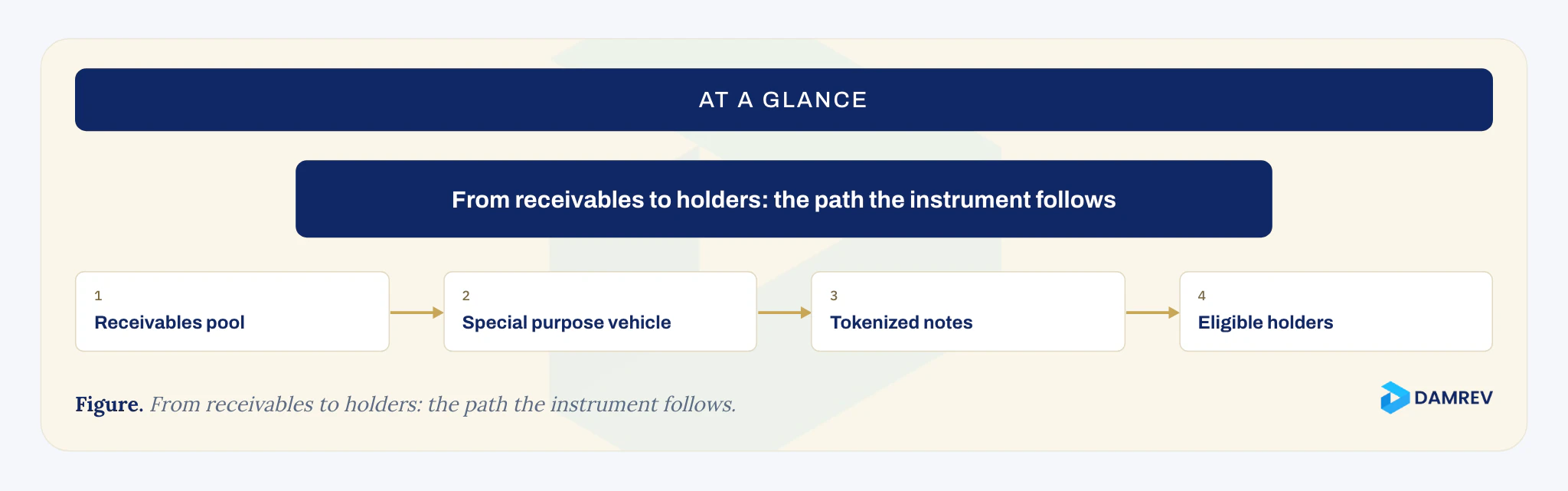
A receivables book is a pool of amounts owed to a business: trade invoices, instalment contracts, loan repayments. Financing it gives investors a claim on the cash those amounts produce, usually through a vehicle that holds the pool and issues notes in tranches of different seniority. None of that is new. Structured finance has done it for decades.
What tokenization changes is the operating layer. The ranking, the eligibility rules and the allocation of collections become part of the instrument, so a transfer to an ineligible holder does not settle and a payment follows the order the documents set.
The market is moving this way: private credit was among the tokenized categories that each passed one billion US dollars by March 20261, with growth coming mainly from new issuance2. A projection by Boston Consulting Group for Ripple expects adoption to move from money market funds and bonds toward private credit and structured finance3.
02 · Stage one
Establish what exists, how it is evidenced, and what the investor will own. For receivables that means the pool's data, the criteria a receivable must meet to enter the pool, and the claim investors take on its cash flows. Counsel settles how the receivables pass to the vehicle.
Settle these first
This stage decides most of what follows. A pool described loosely cannot be encoded precisely, and eligibility criteria that live only in a credit memo cannot be enforced by a contract. DAMREV's Structuring Review begins here, with nine questions on the asset, the claim, the structure and the programme context.
Where the programme depends on data from outside the chain, Beacon brings it on-chain through an oracle network and can halt minting when a stated condition is not met.
03 · Stage two
With counsel and the appointed parties, before any code. The vehicle that will hold the pool is chosen, the notes are divided into tranches, and the ranking between them is fixed, together with the waterfall that allocates collections. Each regulated role goes to a party that holds the relevant permissions.
| Role | What it does | Held by |
|---|---|---|
| Originator | Creates the receivables and often continues to collect them | The client |
| Issuer | The vehicle that holds the pool and issues the notes | A dedicated entity; where the group supplies the issuer, DAMREV Capital Partners |
| Servicer | Collects the receivables and reports on the pool | A party appointed by the programme |
| Custodian and bank | Hold assets and cash in their regulated roles | Appointed regulated parties |
| Register of holders | Records each holder and each transfer | Registry, performing the transfer-agent function as a function |
| Technology and operations | Structures the programme, and builds and operates the software | DAMREV Labs, LLC, which is not a party to the transaction |
The waterfall is the heart of the structure. It states, in order, what each unit of collected cash pays, typically servicing costs first, then the senior tranche, then the junior tranches, with any shortfall falling on the most junior first.
Writing it once, in terms both counsel and engineers accept, is what allows the instrument to apply it later without reinterpretation. The decision to pass this stage is taken under four eyes or six eyes and recorded on the programme record.
04 · Stage three
The rights, eligibility rules and transfer restrictions the documents set, and the logic of the waterfall. Sentinel applies the transfer rules at the moment of each transfer, Cadence holds any release or lockup schedule, and the contracts run on Soroban, natively on the Stellar ledger that holds the record4.
Only holders whose credentials satisfy the rules can receive the notes.
Collections are allocated between tranches in the documented order.
Lockups and staged releases follow the terms, gated at each release.
A smart contract assessor assesses the contracts and signs an attestation before they are relied on.
The format does not change the law. In the United States, three divisions of the Securities and Exchange Commission (SEC) stated on 28 January 2026 that the format in which a security is issued does not affect the application of the federal securities laws5.
If the notes are securities on paper, they are securities as tokens, and the encoded rules have to reflect the offering's restrictions exactly.
Before anything is issued, a smart contract assessor, a related party through common ownership, assesses the smart contracts and renders a signed attestation. The assessor renders the verdict, Sentinel acts on it, and no party holds both powers.
05 · Stage four
Forge issues the notes only after Veritas and Sentinel clear eligibility, under the issuer authority of the relevant entity, and Registry records every holder. A licensed provider verifies investors, and Veritas issues a reusable credential they control, aligned with the World Wide Web Consortium (W3C) Verifiable Credentials 2.0 standard6.
Stellar gives the issuer controls at the level of the ledger. Any account can issue an asset natively, and authorisation flags and clawback are available to the issuer7, so the eligibility the documents require is backed by the network as well as by the contract.
Settlement runs in the asset each jurisdiction permits, such as USDC, EURC, a licensed local stablecoin, tokenized deposits, or fiat through a bank. The group issues none of them.
On Stellar a ledger closes roughly every five seconds with finality at close7. Where investors bring fiat, a licensed third-party provider operates the on-ramp through Conduit.
06 · Stage five
Every event after issuance, for as long as the notes exist: collections allocated through the waterfall, payments to holders, transfers between eligible investors, corporate actions and reporting. Registry services the notes, Portal presents staged disclosure and reporting to verified holders, and every event is recorded against the rule that governed it.
| Stage | What is decided or done | Engines and parties |
|---|---|---|
| The asset and the claim | The pool, its evidence and the investor's claim | Client, counsel, and Beacon for external data |
| The structure | Vehicle, tranches, ranking and waterfall | Counsel, appointed parties, four eyes or six eyes |
| The instrument | Eligibility, transfer rules, release schedules and waterfall logic | Sentinel, Cadence, and a smart contract assessor's attestation |
| Issuance and the register | Notes issued to verified holders and recorded | Veritas, Forge and Registry |
| Servicing for life | Collections, payments, transfers and reporting | Registry, Portal and Sentinel |
07 · The legal frame
Into two groups. On 28 January 2026 three divisions of the Securities and Exchange Commission (SEC) separated securities tokenized by or on behalf of their issuer from those tokenized by unaffiliated third parties, which are custodial or synthetic5. In the issuer-sponsored model, the issuer or its agent keeps the master securityholder file on one or more crypto networks5.
08 · The ledger
Four flags on the issuing account. With authorisation required, an account needs the issuer's approval before it can hold the asset. With authorisation revocable, the issuer can freeze the asset an account holds. Clawback lets the issuer take the asset back, and authorisation immutable stops the other authorisation flags being changed7.
09 · Eligibility
That the claims in it genuinely come from the issuer and have not been tampered with. Verifiable Credentials 2.0, a W3C Recommendation since 15 May 2025, describes credentials that are cryptographically secure, privacy respecting and machine-verifiable6. A holder can also share only part of a credential, which W3C calls selective disclosure6.
10 · Worked example
Illustratively, like this. A distributor with a book of trade invoices owed by its customers wants to finance the book without selling the business. The example names no client and uses no figures.
Worked example
An illustration, stage by stage. It describes no real transaction.
The invoices and their collection history are described, and investors are to hold notes paid from collections.
Counsel settles the transfer of the invoices to a dedicated vehicle, a senior and a junior tranche, and the waterfall between them.
The eligibility rules, the waterfall and a lockup on the junior tranche are encoded, and a smart contract assessor attests the contracts.
Verified investors receive the notes through Forge, and Registry records each holder.
Collections run through the waterfall, holders are paid in the settlement asset, and Portal reports to them.
Have a receivables book of your own?
Start a Structuring ReviewCommon questions
Short answers to the questions people ask most about this topic.
The treatment follows the instrument, not its format. In the United States, three SEC divisions stated that the format of a security does not affect the application of the federal securities laws5.
The parties to the structure, with counsel, during stage two. DAMREV encodes the waterfall they agree, so the instrument applies it as written.
A licensed identity provider performs the checks, and Veritas issues a reusable credential the investor controls6.
The investors, in their own wallets. Vault is non-custodial, signing happens on the holder's device through Sentry, and DAMREV holds no client assets.
Where the rules allow it, yes: Stellar makes clawback available to the issuer of an asset7. When it may be used is set in the programme documents.
With the Structuring Review, which covers nine questions on the asset, the claim, the structure and the programme context.
The pages below pick up where this one ends. Start with the one closest to where your asset or programme stands today.
This guide is analysis of public sources, not legal advice. Last updated:
Insights

Since 17 September 2026 a tokenized securities venue may run automated liquidity pools in tokenized listed stock without registering as an exchange, on conditions.

The GENIUS Act binds payment stablecoin issuers from 18 January 2027, not the firms that hold or settle in stablecoins. Service providers follow in 2028.

The CLARITY Act stalled on a 49 to 50 vote, so tokenized securities stay with the Securities and Exchange Commission, as before.

Guernsey's guidance of 24 July 2026 lets a fund or issuer record and transfer its investments as tokens, under the regimes already applying to it.
Tell us what you want to tokenize.
We will show you how DAMREV can run it.
