


Article · Market Infrastructure & Settlement
Atomic Settlement & Delivery Versus Payment
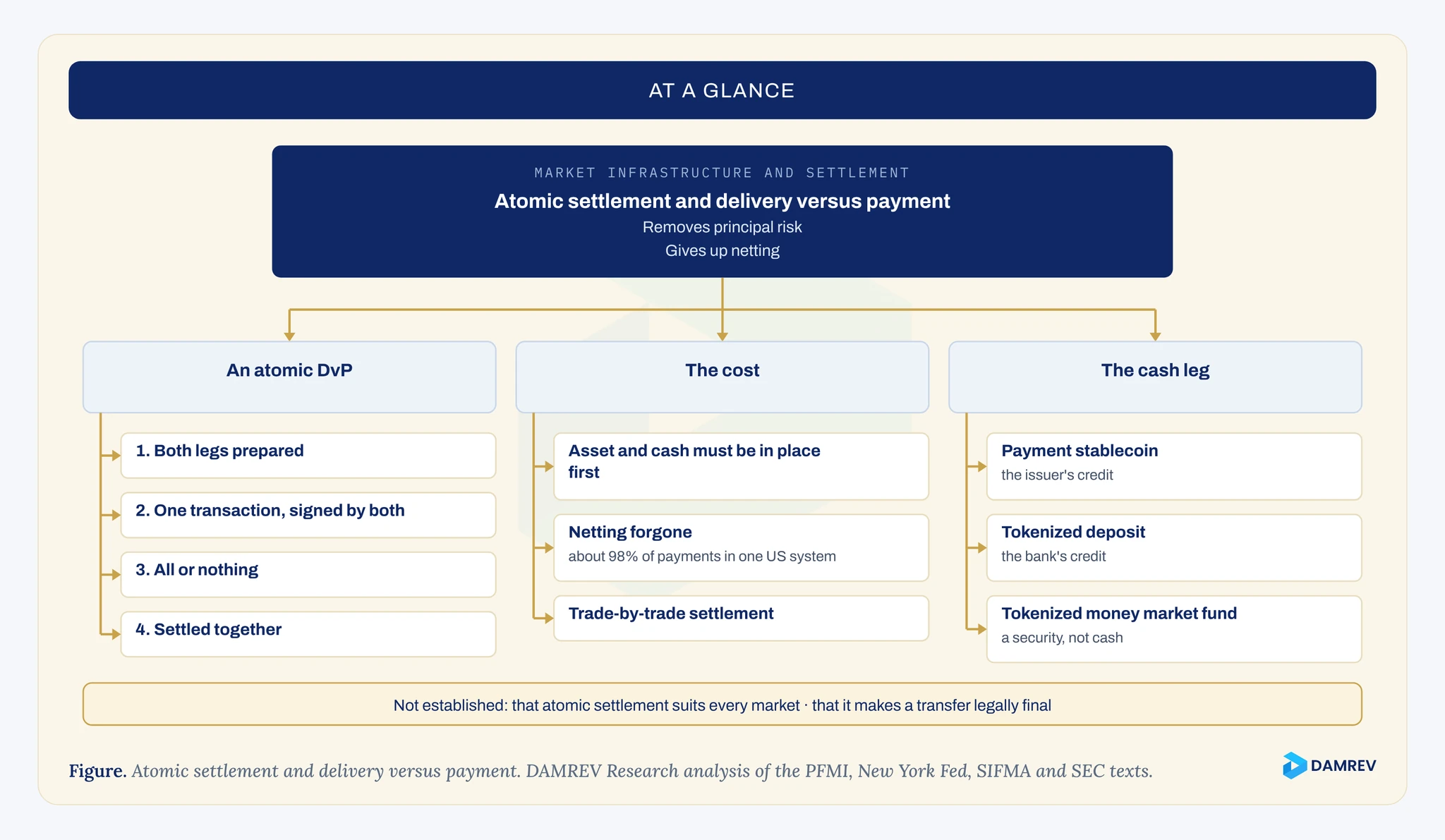
Atomic settlement moves the security and the cash in one indivisible step, so either both legs settle or neither does3, 4.
That is delivery versus payment in its strictest form: it removes the risk of delivering an asset and not being paid, which the international standard requires infrastructures to eliminate1; the price is that both legs must be in place before the trade settles, which gives up the netting that conventional systems rely on3, 5.


01 · The risk
What risk does delivery versus payment remove?
Delivery versus payment removes principal risk: the risk that one party delivers in full and receives nothing, because its counterparty fails between the two legs. Delivery versus payment ties the legs together so that cannot happen1.
Every securities trade has two obligations. The seller owes the security; the buyer owes the cash. If they are discharged separately, there is a window in which one party has performed and the other has not.
Should the second party fail inside that window, the first can lose the whole value of the trade, not just the change in price. That exposure is principal risk.
Central banks named the problem decades ago. Their 1992 report on delivery versus payment set out how settlement systems link the two legs, and the models it described still frame the subject2. Twenty years later the standard for market infrastructure made the requirement explicit.
If an FMI settles transactions that involve the settlement of two linked obligations (for example, securities or foreign exchange transactions), it should eliminate principal risk by conditioning the final settlement of one obligation upon the final settlement of the other.1
The 1992 report described three ways of building the link. Securities and cash can both settle trade by trade, gross. Securities can settle gross while cash is netted and paid at the end of a cycle. Or both can be netted and settled together at the end of the cycle2.
Each is delivery versus payment, because in each the final transfer of the security depends on the final transfer of the cash. They differ in how much liquidity they demand and how long each party waits.
The principle does not say how the linkage must be built. A central securities depository can achieve it by moving securities only against a confirmed cash transfer, gross or net. A ledger can achieve it another way: by putting both legs in a single transaction.
02 · What atomic means
What makes settlement atomic?
Atomic settlement means both legs settle in one indivisible step. On a ledger that supports it, the security and the cash move inside a single transaction, and if any part fails, every part fails and nothing changes3, 4.
The word comes from computing, where an atomic operation cannot be split. Economists at the Federal Reserve Bank of New York prefer a narrower definition for finance: they "define 'atomic' settlement as being equivalent to 'simultaneous' settlement"3. Simultaneous settlement, they write, "assures that there is no imbalance between the counterparties"3.
Ledgers deliver this through the rules of the transaction itself. Stellar's documentation states it in three words: "Transactions are atomic"4. A standard transaction can bundle between one and 100 operations; a smart contract transaction carries one4. Put the transfer of a tokenized unit and the transfer of the cash into one transaction, and they settle together or not at all.
An atomic delivery versus payment on a ledger
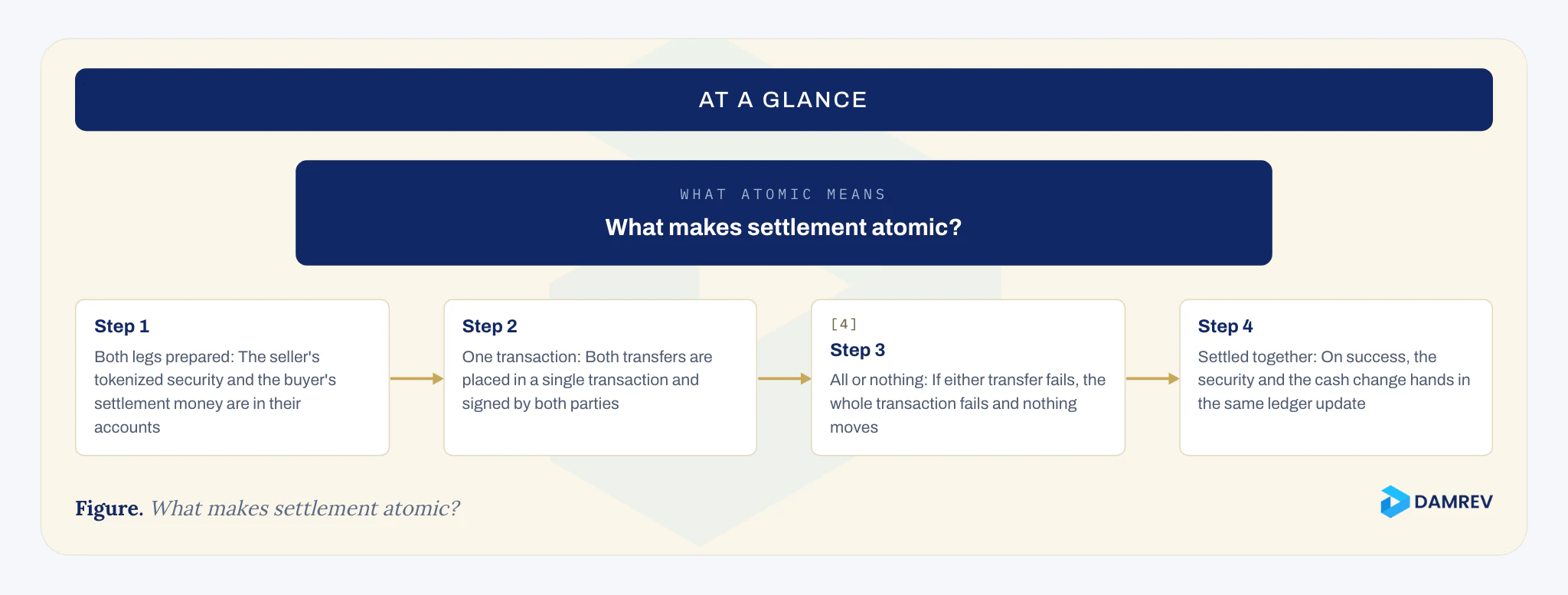
- What makes settlement atomic?
- Step 1: Both legs prepared: The seller's tokenized security and the buyer's settlement money are in their accounts
- Step 2: One transaction: Both transfers are placed in a single transaction and signed by both parties
- Step 3: All or nothing: If either transfer fails, the whole transaction fails and nothing moves ([4])
- Step 4: Settled together: On success, the security and the cash change hands in the same ledger update
For the holder, this means the moment of payment and the moment of ownership are the same moment. For the issuer and its register, it means there is no state in which a unit has moved and the price has not.
03 · The cost
What does atomic settlement cost?
Atomic settlement costs liquidity: each trade settles on its own, so the asset and the cash must both be in place first. That gives up netting, which conventional markets use to cut the cash they exchange by most of its value3, 5, 6.
The New York Fed authors are careful about where the costs fall. They argue that simultaneous settlement is "probably always desirable", while instant settlement "may not be"3. Settling each trade the moment it is agreed means "only trades in which cash and securities are pre-positioned can be executed", and it makes "netting of settlement obligations impossible"3.
The Depository Trust & Clearing Corporation (DTCC) states that its clearing subsidiary's netting reduces the value of payments that need to be exchanged by an average of 98 percent each day5. Its own experts put the trade-off directly: settling instantaneously means losing the benefit of netting, and without netting a market increases risk and strains liquidity5.
- Average daily reduction in payments exchanged through National Securities Clearing Corporation (NSCC) netting, which trade-by-trade settlement forgoes5
- 98%
- Operations a single standard Stellar transaction may bundle, all of which settle or fail together4
- 1 to 100
The Securities Industry and Financial Markets Association (SIFMA) wrote in June 2026 that atomic settlement gives trade-by-trade certainty but requires cash and securities to be fully prefunded at the moment of settlement, and that intraday batch settlement often performed better on operational and capital efficiency in its own work6.
For a fund with a small number of large subscriptions and redemptions, the calculation differs from that of a market maker trading all day. Prefunding a few large transfers costs little; prefunding thousands of small ones does not.
04 · The cash leg
What does the cash leg need?
The cash leg must live on the same ledger as the security, in a form both parties accept. That means a tokenized form of money, such as a payment stablecoin, a tokenized deposit, or, in some settings, a tokenized money market fund7.
Atomic settlement works only where both legs can be moved by the same transaction. A tokenized security on one ledger and cash in a bank account cannot be swapped atomically, because no single transaction controls both. One leg would have to settle first, and principal risk returns through the gap.
The Securities and Exchange Commission (SEC) order of 17 September 2026 shows the point in regulatory form. It requires each tokenized stock on a tokenized securities venue to be paired with another tokenized national market system (NMS) stock, a non-security crypto asset such as a permitted payment stablecoin, or a tokenized money market fund7.
| Cash leg | Who stands behind it | What it means for the trade | Source |
|---|---|---|---|
| Payment stablecoin | The issuer, against its reserves | Settles on the ledger; the holder carries the issuer's credit and redemption terms | SEC order7 |
| Tokenized deposit | The issuing bank, as a deposit liability | Settles on the ledger; the holder carries the bank's credit | Guiding and Establishing National Innovation for US Stablecoins Act, Section 2(22)8 |
| Tokenized money market fund unit | The fund's assets | A pair the SEC order permits on a venue; it is a security, not cash | SEC order7 |
For an issuer, this moves a familiar question to a new place. In a conventional fund, the transfer agent and the cash agent reconcile units against money after the fact. On a ledger with an on-ledger cash leg, the reconciliation is the transaction itself, and the work shifts to choosing the money and making sure holders can obtain it.
Which of these a programme uses is a structuring decision with consequences beyond settlement: who the holder is exposed to, which regulator oversees the cash, and how the cash is redeemed into bank money. The companion article on tokenized deposits and stablecoins takes that question up.

05 · What it does not establish
What do the sources not establish?
As of 7 October 2026, the New York Fed and SIFMA analyses read here do not establish that atomic settlement is right for every market or makes a ledger transaction legally final, and do not address settlement timing, a separate question3, 6.
| Question | What the sources say | Source |
|---|---|---|
| Is atomic settlement always better? | Simultaneous probably always desirable; instant may not be | New York Fed3 |
| Does it outperform batch settlement? | Not always; SIFMA's own work often found intraday batches more efficient | SIFMA6 |
| Does atomic settlement make a transfer legally final? | Not addressed; legal finality depends on the system's rules and law | None of these sources |
| Does atomic mean same-day? | No. Atomic concerns how the legs move, not on which day | New York Fed3 |
| Does it remove the risk in the cash leg itself? | No. The holder still carries the credit of whoever issued the settlement money | SEC order7 |
The first distinction is between atomic and same-day. A trade can be agreed on Monday and settled atomically on Wednesday. Another can settle on the trade date through a conventional, non-atomic process; DTCC states that its depository already settles transactions on a near-instantaneous basis5. Timing is the subject of the T+0 article in this category.
The second is between removing principal risk and removing all risk. Atomic settlement guarantees that neither party performs alone. It does not guarantee that the trade happens, since "simultaneous settlement doesn't guarantee that settlement takes place"3, and it does nothing about the quality of the money in the cash leg.
Common questions
What else do people ask?
Short answers on atomic settlement: whether it is the same as T+0 or as instant settlement, whether it guarantees that a trade settles, and why conventional markets do not settle every trade atomically.
Is atomic settlement the same as T+0?
No. Atomic describes how the two legs settle: together or not at all. T+0 describes when: on the trade date. A trade can settle atomically days after it was agreed, and a trade can settle on the trade date without being atomic3, 5.
Is atomic settlement the same as instant settlement?
Not necessarily. Economists at the Federal Reserve Bank of New York define atomic as simultaneous, and note the term is often used for settlement that is both simultaneous and instant. They treat the two properties separately3.
Does atomic settlement guarantee that a trade settles?
No. It guarantees that neither leg settles without the other. If one side lacks the asset or the cash, the whole transaction fails and nothing moves3, 4.
Why do conventional markets not settle every trade atomically?
Because netting saves liquidity. In US equities, NSCC's netting reduces the value of payments that need to be exchanged by an average of 98 percent each day, a saving gross trade-by-trade settlement gives up5.
Where should you go next?
The pages below pick up where this one ends. Start with the one closest to where your asset or programme stands today.
- T+0: What Same-Day Settlement Changes for a FundSame-day settlement concerns timing, not how the legs move. For a fund, it asks for cash and register updates on the trade date.
- Tokenized Deposits & Stablecoins: Two Kinds of Settlement MoneyA tokenized deposit is a claim on a bank; a stablecoin is a token its issuer undertakes to redeem from reserves. US law separates them.
- The SEC's Innovation Exemption of 17 September 2026: What Tokenized Securities Venues & Tokenized NMS Stock May Now DoSince 17 September 2026 a tokenized securities venue may run automated liquidity pools in tokenized listed stock without registering as an exchange, on conditions.
- Settlement & LiquidityHow value settles in the asset each jurisdiction permits: fiat through a licensed provider, swaps without custody, and sales behind an eligibility gate.
References
- 1.Committee on Payment and Settlement Systems and Technical Committee of IOSCO, "Principles for financial market infrastructures", April 2012, Principle 12, as shown in the CPMI's PFMI implementation database. https://www.bis.org/committees/cpmi/pfmi/l2-database?page=408
- 2.Committee on Payment and Settlement Systems, "Delivery versus payment in securities settlement systems", September 1992. https://www.bis.org/cpmi/publ/d06.pdf
- 3.Michael Lee, Antoine Martin and Benjamin Müller, "What is atomic settlement?", Liberty Street Economics, Federal Reserve Bank of New York, 7 November 2022. https://libertystreeteconomics.newyorkfed.org/2022/11/what-is-atomic-settlement
- 4.Stellar developer documentation, "Operations and transactions", read 7 October 2026. https://developers.stellar.org/docs/learn/fundamentals/transactions/operations-and-transactions
- 5.DTCC, "Ask the expert: same day, every day, how same-day settlement works at DTCC", 19 April 2021. https://www.dtcc.com/dtcc-connection/articles/2021/april/19/ask-the-expert-same-day-every-day-how-same-day-settlement-works-at-dtcc
- 6.SIFMA, Micah Smith and Peter J. Ryan, "The future of markets: analyzing atomic settlement in equities markets", 22 June 2026. https://www.sifma.org/news/blog/the-future-of-markets-analyzing-atomic-settlement-in-equities-markets
- 7.US Securities and Exchange Commission, Order Granting Exemptions for Tokenized Securities Venues, Exchange Act Release No. 34-106402, 17 September 2026. https://www.sec.gov/files/rules/exorders/2026/34-106402.pdf
- 8.Guiding and Establishing National Innovation for US Stablecoins Act, Public Law 119-27, 18 July 2025, Section 2(22). https://www.govinfo.gov/content/pkg/PLAW-119publ27/html/PLAW-119publ27.htm
This article is analysis of public sources, not legal advice. Last updated:




