


Article · Market Infrastructure & Settlement
Tokenized Deposits & Stablecoins: Two Kinds of Settlement Money
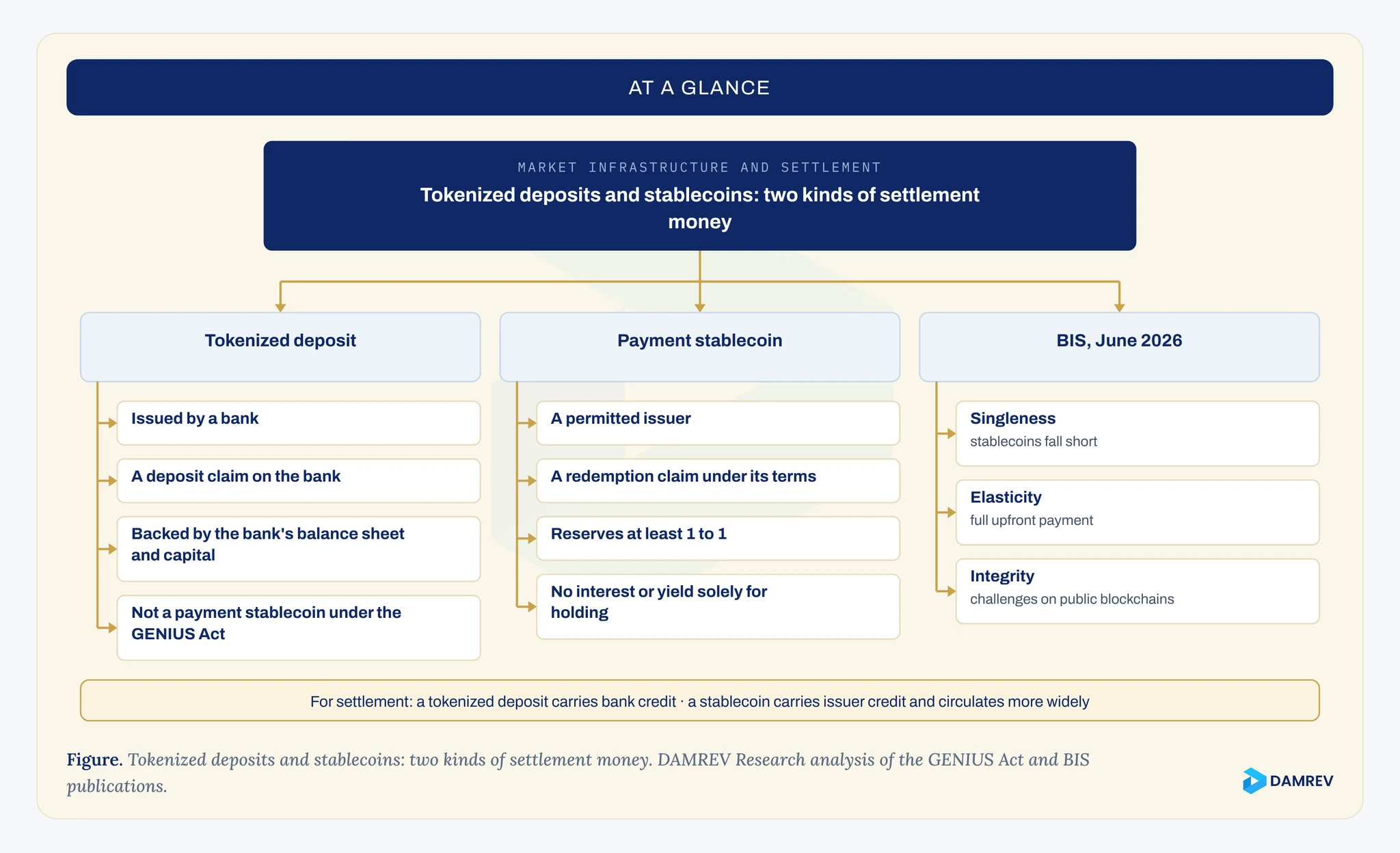
A tokenized deposit is a bank deposit recorded on a ledger: the holder has a claim on the bank, inside banking regulation. A stablecoin is a token whose issuer undertakes to redeem it, backed by reserves.
US law treats the two as different things and excludes deposits, including those recorded on a ledger, from the definition of a payment stablecoin1. The Bank for International Settlements (BIS) argued in June 2026 that current stablecoins fall short on singleness, the ability to redeem at par for central bank money2.


In this article
01 · Two kinds
What is the difference between a tokenized deposit and a stablecoin?
A tokenized deposit and a stablecoin differ in the issuer and the claim: a tokenized deposit is a bank's deposit liability recorded on a ledger. A stablecoin is a token its issuer undertakes to redeem for a fixed amount, backed by a pool of reserves1.
Both put money on a ledger, and both are meant to hold a stable value against a national currency. That similarity hides a difference in what the holder owns.
A holder of a tokenized deposit has the same claim as any depositor at that bank: the bank owes it money, and the bank's capital, supervision, and access to central bank facilities stand behind that debt. The ledger is a new way of recording the deposit, not a new kind of money.
A holder of a stablecoin has a claim on the issuer under the issuer's terms. The issuer holds reserves to meet redemptions, and the quality of those reserves, and the issuer's willingness and ability to pay, decide what the token is worth in a crisis.
United States law draws the line in the definitions. The Guiding and Establishing National Innovation for US Stablecoins (GENIUS) Act defines a payment stablecoin as a digital asset used as a means of payment or settlement whose issuer "is obligated to convert, redeem, or repurchase for a fixed amount of monetary value"1.
It then excludes a deposit as defined in the Federal Deposit Insurance Act, "including a deposit recorded using distributed ledger technology"1.
02 · Who stands behind each
Who stands behind each one?
A bank stands behind a tokenized deposit, as a debtor to its depositor. A stablecoin issuer stands behind a stablecoin, through reserves it must hold at least one to one and a redemption promise set by its terms1, 4.
The differences follow from that starting point. A bank lends against its deposits; that is how deposits fund credit.
A permitted payment stablecoin issuer must instead "maintain identifiable reserves backing the outstanding payment stablecoins" on "an at least 1 to 1 basis"1. It is barred from paying holders "any form of interest or yield" solely for holding the stablecoin1. Deposits are outside that definition, so that prohibition does not reach them.
| Feature | Tokenized deposit | Payment stablecoin | Source |
|---|---|---|---|
| Issuer | A bank | A permitted payment stablecoin issuer | GENIUS Act1 |
| Holder's claim | A deposit claim on the bank | A redemption claim on the issuer, under its terms | GENIUS Act1; Circle terms4 |
| Backing | The bank's balance sheet, capital, and supervision | Identifiable reserves of at least one to one | GENIUS Act1 |
| Interest | Outside the Act's prohibition | Issuer may not pay interest or yield solely for holding | GENIUS Act1 |
| Treated as a payment stablecoin? | No; deposits recorded on a ledger are excluded | Yes | GENIUS Act1 |
Redemption works differently in practice too. A depositor deals with its own bank. A stablecoin holder may not have a direct line to the issuer at all: Circle's terms, for instance, let only Circle Mint account holders redeem USDC directly4. Everyone else reaches dollars through an intermediary.
03 · The BIS argument
What did the BIS argue in June 2026?
The BIS argued in June 2026 that stablecoins show what tokenization can do for payments but, in their current form, fall short on singleness (the ability to redeem at par for central bank money) and carry wider stability risks2.
The Bank for International Settlements, the central banks' own institution, set out its view in its Annual Economic Report of June 2026. It credited stablecoins with displaying "some of tokenisation's potential to support faster, programmable payments"2. Then it turned.
Their current form, however, falls short on key properties of money and has structural flaws.2
The property it singled out was singleness: "the ability to redeem different forms of money exactly at par" in exchange for central bank money2.
Money works as money because a dollar in one bank, in cash, or in a payment system is the same dollar everywhere. A token that trades slightly above or below par, depending on who issued it and where it circulates, is closer to a financial asset than to money.
Singleness
Asset-backed stablecoins typically fail this test and behave like financial assets, the BIS wrote in 20253.
Elasticity
Extra stablecoin supply requires full upfront payment by holders, so it cannot expand with demand the way bank credit can3.
Integrity
Circulation on public, permissionless blockchains raises challenges for resilience against financial crime2, 3.
The BIS's preferred direction is a "unified ledger" that integrates different forms of tokenized money in the same venue, with tokenized commercial bank deposits settling against tokenized central bank reserves2. In that design, tokenized deposits do the everyday work and central bank money provides the final settlement, as in today's two-tier system3.
04 · For settlement
What does the difference mean for settling a tokenized security?
For settling a tokenized security, the difference changes the counterparty the holder carries and the set of people who can receive the money. A tokenized deposit carries bank credit and reaches that bank's clients; a stablecoin carries issuer credit and can circulate more widely1, 2.
For a fund or issuer choosing settlement money, three questions follow from the sources. Whose credit does each investor carry between subscription and investment? Can every investor hold the chosen money? And how does it convert back into bank money when the investor leaves?
A tokenized deposit answers the first question well for investors who already bank with the issuing bank. It answers the second less well, because a deposit is a relationship with a specific bank, and the investor on the other side of a trade may bank elsewhere.
Settlement between banks then needs a further step in central bank money, which is the gap the BIS's unified ledger is meant to close2.
A stablecoin answers the second question more broadly. Any holder able to hold the token can receive it, on any supported ledger. But each holder carries the issuer's credit and redemption terms, and the BIS notes that circulation on public chains introduces challenges for redeemability2.
The third question, conversion back into bank money, is where the two differ most for a departing investor. A tokenized deposit converts to an ordinary deposit at the same bank by an entry on the bank's own books.
A stablecoin converts through redemption with the issuer or a sale to an intermediary, on the terms each sets, and Circle's own terms say it does not guarantee that USDC will equal one US dollar on third-party platforms4.
For an investor redeeming a large holding on a stressed day, the route to bank money matters as much as the speed of settlement on the ledger.
A fund's documents should therefore say which settlement money it accepts and pays, and what happens if that money becomes unavailable or trades away from par. That is a disclosure question as much as an operational one.
Neither choice is free of trade-offs, and the right one depends on who the investors are. A programme whose investors share a bank faces a different question from one whose investors are spread across many banks and countries.

05 · What it does not establish
What do the sources not establish?
As of 7 October 2026, the GENIUS Act and the BIS publications read here do not establish how the two rank for any particular programme or how deposit insurance applies to a given tokenized deposit, and the BIS view is analysis, not regulation1, 2.
| Question | What the sources say | Source |
|---|---|---|
| Which settlement money should a programme use? | Not addressed | None |
| Is a tokenized deposit insured? | Not addressed in these sources; the Act defines it by reference to the Federal Deposit Insurance Act | GENIUS Act1 |
| Is the BIS view binding? | No. It is the central banks' institution's analysis | BIS2 |
| Are GENIUS Act reserve rules in force? | The Act takes effect on 18 January 2027 | GENIUS Act1 |
| Do all stablecoins trade at par? | Circle does not guarantee USDC equals one US dollar on third-party platforms | Circle terms4 |
The GENIUS Act's definition settles classification in the United States. It does not settle the practical questions a depositor would ask, such as how a tokenized deposit is treated if the bank fails or how it moves between banks. Those depend on banking law and on each bank's terms, which these sources do not cover.
The BIS argument, likewise, is a view about the monetary system as a whole. It does not say a particular stablecoin is unsafe or a particular tokenized deposit is safe, and it does not bind any regulator.
Nothing here addresses the accounting or tax treatment of holding either form of money. Those questions belong with the reader's own auditor or tax adviser.
Common questions
What else do people ask?
Short answers to the questions people ask most about this topic.
Is a tokenized deposit a stablecoin under the GENIUS Act?
No. The Act's definition of a payment stablecoin excludes a deposit as defined in the Federal Deposit Insurance Act, including a deposit recorded using distributed ledger technology1.
Can a stablecoin pay interest?
Not from a permitted or foreign issuer under the GENIUS Act, which bars paying the holder any form of interest or yield solely for holding, using, or retaining the stablecoin1. Deposits fall outside that definition.
What does singleness of money mean?
The ability to redeem different forms of money exactly at par in exchange for central bank money. The BIS argued in June 2026 that current stablecoin designs fall short on it2.
Which is better for settling a tokenized security?
The sources do not say. Each carries a different counterparty and reaches a different set of holders, and the choice depends on the programme, its investors, and its regulators.
Where should you go next?
The pages below pick up where this one ends. Start with the one closest to where your asset or programme stands today.
- USDC Settlement Without Taking CustodyA programme can settle in the USDC stablecoin without taking custody, by letting value move directly between the investor's and the issuer's accounts.
- Atomic Settlement & Delivery Versus PaymentAtomic settlement moves the security and the cash in one indivisible step, removing principal risk, but both legs must be ready first.
- When the GENIUS Act Takes Effect: 18 January 2027 & 18 July 2028The GENIUS Act binds payment stablecoin issuers from 18 January 2027, not the firms that hold or settle in stablecoins. Service providers follow in 2028.
- Settlement & LiquidityHow value settles in the asset each jurisdiction permits: fiat through a licensed provider, swaps without custody, and sales behind an eligibility gate.
References
- 1.Guiding and Establishing National Innovation for US Stablecoins Act, Public Law 119-27, 18 July 2025, Sections 2(22), 4(a)(1)(A) and 4(a)(11). https://www.govinfo.gov/content/pkg/PLAW-119publ27/html/PLAW-119publ27.htm
- 2.Bank for International Settlements, "The path to the next-generation monetary and financial system lies in safeguarding trust in money", media release on the Annual Economic Report 2026, 23 June 2026. https://www.bis.org/press/p260623.htm
- 3.Bank for International Settlements, Annual Economic Report 2025, Chapter III, "The next-generation monetary and financial system", 29 June 2025. https://www.bis.org/publ/arpdf/ar2025e3.htm
- 4.Circle, "USDC Terms", last updated 12 December 2025, Sections 2 and 13. https://www.circle.com/legal/usdc-terms
This article is analysis of public sources, not legal advice. Last updated:




