


Article · Market Infrastructure & Settlement
USDC Settlement Without Taking Custody
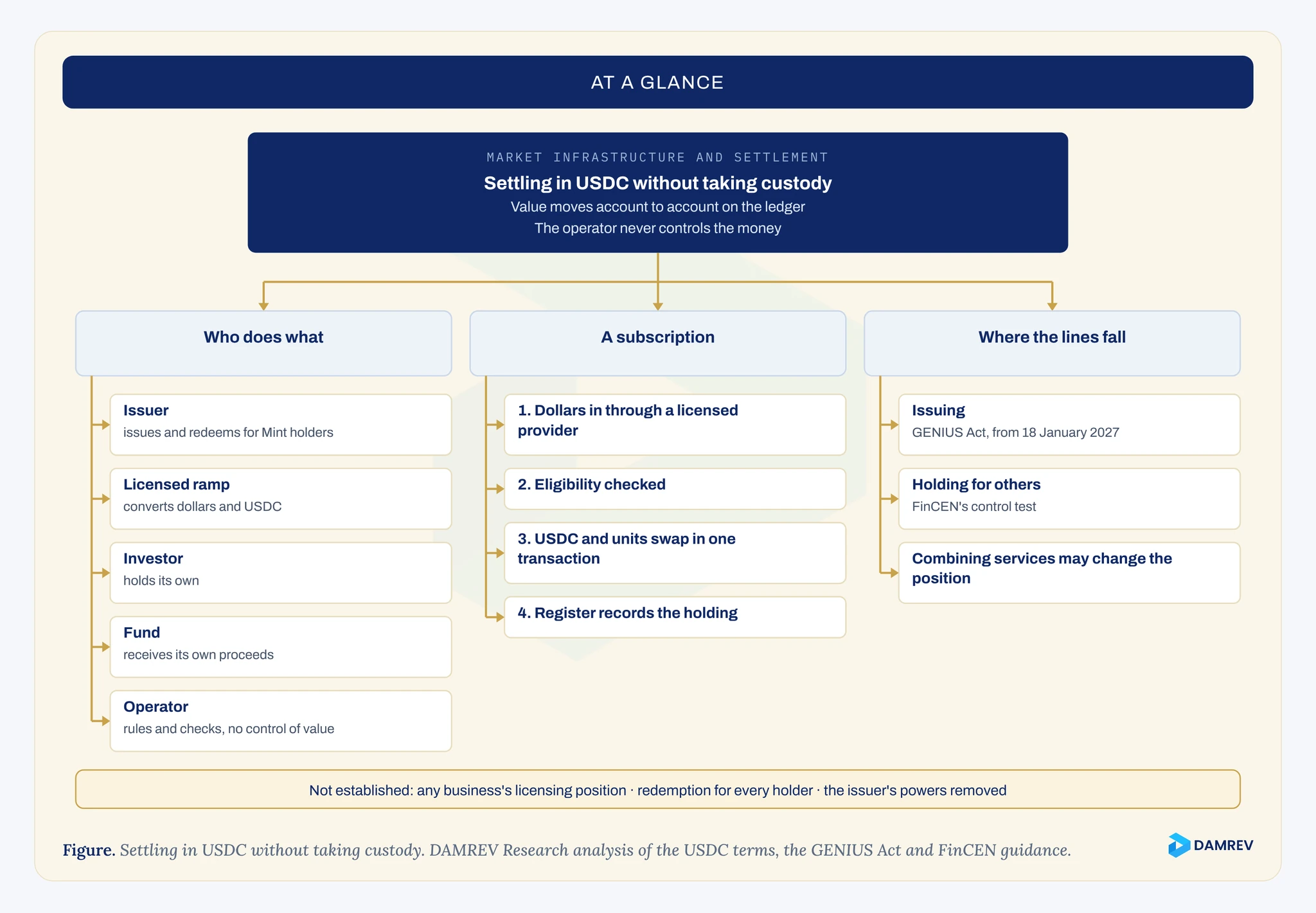
A programme can settle in USDC without taking custody by letting value move directly between the investor's account and the issuer's account on the ledger, so the operator never controls the money in between1, 3.
USDC is issued and redeemed by Circle, and under the Guiding and Establishing National Innovation for US Stablecoins (GENIUS) Act a business that only uses a payment stablecoin is a user, not an issuer1, 2; whether a particular operator holds client money turns on whether it has independent control over the value3.


In this article
01 · The model
What does settling without taking custody mean?
Non-custodial settlement means the programme's operator never holds the investor's money. Settlement money moves from the investor's own account to the issuer's or fund's account on the ledger, and the operator's software routes and checks the transfer without controlling the value3.
In a conventional fund, subscription money usually passes through someone else's hands. It goes to a transfer agent's collection account, a nominee, or a platform's client money account, and waits there until units are issued. Each of those holders takes on duties for money that is not theirs: segregation, reconciliation, and, depending on the jurisdiction, a licence.
A ledger allows a different arrangement. If the investor holds settlement money in an account it controls, and the fund holds its units in an account the issuer controls, the two can be exchanged directly. The operator of the programme writes the rules, checks eligibility, and builds the transaction. It does not hold the money at any point.
The arrangement moves a burden as well as removing one. An investor that holds its own settlement money must hold its own keys, or appoint a custodian it chooses and pays for.
A custodian then holds the USDC under its own licence and duties, and the programme still never touches it. Custody then sits with a party the investor selected, rather than with the operator of the programme.
Whether a business is holding other people's money is the question that decides much of how it is regulated. In the United States, the Financial Crimes Enforcement Network (FinCEN) has framed that question for virtual currency in terms of control: a hosted wallet provider is a money transmitter because "the host has total independent control over the value"3.
02 · What USDC is
Who stands behind USDC, and who can redeem it?
USDC is issued by Circle Internet Financial, LLC, with Circle Internet Financial Europe SAS as a second issuer, and only holders with a Circle Mint account can redeem it with Circle directly1.
USDC is a payment stablecoin: a token its issuer undertakes to redeem for US dollars. Circle's terms name the issuers and describe USDC as operating on a list of supported blockchains1. A programme that settles in USDC does not issue it and does not stand behind it.
The terms themselves are split by geography: they apply to USDC held outside the European Economic Area, and holders inside it are directed to Circle's white paper1. The holder's claim is on Circle, under Circle's terms.
The redemption promise is specific. Circle "commits to redeem 1 USDC for 1 USD, subject to these Terms, applicable law, and any fees where applicable"1. It is also limited. "Only Users Type A can redeem USDC directly with Circle", meaning holders with a Circle Mint account1.
Anyone else holding USDC reaches dollars through an intermediary that does have that access, such as an exchange or a licensed on-ramp and off-ramp provider. The terms also say Circle does not guarantee that USDC will equal one US dollar on third-party platforms1.
| Party | Role | Holds the investor's money? | Source |
|---|---|---|---|
| Circle | Issues USDC and redeems it for Circle Mint holders | No; it stands behind USDC under its terms | Circle terms1 |
| Licensed on-ramp or off-ramp | Converts the investor's dollars to USDC and back | Briefly, under its own licence | Not addressed by these sources; depends on the provider's licence |
| Investor | Holds USDC in an account it controls | Yes, its own | FinCEN3 |
| Issuer or fund | Receives USDC for units, pays it out on redemption | Its own proceeds | Structure of the programme |
| Programme operator | Writes rules, checks eligibility, builds transactions | No, if it lacks independent control | FinCEN3 |
03 · How value moves
How does value move in a non-custodial programme?
Settlement takes four steps: dollars become USDC through a licensed provider, the investor's eligibility is checked, USDC and units swap in one transaction, and redemption runs the same path in reverse1, 4.
A subscription settled in USDC without the operator taking custody
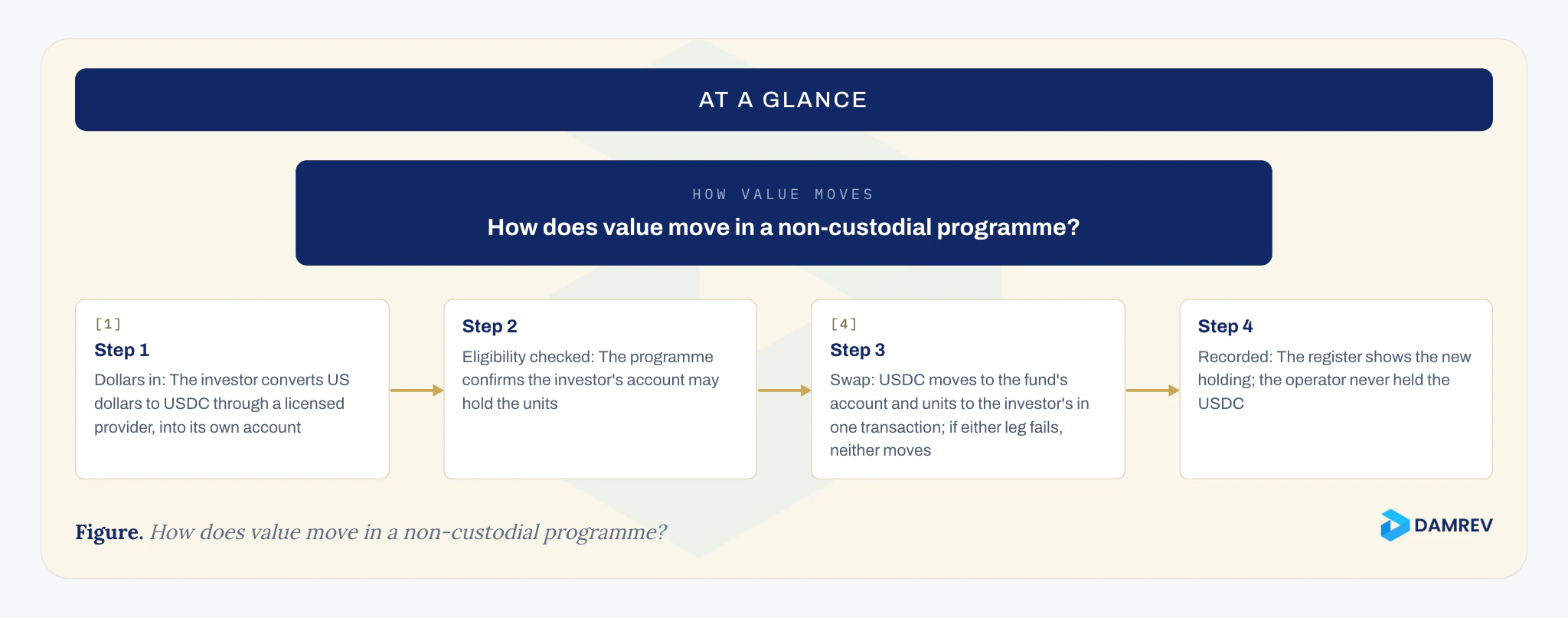
- How does value move in a non-custodial programme?
- Step 1: Dollars in: The investor converts US dollars to USDC through a licensed provider, into its own account ([1])
- Step 2: Eligibility checked: The programme confirms the investor's account may hold the units
- Step 3: Swap: USDC moves to the fund's account and units to the investor's in one transaction; if either leg fails, neither moves ([4])
- Step 4: Recorded: The register shows the new holding; the operator never held the USDC
The third step is where custody is avoided. On a ledger whose transactions are atomic, the transfer of USDC and the transfer of units can sit in a single transaction, and "if one operation in a transaction fails, all operations fail"4.
Neither party has to send first, so neither needs a trusted party to hold its side. That removes the commercial reason for an escrow or collection account.
The investor's units go back to the fund and the fund's USDC comes to the investor in the same transaction, after which the investor can convert to dollars through a provider with redemption access1.
For the fund, the effect is that subscription money arrives in its own account at the moment units are issued. There is no period in which an intermediary holds money awaiting allotment, and no reconciliation between a collection account and the register.
04 · The regulatory lines
Where do the regulatory lines fall?
Regulation applies at issuance and at control: the GENIUS Act regulates who may issue a payment stablecoin, and from 18 July 2028 who may offer one. FinCEN's guidance asks whether a business controls the value it moves2, 3.
The GENIUS Act's licensing requirement falls on issuers2. A fund that settles subscriptions in USDC is a user of a stablecoin it did not issue. Using it is not issuing it, so the Act's issuer licence does not apply to that use, though other laws, such as the money transmission rules in the next paragraphs, still can.
The Act takes effect on 18 January 2027, the earlier of its two statutory dates, since no final implementing rule was issued in time to bring it forward, and its restriction on digital asset service providers offering stablecoins from issuers that are not permitted applies from 18 July 20282.
A business that exchanges, transfers, or holds stablecoins for others should read that restriction closely, because it may be such a provider.
Issuing
Regulated by the GENIUS Act from 18 January 2027. Settling in a stablecoin someone else issues is not issuing2.
Holding for others
A provider with total independent control over the value is a hosted, account-based money transmitter in FinCEN's analysis3.
Combining services
A provider that adds other services to a non-custodial wallet may become a money transmitter through those services3.
FinCEN's 2019 guidance shows how fine the control line can be. A provider of unhosted multiple-signature wallets "is not a money transmitter because it does not accept and transmit value", but if it combines that with other services, "that person will then qualify as a money transmitter"3.
Non-custodial is a description of a particular design, and the design must hold in every step.

05 · What it does not establish
What do the sources not establish?
As of 7 October 2026, the Circle terms, GENIUS Act and FinCEN guidance read here do not establish any business's licensing position, remove the issuer's own powers over USDC, or make redemption available to every holder1, 2, 3.
| Question | What the sources say | Source |
|---|---|---|
| Is a particular operator a money transmitter? | A question of facts and control, case by case | FinCEN3 |
| Can the issuer stop a USDC transfer? | Yes. Circle may block transfers to and from an address under its blocklisting policy | Circle terms1 |
| Can any holder redeem with Circle? | No. Only Circle Mint account holders redeem directly | Circle terms1 |
| Is USDC worth one US dollar everywhere? | Circle does not guarantee that on third-party platforms | Circle terms1 |
| Does the GENIUS Act license USDC users? | No. It licenses issuers; providers face a restriction from 18 July 2028 | Act2 |
Non-custodial settlement removes one risk and leaves others in place. The holder no longer depends on an operator keeping client money safe.
It still depends on Circle's reserves and terms, and Circle "reserves the right to block the transfer of USDC to and from an address on chain" under its policy1. That power exists for legal and sanctions reasons, and holders should know it is there.
FinCEN's guidance dates from 2019 and addresses business models of that time. It remains the agency's published framework, but each business must apply it to its own facts, and none of these sources makes that judgement for any reader.
Nothing here addresses the tax or accounting treatment of settling in a stablecoin. Readers should take those questions to their own adviser or auditor.
Common questions
What else do people ask?
Short answers to the questions people ask most about this topic.
Who can redeem USDC for US dollars directly?
Only holders with a Circle Mint account. Circle's terms say a holder without one may not redeem with Circle until it opens such an account1.
Does a fund that settles in USDC need a licence under the GENIUS Act?
Not as a user. The Act's licensing requirement falls on issuers. A business that exchanges, transfers, or holds stablecoins for others may be a digital asset service provider, and the restriction on those providers applies from 18 July 20282.
Can Circle stop a USDC transfer?
Yes. Circle's terms reserve the right to block the transfer of USDC to and from an address on chain under its blocklisting policy, and to freeze USDC in response to a legal order from a valid government authority1.
Is a non-custodial programme free of money transmission rules?
Not automatically. FinCEN's 2019 guidance turns on whether a provider has total independent control over the value. A provider that combines other services with a non-custodial wallet may still qualify as a money transmitter3.
Where should you go next?
The pages below pick up where this one ends. Start with the one closest to where your asset or programme stands today.
- When the GENIUS Act Takes Effect: 18 January 2027 & 18 July 2028The GENIUS Act binds payment stablecoin issuers from 18 January 2027, not the firms that hold or settle in stablecoins. Service providers follow in 2028.
- Atomic Settlement & Delivery Versus PaymentAtomic settlement moves the security and the cash in one indivisible step, removing principal risk, but both legs must be ready first.
- Tokenized Deposits & Stablecoins: Two Kinds of Settlement MoneyA tokenized deposit is a claim on a bank; a stablecoin is a token its issuer undertakes to redeem from reserves. US law separates them.
- Settlement & LiquidityHow value settles in the asset each jurisdiction permits: fiat through a licensed provider, swaps without custody, and sales behind an eligibility gate.
References
- 1.Circle, "USDC Terms", last updated 12 December 2025, Sections 1, 2 and 13. https://www.circle.com/legal/usdc-terms
- 2.Guiding and Establishing National Innovation for US Stablecoins Act, Public Law 119-27, 18 July 2025, Sections 3 and 20. https://www.govinfo.gov/content/pkg/PLAW-119publ27/html/PLAW-119publ27.htm
- 3.Financial Crimes Enforcement Network, "Application of FinCEN's Regulations to Certain Business Models Involving Convertible Virtual Currencies", FIN-2019-G001, 9 May 2019, Sections 4.2.1 and 4.2.2. https://www.fincen.gov/sites/default/files/2019-05/FinCEN%20Guidance%20CVC%20FINAL%20508.pdf
- 4.Stellar developer documentation, "Operations and transactions", read 7 October 2026. https://developers.stellar.org/docs/learn/fundamentals/transactions/operations-and-transactions
This article is analysis of public sources, not legal advice. Last updated:




