


Article · Market Infrastructure & Settlement
T+0: What Same-Day Settlement Changes for a Fund
T+0 settlement means a trade settles on the day it is agreed.
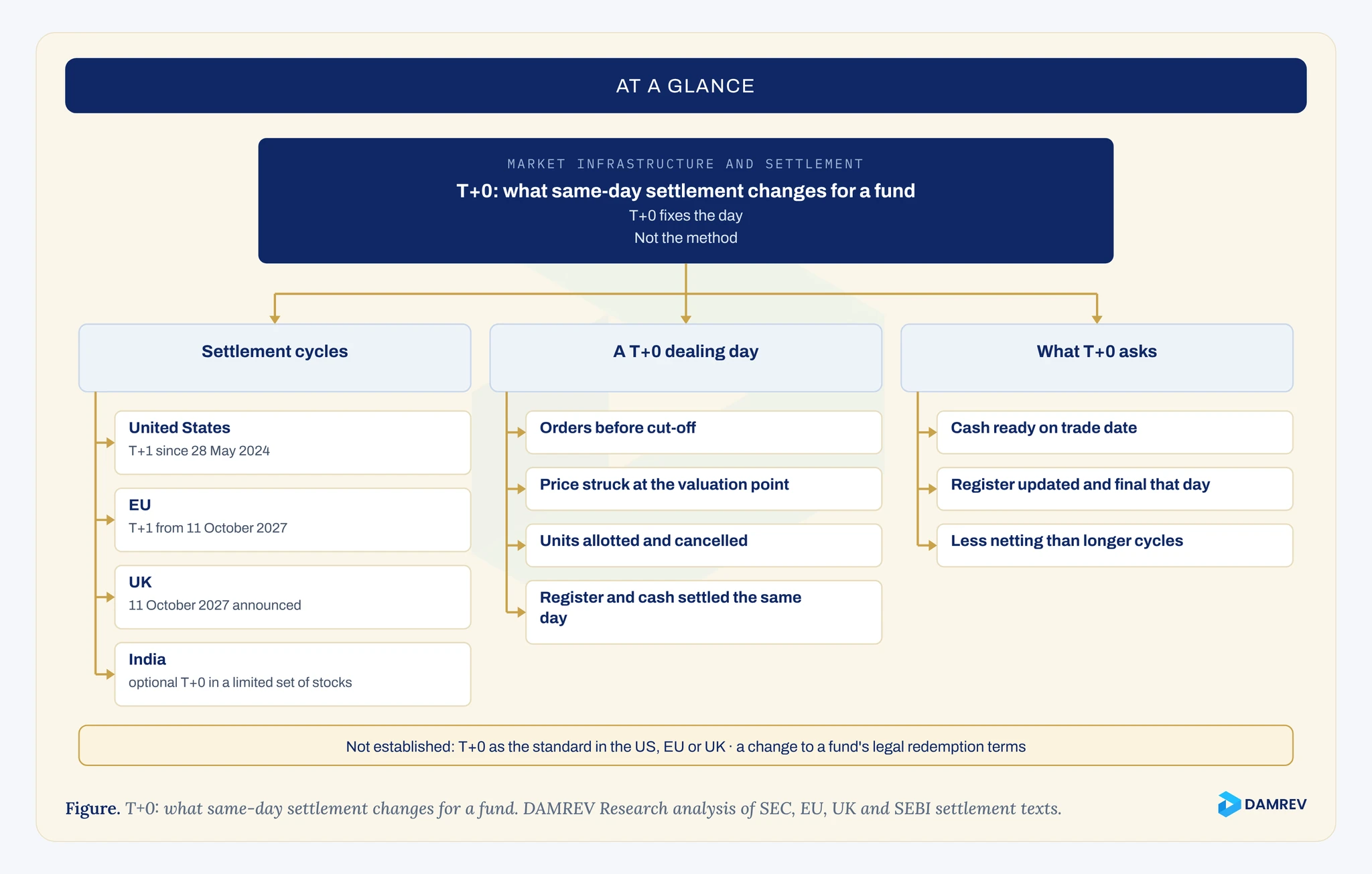
It is a statement about timing, not about how the two legs move, so it is not the same as atomic or instant settlement6; for a fund, it asks for the cash to be ready on trade date and for the register to be updated the same day, and it gives up some of the netting that longer cycles allow5.


In this article
01 · The term
What does T+0 mean?
T+0 is settlement on trade date: the T is the day the trade is agreed, and the number is the business days until the security and the cash change hands. T+0 means zero days: the same day1, 4.
Settlement cycles are named by counting. A market on T+2 settles two business days after the trade; T+1 settles the next business day. T+0 settles on the day itself, at some point before the close of that day's settlement processing.
That definition says nothing about how the settlement happens. It does not require a blockchain, and it does not require that each trade settle the moment it is agreed. A T+0 market could settle every trade in a single batch at the end of the day.
Many observers run the ideas together. The confusion matters, because each one asks different things of a fund: T+0 asks for cash and records by the end of the day, while instant settlement asks for them at the moment of every trade.
Economists at the Federal Reserve Bank of New York draw the relevant line. They separate settlement that is simultaneous, where both legs move together, from settlement that is instant, where the trade settles the moment it is made6. T+0 is neither of those. It is a deadline.
02 · Where cycles stand
Where do settlement cycles stand in October 2026?
The US has settled on T+1 since 28 May 2024. European Union (EU) law sets T+1 from 11 October 2027, a date the UK has also announced, and India runs optional T+0 in a limited set of stocks1, 2, 3, 4.
Every change so far in these markets has shortened the cycle, and the standard adopted or announced in each is T+1, not T+0. The Securities and Exchange Commission (SEC) adopted its rule in February 2023 and the US converted on 28 May 20241.
The EU adopted Regulation (EU) 2025/2075 on 8 October 2025, and it applies from 11 October 20272. The UK government has announced the same date and published a draft statutory instrument, the Central Securities Depositories (Amendment) (Intended Settlement Date) Regulations 20263.
| Market | Standard cycle | Same-day option | Source |
|---|---|---|---|
| United States | T+1, since 28 May 2024 | Depository Trust & Clearing Corporation (DTCC) states the operational capability exists | SEC1; DTCC5 |
| European Union | T+2; T+1 applies from 11 October 2027 under Regulation (EU) 2025/2075 | Not set by the regulation | AMF2 |
| United Kingdom | T+2; 11 October 2027 announced for T+1, draft instrument published | Not set by the policy | HM Treasury3 |
| India | T+1 | Optional T+0 beta in a limited set of stocks since March 2024 | SEBI4 |
Same-day settlement is already possible in some conventional systems, which is worth stating before anyone credits it to a new technology.
DTCC wrote in April 2021 that its clearing and settlement subsidiaries "have the operational capability to clear and settle transactions same-day, on T+0 with existing technology", at a time when the US cycle was still T+25. It added that its depository "is already a T+0 platform and settles transactions on a near-instantaneous basis"5.
The barrier to T+0 in conventional markets is not mainly technical. It is the liquidity and operational cost of giving up time.
03 · The fund's cash
What does T+0 ask of a fund's cash?
T+0 needs the money ready on the day. Subscribers must fund on trade date, the fund must meet redemptions on trade date, and the netting that a longer cycle allows across a day's or several days' trades is reduced5.
A longer cycle gives a fund time. Between trade and settlement it can match subscriptions against redemptions, raise cash from its holdings, and settle only the difference.
Netting is the main benefit of that time, and its scale in conventional markets is large: DTCC states that netting "reduces the value of payments that need to be exchanged by an average of 98% across all settlement cycles"5.
T+0 compresses that window to hours. A fund that offers same-day settlement must hold, or be able to raise within the day, the cash to pay leavers before the day's subscriptions have arrived and been matched.
For a money market fund holding short-dated assets, that is ordinary business. For a fund holding private credit or property, it is a different proposition, and same-day dealing may be impossible to offer without holding a liquidity buffer for the purpose.
- Average reduction in payments exchanged through DTCC netting, across settlement cycles5
- 98%
The subscriber's side matters too. T+0 requires subscription money to arrive on trade date. On a ledger, that means investors holding settlement money on the same ledger before they trade, which the atomic settlement article in this category explains. The cash question does not disappear with tokenization; it moves earlier in the day.
04 · The register
What does T+0 ask of the register?
T+0 needs the register updated on trade date, and the update final. A register that changes the same day but remains provisional has met the deadline in form only, which is why finality and timing belong together6.
A fund's dealing day has a fixed shape. Orders arrive before a cut-off, the net asset value is struck, units are allotted or cancelled at that value, and the register is updated. On longer cycles the register update may come a day or more after the price.
A dealing day on a T+0 fund

- What does T+0 ask of the register?
- Before cut-off: Orders received: Subscriptions and redemptions accepted for the day, with subscription money due the same day (Step 1)
- Valuation point: Price struck: The net asset value per unit fixed for the day's orders (Step 2)
- After valuation: Units moved: Units allotted to subscribers and cancelled for leavers at that price (Step 3)
- Same day: Register and cash settled: The register updated and redemption money paid before the day closes (Step 4)
A register kept on a ledger that is final at close can meet this shape without a separate overnight reconciliation. Each allotment or cancellation becomes part of the record when the ledger closes.
The fund on Stellar that this site has written about keeps its official record of share ownership in a blockchain-integrated system that uses public networks, with Stellar as the primary one, which shows the register side can work with a public network8, 9.
The same-day register also changes what a record date means. When a fund declares a distribution, it pays whoever is on the register at a stated moment.
On a longer cycle, trades agreed before that moment may not yet appear, and the fund and its dealers follow conventions to decide who is paid. When the register settles on trade date, the holder on the record is much closer to the holder who actually bought, and fewer of those conventions are needed.
What a ledger cannot do is strike the price. The valuation point, the pricing policy, and the administrator's checks remain where they were. Tokenization speeds up the record of a decision; it does not make the decision.

05 · What it does not establish
What do the sources not establish?
As of 7 October 2026, the settlement texts and Investment Company Act read here do not establish T+0 as the standard in the US, EU or UK, change a fund's legal redemption terms, or make same-day settlement atomic or final1, 2, 3, 7.
| Question | What the sources say | Source |
|---|---|---|
| Is T+0 required in the US, EU or UK? | No. The standard is or will be T+1 | SEC, AMF, HM Treasury1, 2, 3 |
| Is the UK date law? | Not yet. The date is announced and a draft instrument published; we found no made instrument as of 7 October 2026 | HM Treasury3 |
| Does T+0 change a US fund's redemption ceiling? | No. Payment may not be postponed beyond seven days, subject to exceptions | Investment Company Act7 |
| Is a T+0 trade atomic? | Not necessarily; timing and mechanism are separate | New York Fed6 |
| Is T+0 suitable for every fund? | Not addressed; it depends on the liquidity of the fund's assets | None of these sources |
The fund's own documents decide how quickly it settles with investors. A prospectus can promise same-day settlement within the legal ceiling, or something slower.
A faster market cycle does not rewrite those terms, and the Investment Company Act sets its own outer limit for US funds: no registered fund may "suspend the right of redemption, or postpone the date of payment" beyond seven days except as the Act allows7.
Two further cautions follow. First, settlement on trade date is not settlement in real time; a same-day batch at the close still leaves the day's trades unsettled for hours. Second, a register updated on trade date is only as good as its finality. The settlement finality article in this category sets out why those are separate tests.
Common questions
What else do people ask?
Short answers to the questions people ask most about this topic.
Is T+0 the same as atomic settlement?
No. T+0 says on which day a trade settles. Atomic settlement says that the security and the cash move together or not at all. A trade can be one without the other6.
Which major markets settle on T+0 today?
None as their standard cycle among the US, EU, and UK. The US moved to T+1 on 28 May 2024. EU law sets T+1 from 11 October 2027, and the UK government has announced the same date and published a draft instrument1, 2, 3. India has run an optional T+0 cycle in a limited set of stocks since March 20244.
Does T+0 change when a US fund must pay a redemption?
No. The Investment Company Act bars a registered fund from postponing payment on redemption for more than seven days, with limited exceptions. A faster settlement cycle leaves that legal ceiling as it is7.
Why not settle everything on T+0?
Because it costs liquidity. DTCC states that netting reduces the value of payments exchanged through its clearing subsidiary by an average of 98 percent across settlement cycles, and settling trade by trade gives that up5.
Where should you go next?
The pages below pick up where this one ends. Start with the one closest to where your asset or programme stands today.
- Atomic Settlement & Delivery Versus PaymentAtomic settlement moves the security and the cash in one indivisible step, removing principal risk, but both legs must be ready first.
- Settlement Finality on a Blockchain: Why a Register Cannot Be Probably TrueA register can record a transfer only once it is final. Probabilistic finality never gets there outright, and technical finality is not legal finality.
- Why the First US-Registered Tokenized Money Market Fund Runs on StellarThe first US-registered money market fund with a public blockchain as its official record runs on Stellar: finality at ledger close, and issuer controls.
- Settlement & LiquidityHow value settles in the asset each jurisdiction permits: fiat through a licensed provider, swaps without custody, and sales behind an eligibility gate.
References
- 1.US Securities and Exchange Commission, press release 2024-62 on the T+1 compliance date of 28 May 2024, 21 May 2024; final rule, Release No. 34-96930, 15 February 2023. https://www.sec.gov/news/press-release/2024-62
- 2.Autorité des marchés financiers, "Settlement cycle: T+1", on Regulation (EU) 2025/2075 of 8 October 2025 amending Regulation (EU) No 909/2014, read 7 October 2026. https://www.amf-france.org/en/news-publications/depth/settlement-cycle-t1
- 3.HM Treasury, "Accelerated settlement: T+1", policy paper and draft Central Securities Depositories (Amendment) (Intended Settlement Date) Regulations 2026, read 7 October 2026. https://www.gov.uk/government/publications/accelerated-settlement-t1
- 4.Securities and Exchange Board of India, circular SEBI/HO/MRD/MRD-PoD-3/P/CIR/2024/20, "Introduction of beta version of T+0 rolling settlement cycle on optional basis in addition to the existing T+1 settlement cycle in equity cash markets", 21 March 2024. https://www.sebi.gov.in/legal/circulars/mar-2024/introduction-of-beta-version-of-t-0-rolling-settlement-cycle-on-optional-basis-in-addition-to-the-existing-t-1-settlement-cycle-in-equity-cash-markets_82455.html
- 5.DTCC, "Ask the expert: same day, every day, how same-day settlement works at DTCC", 19 April 2021. https://www.dtcc.com/dtcc-connection/articles/2021/april/19/ask-the-expert-same-day-every-day-how-same-day-settlement-works-at-dtcc
- 6.Michael Lee, Antoine Martin and Benjamin Müller, "What is atomic settlement?", Liberty Street Economics, Federal Reserve Bank of New York, 7 November 2022. https://libertystreeteconomics.newyorkfed.org/2022/11/what-is-atomic-settlement
- 7.Investment Company Act of 1940, Section 22(e), 15 U.S.C. 80a-22(e). https://www.law.cornell.edu/uscode/text/15/80a-22
- 8.Stellar Development Foundation, Franklin Templeton case study, read 7 October 2026. https://stellar.org/case-studies/franklin-templeton
- 9.Franklin Templeton Trust, Franklin OnChain U.S. Government Money Fund, prospectus dated 1 August 2026 (Form N-1A post-effective amendment), "Use of Blockchain" and "Multi-Chain Support and Network Suitability Framework". https://www.sec.gov/Archives/edgar/data/0001786958/000165558926000970/c485bpos.htm
This article is analysis of public sources, not legal advice. Last updated:




