Article · Market Infrastructure & Settlement
Why the First US-Registered Tokenized Money Market Fund Runs on Stellar
The network gives a fund what its system of record needs: records that are final at ledger close, and issuer controls built into the ledger1. Franklin Templeton's OnChain U.S. Government Money Fund launched on Stellar in April 2021, the first US-registered money market fund to use a public blockchain as its official system of record2.

In this article
01 · The precedent
What did Franklin Templeton put on-chain in 2021?
The official record itself. The Franklin OnChain U.S. Government Money Fund, ticker FOBXX and token BENJI, uses a public blockchain as the official system of record for its transactions and share ownership. It launched on Stellar in April 2021, the first US-registered money market fund to do so2.
The distinction matters. Many tokenization projects create a token that mirrors a record kept somewhere else, so the token is a copy and a database elsewhere is the truth. Here the chain is the truth. Share ownership is what the ledger says it is, and a transaction has happened when the ledger records it.
A money market fund is a demanding place to start. It is registered, it is held for its stability, and its investors expect ownership records to be exact every day.
Franklin Templeton's own reasons for its choice are not in the sources this article relies on, so the chapters that follow read the properties the network documents rather than guess at the decision.
02 · Ledger properties
What does a fund need from a ledger that holds its register?
Finality, issuer control and an operating history. A register cannot be provisional, the issuer must be able to control who holds its shares, and a sponsor needs a network that has run long enough to judge. Stellar documents all three: finality at ledger close, native issuance with issuer controls, and public operation since 31 July 20141.
| What a fund register needs | What Stellar documents | Why it matters |
|---|---|---|
| Final records | A ledger closes roughly every five seconds, with finality at close1 | Ownership is settled when the ledger closes, not after a waiting period |
| Native issuance | Any account can issue an asset natively1 | The fund's shares are ledger assets, not entries in an application on top |
| Control over who may hold | Authorisation flags available to the issuer1 | The issuer can restrict holding to approved accounts |
| A way to correct a holding | Clawback available to the issuer1 | An issuer can recover an asset where its rules require it |
| Operating history | Public since 31 July 2014, on the Stellar Consensus Protocol1 | A sponsor can judge years of operation before relying on it |
Finality deserves the most attention. On networks where finality is probabilistic, a transaction becomes more certain as further blocks are added, and a register has to decide how long to wait before treating a transfer as done.
A ledger that is final at close removes that judgement. For a fund whose shares change hands daily, the difference is between a record that is true and one that is probably true.
03 · Programmability
What did Soroban add in 2024?
Programmable rules on the same ledger. Soroban smart contracts went live on Stellar mainnet in February 2024 with Protocol 20, and they run natively alongside the assets they govern3. The issuer controls described above became building blocks that contracts can combine.
Eligibility at transfer
A contract can check a holder's credentials before a transfer settles.
Waterfalls and ranking
Payments can be allocated between tranches in the order the documents set.
Release schedules
Vesting and lockups can follow the terms rather than a manual calendar.
For a money market fund, native issuance and issuer flags cover most of what the register needs. Structured finance asks for more. A receivables programme allocates collections through a waterfall, a feeder fund enforces eligibility on every transfer, and a pre-listing instrument may release in stages.
Before Soroban, that logic ran off-chain and reported back. Since February 2024 it can run on the same ledger as the record it acts on3, which makes the whole instrument programmable, not only its register.
04 · The market
How large has the tokenized asset market become?
About 26.4 billion US dollars in March 2026, excluding stablecoins, against about 6.6 billion US dollars a year earlier4. Private credit, commodities, US Treasuries, corporate bonds, non-US government debt and institutional alternative funds each passed one billion US dollars4.
- Tokenized real-world assets on public chains, March 2026, excluding stablecoins4
- US$26.4 billion
- The same measure a year earlier4
- US$6.6 billion
- A projection for tokenized assets by 2033, including stablecoins and tokenized deposits5
- US$18.9 trillion
Two details in the same reporting are worth reading closely. Growth came mainly from issuance rather than trading, and typical on-chain transfers were around 10 million US dollars6. Transfers of that size suggest institutional holders placing instruments on-chain rather than retail trading.
A longer view comes with a caution. Boston Consulting Group, in a report for Ripple published in April 2025, projected tokenized assets reaching 18.9 trillion US dollars by 2033, including stablecoins and tokenized deposits5.
It is a projection, not a measurement. Its more useful point is the order it expects: adoption in phases from money market funds and bonds toward private credit and structured finance5. Franklin Templeton's fund sits at the start of that sequence.
05 · For structured finance
What does the precedent mean for structured finance on Stellar?
It shows that a registered fund can keep its official record on a public ledger, and the properties that allowed it carry over to structured instruments. DAMREV builds on the same network: it settles in the asset each jurisdiction permits, issues through Forge on Stellar and Soroban, and enforces transfer rules in contract logic through Sentinel.
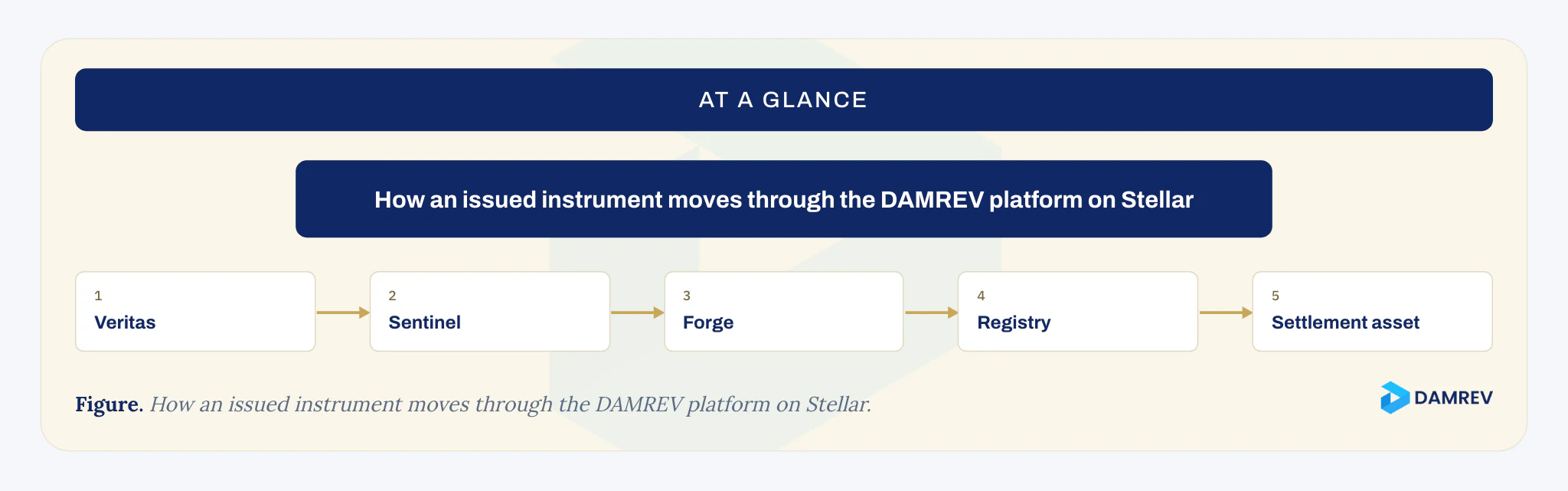
- How an issued instrument moves through the DAMREV platform on Stellar
- Veritas (1)
- Sentinel (2)
- Forge (3)
- Registry (4)
- Settlement asset (5)
- 1Veritas: Holder credentials, after checks by a licensed provider
- 2Sentinel: Transfer rules enforced in contract logic
- 3Forge: Issuance once eligibility clears
- 4Registry: The register of holders, serviced for life
- 5Settlement asset: Chosen per jurisdiction; the group issues none
A precedent is not an endorsement, and nothing here suggests any relationship between Franklin Templeton and DAMREV. What the fund establishes is narrower and more useful: a US-registered fund has kept its official record on this ledger since 20212.
A structured programme on the same network starts with a documented answer to the first question a regulator or auditor asks, which is where the true record lives.
Common questions
What else do people ask?
Short answers to the questions people ask most about this topic.
What is BENJI?
The token of the Franklin OnChain U.S. Government Money Fund, ticker FOBXX, which launched on Stellar in April 20212.
What does system of record mean here?
The fund uses a public blockchain as the official record of its transactions and share ownership, so the ledger is the register rather than a copy of it2.
How quickly is a Stellar transaction final?
At ledger close. Stellar closes a ledger roughly every five seconds, with finality at close1.
Can an issuer control who holds its asset on Stellar?
Yes. Any account can issue an asset natively, and authorisation flags and clawback are available to the issuer1.
When did smart contracts arrive on Stellar?
In February 2024, when Soroban went live on mainnet with Protocol 20, running natively on the same ledger3.
Where should you go next?
The pages below pick up where this one ends. Start with the one closest to where your asset or programme stands today.
- Settlement Finality on a Blockchain: Why a Register Cannot Be Probably TrueA register can record a transfer only once it is final. Probabilistic finality never gets there outright, and technical finality is not legal finality.
- Which Record Controls Ownership of a Tokenized Security?The record that controls a tokenized security is the one the law and documents make official, and in the United States it may be off-chain.
- Settlement & LiquidityHow value settles in the asset each jurisdiction permits: fiat through a licensed provider, swaps without custody, and sales behind an eligibility gate.
- Technical ArchitectureThe engineer's view: five architecture layers on Stellar, Soroban contract logic in Rust, twenty engines, and every named integration and standard.
References
- 1.Chainstack, "What is Stellar". https://chainstack.com/what-is-stellar/ Also: Stellar developer documentation, "Control access to an asset", https://developers.stellar.org/docs/tokens/control-asset-access
- 2.Stellar Development Foundation, Franklin Templeton case study. https://stellar.org/case-studies/franklin-templeton
- 3.Stellar Development Foundation, "Protocol 20 and smart contracts are live on Mainnet". https://stellar.org/blog/developers/protocol-20-and-smart-contracts-are-live-on-mainnet
- 4.PYMNTS, "Tokenized real-world asset value jumps fourfold to $26 billion", reporting RWA.xyz data. https://www.pymnts.com/blockchain/2026/tokenized-real-world-asset-value-jumps-fourfold-to-26-billion/ Also: RWA.xyz, live data, https://app.rwa.xyz/
- 5.Ledger Insights, "BCG, Ripple predict tokenization to reach $18.9 trillion by 2033". https://www.ledgerinsights.com/bcg-ripple-predict-tokenization-to-reach-18-9-trillion-by-2033/
- 6.RWA.xyz data, as reported by PYMNTS, "Tokenized real-world asset value jumps fourfold to $26 billion". https://www.pymnts.com/blockchain/2026/tokenized-real-world-asset-value-jumps-fourfold-to-26-billion/
This article is analysis of public sources, not legal advice. Last updated: