


Article · Market Infrastructure & Settlement
Which Record Controls Ownership of a Tokenized Security?
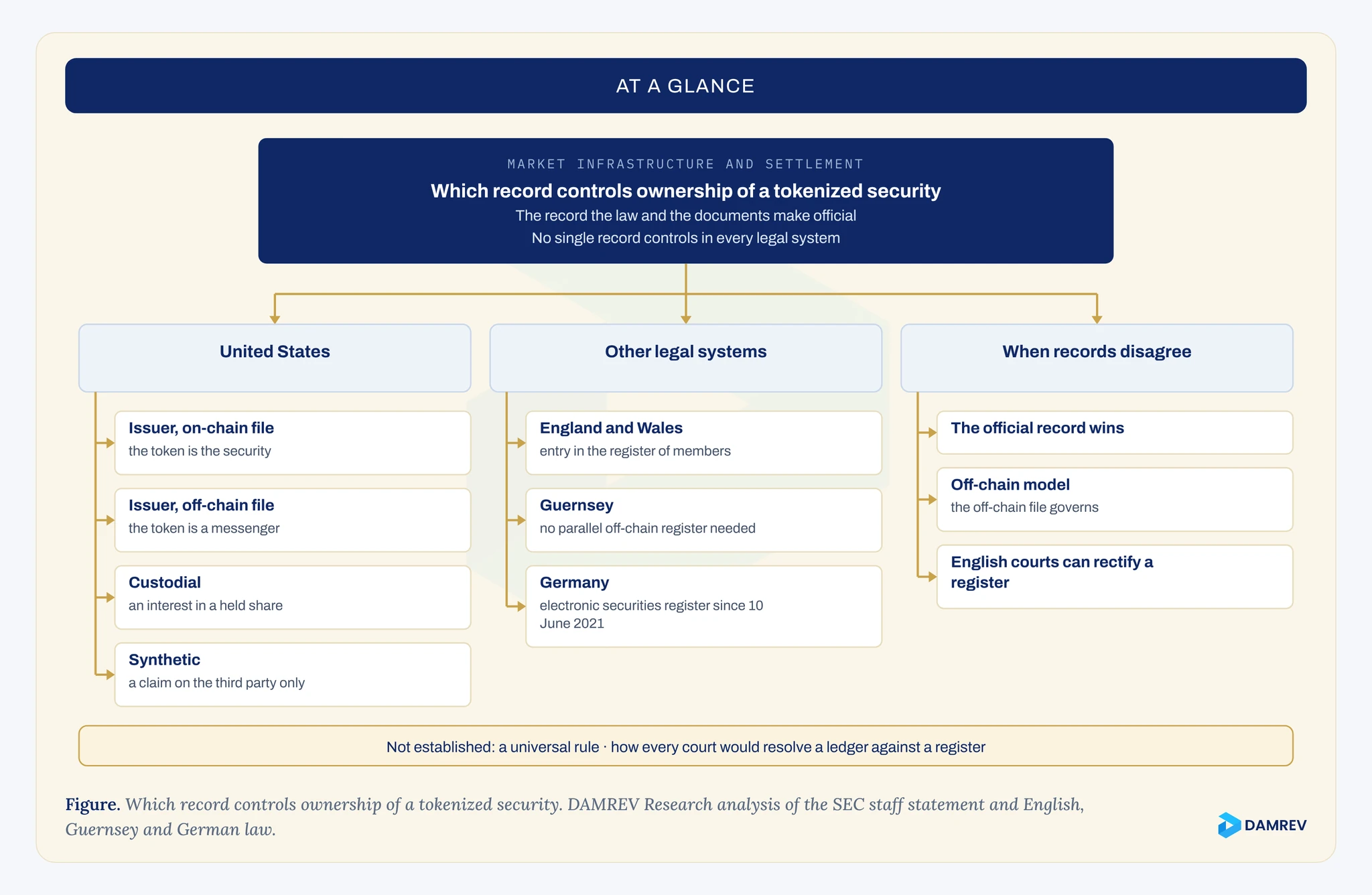
For a tokenized security, the register that controls is the one the governing law and the instrument's own documents make official: in the United States that is the master securityholder file, which an issuer may keep on a ledger or off it; if it is kept off-chain, the token is a messenger and the off-chain file decides1, 2.
Other legal systems answer differently, so no single record controls in every case4, 6, 7.


In this article
01 · Three records
Which records could claim to show who owns a tokenized security?
A tokenized security has up to three ownership records: the issuer's own register, the record a transfer agent keeps for the issuer, and the token ledger itself. Which one controls depends on how the instrument is built and which law governs it1, 2.
A conventional security already has a chain of records. The issuer, or a transfer agent acting for it, keeps the register of holders. Brokers and custodians keep their own books of what their clients hold through them. Disputes are settled by asking which record the law treats as the official one, and the answer is usually the issuer's register.
Tokenization adds a third candidate. A token ledger shows which wallet holds which token at every moment, publicly and without a gap. That makes it tempting to treat the ledger as the truth.
Sometimes it is. Sometimes the token is a convenience that reports to a register kept elsewhere, and sometimes the token gives no ownership of the security at all.
The question matters most when something goes wrong: a compromised wallet, a court order, a death, or a token and register showing different names.
02 · The United States
Which record controls in the United States?
In the US, the master securityholder file controls. The SEC staff describe issuers that keep it on a ledger, so the token transfer is the register entry, and issuers that keep it off-chain, so the token only prompts an update1, 2.
The SEC staff statement of 28 January 2026 sets out the models in plain terms.
In the first issuer-sponsored model, the issuer or its agent "integrates DLT into the systems that it uses to record owners of the security", so that a transfer of the token is a transfer on the master securityholder file1. The ledger is the official record, sometimes alongside off-chain records.
In the second issuer-sponsored model, the security is issued off-chain and holders also receive a crypto asset. Here the staff are explicit that "the crypto asset does not convey any rights, obligations, or benefits of the security"1. The off-chain file is the register, and the token is a way of telling the issuer to update it.
Third-party tokens sit further away. A custodial token evidences an ownership interest, direct or indirect, in a security held in custody, and may or may not give any claim on the issuer1. A synthetic token gives exposure without ownership: a security-based swap "does not convey to the holder any equity, voting, information, or other rights"1.
| Model | Where the official record sits | What the token holder has | Source |
|---|---|---|---|
| Issuer-sponsored, on-chain file | On one or more crypto networks, possibly with off-chain records | The security itself | Statement1 |
| Issuer-sponsored, off-chain file | Off-chain; the token updates it | The security, recorded off-chain; the token conveys no rights of the security | Statement1 |
| Third-party, custodial | The issuer's register shows the custodian's holding | An interest, direct or indirect, in a share held in custody | Statement1 |
| Third-party, synthetic | Not applicable; no interest in the share | A claim on the third party only | Statement1 |
State corporate law sets the floor beneath the federal record. Delaware defines a corporation's stock ledger as the records "administered by or on behalf of the corporation" of its stockholders, issuances, and transfers, and makes it "the only evidence" of who may vote at a meeting3.
Since 2017 those records may be kept on distributed electronic networks or databases, provided they can be converted into legible paper form, can be used to prepare the stockholder lists the statute requires, record the information it specifies, and record transfers as Article 8 of the Uniform Commercial Code governs3.
03 · Other legal systems
Does the answer change under other legal systems?
Outside the US, some laws let the ledger be the register outright, some still require a statutory register beside it, and one makes entry in a licensed electronic register the act that creates the security4, 5, 6, 7.
A holder of a token over an English share, one over a Guernsey fund unit, and one over a German bond may see identical wallets and hold different things in law.
England and Wales
A person who agrees to become a member becomes one when entered in the register of members, which is prima facie evidence of what it records4. The UK Jurisdiction Taskforce found on-chain transfer of digital equity possible "even if a fully decentralised blockchain cannot currently be used as a register of members"5.
Guernsey
The register may be kept on public or private distributed ledger technology (DLT), and where records are natively issued on a blockchain the guidance says "a parallel off-chain register is not required"6.
Germany
Since 10 June 2021, securities can be issued by entry in an electronic securities register without a certificate, and keeping a crypto securities register is a licensed financial service7.
Each answer rests on the corporate or securities law of the place, not on the technology. The Guernsey position comes from company and partnership laws that already allowed electronic registers capable of being printed6.
The German position comes from a statute written for the purpose, which makes the register entry itself the act of issue7. English law reaches its position through a register defined by the Companies Act, which the Taskforce read as not yet satisfied by a fully decentralised chain4, 5.
For an issuer, the structuring decision comes first: the vehicle and governing law decide which record controls.
04 · When records disagree
What happens when the records disagree?
When records disagree, the official record wins, and it can be corrected. Under an off-chain model the off-chain file governs and the token is evidence for updating it; English law lets a court rectify a register that is wrong1, 4.
The SEC staff statement does not set out a procedure for a divergence between on-chain and off-chain records. It does say which record governs in the off-chain model.
Because the offchain database records constitute the master securityholder file, the issuer (or its agent) will use the onchain database records to update the offchain database records to record the transfer of ownership of the security.1
Information flows from the token to the file, and the file is authoritative1. It follows, on our reading rather than in any words of the statement, that a token movement the issuer's rules do not permit changes nothing until the file records it.
Where the ledger is itself the official record, a divergence of that kind cannot arise, because there is only one record. The risk moves instead to the ledger entry being wrong: a transfer made by someone who should not have made it.
In England, a person whose name is wrongly entered in or left off a register of members, or the company itself, may apply to the court to rectify the register4. The register is evidence of membership, not proof beyond challenge4.
For holders, the practical test is to ask three questions of any tokenized security. Which record is official? Who may correct it? And does the token ledger update the register, or is it the register?

05 · What it does not establish
What do the sources not establish?
As of 7 October 2026, the SEC staff and UK Jurisdiction Taskforce statements read here do not establish a universal rule or how a court would resolve a conflict between a ledger and a register in every jurisdiction, and the SEC staff statement is not a Commission rule1, 5.
| Question | What the sources say | Source |
|---|---|---|
| Is there one rule for every tokenized security? | No. Each answer comes from the governing corporate or securities law | All sources |
| Is the SEC staff statement binding? | It reflects staff views, is not a Commission rule, and creates no new obligations | Statement1 |
| How is an on-chain and off-chain divergence resolved? | Not addressed, beyond the off-chain file governing in that model | Statement1 |
| Can a fully decentralised chain be an English register of members? | Not currently, in the Taskforce's view, which is not a court ruling | Taskforce5 |
| What does a custodial token holder own? | An interest, direct or indirect; its nature depends on the custody terms | Statement1 |
The SEC statement also assumes that the token created to represent a security is not itself a separate security1. That assumption carries weight in the custodial and synthetic models, where the token may be a security of its own issued by someone other than the company.
The Taskforce's view is a statement of English private law by a respected body. It carries persuasive weight, but it is not a judgment, and it was written about one legal system5.
Nor do the sources separate record ownership from beneficial ownership. A register can show a custodian or nominee as the holder while the investor's interest sits in that intermediary's books, and identifying the official register answers only the first of those questions.
Nor do the sources tell any reader what they hold. That is a question for the issuer's documents and the reader's own adviser.
Common questions
What else do people ask?
Short answers to the questions people ask most about this topic.
What is a master securityholder file?
The official list of individual securityholder accounts, as SEC Rule 17Ad-9 defines it. It is the record a US issuer or its transfer agent keeps of who holds its securities2.
Can a blockchain be the official register of a US company's shares?
It can hold the official record. The SEC staff describe issuers that keep the master securityholder file on one or more crypto networks1, and Delaware law allows a corporation's stock ledger to be kept on distributed electronic networks or databases if it meets the statute's conditions3.
If I hold a third-party token over a share, do I own the share?
Not necessarily. In the custodial model the token evidences an interest, direct or indirect, in a share held in custody; in the synthetic model the holder has no rights in the share at all and is exposed to the third party1.
Does an English company's register of members have to be off-chain?
The UK Jurisdiction Taskforce concluded that on-chain transfer of digital equity is possible even though a fully decentralised blockchain cannot currently be used as a register of members5. The statutory register remains the evidence of membership4.
Where should you go next?
The pages below pick up where this one ends. Start with the one closest to where your asset or programme stands today.
- Settlement Finality on a Blockchain: Why a Register Cannot Be Probably TrueA register can record a transfer only once it is final. Probabilistic finality never gets there outright, and technical finality is not legal finality.
- Why the First US-Registered Tokenized Money Market Fund Runs on StellarThe first US-registered money market fund with a public blockchain as its official record runs on Stellar: finality at ledger close, and issuer controls.
- Does Tokenizing a Security Change Whether It Is a Security?In the United States, the European Union, Guernsey, and Jersey, tokenizing a security does not change whether it is one, only which one is held.
- The Securities RegisterHow Registry keeps the register of holders from issuance onwards, performs the transfer-agent function as software, and handles corporate actions.
References
- 1.SEC Divisions of Corporation Finance, Investment Management, and Trading and Markets, "Statement on Tokenized Securities", 28 January 2026. https://www.sec.gov/newsroom/speeches-statements/corp-fin-statement-tokenized-securities-012826
- 2.17 CFR 240.17Ad-9, definitions for transfer agent recordkeeping, paragraph (b), "master securityholder file". https://www.ecfr.gov/current/title-17/section-240.17Ad-9
- 3.Delaware General Corporation Law, Title 8, Sections 219 and 224. https://delcode.delaware.gov/title8/c001/sc07/index.html
- 4.Companies Act 2006 (United Kingdom), Sections 112, 125 and 127. https://www.legislation.gov.uk/ukpga/2006/46/section/127
- 5.UK Jurisdiction Taskforce, "Legal statement on the issuance and transfer of digital securities under English private law", February 2023. https://lawtechuk.io/ukjt/legal-statement-on-digital-securities/
- 6.Guernsey Financial Services Commission, Guidance Note on the Tokenisation of Investments and Other Assets in the Bailiwick of Guernsey, July 2026. https://www.gfsc.gg/sites/default/files/media/helix-file/Guidance%20-%20Tokenisation%20of%20Investments%20%28July%202026%29.pdf
- 7.Federal Financial Supervisory Authority (BaFin), "Crypto securities registry management", on the Electronic Securities Act (eWpG) in force from 10 June 2021, read 7 October 2026. https://bafin.de/EN/Aufsicht/FinTech/Geschaeftsmodelle/DLT_Blockchain_Krypto/Kryptowertpapierregisterfuehrung/Wertapierregister_node_en.html
This article is analysis of public sources, not legal advice. Last updated:




