


Article · Market Infrastructure & Settlement
Privacy & the Blockchain Securities Register: GDPR & POPIA
The European Union's and South Africa's data protection laws both let a register use a ledger, but neither relaxes for it: the register must collect no more than it needs, correct what is wrong, and answer to an accountable controller1, 3, 5.
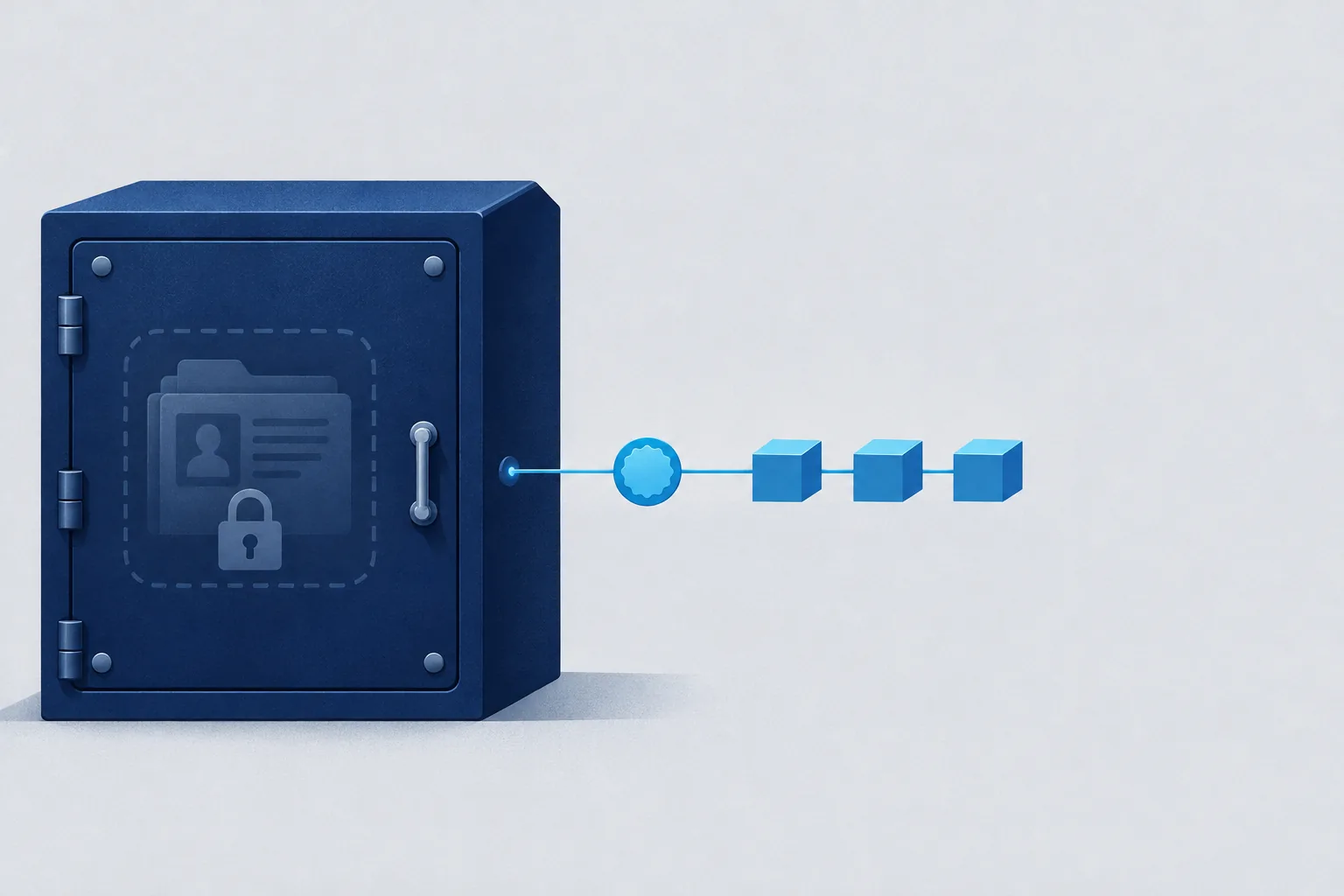
The European Data Protection Board advises against storing personal data on a blockchain at all, and warns that hashes can still be personal data1; the workable pattern keeps identity off the ledger with a licensed provider and puts only a proof of eligibility on it1, 5.

In this article
01 · The tension
What do data protection laws ask of an on-chain register?
Privacy law asks the same of an on-chain register as of any register: collect only what is needed, keep it accurate, correct or delete it when the law requires, and name who is responsible. A ledger changes how hard those duties are, not whether they apply1, 2, 3.
A securities register is a list of people and what they own. That makes it personal data under the European Union's General Data Protection Regulation (GDPR) and personal information under South Africa's Protection of Personal Information Act (POPIA). Neither law has an exception for registers kept on a distributed ledger.
Ledgers are built to do the opposite of what privacy law asks: a public ledger is copied to every node, readable by anyone, and cannot be changed. The European Data Protection Board (EDPB), which issues guidance on the GDPR, finalised its guidelines on blockchain in July 20264.
They state that controllers "must ensure the application of the principles of data minimisation and storage limitation, and the effective exercise of data subjects' rights like erasure and rectification"1.
POPIA is close to the GDPR in structure but differs in one respect that matters for funds. Its definition of personal information covers "an identifiable, living, natural person" and, where applicable, "an identifiable, existing juristic person"3.
A South African register of corporate and trust holders is therefore within the Act in a way a European Union register of companies would not be.

02 · What counts as personal data
What counts as personal data on a ledger?
Personal data on a ledger covers more than names: a wallet address, a hash, or any other value that can be linked back to a person may be personal data, because replacing an identifier does not make data anonymous if the link can be rebuilt1, 2.
The obvious approach to an on-chain register is to leave names off and record only addresses or hashes. The GDPR treats that as pseudonymisation, not anonymisation, and pseudonymised data remains personal data2.
The EDPB applies the point directly: data that replaces identifiers "may still constitute personal data", and where a hash can be linked to a person, "the hash will also be considered personal data"1.
A register cannot easily avoid that link, because its whole purpose is to connect each holding to a person who can be paid, can vote, and can be traced for anti-money laundering checks. Someone, usually the issuer, its administrator, or its transfer agent, will always hold the key that turns an address into a name.
| Data on or about the register | GDPR view | POPIA view | Source |
|---|---|---|---|
| Holder's name and address in plain text on-chain | Personal data; plain-text storage on-chain is strongly discouraged | Personal information | EDPB1; POPIA3 |
| Wallet address linked to a known holder | Personal data where the link can be made | Personal information where it can be linked by a reasonably foreseeable method | GDPR2; POPIA3 |
| Hash of a holder's identity data | Personal data where it can be linked to the person | Not de-identified while relinking remains foreseeable | EDPB1; POPIA3 |
| Corporate holder's details | Outside the GDPR unless they identify a natural person | Personal information of a juristic person | GDPR2; POPIA3 |
The EDPB's practical conclusion is blunt: "In general, it is not advisable to store personal data on the blockchain, and it should not be stored in the content of transactions"1.
03 · Eligibility without identity
How can eligibility be proven without publishing identity?
A register proves eligibility by keeping identity off the ledger with a licensed provider, and putting on the ledger only what a transfer needs: confirmation that the receiving account belongs to someone who has passed the checks1, 5.
A regulated security cannot move to just anyone, so the receiving holder must be checked before a transfer settles. That does not require the ledger to know who the holder is.
The pattern that fits both data protection law and transfer rules separates two questions. Who is this person? That stays with an identity provider licensed to verify it, in its own records, under its own data protection duties.
Is this account allowed to hold the asset? That is the only fact the ledger needs, and it can be expressed as an authorisation rather than as personal data. On Stellar, for example, an issuer can require that "an issuer must approve an account before that account can hold its asset"5.
Proving eligibility at transfer without putting identity on the ledger

- How can eligibility be proven without publishing identity?
- Step 1: Checks off-chain: A licensed provider verifies the investor and keeps the identity records in its own systems
- Step 2: Account approved: The issuer or its agent authorises the investor's account to hold the asset ([5])
- Step 3: Transfer tested: Before a transfer settles, the receiving account's authorisation is checked
- Step 4: Register kept: The register holder can map accounts to people; the public ledger shows only accounts
The approach reduces what is published. It does not remove the register's privacy duties, because the mapping from account to person still exists and is still personal data1. It moves those duties to the place where they can be met: an off-chain record that can be corrected and, where the law allows, deleted.
04 · The register's own duties
What duties does the register keep regardless of the ledger?
Three duties survive any ledger: the company-law duty to keep the register, the data protection duty to correct it, and the duty to assess the risk first. Technical design cannot be used to excuse a failure to meet any of them1, 2, 6.
Two legal regimes pull on the same record. Company law requires a company to keep a register of its securities: South Africa's Companies Act requires every company to "establish or cause to be established a register of its issued securities in the prescribed form"6.
Data protection law then governs how that register is kept, and each regime has its own rule for where the two meet. Under the GDPR, the right to erasure gives way to processing that is necessary "for compliance with a legal obligation which requires processing by Union or Member State law"2.
That exception is engaged by EU or member state law, so a South African register duty does not trigger it. POPIA has its own rule: personal information may be kept longer than its purpose requires where "retention of the record is required or authorised by law"3.
That exception does not reach correction. A holder whose details are wrong can ask for them to be fixed under both laws2, 3.
POPIA allows a data subject to ask a responsible party to correct or delete information that is "inaccurate, irrelevant, excessive, out of date, incomplete, misleading or obtained unlawfully"3. If personal data has been written into an immutable ledger, the responsible party cannot correct it there.
The EDPB emphasises that technical impossibility cannot be invoked to justify non-compliance with GDPR requirements.1
The guidelines turn that principle into three working rules.
Assess first
Where processing is likely to result in a high risk, a data protection impact assessment is mandatory, and it should ask whether a blockchain is needed at all1.
Favour permissioned designs
Organisations should favour permissioned blockchains, and document why if they choose otherwise1.
Name the controller
Nodes may or may not be controllers depending on the design; for public chains the EDPB encourages a consortium or other legal entity among the nodes1.
For an issuer, the order of work follows: decide what company law requires the register to hold, what the ledger needs to enforce transfers, and keep the difference off-chain.

05 · What it does not establish
What do the sources not establish?
As of 7 October 2026, the EDPB guidelines and POPIA read here do not establish that any particular register design complies or settle every question of who is a controller on a public chain, and we found no blockchain-specific guidance from South Africa's Information Regulator1, 3.
| Question | What the sources say | Source |
|---|---|---|
| Is a given on-chain register compliant? | Not addressed; compliance is assessed case by case, starting with an impact assessment | EDPB1 |
| Are the EDPB guidelines binding? | They are the Board's guidance on applying the GDPR, not legislation | EDPB1, 4 |
| Who is the controller on a public permissionless chain? | Unclear; the EDPB encourages nodes to form a legal entity | EDPB1 |
| Has South Africa's regulator issued blockchain guidance? | We found none as of 7 October 2026; POPIA applies as written | POPIA3 |
| Can personal data on an immutable ledger be erased? | Actual deletion may be technically impracticable, which does not excuse non-compliance | EDPB1 |
The EDPB acknowledges that "it might be technically impracticable to grant the request for actual deletion" on some ledgers1. The guidelines expect the design to avoid the problem rather than explain it afterwards.
POPIA's coverage of juristic persons is the point most likely to surprise readers used to the GDPR. A South African fund whose register holds only companies and trusts still processes personal information, and its responsible party carries the Act's duties for each of them3.
Common questions
What else do people ask?
Short answers to the questions people ask most about this topic.
Is a wallet address personal data?
It can be. Under the GDPR, data that replaces an identifier may still be personal data if it can be linked back to a person, and the EDPB says a hash will also be considered personal data in that case1, 2.
Does POPIA protect companies as well as individuals?
Yes. POPIA's definition of personal information covers an identifiable, living, natural person and, where applicable, an identifiable, existing juristic person3. A register of corporate holders in South Africa is still within the Act.
Can a holder demand erasure from a securities register?
Under the GDPR, the right to erasure does not apply where processing is necessary for compliance with a legal obligation under Union or member state law to which the controller is subject2. In South Africa, POPIA allows a record to be retained where retention is required or authorised by law3.
South Africa's Companies Act requires a register of securities6. Each case turns on the law that requires the record.
Does the EDPB forbid public blockchains?
No. It says organisations should favour permissioned blockchains, and use alternatives only where that choice is well justified and documented1.
Must a tokenized register carry out a data protection impact assessment?
Where processing is likely to result in a high risk, the EDPB says a data protection impact assessment is mandatory, and that it should address whether a blockchain is necessary at all1.
Where should you go next?
The pages below pick up where this one ends. Start with the one closest to where your asset or programme stands today.
- Which Record Controls Ownership of a Tokenized Security?The record that controls a tokenized security is the one the law and documents make official, and in the United States it may be off-chain.
- Public or Permissioned Blockchains for Regulated SecuritiesOn any ledger an issuer can restrict who holds its security. Only a permissioned one lets an identifiable operator control who validates and reads it.
- Identity & EligibilityHow a holder is verified once by a licensed provider, receives a reusable credential from Veritas, and is checked at every transfer.
- The Securities RegisterHow Registry keeps the register of holders from issuance onwards, performs the transfer-agent function as software, and handles corporate actions.
References
- 1.European Data Protection Board, Guidelines 02/2025 on processing of personal data through blockchain technologies, version 2.0, adopted 7 July 2026, paragraphs 9, 27, 35, 40, 42 to 44, 48, 50, 52, 91, 98 and 103. https://www.edpb.europa.eu/system/files/2026-07/edpb_guidelines_202502_blockchain_v2_en.pdf
- 2.Regulation (EU) 2016/679 (General Data Protection Regulation), Articles 4, 5, 16, 17 and 25, and Recital 26. https://eur-lex.europa.eu/legal-content/EN/TXT/?uri=CELEX:32016R0679
- 3.Protection of Personal Information Act 4 of 2013 (South Africa), Sections 1, 10, 14 and 24. https://www.gov.za/sites/default/files/gcis_document/201409/3706726-11act4of2013popi.pdf
- 4.European Data Protection Board, "EDPB sheds light on anonymisation and web scraping for generative AI and adopts final version of guidelines on blockchain", 8 July 2026. https://www.edpb.europa.eu/news/edpb-sheds-light-on-anonymisation-and-web-scraping-for-generative-ai-and-adopts-final-version_en
- 5.Stellar developer documentation, "Control access to an asset", read 7 October 2026. https://developers.stellar.org/docs/tokens/control-asset-access
- 6.Companies Act 71 of 2008 (South Africa), Section 50, securities register and numbering. https://www.acts.co.za/companies-act-2008/50_securities_register_and_numbering
This article is analysis of public sources, not legal advice. Last updated:




