


Article · Market Infrastructure & Settlement
Public or Permissioned Blockchains for Regulated Securities
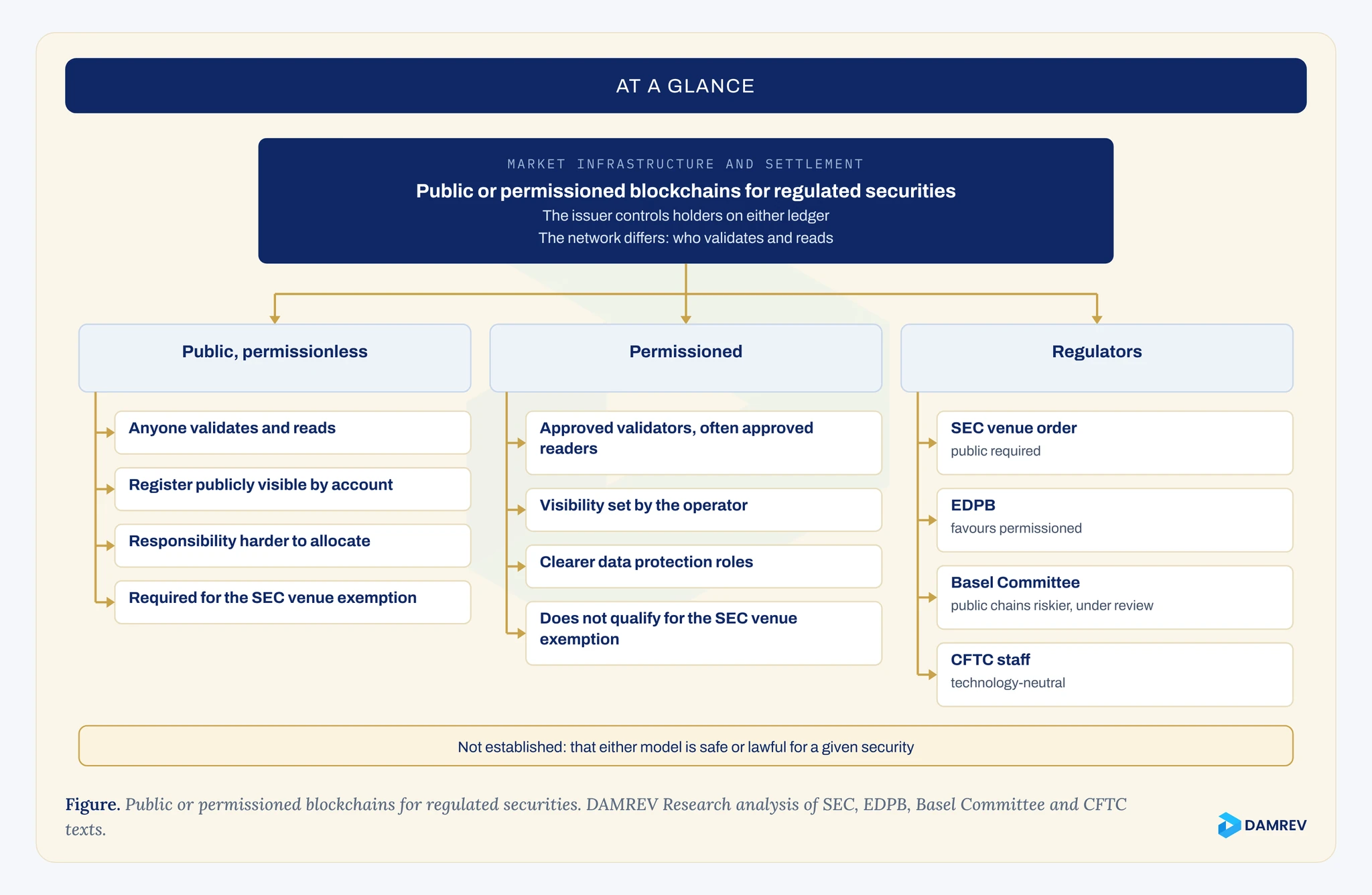
The choice between a public and a permissioned blockchain changes who controls the network, not whether the issuer controls its security: on either kind of ledger an issuer can restrict who holds its instrument, but only on a permissioned ledger does an identifiable operator also control who validates and reads it1, 4.
Regulators point in different directions: the venue exemption of the US Securities and Exchange Commission (SEC) requires a public, permissionless ledger, while the European Union's data protection board favours permissioned ones and the bank capital standard-setter has treated public chains as riskier2, 3, 4.


In this article
01 · The difference
What separates a public ledger from a permissioned one?
A public ledger and a permissioned one differ in who may run the network and who may see it: anyone can validate and read a public, permissionless ledger. A permissioned ledger admits only approved validators, and often only approved readers, under an operator's rules2, 4.
The words get used loosely, so it helps to separate two questions. The first is who may take part in maintaining the ledger: anyone, or only approved operators. The second is who may hold and transfer a particular asset on it. The first is a property of the network. The second is a property of the instrument.
A public, permissionless ledger answers the first question with "anyone". Validators are independent of each other and of the issuer, the full history is visible, and no single party can change the rules alone.
A permissioned ledger answers it with a list. An operator, or a consortium, decides who validates and often who can read, and is accountable for doing so.
Between the two sit hybrid arrangements, and the SEC's venue exemption describes one. It requires the contracts to run on a public network while admitting only approved participants to trade2. Open infrastructure with a closed membership is a recognisable design in its own right, not a compromise between the other two.
The second question can be answered "approved holders only" on either kind of network. It is the question that matters most for a regulated security.
02 · For the issuer and the register
What changes for the issuer and the register?
The choice of ledger changes less than the labels suggest for the issuer, and more for the register. An issuer can restrict holders on either kind of ledger; what changes is who can see the register and who stands behind the network1, 4.
An issuer's core need is control over its instrument: who may hold it, who may receive it, and how a holding can be frozen or corrected where the rules require. Public ledgers can provide that at the level of the asset.
On Stellar, an issuer can require that "an issuer must approve an account before that account can hold its asset", and, where it has also set a separate revocable flag, can revoke that authorisation to freeze a holding1. Setting the approval flag alone does not give the power to freeze.
The fund on Stellar that this site has written about keeps its official record of share ownership in a blockchain-integrated system that uses public networks, with Stellar as the primary one7, 9.
The register is where the difference shows. On a public ledger, every holding and every transfer is visible to anyone, even if the names behind the accounts are not. On a permissioned ledger, the operator can limit who reads it. That bears directly on data protection, confidentiality between investors, and what competitors can learn from the flow of units.
| Party | Public, permissionless ledger | Permissioned ledger | Source |
|---|---|---|---|
| Issuer | Controls holders through asset-level authorisation and contract rules | Controls holders through the same tools, plus network membership | Stellar1 |
| Register | Every holding and transfer publicly visible by account | Visibility limited to those the operator admits | European Data Protection Board (EDPB)4 |
| Data protection | Responsibility harder to allocate among independent nodes | Clearer allocation of responsibilities | EDPB4 |
| Network risk | Depends on independent third-party validators | Depends on the operator or consortium | Basel Committee3 |
| Venue eligibility under the SEC order | Required for a tokenized securities venue | Does not qualify for that exemption | SEC order2 |
03 · What regulators have said
What have regulators said?
Regulators have said different things, for different reasons: the SEC's venue exemption requires a public, permissionless ledger; the EDPB favours permissioned ones for data protection; and the Basel Committee has treated permissionless chains as carrying risks it could not yet mitigate2, 3, 4.
The SEC order of 17 September 2026 is the clearest case for public ledgers. A tokenized securities venue's smart contracts must be "auditable, public, and deployed on a public, permissionless distributed ledger"2.
The same order requires that only permissioned participants trade2. The SEC wants an open network with known users: transparency of code and history, combined with control over who takes part.
Data protection pulls the other way. The EDPB says organisations "should favour permissioned blockchains", because they allow a clearer allocation of responsibilities, and should use alternatives only when the choice is well justified and documented4.
Bank capital rules add a third view.
The Committee has completed this review and concluded that the use of permissionless blockchains gives rise to a number of unique risks, some of which cannot be sufficiently mitigated at present.3
The Committee named the reliance on third parties for basic operations, and risks around settlement finality, privacy, and liquidity, among others3. It proposed no change to let cryptoassets on permissionless chains into its most favourable group. That was the position in December 2023. On 1 October 2026 the Committee said it is reviewing targeted elements of the standard5.
The derivatives regulator's staff take a fourth position: neutrality. The collateral guidance of the US Commodity Futures Trading Commission (CFTC) says none of its regulations require any particular technology or operational infrastructure for holding eligible collateral6.
04 · Governance
Who governs the network, and why does it matter?
Network governance matters because whoever governs the network decides how it changes. On a permissioned ledger that is an accountable operator; on a public ledger it is a dispersed set of validators the issuer does not control3, 4.
A register has to outlast software upgrades, operator changes, and disputes. Each ledger handles those differently. On a permissioned ledger, the operator decides on upgrades, admits and removes validators, and can be held to account by contract and, where it is regulated, by its supervisor. That is the "clearer allocation of responsibilities" the EDPB refers to4.
On a public ledger, upgrades require broad agreement among independent validators, and no single party can impose a change. That protects the register against unilateral interference by any operator, including the issuer's own service providers. It also means the issuer depends on parties it has no contract with, which is the reliance on third parties the Basel Committee identified3.
The hardest case on a public ledger is a split in the network itself, where validators disagree and two versions of the chain continue. An issuer cannot prevent that, but it can decide in advance how it will respond.
Circle's terms for USDC, for example, warn that a fork of a supported blockchain could cause downtime and reserve to Circle the decision about which fork, if any, it will support8.
An issuer of a tokenized security can write the same kind of rule into its own documents, so holders know which version of the ledger the register will follow.
For a holder, the practical question is not which model is better in the abstract. It is who can change the rules under which their holding is recorded, and what recourse they have if that happens. The issuer's documents should answer it either way.

05 · What it does not establish
What do the sources not establish?
As of 7 October 2026, the SEC order, the Basel Committee documents and the EDPB guidelines read here do not establish that either model is safe or lawful for a given security; the Basel position is under review, and the SEC's requirement applies to one exemption, not to tokenized securities generally2, 3, 5.
| Question | What the sources say | Source |
|---|---|---|
| Must a tokenized security sit on a public ledger in the US? | No. The requirement applies to venues relying on the SEC exemption | SEC order2 |
| Is the Basel position final? | Proposed in December 2023; on 1 October 2026 the Committee said it is reviewing targeted elements | Basel Committee3, 5 |
| Do permissioned ledgers satisfy the General Data Protection Regulation (GDPR)? | Not by themselves; the EDPB favours them but compliance is assessed case by case | EDPB4 |
| Does the CFTC prefer either? | No. Its staff guidance is technology-neutral | CFTC6 |
| Which ledger should a given issuer choose? | Not addressed by any of these sources | None |
The positions are less contradictory than they look, because each regulator is answering its own question. The SEC wants trading on transparent, auditable infrastructure. The EDPB wants a responsible party for personal data. The Basel Committee wants banks capitalised against operational risks it cannot yet measure. An issuer can face all three at once.
None of the sources compares named networks, and this article does not either. Choosing a ledger for a particular instrument depends on its investors, its jurisdictions, its venues, and its data, and that decision belongs to the issuer and its counsel.
Common questions
What else do people ask?
Short answers to the questions people ask most about this topic.
Can an issuer control who holds its security on a public blockchain?
Yes, through controls on the asset rather than on the network. On Stellar, for example, an issuer can require that it approve an account before that account can hold its asset, and, if it has also set the revocable flag, can revoke that approval to freeze the holding1.
Does the SEC require a public blockchain?
For the venues its order of 17 September 2026 exempts, yes. A tokenized securities venue's smart contracts must be auditable, public, and deployed on a public, permissionless distributed ledger, while the people trading must be permissioned participants2.
Why does the EU data protection board prefer permissioned blockchains?
Because they allow a clearer allocation of responsibilities. The EDPB says organisations should favour permissioned blockchains and document why if they choose otherwise4.
Are banks penalised for holding assets on public blockchains?
The Basel Committee concluded in December 2023 that permissionless blockchains give rise to unique risks, some not yet mitigable, and proposed no change to let them into its most favourable group. On 1 October 2026 it said it is reviewing targeted elements of the standard3, 5.
Where should you go next?
The pages below pick up where this one ends. Start with the one closest to where your asset or programme stands today.
- Privacy & the Blockchain Securities Register: GDPR & POPIAEuropean and South African data protection laws let a register use a ledger without relaxing. The workable pattern keeps identity off the ledger.
- Settlement Finality on a Blockchain: Why a Register Cannot Be Probably TrueA register can record a transfer only once it is final. Probabilistic finality never gets there outright, and technical finality is not legal finality.
- The SEC's Innovation Exemption of 17 September 2026: What Tokenized Securities Venues & Tokenized NMS Stock May Now DoSince 17 September 2026 a tokenized securities venue may run automated liquidity pools in tokenized listed stock without registering as an exchange, on conditions.
- Issuance & Transfer ControlThe controls on the two moments that define an instrument: gated minting through Forge, scheduled release through Cadence, and on-chain transfer rules.
References
- 1.Stellar developer documentation, "Control access to an asset", read 7 October 2026. https://developers.stellar.org/docs/tokens/control-asset-access
- 2.US Securities and Exchange Commission, Order Granting Exemptions for Tokenized Securities Venues, Exchange Act Release No. 34-106402, 17 September 2026. https://www.sec.gov/files/rules/exorders/2026/34-106402.pdf
- 3.Basel Committee on Banking Supervision, "Cryptoasset standard amendments", consultative document, 14 December 2023. https://www.bis.org/bcbs/publ/d567.pdf
- 4.European Data Protection Board, Guidelines 02/2025 on processing of personal data through blockchain technologies, version 2.0, adopted 7 July 2026, paragraphs 40 and 42 to 44. https://www.edpb.europa.eu/system/files/2026-07/edpb_guidelines_202502_blockchain_v2_en.pdf
- 5.Bank for International Settlements, "Basel Committee meets to advance supervisory and regulatory initiatives and discuss risks and vulnerabilities", 1 October 2026. https://www.bis.org/media-releases/20261001-basel-committee-meets-advance-supervisory-and-regulatory-initiatives-and-discuss-risks-and
- 6.CFTC Market Participants Division, Division of Market Oversight, and Division of Clearing and Risk, "Tokenized Collateral Guidance", CFTC Letter No. 25-39, 8 December 2025. https://www.cftc.gov/csl/25-39/download
- 7.Stellar Development Foundation, Franklin Templeton case study, read 7 October 2026. https://stellar.org/case-studies/franklin-templeton
- 8.Circle, "USDC Terms", last updated 12 December 2025, Section 8. https://www.circle.com/legal/usdc-terms
- 9.Franklin Templeton Trust, Franklin OnChain U.S. Government Money Fund, prospectus dated 1 August 2026 (Form N-1A post-effective amendment), "Use of Blockchain" and "Multi-Chain Support and Network Suitability Framework". https://www.sec.gov/Archives/edgar/data/0001786958/000165558926000970/c485bpos.htm
This article is analysis of public sources, not legal advice. Last updated:




