


Article · Market Infrastructure & Settlement
Tokenized Collateral & Margin
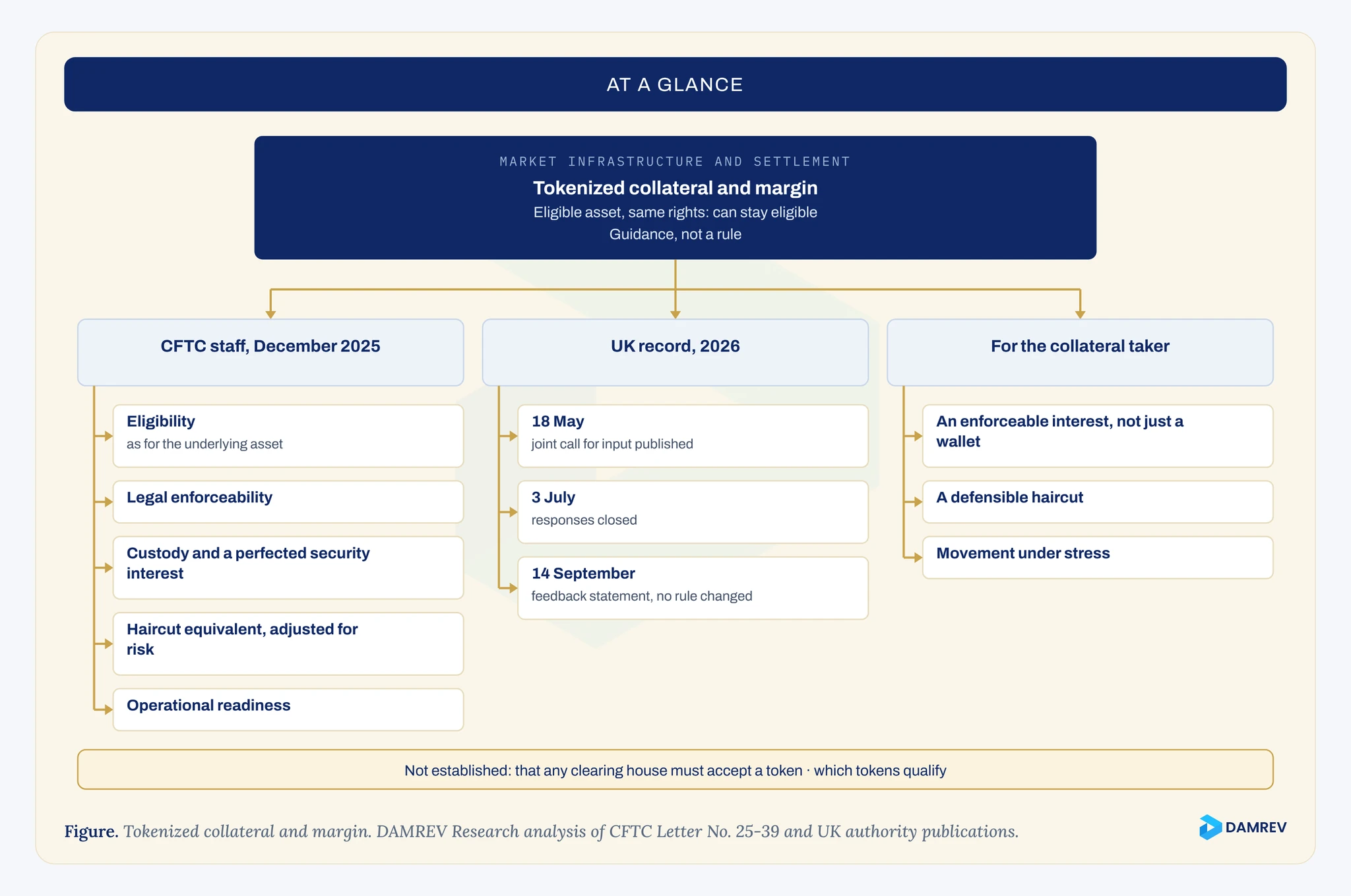
Staff of the US Commodity Futures Trading Commission (CFTC) and the UK authorities take the same starting point on tokenized collateral: a tokenized form of an asset that is already eligible as margin can keep that eligibility, if the token carries the same rights and its added risks are managed1, 3.
Neither creates a new class of collateral, and neither is a rule: the US document is staff guidance and the UK document was a call for input1, 3.


In this article
01 · The question
Can a tokenized Treasury or fund unit be posted as margin?
Tokenized assets can in principle serve as margin where the underlying asset is already eligible. US and UK authorities both start from one idea: treat the token like the asset it represents, if the rights are the same and the added risks are managed1, 3.
Margin is the collateral a party posts to cover its exposure on a derivatives contract. It has to be safe, easy to value, and easy to move, because a clearing house or dealer may need to sell it quickly if the party fails.
That is why regulators keep lists of eligible collateral, set haircuts on each asset, and care where it is held.
Tokenized Treasuries and tokenized money market fund units are attractive candidates because their underlying assets are already on those lists.
The question is not whether a Treasury bill is good collateral. It is whether a token representing one carries the same legal claim, can be held and moved with the same certainty, and can be sold as fast when it matters.
Two documents now frame that question for professionals. In December 2025, three divisions of the US Commodity Futures Trading Commission issued staff guidance on tokenized collateral1. In May 2026, the UK's Financial Conduct Authority (FCA) and the Bank of England published a joint vision for tokenization in wholesale markets, with collateral among its subjects3, 4.
02 · The United States
What does the CFTC guidance say?
CFTC guidance says technology does not change eligibility. An asset already eligible as margin stays eligible in tokenized form if it meets the existing requirements, and firms should assess legal, custody, valuation, and operational risks before accepting it1.
The guidance, CFTC Letter No. 25-39, was issued on 8 December 2025 by the Market Participants Division, the Division of Market Oversight, and the Division of Clearing and Risk1. It starts from technology neutrality.
As commenters and the GMAC have noted, none of the Commission's regulations require any particular technology or operational infrastructure that a registered entity or registrant must employ to transfer or hold assets as eligible collateral.1
From there it says assets "retain their margin eligibility so long as they satisfy applicable regulatory requirements"1. The guidance concentrates on assets already eligible as regulatory margin, where the underlying is liquid and haircuts are established1. It sets out what clearing houses, futures commission merchants, and swap dealers should consider before accepting a token.
The guidance does not list approved tokens or ledgers. It lists questions a firm must be able to answer about any token it accepts, under its existing rules.
| Consideration | What the guidance expects | Source |
|---|---|---|
| Eligibility | Standards for liquidity, maturity, and credit quality, as for the underlying asset | Letter 25-391 |
| Legal enforceability | Clear legal status and documentation; a clearing house needs a well-founded, transparent, and enforceable legal framework, including settlement finality | Letter 25-391 |
| Custody and control | A perfected security interest in the token, held under segregation and eligible custodian requirements | Letter 25-391 |
| Haircuts | An equivalent haircut to the traditional form, adjusted for settlement-time and other risk differences | Letter 25-391 |
| Operational risk | Readiness on cybersecurity, access and authorisation, and threats across the network | Letter 25-391 |
The same day, the Market Participants Division issued a separate no-action letter, No. 25-402. It is often reported alongside the guidance and is a different thing.
It lets futures commission merchants accept non-securities digital assets, including payment stablecoins, as margin, under conditions that include, for the first three months after a futures commission merchant begins relying on it, a limit to payment stablecoins, bitcoin, and ether, and a notice the merchant must file with the Division before it relies on the letter2, 5.
On 6 February 2026 the Division reissued it as CFTC Letter No. 26-05, with all conditions unchanged except a limited revision to its definition of payment stablecoin, so that a national trust bank may count as a permitted issuer5. Tokenized Treasuries and fund units are securities and sit under the guidance, not the pilot.
03 · The United Kingdom
What have the UK authorities said?
UK authorities say tokenized versions of assets already acceptable as regulatory collateral should, as a policy preference, qualify where the risks are mitigated. The approach is phased, and neither the call for input nor the FCA's feedback statement changed a rule3, 4, 6.
The joint vision was published on 18 May 2026 as a call for input, with responses due by 3 July 20263, 4. It states a general principle that tokenized assets "should, in general, receive the same treatment as their non-tokenised equivalents", applied where legal rights are identical and risks comparable3.
On collateral at clearing houses, the paper says "the policy preference is to allow tokenised versions of assets already acceptable as regulatory collateral to qualify", if the risks of the tokenization arrangements are appropriately mitigated3.
For uncleared over-the-counter derivatives, the FCA and the Prudential Regulation Authority are reviewing eligibility while "recognising the benefits of using tokenised Money Market Funds (MMFs) and tokenised gold" as collateral3.
The UK record so far, as of 7 October 2026
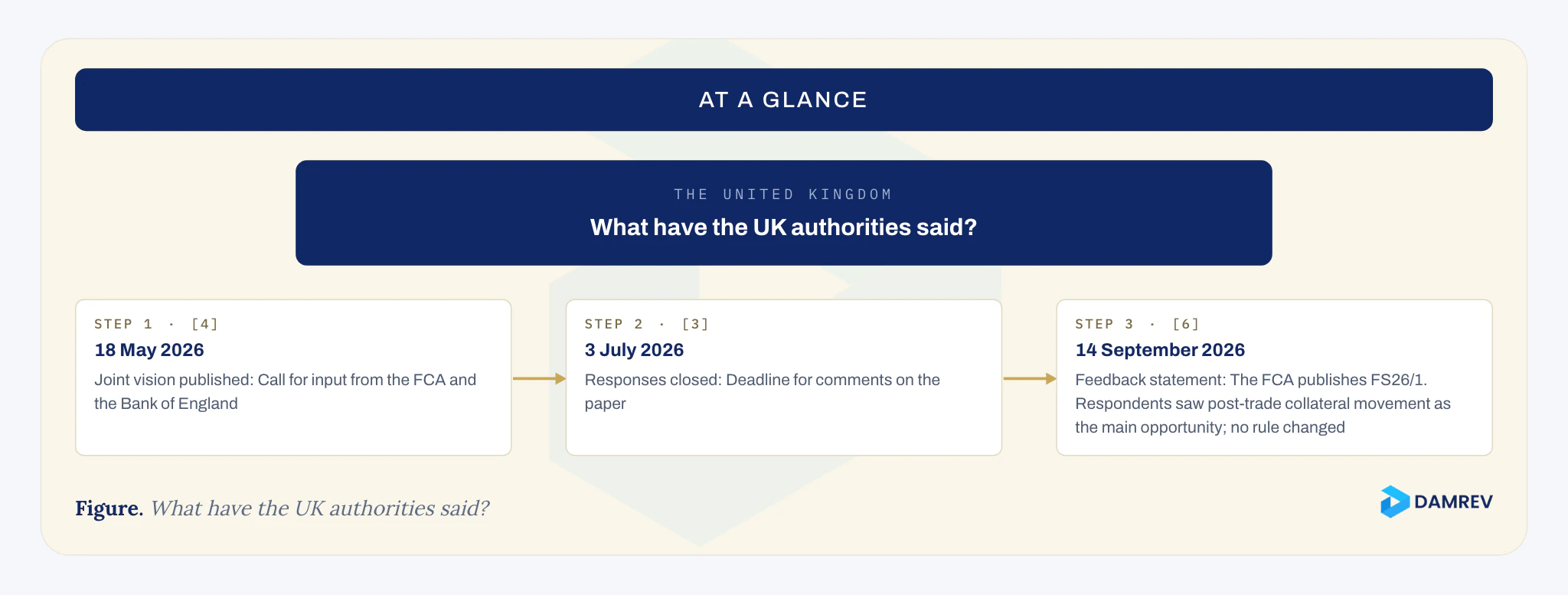
- What have the UK authorities said?
- 18 May 2026: Joint vision published: Call for input from the FCA and the Bank of England (Step 1, [4])
- 3 July 2026: Responses closed: Deadline for comments on the paper (Step 2, [3])
- 14 September 2026: Feedback statement: The FCA publishes FS26/1. Respondents saw post-trade collateral movement as the main opportunity; no rule changed (Step 3, [6])
The paper also records the Bank's position on its own operations: eligibility of tokenized assets there is considered in a phased approach that includes the digital gilt instrument3. Neither document changes a rule.
04 · What changes
What does tokenization change for the collateral taker?
Tokenization mainly changes speed and timing, with new risks to manage. A token can move faster and outside banking hours, but the taker must still hold an enforceable interest, value it correctly, and trust the ledger's finality1, 3.
The benefit both authorities record is mobility. UK firms frequently cite "faster settlement and collateral movement"3. Collateral that can move in minutes on any day can meet a margin call that would otherwise wait for the next settlement window.
For a fund holding tokenized money market units, that is the practical appeal: the same asset can stay invested and serve as collateral without being redeemed into cash first.
An enforceable interest
The taker needs a perfected security interest in the token, not just control of a wallet, and the token must carry the same legal claim as the asset1, 3.
A defensible haircut
The haircut should match the traditional asset's, adjusted for any difference in settlement time or risk1.
Movement under stress
The UK paper asks for confidence that smart contracts can support the movement of collateral between counterparties during market stress3.
Speed also moves risk: a taker that can receive collateral at any hour must be ready to value it and act on it at any hour.
Each of these sends a holder back to the instrument's structure. A tokenized fund unit is good collateral only if the fund's documents, the custody arrangements, and the governing law make the token the unit in law, as the article in this category on which record controls ownership explains.
Finality matters in the same way. The CFTC guidance places settlement finality inside the legal framework a clearing house must have, alongside netting1.

05 · What it does not establish
What do the sources not establish?
As of 7 October 2026, the CFTC guidance and UK call for input read here do not require any clearing house or dealer to accept a token, are not rules, and do not establish which tokenized funds or Treasuries meet the conditions1, 3.
| Question | What the sources say | Source |
|---|---|---|
| Is the CFTC guidance binding? | It represents only the views of the divisions and creates no binding rules | Letter 25-391 |
| Must a clearing house accept a tokenized asset? | No. Acceptance remains each firm's decision under its own rules | Letter 25-391 |
| Has UK law changed? | No. A stated policy preference, a call for input that closed on 3 July 2026, and a feedback statement of 14 September 2026 that changed no rule | Call for input3; FS26/16 |
| Does the US pilot cover tokenized securities? | No. It covers non-securities digital assets, including payment stablecoins | Letter 25-402 |
| Which specific tokens qualify? | Not addressed by either authority | None |
The guidance itself says it "represents only the views of the Divisions"1. A later Commission could take a different view, and nothing in the letter binds a clearing house to accept any particular token. The UK position is earlier still: a stated preference, a consultation that has closed, and a feedback statement that changed no rule3, 6.
Neither authority names a token. A reader looking for whether a particular tokenized fund can be posted as margin needs the rules of the clearing house or the terms of the dealer concerned, not these documents.
Nor do the documents address the accounting or tax treatment of posting tokenized collateral. Those questions belong with the reader's own auditor or tax adviser.
Common questions
What else do people ask?
Short answers to the questions people ask most about this topic.
Can a tokenized money market fund unit be posted as margin in the US?
The CFTC staff guidance names money market fund shares among its examples of tokenized assets, and says an asset keeps its margin eligibility so long as it meets the applicable requirements. Whether a given clearing house or futures commission merchant accepts a given token is for that firm and its rules1.
Is the CFTC's December 2025 pilot about tokenized securities?
No. The pilot in CFTC Letter No. 25-40 concerns non-securities digital assets, including payment stablecoins, with bitcoin and ether named in its temporary conditions. Tokenized Treasuries and fund units are addressed by the separate guidance in Letter No. 25-391, 2.
Does the haircut change when an asset is tokenized?
The CFTC staff expect firms to analyse whether the tokenized form can take an equivalent haircut to the traditional form, adjusted for differences in settlement time or in credit, market, or liquidity risk1.
What has the UK decided on tokenized collateral?
As of 7 October 2026, a stated policy preference rather than a rule. The FCA and the Bank of England said tokenized versions of assets already acceptable as regulatory collateral should qualify where the risks are mitigated. Responses closed on 3 July 2026, and the FCA's feedback statement of 14 September 2026 changed no rule3, 4, 6.
Where should you go next?
The pages below pick up where this one ends. Start with the one closest to where your asset or programme stands today.
- SEC & CFTC Authority After the CLARITY Act Failed to AdvanceThe CLARITY Act stalled on a 49 to 50 vote, so tokenized securities stay with the Securities and Exchange Commission, as before.
- Why the First US-Registered Tokenized Money Market Fund Runs on StellarThe first US-registered money market fund with a public blockchain as its official record runs on Stellar: finality at ledger close, and issuer controls.
- Settlement Finality on a Blockchain: Why a Register Cannot Be Probably TrueA register can record a transfer only once it is final. Probabilistic finality never gets there outright, and technical finality is not legal finality.
- Settlement & LiquidityHow value settles in the asset each jurisdiction permits: fiat through a licensed provider, swaps without custody, and sales behind an eligibility gate.
References
- 1.CFTC Market Participants Division, Division of Market Oversight, and Division of Clearing and Risk, "Tokenized Collateral Guidance", CFTC Letter No. 25-39, 8 December 2025. https://www.cftc.gov/csl/25-39/download
- 2.CFTC Market Participants Division, no-action position on digital assets accepted as margin collateral, CFTC Letter No. 25-40, 8 December 2025. https://www.cftc.gov/csl/25-40/download
- 3.Financial Conduct Authority and Bank of England, "Call for Input: The future of tokenisation, a joint vision from the authorities for UK wholesale financial markets", May 2026, Sections 1.8, 2.2, 3.13, 4.10, 4.20, 5.1 and 5.5. https://www.fca.org.uk/publication/call-for-input/future-tokenisation-joint-vision-authorities-uk-wholesale-financial-markets.pdf
- 4.Bank of England, "FCA and Bank of England set out shared vision for tokenisation in UK wholesale markets", 18 May 2026. https://www.bankofengland.co.uk/news/2026/may/fca-and-boe-set-out-shared-vision-for-tokenisation-in-uk-wholesale-markets
- 5.CFTC Market Participants Division, CFTC Letter No. 26-05, reissuing Letter No. 25-40, 6 February 2026; and press release 9180-26. https://www.cftc.gov/csl/26-05/download
- 6.Financial Conduct Authority, Feedback Statement FS26/1, "Tokenisation in wholesale markets", 14 September 2026. https://www.fca.org.uk/publications/feedback-statements/fs26-1-tokenisation-wholesale-markets
This article is analysis of public sources, not legal advice. Last updated:




