


Article · Structures, Title & Asset Classes
Tokenized Equity Securities: A Path to a Listing Without Promising One
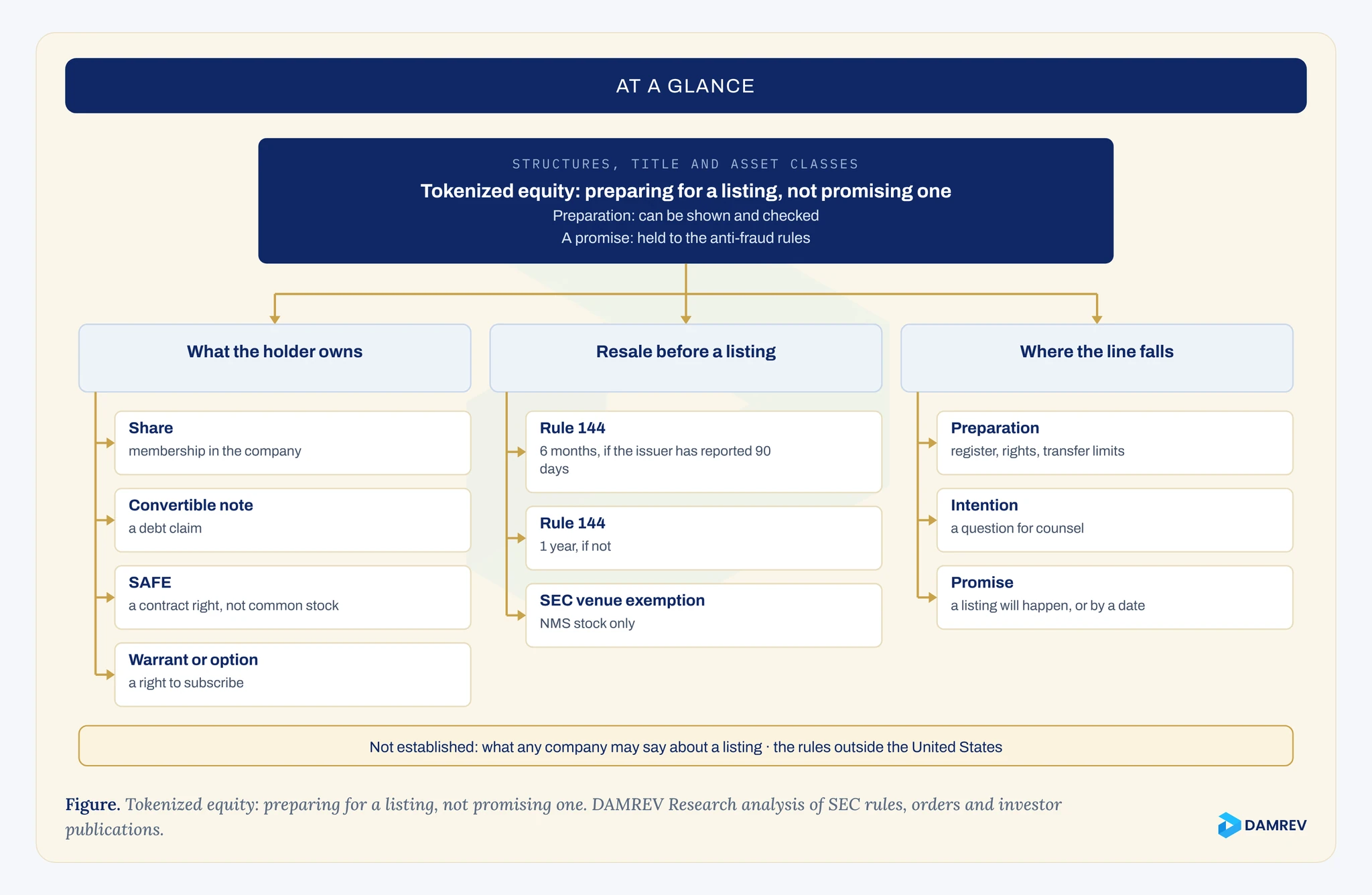
Tokenized equity securities, such as a tokenized share or pre-listing instrument, can prepare a company for a listing, by putting its register and its investors' rights in order early, but it cannot promise one1, 3.
The holder owns the instrument the documents create, its resale is restricted until a market exists, and any statement that a listing will happen is held to the anti-fraud rules2, 4, 5.


01 · The answer
Can a tokenized equity security lead to a listing?
A tokenized equity security can prepare a company for a listing: a company that records its shares or pre-listing instruments on a ledger early can arrive at a listing with a clean register and settled rights. It cannot promise a listing, because neither the token nor the issuer controls that outcome1, 3, 4.
Tokenized equity securities cover two different things. One is a tokenized share of a company already listed, which trades in an established market. The other is a share, or an instrument that may become a share, of a company that is not listed yet.
This article is about the second. For that company, tokenization is a way of recording what it has issued, not a way of creating a market for it.
| Instrument | What the holder owns now | What can change it |
|---|---|---|
| Ordinary or preference share | A share in the company, with the rights its constitution gives | A later reorganisation or listing, under the company's documents |
| Convertible note | A debt claim that may convert into shares | The conversion terms in the note |
| Simple agreement for future equity (SAFE) | A contract right to equity if a triggering event occurs; not common stock6 | A priced round, sale, or other trigger in the agreement6 |
| Warrant or option | A right to subscribe for shares at a set price | Exercise under its terms |
In each row, what the holder owns is set by the instrument's documents. Recording it as a token changes the format, and the staff of the US Securities and Exchange Commission (SEC) say the format of a security does not affect how the federal securities laws apply1.
02 · The instrument
What does the holder of a pre-listing instrument own?
The holder of a pre-listing instrument owns exactly what the instrument's terms give, and tokenizing it leaves those terms intact. A share confers membership; a note, a debt claim; a SAFE, a contract right that may never become equity1, 6.
The SAFE shows why the label matters. The SEC's investor bulletin on SAFEs says plainly that "SAFEs are not common stock", that a SAFE "may only convert to equity if certain triggering events occur", and that without a trigger an investor could be left "with nothing"6. A token that represents a SAFE carries that position with it.
For a company issuing shares, the ledger can do useful work. Delaware law allows a corporation's stock ledger to be kept on distributed electronic networks or databases, provided it can produce the stockholder list, record transfers lawfully, and be converted into clearly legible paper form within a reasonable time7.
A company that keeps its register this way from its first round arrives at any later listing with a record that can be checked. That is preparation. It is not a listing.
03 · The resale
Can tokenized pre-listing securities be traded before a listing?
Tokenized pre-listing securities can be traded before a listing only within the resale rules: in the United States, privately issued securities are usually restricted, Rule 144 sets holding periods before public resale, and the SEC's tokenized venue exemption covers listed stock only2, 3.
Shares sold privately are restricted securities when acquired "in a transaction or chain of transactions not involving any public offering", or subject to the resale limits that apply after a US private offering or under Rule 701(c)2. Rule 144 provides one route to public resale, after a holding period that depends on whether the issuer reports to the SEC2.
- Minimum Rule 144 holding period where the issuer has been a reporting company for at least 90 days2
- 6 months
- Minimum Rule 144 holding period where it has not2
- 1 year
- Stock traded in the US national market system (NMS stock), the only stock the SEC's tokenized venue exemption of 17 September 2026 covers3
- NMS stock
The SEC's order of 17 September 2026 does not reach a private company. It covers tokenized NMS stock, and it states that "No primary issuance or initial offerings of securities are permitted on a TSV", a tokenized securities venue3. A token of an unlisted share has no venue under that order.
A token contract can enforce these limits, by refusing transfers before a holding period ends or to buyers who do not qualify. What it cannot do is create the market a listing would. A transferable token is not a liquid one.
04 · The promise
Where is the line between preparing for a listing and promising one?
The line between preparing for a listing and promising one falls at any statement that a listing will happen, or soon. The anti-fraud rules prohibit untrue or misleading statements of material fact, and the SEC's investor alerts name claims of an imminent listing as a warning sign4, 5.
Rule 10b-5 makes it unlawful "To make any untrue statement of a material fact or to omit to state a material fact necessary in order to make" the statements made not misleading5. A statement that a private company will list can matter a great deal to an investor deciding whether to buy, and it is held to that standard.
The SEC's Office of Investor Education and Advocacy has described how listing claims are used to sell private shares.
Its alert warns that fraudsters may say an initial public offering is "imminent" or will happen "this year", that "investors may be unable to resell their shares", and that crypto assets are among the areas such schemes pitch4. Its central caution is short.
the company may never go public4
Preparation
A register kept to listing standard, rights written clearly, transfer limits enforced, and disclosure kept current. Each can be shown and checked.
Intention
A company may have a plan to seek a listing. Whether and how it may say so, and with what qualifications, is a question for its counsel under the anti-fraud rules5.
Promise
A statement that a listing will happen, or by a date, when its outcome depends on an exchange, regulators, and markets the company does not control4.
The ledger helps on the first point and is irrelevant to the third. It can show that a company is ready. It cannot make an exchange admit it.

05 · What it does not establish
What does this reading not establish?
As of 7 October 2026, the SEC rules, order, and investor publications read here do not establish what any company may say about a listing, the resale position of any particular security, or the rules outside the United States. The article reads the US rules that frame the question2, 5.
| Question | Position | Source |
|---|---|---|
| What a given company may say about a listing | Not established. That is a question for its counsel on its facts | 5 |
| The resale position of any security | Not established. Rule 144 has further conditions, and other exemptions exist | 2 |
| Listing rules of any exchange | Not read here; each exchange sets its own admission requirements | |
| Rules outside the United States | Not established. Each jurisdiction's offering, resale, and listing rules apply | |
| The status of the SEC investor publications | Investor education material, not rules; quoted for what the SEC's staff warn investors about | 4, 6 |
The investor alert and bulletin are education material, not rules4, 6. They are quoted here because they show what the SEC's staff tell investors to watch for.
What the texts establish is a division of labour. The company controls its register, its instruments, and what it says. The exchange and the market control the listing. A tokenized equity security sits entirely on the first side of that line.
Common questions
What else do people ask?
Short answers to the questions people ask most about this topic.
Is a tokenized share of a private company a listed security?
No. It is a share of a private company recorded in a different format. The format does not change how the securities laws apply to it1.
Can a private company's tokenized shares trade on a tokenized securities venue under the SEC's exemption of September 2026?
No. That exemption covers tokenized NMS stock, which is stock already traded in the national market system, and permits no primary issuance or initial offering on the venue3.
Does a SAFE make the holder a shareholder?
Not until it converts. The SEC's investor bulletin says SAFEs are not common stock and may convert only if certain triggering events occur6.
Can a company say it intends to list?
Statements about a listing are subject to the anti-fraud rules, which prohibit untrue statements of material fact and omissions that make statements misleading5. What may be said in a given case is a question for the company's counsel.
Where should you go next?
The pages below pick up where this one ends. Start with the one closest to where your asset or programme stands today.
- SPV for Tokenization: When a Special Purpose Vehicle Is NeededTokenizing an asset usually needs a special purpose vehicle, because a building cannot issue anything. An issuer tokenizing its own securities may not.
- The SEC's Innovation Exemption of 17 September 2026: What Tokenized Securities Venues & Tokenized NMS Stock May Now DoSince 17 September 2026 a tokenized securities venue may run automated liquidity pools in tokenized listed stock without registering as an exchange, on conditions.
- Equity & Pre-Listing InstrumentsHow private shares, convertibles, and pre-listing instruments become tokenized equity whose register applies transfer restrictions and processes corporate actions.
- Listing ReadinessWhat a company needs before it lists, what a tokenized listing adds, and a check that shows where your company stands.
References
- 1.SEC Divisions of Corporation Finance, Investment Management, and Trading and Markets, "Statement on Tokenized Securities", 28 January 2026. https://www.sec.gov/newsroom/speeches-statements/corp-fin-statement-tokenized-securities-012826
- 2.Code of Federal Regulations, Title 17, section 230.144 (Rule 144). https://www.law.cornell.edu/cfr/text/17/230.144
- 3.US Securities and Exchange Commission, Order Granting Temporary Conditional Exemptive Relief for Distributed Ledger Trading Venues for Tokenized NMS Stocks, Exchange Act Release No. 34-106402, 17 September 2026. https://www.sec.gov/files/rules/exorders/2026/34-106402.pdf
- 4.SEC Office of Investor Education and Advocacy, "Investor Alert: Pre-IPO Investment Scams (Updated)", 7 June 2024. https://www.investor.gov/additional-resources/news-alerts/alerts-bulletins/investor-alert-pre-ipo-investment-scams-updated
- 5.Code of Federal Regulations, Title 17, section 240.10b-5 (Rule 10b-5). https://www.law.cornell.edu/cfr/text/17/240.10b-5
- 6.SEC Office of Investor Education and Advocacy, "Investor Bulletin: Be Cautious of SAFEs in Crowdfunding", 9 May 2017. https://www.investor.gov/introduction-investing/general-resources/news-alerts/alerts-bulletins/investor-bulletins-52
- 7.Delaware Code, Title 8, Chapter 1, Subchapter VII, sections 219 and 224. https://delcode.delaware.gov/title8/c001/sc07/index.html
This article is analysis of public sources, not legal advice. Last updated:




