


Article · Structures, Title & Asset Classes
SPV for Tokenization: When a Special Purpose Vehicle Is Needed
Tokenization usually needs a special purpose vehicle (SPV) when the thing being tokenized is an asset rather than a security, because a building or a loan book cannot issue anything1, 5. A vehicle is the usual owner that gives investors rights; a trust, co-ownership, or a direct sale can serve in some cases.
An issuer that tokenizes its own shares, bonds, or fund units is already that owner, and the law in some places lets it keep its own register on a ledger without a new vehicle1, 2, 3.

01 · The answer
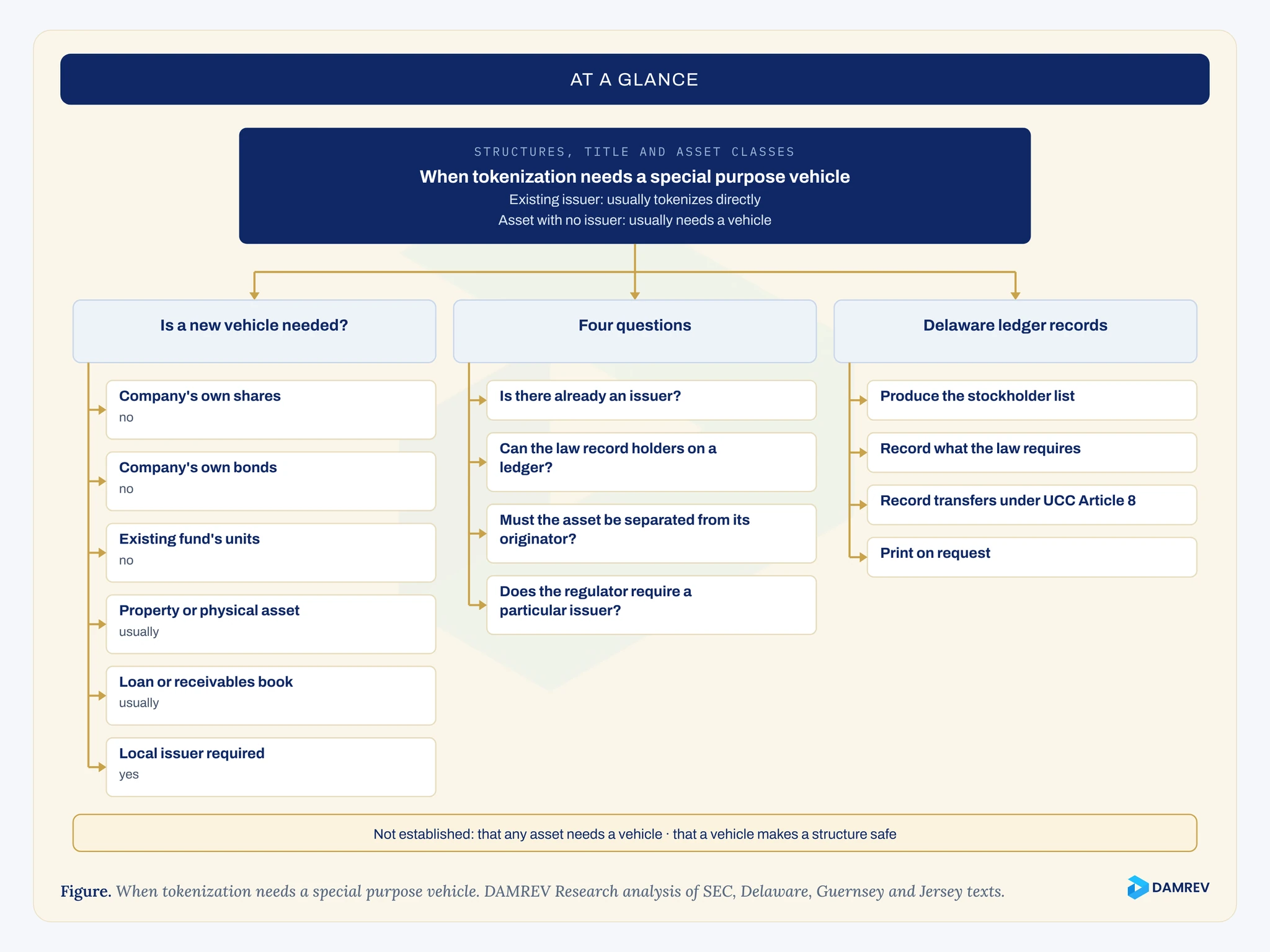
When does tokenization need a special purpose vehicle?
An SPV for tokenization is needed when the thing being tokenized is an asset with no issuer of its own, when the holders need the asset separated from its originator, or when a regulator requires a local issuer. Otherwise an existing issuer can usually tokenize directly1, 4, 6.
A token needs something to represent. If that something is a share, bond, or fund unit, a legal person already issues it, and tokenization changes how the holding is recorded1. If it is a building, a book of receivables, or a work of art, nothing has been issued yet.
The structure must give investors rights through whoever owns the asset. The usual way is to put the asset into a legal person that can own it and issue interests in it, and that person is the vehicle.
A trust or a co-ownership arrangement can serve in some jurisdictions, and the choice is a structuring decision under the law of the asset. Receivables are the partial exception: an originator can sell them to an existing buyer, and a new vehicle is used where the holders need a buyer that is separate and dedicated to the assets.
| What is being tokenized | Is there already an issuer? | Is a new vehicle usually needed? |
|---|---|---|
| A company's own shares | Yes, the company | No, where its corporate law allows an electronic register2 |
| A company's own bonds or notes | Yes, the company | No, subject to the terms of the instrument |
| Units of an existing fund | Yes, the fund | No; the fund is the vehicle3 |
| A property or other physical asset | No | Usually, unless a trust or co-ownership arrangement is used, or the token is only a contract claim |
| A book of loans or receivables | No; the originator owns the assets | Usually, to separate the assets from the originator6 |
| An asset where the regulator requires a local issuer | Depends | Yes, in that jurisdiction4 |
Each row is the usual position, subject to the law of the place where the asset and the issuer sit.
02 · The asset
Why does an asset usually need a vehicle before it can be tokenized?
An asset usually needs a vehicle because it cannot issue anything. Someone must own it and give investors rights in it, and a vehicle that issues interests is the usual way; otherwise the token represents a contract claim against the owner, or an interest under a trust or co-ownership arrangement where the law allows1, 5.
Take land. Under South Africa's Deeds Registries Act, ownership of land passes only by a registered deed of transfer5. A token cannot be registered as a deed, so a token holder cannot own the land through the token.
What the token can represent is a share or membership interest in a vehicle that the deeds registry names as owner. The vehicle exists to be the registered owner, so that the token has something it can lawfully represent.
The same applies to other assets with their own system of title or transfer. A receivable is transferred by assignment under the law that governs it. A loan is transferred under its own documents. In each case the vehicle takes the asset under the asset's own law, and then issues interests under company or trust law. The token comes last.
Without a vehicle, a token over an asset can still be issued, for example as a contract right against whoever owns the asset.
Such a holder is, in general, an unsecured creditor of the owner and has no interest in the asset itself, unless it also holds an effective security interest or another protection, such as a beneficial interest under a valid trust.
03 · The issuer
When can an issuer tokenize without a new vehicle?
An issuer can tokenize without a new vehicle when it is tokenizing its own securities and its law allows its register to be kept on a ledger. The staff of the US Securities and Exchange Commission (SEC) describe this issuer-sponsored model, and Delaware law allows a stock ledger on distributed networks1, 2.
The SEC staff statement of January 2026 describes the model directly, with distributed ledger technology (DLT) built into the issuer's own records: the issuer, or its agent, "integrates DLT into the systems that it uses to record owners of the security"1. No second entity is needed, because the issuer is already the legal person whose securities the token records.
Corporate law sets the limit. Delaware amended its corporation law to let a corporation keep its records "on, or by means of" electronic networks or databases, "including 1 or more distributed electronic networks or databases"2. The ledger must still do what a stock ledger does.
'stock ledger' means 1 or more records administered by or on behalf of the corporation in which the names of all of the corporation's stockholders of record, the address and number of shares registered in the name of each such stockholder, and all issuances and transfers of stock of the corporation are recorded in accordance with § 224 of this title2
Produce the stockholder list
The records must be usable to prepare the list of stockholders that sections 219 and 220 require2.
Record what the law requires
They must record the information specified in sections 156, 159, 217(a), and 218, such as partly paid shares and voting arrangements2.
Record transfers lawfully
They must record transfers of stock as governed by Article 8 of the Uniform Commercial Code as enacted in Delaware2.
Print on request
The records must be capable of being "converted into clearly legible paper form within a reasonable time"2.
A fund is in the same position. It is already a vehicle, and Guernsey's guidance accepts that its register may be kept on public or private distributed ledger technology without a parallel off-chain register, provided it can be reproduced in hard copy3.
04 · The ring-fence
When does separation require a vehicle?
Separation requires a vehicle when holders need the asset kept out of the originator's insolvency, or when a regulator requires a particular issuer. A vehicle gives the asset an owner of its own, and the separation has to be built off-chain4, 6.
Separation is the second reason a vehicle appears even where an issuer exists. A lender that tokenizes participations in its own loan book can issue a contract claim against itself, but its token holders then share its insolvency risk.
If the loans are sold to a vehicle, the loans belong to the vehicle, and the US Bankruptcy Code's estate rules reach the originator's property, not the vehicle's, subject to the trustee's power to undo some transfers made before a filing6. The sale, not the token, makes the difference.
Four questions that decide whether a vehicle is needed
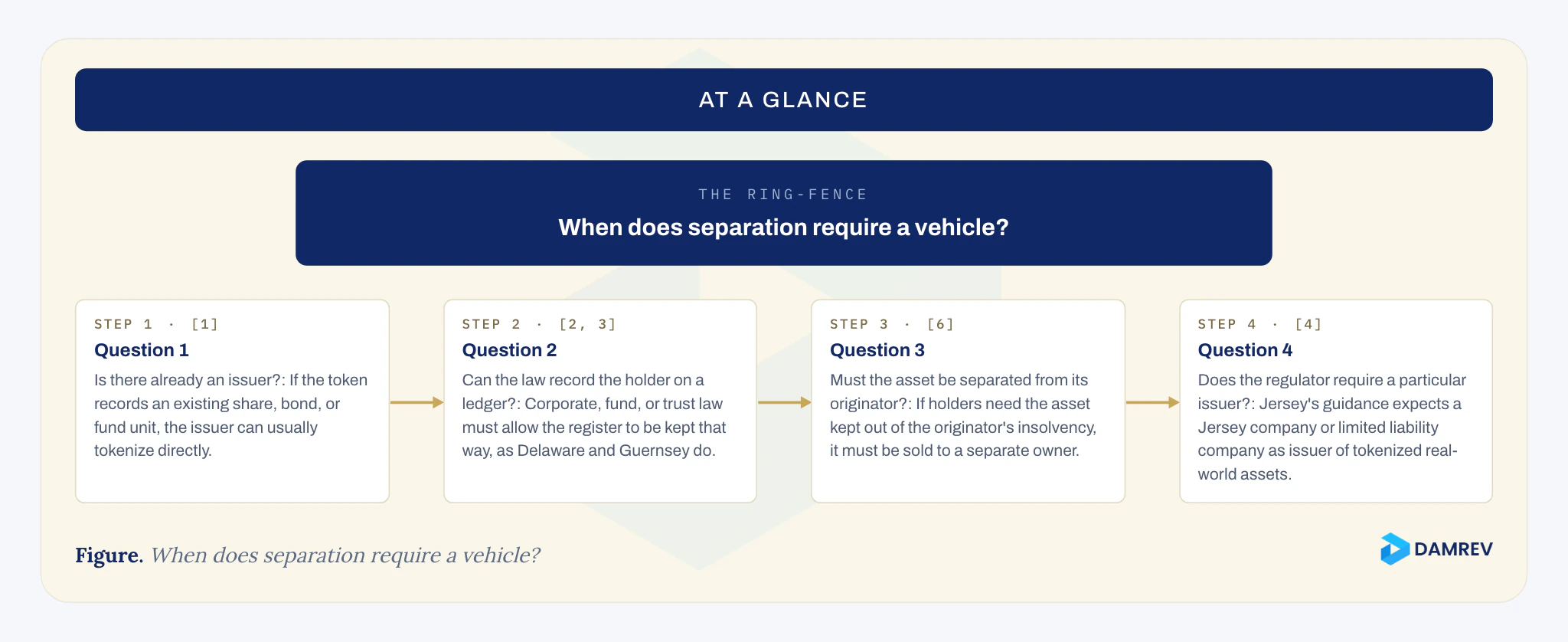
- When does separation require a vehicle?
- Question 1: Is there already an issuer?: If the token records an existing share, bond, or fund unit, the issuer can usually tokenize directly. (Step 1, [1])
- Question 2: Can the law record the holder on a ledger?: Corporate, fund, or trust law must allow the register to be kept that way, as Delaware and Guernsey do. (Step 2, [2, 3])
- Question 3: Must the asset be separated from its originator?: If holders need the asset kept out of the originator's insolvency, it must be sold to a separate owner. (Step 3, [6])
- Question 4: Does the regulator require a particular issuer?: Jersey's guidance expects a Jersey company or limited liability company as issuer of tokenized real-world assets. (Step 4, [4])
Regulators can also make the decision for the issuer. Jersey's guidance on tokenized real-world assets expects the issuer to be incorporated as "a Jersey company or Jersey limited liability company (LLC)"4. A sponsor elsewhere that wants to issue under that regime needs a Jersey vehicle whatever the asset is.

05 · What it does not establish
What does this reading not establish?
As of 7 October 2026, the SEC staff statement, Delaware law, and the Guernsey and Jersey guidance read here do not establish that any particular asset or issuer needs a vehicle, that a vehicle makes a structure safe, or how any jurisdiction other than those read here treats an electronic register2, 3, 4.
| Question | Position | Source |
|---|---|---|
| Whether a given issuer needs a vehicle | Not established. That depends on the asset, the law of each place involved, and the holders' needs | 1, 4 |
| Whether a vehicle protects holders | Not established. A vehicle separates assets only if the transfer and the documents are effective; see the bankruptcy remoteness article | 6 |
| Electronic registers outside Delaware and Guernsey | Not established. Each corporate and fund law must be read | 2, 3 |
| The status of the SEC staff statement | A staff statement. It describes models and grants no relief | 1 |
| Tax consequences of using a vehicle | Outside the scope of this article. Take advice from your own tax adviser |
A vehicle is another legal person to form, administer, account for, and keep separate. Where the asset has an issuer, holders need no ring-fence, and no regulator demands one, the question becomes whether the issuer's own law lets it keep its register on a ledger.
Common questions
What else do people ask?
Short answers to the questions people ask most about this topic.
Can a company tokenize its own shares without a special purpose vehicle?
Where its corporate law allows. Delaware lets a corporation keep its records, including its stock ledger, on distributed electronic networks or databases, provided they can produce the stockholder list, record transfers, and be converted into clearly legible paper form within a reasonable time2.
Can an asset be tokenized without any vehicle?
Yes, though the alternatives are limited. The token can be a contract claim against the owner, which gives no interest in the asset itself, or an interest under a trust or co-ownership arrangement where the law of the asset allows. For land, title still passes only as the land law provides5.
Does a regulator ever require a vehicle?
Some do. Jersey's guidance on tokenized real-world assets expects the issuer to be a Jersey company or Jersey limited liability company4.
Is the vehicle what makes the token a security?
No. Under US federal securities law, an interest in a vehicle is often a security, and the SEC staff say the format of a security does not change how the law applies1.
Where should you go next?
The pages below pick up where this one ends. Start with the one closest to where your asset or programme stands today.
- Bankruptcy Remote SPV Tokenization: What the Vehicle Must Still Do Off-ChainCode cannot make a vehicle bankruptcy remote. A special purpose vehicle gets there off-chain, through a true sale, its documents, and a separate existence.
- Real Estate Tokenization Legal Structure: The Token Is Not the TitleA real estate token is rarely title to land. The holder owns a vehicle interest or a contract right, and the land register decides ownership.
- Capital StructuringPreparing the structure behind a raise before any investor sees it: the instrument, ranking, eligibility rules, register, and operating model.
- Token Classes We IssueHow security, utility, payment, and asset-backed tokens differ, why the issuer and its counsel decide a token's class, and what DAMREV encodes.
References
- 1.SEC Divisions of Corporation Finance, Investment Management, and Trading and Markets, "Statement on Tokenized Securities", 28 January 2026. https://www.sec.gov/newsroom/speeches-statements/corp-fin-statement-tokenized-securities-012826
- 2.Delaware Code, Title 8, Chapter 1, Subchapter VII, sections 219 and 224. https://delcode.delaware.gov/title8/c001/sc07/index.html
- 3.Guernsey Financial Services Commission, Guidance Note on the Tokenisation of Investments and Other Assets in the Bailiwick of Guernsey, July 2026. https://www.gfsc.gg/sites/default/files/media/helix-file/Guidance%20-%20Tokenisation%20of%20Investments%20%28July%202026%29.pdf
- 4.Jersey Financial Services Commission, "Tokenisation of real-world assets (RWAs)", issued 28 August 2024, last revised 13 July 2026. https://www.jerseyfsc.org/industry/guidance-and-policy/tokenisation-of-real-world-assets-rwas/
- 5.Deeds Registries Act 47 of 1937 (South Africa), section 16, consolidated text. https://www.saflii.org/za/legis/consol_act/dra1937172/
- 6.United States Code, Title 11, section 541, "Property of the estate". https://www.law.cornell.edu/uscode/text/11/541
This article is analysis of public sources, not legal advice. Last updated:




