


Article · Structures, Title & Asset Classes
Bankruptcy Remote SPV Tokenization: What the Vehicle Must Still Do Off-Chain
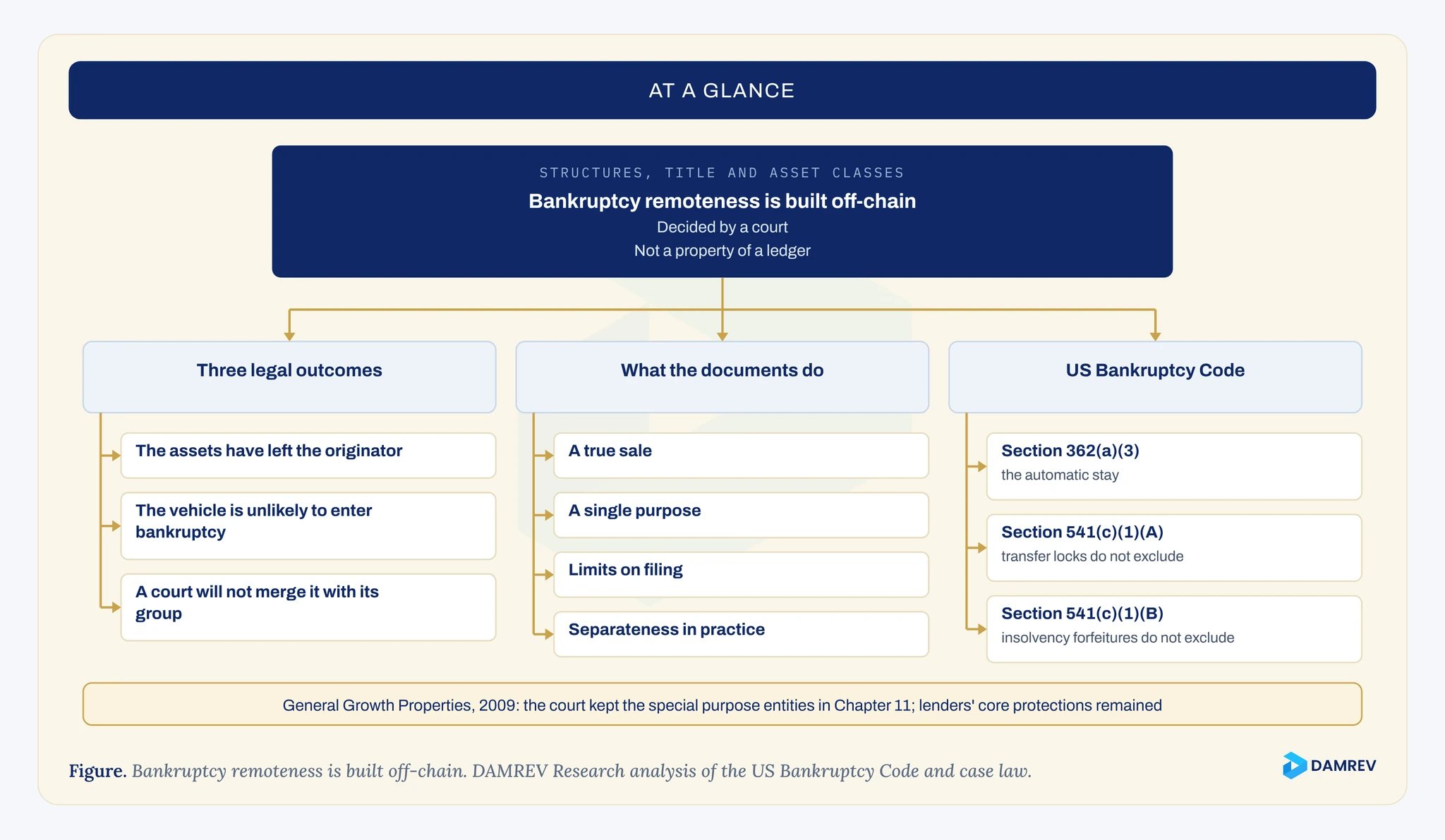
Code cannot make a vehicle bankruptcy remote, because bankruptcy remoteness is a set of legal outcomes decided by a court under bankruptcy law, not a property of a ledger1, 2.
In bankruptcy remote SPV tokenization, the vehicle reaches it the same way any special purpose vehicle (SPV) does, off-chain: a true sale of the assets into it, documents that limit who can put it into bankruptcy, and a separate existence that a court will respect3, 4.


01 · The answer
What makes a vehicle bankruptcy remote?
A vehicle is bankruptcy remote through three legal outcomes, each decided off-chain: the assets have left the originator, the vehicle is unlikely to enter bankruptcy itself, and a court will not merge it with its group. None of them is a feature of a ledger2, 3, 4.
A tokenized vehicle is a company, trust, or partnership that issues tokens instead of, or as well as, certificates. Its holders want the assets backing their claim to stay available if the business that created the vehicle fails. Bankruptcy remoteness is a prediction about how a court will treat the vehicle.
02 · The statute
Can a smart contract override bankruptcy law?
No. Bankruptcy law overrides contracts, and a smart contract is a contract in executable form. In the United States, the automatic stay and the estate rules apply whatever an agreement or its code provides1, 2.
The US Bankruptcy Code has two provisions that bear directly on code-based protections: the automatic stay, which reaches "any act to obtain possession of property of the estate or of property from the estate or to exercise control over property of the estate"1, and the estate rule in section 541(c), set out in the table with its limits.
Restrictions on a beneficial interest in a trust that are enforceable under other law are preserved2.
| Provision | What it says | What it means for a tokenized structure |
|---|---|---|
| Section 362(a)(3) | A petition stays any act to obtain possession of, or exercise control over, property of the estate | If the assets are still the originator's, a contract that moves them after filing may be such an act |
| Section 541(c)(1)(A) | Estate property includes interests despite terms that restrict or condition their transfer | A transfer lock written in code does not keep an interest out of the estate |
| Section 541(c)(1)(B) | Estate property includes interests despite terms triggered by insolvency or a filing that effect, or give an option to effect, a forfeiture, modification, or termination of the debtor's interest | A contract that forfeits the originator's interest to holders on its insolvency does not of itself remove the assets |
These provisions only bite on property of the estate1, 2. If the assets were genuinely sold to the vehicle before any filing, they are the vehicle's property, and the originator's bankruptcy does not reach them in the same way, though the transfer itself remains open to the trustee's avoidance powers, such as those for preferences and fraudulent transfers.
A court decides whether a transfer was a sale on its substance under the governing law, and can treat a labelled sale as a secured loan.
03 · The documents
What must the vehicle's documents do?
The vehicle's documents must move the assets by a sale the law will recognise, restrict what the vehicle may do and owe, limit who may put it into bankruptcy, and keep it genuinely separate from its group. All four are written and evidenced off-chain3, 4, 5.
A true sale
The assets pass to the vehicle by an outright transfer, so they are the vehicle's property and not the originator's, supported where it matters by a legal opinion in the jurisdiction of the originator.
A single purpose
The constitution limits the vehicle to holding the assets and issuing the tokens, so it cannot take on other business or other creditors who could petition against it5.
Limits on filing
Creditors and holders agree not to petition and to limit their recourse to the vehicle's assets, and a filing by the vehicle needs the consent of an independent director or manager3.
Separateness in practice
The vehicle keeps its own books, accounts, and records and deals with its group at arm's length, because a court looks at conduct, not only documents4.
A ledger that records the vehicle's holdings, payments, and holders produces a continuous record of its separateness. The record is evidence, not the separateness itself, which still depends on the group not treating the vehicle's assets as its own.
Jersey's guidance on tokenized real-world assets reflects the same approach from a regulator. It requires the underlying assets to be "ring-fenced and not lent out for additional yield" unless the regulator expressly agrees, and held by a professional custodian7.
The requirement is placed on the issuer and its custodian, and is checked by independent verification, not by the token contract7.
04 · The record
What has a court done with a special purpose vehicle?
In General Growth Properties, decided on 11 August 2009, a US bankruptcy court allowed special purpose entities to enter Chapter 11 with their parent, while holding that their lenders' core protections remained in place3.
General Growth Properties, a US shopping centre owner, filed for Chapter 11 in April 2009 with many of the bankruptcy-remote special purpose entities that held its malls3, 6. Their lenders moved to dismiss the cases as filed in bad faith.
Before the filings, the group had replaced the independent managers of the entities that required them with managers it selected; the court described the terminations as "admittedly surreptitious" but found they did not show subjective bad faith, because the documents did not prohibit them3.
the fundamental protections that the Movants negotiated and that the SPE structure represents are still in place3
The court also held that a filing decision "can be based in good faith on consideration of the interests of the group"3.
General Growth Properties: from structure to decision
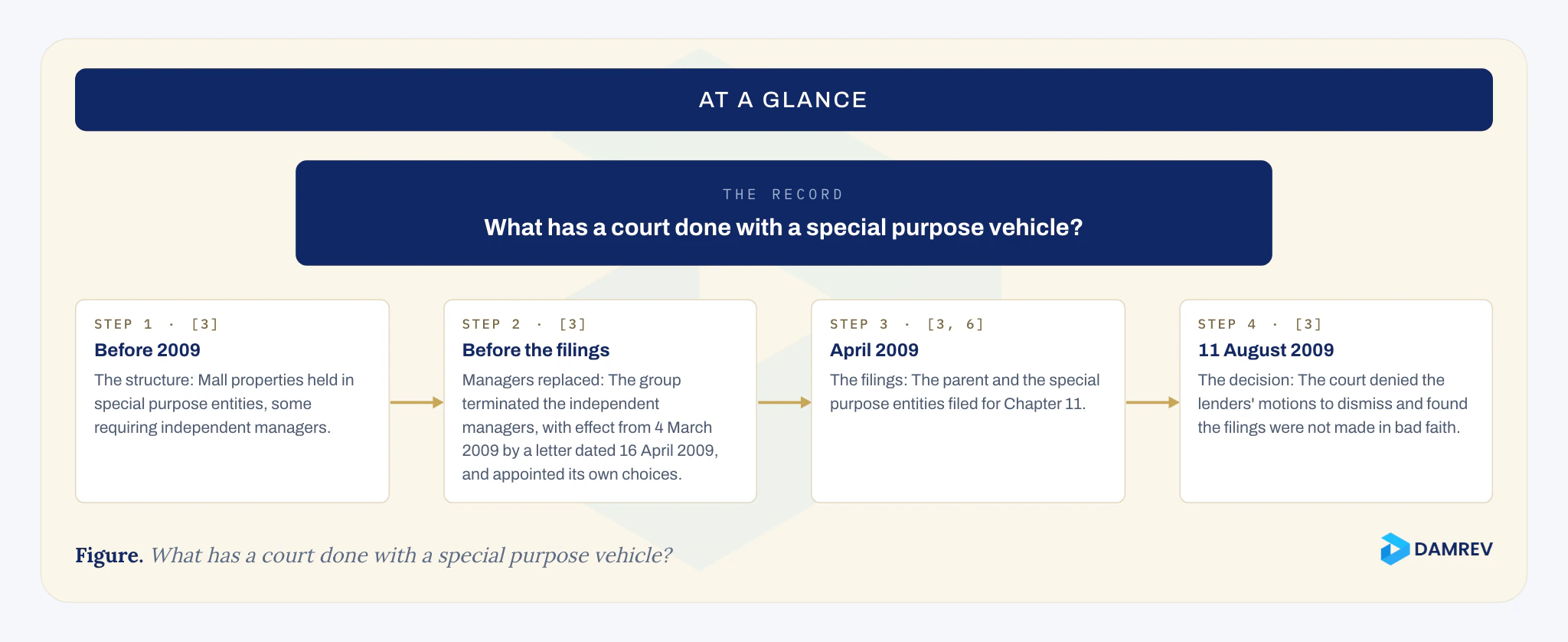
- What has a court done with a special purpose vehicle?
- Before 2009: The structure: Mall properties held in special purpose entities, some requiring independent managers. (Step 1, [3])
- Before the filings: Managers replaced: The group terminated the independent managers, with effect from 4 March 2009 by a letter dated 16 April 2009, and appointed its own choices. (Step 2, [3])
- April 2009: The filings: The parent and the special purpose entities filed for Chapter 11. (Step 3, [3, 6])
- 11 August 2009: The decision: The court denied the lenders' motions to dismiss and found the filings were not made in bad faith. (Step 4, [3])
The decision left the structure standing. The protections the lenders negotiated remained3.
A separate line of authority sets a high bar for merging group entities. In Owens Corning the Third Circuit held that, absent consent, the proponent must show that before the filing the entities disregarded separateness so significantly that their creditors relied on the breakdown of entity borders and treated them as one legal entity.
Or the proponent must show that after the filing their assets and liabilities are so scrambled that separating them is prohibitive and hurts all creditors4. That is the law of one federal circuit.
Bankruptcy remoteness reduced the lenders' exposure, but the vehicles still went to court.

05 · What it does not establish
What does this reading not establish?
As of 7 October 2026, the US Bankruptcy Code provisions and court decisions read here do not establish how any court outside the United States would treat a tokenized vehicle, whether any self-executing contract has been held to breach the automatic stay, or whether any particular vehicle is bankruptcy remote1, 3.
| Question | Position | Source |
|---|---|---|
| Treatment outside the United States | Not established. Insolvency law is national; each jurisdiction must be read on its own terms | 1, 2 |
| A court ruling on a smart contract and the automatic stay | Not found. The statute's words reach any act to exercise control over estate property; we found no decision applying them to self-executing code | 1 |
| Whether a given transfer is a true sale | Not established. That depends on the substance of the transfer under the governing law, not its label, and is usually the subject of a legal opinion | 2 |
| Whether General Growth would be decided the same way today | Not established. It is a 2009 bankruptcy court decision in one district | 3 |
| Whether any particular vehicle is bankruptcy remote | Not established. That is a question for counsel on its own documents | 3, 4 |
The protections that held in General Growth were the ones written into documents and recognised by a court; the independent manager failed because the documents allowed the group to change who held the seat3. A ledger can only record whether the sponsor kept its word.
Common questions
What else do people ask?
Short answers on bankruptcy remoteness: whether a smart contract takes assets out of the originator's estate or keeps paying holders after a filing, what a non-petition clause is, and whether an independent director can stop a vehicle filing.
Does putting assets in a smart contract take them out of the originator's estate?
Not of itself. In US bankruptcy, what leaves the estate is decided by the law on transfers, such as whether the assets were sold or only pledged, not by where they are recorded2.
Can a smart contract keep paying token holders after the originator files for bankruptcy?
That depends on whose property the contract is moving. If the assets are property of the bankrupt estate, the automatic stay reaches any act to exercise control over them1. We found no decision applying that provision to a self-executing contract.
What is a non-petition clause?
A promise by the vehicle's creditors and holders not to start bankruptcy proceedings against it. It is one of the contract terms that reduce the chance of an involuntary filing; its enforceability is a question for counsel in the governing jurisdiction.
Can an independent director stop a vehicle filing for bankruptcy?
Not reliably. In General Growth, the group replaced the independent managers before filing, and the court found that the replacement did not show bad faith3.
Where should you go next?
The pages below pick up where this one ends. Start with the one closest to where your asset or programme stands today.
- Real Estate Tokenization Legal Structure: The Token Is Not the TitleA real estate token is rarely title to land. The holder owns a vehicle interest or a contract right, and the land register decides ownership.
- SPV for Tokenization: When a Special Purpose Vehicle Is NeededTokenizing an asset usually needs a special purpose vehicle, because a building cannot issue anything. An issuer tokenizing its own securities may not.
- Credit, Receivables & Project FinanceHow loan books, receivables, and project cash flows become tokenized debt that applies its own ranking and eligibility rules, while credit risk stays unchanged.
- Capital StructuringPreparing the structure behind a raise before any investor sees it: the instrument, ranking, eligibility rules, register, and operating model.
References
- 1.United States Code, Title 11, section 362, "Automatic stay". https://www.law.cornell.edu/uscode/text/11/362
- 2.United States Code, Title 11, section 541, "Property of the estate". https://www.law.cornell.edu/uscode/text/11/541
- 3.In re General Growth Properties, Inc., 409 B.R. 43 (Bankr. S.D.N.Y. 2009), opinion of Judge Allan L. Gropper, 11 August 2009. https://www.courtlistener.com/opinion/1551709/in-re-general-growth-properties-inc/
- 4.In re Owens Corning, 419 F.3d 195 (3d Cir. 2005), opinion filed 15 August 2005, as amended 12 October 2005. https://openjurist.org/419/f3d/195/in-re-owens-corning
- 5.United States Code, Title 11, section 303, "Involuntary cases". https://www.law.cornell.edu/uscode/text/11/303
- 6.Ropes & Gray, "Bankruptcy court denies lenders' motions to dismiss SPE bankruptcies but says fundamental protections of SPE structure continue", 14 August 2009. https://www.ropesgray.com/en/insights/alerts/2009/08/bankruptcycourtdenieslendersmotionstodismissspebankruptciesbutsaysfundamentalprotectionsofspestructu
- 7.Jersey Financial Services Commission, "Tokenisation of real-world assets (RWAs)", issued 28 August 2024, last revised 13 July 2026. https://www.jerseyfsc.org/industry/guidance-and-policy/tokenisation-of-real-world-assets-rwas/
This article is analysis of public sources, not legal advice. Last updated:




