


Article · Structures, Title & Asset Classes
Real Estate Tokenization Legal Structure: The Token Is Not the Title
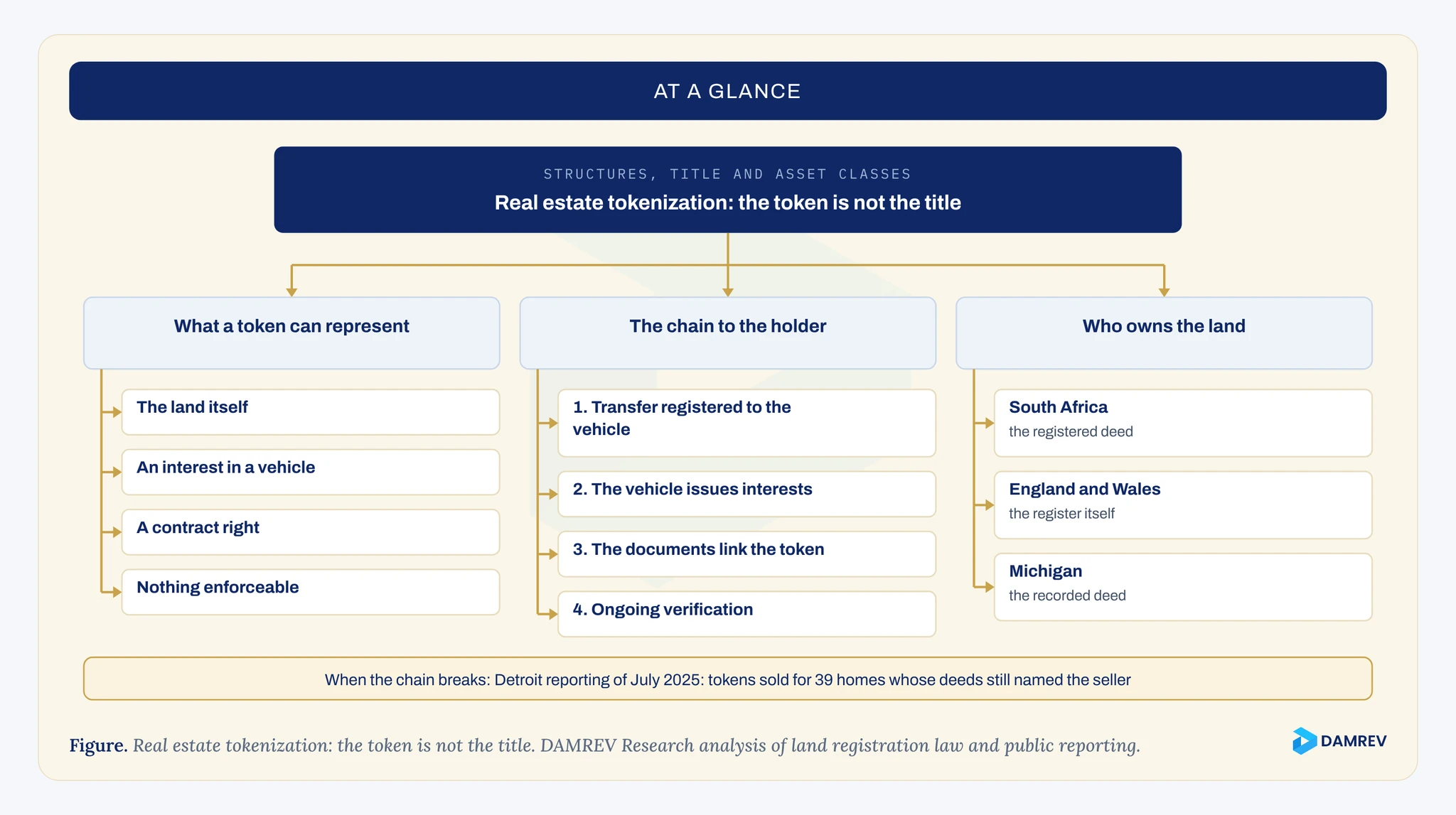
In a typical real estate tokenization legal structure, the token holder owns an interest in a vehicle that holds the title, or a contract right against an issuer, while title to the land is decided by the land registration law and its official records1, 2, 3.
Whether the holder owns anything enforceable turns on whether the chain from register to vehicle to token is complete, and press reporting from Detroit shows what can happen when it is not5, 7.


01 · The answer
What does a real-estate token holder own?
Under any real estate tokenization legal structure, the holder owns one of four things: the land itself, an interest in a vehicle that holds the land, a contract right against an issuer, or nothing enforceable. Which one depends on the documents and the land register, not on the token1, 2, 3.
A token is a record on a ledger. Land is owned according to a different record, kept by the state or by a recorder under statute, and the two records only meet if someone makes them meet1, 2, 3. The structures read here sit one or two steps away from the land.
The usual structure puts the property in a company, a limited liability company (LLC), a trust, or a fund, and issues tokens that represent shares, membership interests, or units in that vehicle. The holder then owns a claim on the vehicle, and the vehicle owns the land.
The Jersey regulator puts the general point plainly in its guidance on tokenized real-world assets: issuers must disclose where "the rights of the token differ to the rights of holding the underlying asset"9.
| What the token represents | What the holder can enforce | Where the link to the land sits |
|---|---|---|
| The land itself | Ownership, if the land register records the holder | The land register |
| An interest in a vehicle | Rights in the vehicle under its constitution; the vehicle owns the land | The register names the vehicle; the vehicle's own records name the holder |
| A contract right | A claim against the issuer for payments or a share of proceeds | The contract, and whatever the issuer owns |
| Nothing enforceable | No claim the holder can bring against anyone in respect of the land | None |
The fourth row is the risk for a holder whose token was sold before the vehicle acquired the property, if the purchase never completes. Part 4 sets out press reporting of tokens sold before the vehicles' purchases closed.
02 · The register
Who owns the land, according to the law?
The land law decides who owns the land, and the systems differ. South Africa transfers ownership only by a registered deed, England and Wales deems the registered proprietor to hold title, and in Michigan the deed passes title while recording decides priority1, 2, 3.
If, on the entry of a person in the register as the proprietor of a legal estate, the legal estate would not otherwise be vested in him, it shall be deemed to be vested in him as a result of the registration.2
Three systems show the range: England and Wales runs a title register, South Africa a deeds registry, and Michigan a county recording system.
South Africa: the registered deed
Save where the law provides otherwise, "the ownership of land may be conveyed from one person to another only by means of a deed of transfer" executed or attested by the registrar, under section 16 of the Deeds Registries Act 47 of 19371.
England and Wales: the register itself
Registration as proprietor vests the legal estate, subject to any outstanding registration requirement, under section 58 of the Land Registration Act 20022.
Michigan: the recorded deed
Title passes by deed, but an unrecorded conveyance "shall be void as against any subsequent purchaser in good faith and for a valuable consideration" whose own conveyance is recorded first, under section 565.29 of the Michigan Compiled Laws3.
In each system, a token held outside the registry is not the record the law looks at. A token can only stand for something the register already supports.
03 · The chain
What must connect the register to the token?
The register and the token must be connected by an unbroken chain of three records: the land register or recorded deed naming the vehicle, the vehicle's own register naming the holder, and documents saying the token is that interest. Each link is a separate legal act1, 9.
Where a vehicle sits between the land and the token, every link must hold at once. If the register does not name the vehicle, the vehicle does not own the land; if the vehicle's records do not recognise the holder, the holder owns a token but not an interest.
The chain from land register to token holder

- What must connect the register to the token?
- Step 1: Transfer to the vehicle: The seller conveys the property and the transfer is registered or recorded in the vehicle's name. ([1, 2, 3])
- Step 2: The vehicle issues interests: Shares, membership interests, or units are issued under the vehicle's constitution and entered in its register.
- Step 3: The documents link the token: The constitution and offering documents state that the token is, or evidences, that interest, and which record controls if they differ.
- Step 4: Ongoing verification: The asset is checked against the register and the tokens in issue. Jersey requires independent verification of the underlying assets annually. ([9])
Step 1 is the only step that gives the vehicle the land, and it happens under the land law, through the registry or the recorded deed, not on the ledger. A token issued before Step 1 is complete is a token over a purchase agreement at best.
Jersey's guidance also requires the underlying assets to be held by "a professional custodian with accountability in an equivalent jurisdiction" and verified annually as "100% collateralised and ring-fenced"9. It sets no rules specific to land.
04 · The record
What happens when the link is missing?
Holders can pay for tokens over property the vehicle does not own. Detroit press reporting of 9 July 2025 described RealT tokens fully sold for 39 homes whose deeds still named the seller, which said the purchase had not closed5, 6.
One public example is RealT, which sold tokens over Detroit rental homes. In July 2025 Outlier Media, a Detroit newsroom, reported that investors had bought all the tokens for 39 homes between July 2023 and March 2024, paying more than 2.72 million US dollars, while the deeds still listed the seller as owner5.
The seller's owner told the newsroom the homes had "been under purchase agreement for over a year but hasn't closed"5. RealT's spokesperson attributed the delay to the seller's documentation5. Michigan Public republished the report on 25 July 20256.
- Homes whose tokens were fully sold while the deeds named the seller, as reported on 9 July 20255
- 39
- Paid by investors for those tokens between July 2023 and March 2024, as reported5
- More than US$2.72 million
- Properties in the City of Detroit's nuisance complaint of July 2025, as reported5
- 408
The same report found that, for 25 properties offered in January, as reported in July 2025, Wayne County Register of Deeds records showed RealT as owner in only three5.
According to the reporting, the city's action concerns property condition, not title. In early July 2025 the City of Detroit sued Real Token, its co-founders, and affiliated entities over more than 400 properties7, 8.
On 22 July 2025, Wayne County Circuit Court Judge Annette J. Berry issued a temporary restraining order barring rent collection at properties without a certificate of compliance, according to local reporting7. BridgeDetroit reported that the city's complaint alleged the company used "a web of LLCs and shell companies to escape responsibility"7.

05 · What it does not establish
What does this reading not establish?
As of 7 October 2026, the land registration laws, guidance, and press reports read here do not establish a rule on title for any system not read, do not decide any case, and do not say what a particular token in any offering represents. Those answers sit in the register and the documents1, 2, 3.
| Question | Position | Source |
|---|---|---|
| A single rule on title for every country | Not established. Three systems were read; others must be read on their own terms | 1, 2, 3 |
| Whether an electronic register lets tokens carry title | Not established. South Africa's 2019 Act makes the Chief Registrar's electronic record the only original. It was amended by the Deeds Registries Amendment Act 20 of 2024, and we did not confirm whether its section 3 is in operation | 4 |
| Whether the Detroit purchases later closed | Not established. The reporting describes the position in July 2025 only | 5 |
| The outcome of the City of Detroit's action | Not established. Press reporting of 29 April 2026 describes an agreement in the city's action placing the properties under an outside fiduciary; we did not read the court file | 7, 8, 10 |
| What any other token represents | Not established. That depends on its own constitution, offering documents, and register | 9 |
A token holder's position is fixed by documents the token does not contain: the land register or recorded deed, the vehicle's register, and the offering documents. None of them can be read from the ledger.
The reporting cited here is press, not a court record, and it names a company only as the public record does. Nothing here is an assessment of any party's liability.
Common questions
What else do people ask?
Short answers to the questions people ask most about this topic.
Can a token itself be the title deed to a property?
Only where the land registration law makes the token, or the ledger it sits on, the record of title. In the three systems read here, title is recorded by the state registry, or by a deed recorded in the county records, and a token held elsewhere does not replace that record1, 2, 3, 4.
If the register names a company, what does the token holder own?
Whatever the company's constitution and the offering documents say the token represents: usually shares, membership interests, or units in that company, or a contract claim against it. The holder's rights reach the land only through the company9.
Does an electronic land register mean tokens can carry title?
Not of itself. South Africa's Electronic Deeds Registration Systems Act 19 of 2019, as amended in 2024, provides for an electronic system kept by the Chief Registrar of Deeds, and treats the record in that system as the only original and valid record, subject to the Electronic Communications and Transactions Act.
A token issued outside that system is not that record4.
How can a buyer check the link before investing?
By reading the land register or deeds records for the property against the name of the vehicle in the offering documents, on the date of purchase. In the Detroit reporting, that comparison is how the gap was found5.
Where should you go next?
The pages below pick up where this one ends. Start with the one closest to where your asset or programme stands today.
- Bankruptcy Remote SPV Tokenization: What the Vehicle Must Still Do Off-ChainCode cannot make a vehicle bankruptcy remote. A special purpose vehicle gets there off-chain, through a true sale, its documents, and a separate existence.
- SPV for Tokenization: When a Special Purpose Vehicle Is NeededTokenizing an asset usually needs a special purpose vehicle, because a building cannot issue anything. An issuer tokenizing its own securities may not.
- Verified Physical AssetsHow reserves, commodities, and titled property become tokenized instruments tied to refreshed evidence, with Forge refusing to mint when it fails.
- Does Tokenizing a Security Change Whether It Is a Security?In the United States, the European Union, Guernsey, and Jersey, tokenizing a security does not change whether it is one, only which one is held.
References
- 1.Deeds Registries Act 47 of 1937 (South Africa), section 16, "How real rights shall be transferred", consolidated text. https://www.saflii.org/za/legis/consol_act/dra1937172/
- 2.Land Registration Act 2002 (United Kingdom), section 58, "Conclusiveness". https://www.legislation.gov.uk/ukpga/2002/9/section/58
- 3.Michigan Compiled Laws, section 565.29, recording of conveyances. https://www.legislature.mi.gov/Laws/MCL?objectName=mcl-565-29
- 4.Electronic Deeds Registration Systems Act 19 of 2019 (South Africa), sections 2 and 3, as amended by the Deeds Registries Amendment Act 20 of 2024. https://www.saflii.org/za/legis/consol_act/edrsa2019403/
- 5.Outlier Media, "RealT sold shares of Detroit homes it has never owned", 9 July 2025. https://outliermedia.org/realt-detroit-real-estate-properties-investors/
- 6.Michigan Public, "Crypto real estate company RealT collected millions from investors for Detroit properties it doesn't own", 25 July 2025. https://www.michiganpublic.org/economy/2025-07-25/crypto-real-estate-company-realt-collected-millions-from-investors-for-detroit-properties-it-doesnt-own
- 7.BridgeDetroit, "Judge bars Real Token from collecting rent, orders repairs", 24 July 2025. https://www.bridgedetroit.com/real-token-detroit-rent-repairs/
- 8.WDET, "Detroit suing blockchain-based real estate firm for neglecting hundreds of properties", 3 July 2025. https://wdet.org/2025/07/03/detroit-suing-blockchain-based-real-estate-firm-for-neglecting-hundreds-of-properties/
- 9.Jersey Financial Services Commission, "Tokenisation of real-world assets (RWAs)", issued 28 August 2024, last revised 13 July 2026. https://www.jerseyfsc.org/industry/guidance-and-policy/tokenisation-of-real-world-assets-rwas/
- 10.Outlier Media, "RealT loses control", 29 April 2026. https://outliermedia.org/?p=55010
This article is analysis of public sources, not legal advice. Last updated: