


Article · Market Infrastructure & Settlement
Which Licence a Tokenized Securities Venue Needs: ATS, Exemption, or MTF
In the United States, a venue that brings together buyers and sellers of securities under non-discretionary rules is an exchange, unless it registers as one or operates as an alternative trading system (ATS) under Regulation ATS, which means registering as a broker-dealer and filing with the US Securities and Exchange Commission (SEC)1, 2, 3.
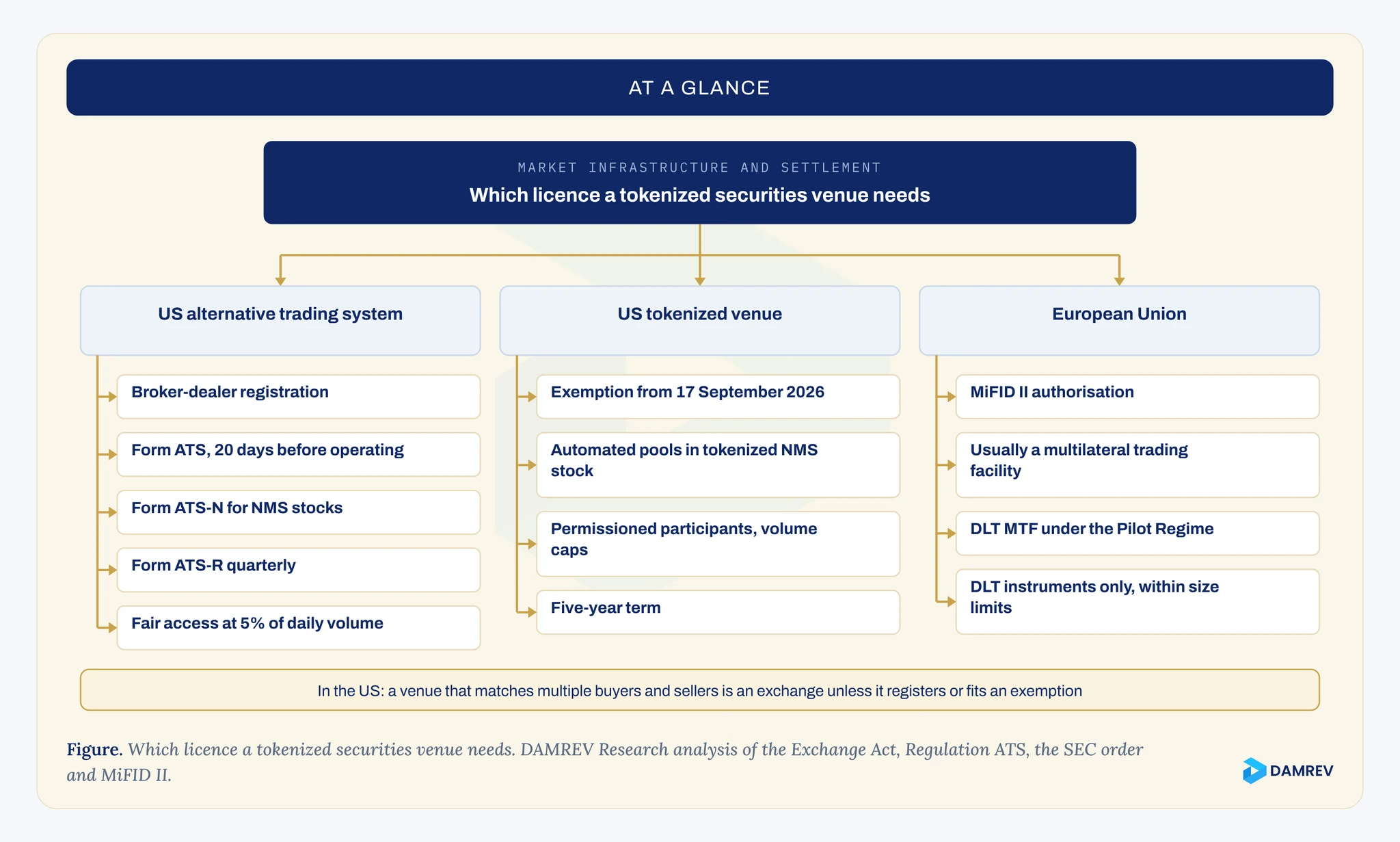
Since 17 September 2026 a third, narrower route exists: the tokenized securities venue exemption, limited to automated liquidity pools in tokenized national market system (NMS) stock4; in the European Union (EU), the equivalent licence is a multilateral trading facility (MTF), with a distributed ledger technology (DLT) variant under the Pilot Regime5, 6.


In this article
01 · The test
When does a venue for tokenized securities need a licence?
A venue for tokenized securities needs a licence when it brings together the orders of multiple buyers and sellers under established, non-discretionary methods. In the United States that makes it an exchange, which must register or fit an exemption such as Regulation ATS1, 2.
The test, set by the SEC's Rule 3b-16, is functional. An organisation provides a market or exchange-type facilities if it "brings together the orders for securities of multiple buyers and sellers" and uses "established, non-discretionary methods" under which those orders interact and the parties "agree to the terms of a trade"1.
The SEC staff statement of January 2026 holds that the format in which a security is issued does not affect how the federal securities laws apply7. A platform that matches buyers and sellers of tokenized shares, bonds, or fund units is doing the same thing as one that matches them in conventional form, and it meets the same test.
A venue that meets the test has three routes in the United States as of 7 October 2026. It can register as a national securities exchange. It can operate as an alternative trading system under Regulation ATS. Or, for one narrow class of activity, it can rely on the tokenized securities venue exemption of 17 September 20261, 3, 4.
A venue that does none of these is operating an unregistered exchange.
02 · An alternative trading system
What does an alternative trading system have to do?
An ATS must register as a broker-dealer, file Form ATS at least 20 days before starting, use Form ATS-N for any NMS stocks, report activity quarterly on Form ATS-R, and take on more obligations as volume grows3.
Regulation ATS is the usual route for a venue that wants to match orders in securities without taking on the full obligations of an exchange, and nothing in it turns on whether the securities are tokenized.
The price is regulation as a broker-dealer and reporting to the SEC. The rule states it plainly: "The alternative trading system shall register as a broker-dealer under section 15 of the Act"3.
| Requirement | What the rule says | Source |
|---|---|---|
| Broker-dealer registration | The system must register as a broker-dealer under Section 15 of the Exchange Act | Rule 301(b)(1)3 |
| Notice before operating | An initial operation report on Form ATS, at least 20 days before commencing operation | Rule 301(b)(2)(i)3 |
| NMS stocks | Operational disclosure for NMS stocks is on Form ATS-N under Rule 304; other securities stay on Form ATS | Rules 301 and 3043 |
| Activity reporting | Quarterly reports on Form ATS-R, within 30 calendar days of each quarter end | Rule 301(b)(9)3 |
| Fair access | Triggered in an NMS stock at 5% or more of average daily volume, over at least four of the preceding six months | Rule 301(b)(5)3 |
| Subscriber conduct | The system may not set rules for subscribers beyond their trading on it, or discipline them other than by exclusion | Rule 300(a)2 |
The last row explains why an ATS is not an exchange. An exchange is a self-regulatory organisation that writes and enforces rules for its members. An ATS is a broker-dealer that runs a matching system; its users are its customers, and its rulebook covers only how they trade on it2.
For a tokenized programme, the broker-dealer requirement is usually the decisive cost. It brings capital rules, customer protection rules, and membership of a self-regulatory organisation, which is why an issuer may prefer to have its instrument traded on an existing ATS rather than build its own.
03 · The tokenized securities venue
Where does the SEC's tokenized securities venue sit?
The SEC's tokenized securities venue sits beside the ATS, not inside it, as a temporary exemption from the definition of an exchange, limited to automated market maker pools in tokenized NMS stock, for permissioned participants, with volume caps and a five-year term4.
The order of 17 September 2026 created a route that did not exist before. A tokenized securities venue is exempted from the definition of an exchange, and certain liquidity providers in its pools from the definition of a dealer, for five years4.
The order defines the venue by what it does: it brings together buyers and sellers of tokenized NMS stock by providing automated market maker liquidity pools for permissioned participants4.
Narrow scope
Tokenized NMS stock is the only security the exemption covers as the traded instrument. A tokenized money market fund may serve as the paired asset, but the order gives no Investment Company Act exemption4.
A different market model
The venue runs automated market maker pools, not an order book. A conventional matching system does not fit the definition4.
Other law still applies
The order does not provide an exemption from any other applicable laws, and anti-fraud rules apply in full4.
An ATS can trade almost any security, through any matching method, indefinitely, but must be a broker-dealer. A tokenized securities venue trades only tokenized NMS stock, through pools, within caps, and for five years; its smart contracts must be "auditable, public, and deployed on a public, permissionless distributed ledger", while only permissioned participants trade4.
The order does not replace Regulation ATS for the instruments most structured finance programmes issue, which remain ATS or exchange business.
04 · Europe
What licence does a venue need in Europe?
A European venue needs authorisation under the Markets in Financial Instruments Directive (MiFID II), usually as a multilateral trading facility. The DLT Pilot Regime adds a DLT MTF, which may trade only DLT financial instruments within size limits5, 6.
EU law leaves no room for an unregulated multilateral venue. The rule once sat in Article 1(7) of MiFID II; since 2024 it sits in the Markets in Financial Instruments Regulation (MiFIR), after Directive (EU) 2024/790 deleted the MiFID II paragraph5, 8.
All multilateral systems shall operate either in accordance with the provisions of Title II of Directive 2014/65/EU concerning MTFs or OTFs or in accordance with the provisions of Title III of that Directive concerning regulated markets.8
A multilateral trading facility is the closest European counterpart to an ATS: a multilateral system, run by an investment firm or market operator, that brings together multiple third-party buying and selling interests under non-discretionary rules5. Operating one is an investment service that needs authorisation5.
The DLT Pilot Regime, which has applied since 23 March 2023, created a variant for tokenized instruments. A DLT MTF is "a multilateral trading facility that only admits to trading DLT financial instruments"6. It can obtain exemptions from some requirements that assume conventional infrastructure, and it can be combined with settlement as a DLT trading and settlement system6.
In exchange, the regime caps what it can admit, and the caps carry qualifications. Fund units qualify only for undertakings within Article 25(4)(a)(iv) of MiFID II, and corporate bonds of issuers whose market capitalisation did not exceed 200 million euro at issuance are left out of the bond threshold6.
- Maximum market capitalisation of a share issuer, and maximum assets under management of an eligible fund, at admission6
- 500m euro
- Maximum issue size for bonds, other securitised debt, and money market instruments, with stated exclusions6
- 1bn euro
- Aggregate value above which no new instrument may be admitted, and the level at which the operator must activate its transition strategy6
- 6bn · 9bn euro
The Commission proposed changes to those limits on 4 December 2025, set out in the companion article on the DLT Pilot Regime cap9. As of 7 October 2026, the limits above are the law in force.

05 · What it does not establish
What do the sources not establish?
As of 7 October 2026, Regulation ATS and the SEC order read here do not establish which route suits a particular venue or every registration it may need, and do not address custody or settlement licences that sit beside the trading licence3, 4.
| Question | What the sources say | Source |
|---|---|---|
| Which route should a given venue take? | Not addressed; it depends on the instruments, the market model, and the users | None |
| What other registrations does a tokenized securities venue need? | The order exempts from the exchange definition only and gives no exemption from other applicable laws | SEC order4 |
| Can an ATS trade tokenized fund units or bonds? | Regulation ATS is not limited by instrument; the order's caps and pairs do not apply to an ATS | Regulation ATS2, 3 |
| Do custody and settlement need separate licences? | Not addressed by the trading-venue rules cited here | None of these sources |
| Have the DLT Pilot limits changed? | No. The Commission proposed changes on 4 December 2025; a proposal, not in force | Regulation (EU) 2022/8586; Commission proposal9 |
Trading is one function among several. A venue that also holds investors' tokens, or settles trades on its own ledger, may need licences for those functions that this article does not cover. The European regime acknowledges this by allowing trading and settlement to be combined in a DLT trading and settlement system6. US rules treat them separately.
Common questions
What else do people ask?
Short answers to the questions people ask most about this topic.
Does tokenizing a security change which venue licence is needed?
No. A tokenized security is still a security, and a venue that brings together its buyers and sellers under non-discretionary rules meets the same exchange test as any other2, 7.
What must an alternative trading system do before it starts?
Register as a broker-dealer, and file an initial operation report on Form ATS at least 20 days before commencing operation. A system trading NMS stocks files its operational disclosures on Form ATS-N for those stocks, and every ATS reports its activity quarterly on Form ATS-R3.
Is the SEC's tokenized securities venue an ATS?
No. It is a separate temporary exemption from the definition of an exchange, for venues that provide automated market maker liquidity pools in tokenized NMS stock to permissioned participants4.
What is a DLT MTF?
Under the EU DLT Pilot Regime, a multilateral trading facility that only admits to trading DLT financial instruments, subject to limits on issuer and issue size. No new instrument may be admitted if the aggregate value would then exceed 6 billion euro, and at 9 billion euro the operator must activate its transition strategy6.
When does an ATS face fair access obligations?
For an NMS stock, when it reaches five percent or more of the average daily volume in that security, measured over at least four of the preceding six calendar months3.
Where should you go next?
The pages below pick up where this one ends. Start with the one closest to where your asset or programme stands today.
- The SEC's Innovation Exemption of 17 September 2026: What Tokenized Securities Venues & Tokenized NMS Stock May Now DoSince 17 September 2026 a tokenized securities venue may run automated liquidity pools in tokenized listed stock without registering as an exchange, on conditions.
- Settlement & LiquidityHow value settles in the asset each jurisdiction permits: fiat through a licensed provider, swaps without custody, and sales behind an eligibility gate.
- Atomic Settlement & Delivery Versus PaymentAtomic settlement moves the security and the cash in one indivisible step, removing principal risk, but both legs must be ready first.
- Public or Permissioned Blockchains for Regulated SecuritiesOn any ledger an issuer can restrict who holds its security. Only a permissioned one lets an identifiable operator control who validates and reads it.
References
- 1.Securities Exchange Act of 1934, Sections 3(a)(1) and 5, and 17 CFR 240.3b-16, definitions of terms used in Section 3(a)(1). https://www.ecfr.gov/current/title-17/section-240.3b-16
- 2.17 CFR 242.300, definitions for Regulation ATS, paragraph (a). https://www.law.cornell.edu/cfr/text/17/242.300
- 3.17 CFR 242.301, requirements for alternative trading systems, paragraphs (b)(1), (b)(2) and (b)(5), and 17 CFR 242.304. https://www.law.cornell.edu/cfr/text/17/242.301
- 4.US Securities and Exchange Commission, Order Granting Exemptions for Tokenized Securities Venues, Exchange Act Release No. 34-106402, 17 September 2026. https://www.sec.gov/files/rules/exorders/2026/34-106402.pdf
- 5.Directive 2014/65/EU of the European Parliament and of the Council of 15 May 2014 on markets in financial instruments (MiFID II), Articles 4(1)(22) and 5(1); Article 1(7) deleted by Directive (EU) 2024/790 of 28 February 2024, Article 1(1). https://eur-lex.europa.eu/legal-content/EN/TXT/HTML/?uri=CELEX:32014L0065
- 6.Regulation (EU) 2022/858 on a pilot regime for market infrastructures based on distributed ledger technology, Articles 2, 3 and 4. https://eur-lex.europa.eu/legal-content/EN/TXT/HTML/?uri=CELEX:32022R0858
- 7.SEC Divisions of Corporation Finance, Investment Management, and Trading and Markets, "Statement on Tokenized Securities", 28 January 2026. https://www.sec.gov/newsroom/speeches-statements/corp-fin-statement-tokenized-securities-012826
- 8.Regulation (EU) 2024/791 of the European Parliament and of the Council of 28 February 2024 amending Regulation (EU) No 600/2014 (MiFIR), Article 1, point (1)(b), inserting Article 1(5b) into Regulation (EU) No 600/2014. https://eur-lex.europa.eu/eli/reg/2024/791/oj/eng
- 9.European Commission, Proposal for a Regulation amending Regulations (EU) No 1095/2010, No 648/2012, No 600/2014, No 909/2014, 2022/858, 2023/1114 and 2024/1689 as regards the further development of capital market integration and supervision within the Union, COM(2025) 943 final, 4 December 2025, Article 8. https://eur-lex.europa.eu/legal-content/EN/TXT/?uri=CELEX:52025PC0943
This article is analysis of public sources, not legal advice. Last updated:




